
 100% FREE ACCESS
12th Standard Syllabus & Materials
12th Standard
TN 12th Maths Applications of Matrices and Determinants Sample Question Papers Study Material - QB365 Set A
NEW12th Standard
TN 12th Computer Applications மின்னணு தரவு பரிமாற்றம் Sample Question Papers Study Material - QB365 Set A
NEW12th Standard
TN 12th Computer Applications மின் - வணிக பாதுகாப்பு அமைப்புகள் Sample Question Papers Study Material - QB365 Set A
NEW12th Standard
TN 12th Computer Applications மின்னணு செலுத்தல் முறைகள் Sample Question Papers Study Material - QB365 Set A
NEW12th Standard
TN 12th Computer Applications மின் - வணிகம் Sample Question Papers Study Material - QB365 Set A
NEW12th Standard
TN 12th Computer Applications திறந்த மூல கருத்துருக்கள் Sample Question Papers Study Material - QB365 Set A

Published on: 16/09/2019
Inverse Trigonometric Functions
Download Tamil Nadu 12th Standard Maths question papers, model tests, one-mark questions, important questions, and public exam papers in PDF format. Free study materials and answer keys for TN State Board students.
Questions + Answers key
Take MCQ Maths Test1.
Evaluate \(sin\left( { cos }^{ -1 }\left( \frac { 1 }{ 2 } \right) \right) \)
2.
Prove that \(2{ tan }^{ -1 }\left( \frac { 2 }{ 3 } \right) ={ tan }^{ -1 }\left( \frac { 12 }{ 5 } \right) \)
3.
Prove that \({ tan }^{ -1 }\left( \frac { 1 }{ 7 } \right) +{ tan }^{ -1 }\left( \frac { 1 }{ 13 } \right) ={ tan }^{ -1 }\left( \frac { 2 }{ 9 } \right) \)
4.
If \({ sin }^{ -1 }\left( \frac { 1 }{ 2 } \right) ={ tan }^{ -1 }x\) then find the value of x,
5.
If \({ cot }^{ -1 }\left( \frac { 1 }{ 7 } \right) =\theta \) find the value of cos \(\theta \)
6.
Find the value of \(cos\left[ \frac { 1 }{ 2 } { cos }^{ -1 }\left( \frac { 1 }{ 8 } \right) \right] \)
7.
Find the value of tan (tan−1(1947))
8.
Find all the values of x such that
-3\(\pi\)\(\le x\le\)-3\(\pi\) and sin x = -1
9.
Find the value of \({ tan }^{ -1 }\left( \sqrt { 3 } \right) -{ sec }^{ -1 }(-2)\)
10.
Find the value of sec−1\(\left( -\frac { 2\sqrt { 3 } }{ 3 } \right) \)
11.
Find the principal value of cos-1\((\frac{1}{2})\).
12.
Is cos-1(-x) = \(\pi\)-cos−1(x) true? Justify your answer.
13.
State the reason for cos-1\([cos(-\frac{\pi}{6})]\neq \frac{\pi}{6}.\)
14.
Simplify sin-1[sin10]
15.
If cot-1\(\frac{1}{7}=\theta\), find the value of cos \(\theta\).
1.
Let \({ cos }^{ -1 }\left( \frac { 1 }{ 2 } \right) =\theta \Rightarrow cos\theta =\frac { 1 }{ 2 } \)
\(\Rightarrow sin\theta =\sqrt { 1-{ cos }^{ 2 }\theta } =\sqrt { 1-\frac { 1 }{ 4 } } =\sqrt { \frac { 3 }{ 4 } } =\frac { \sqrt { 3 } }{ 2 } \)
\(\therefore sin\left( { cos }^{ -1 }\left( \frac { 1 }{ 2 } \right) \right) =\frac { \sqrt { 3 } }{ 2 } \)
2.
LHS = \(2{ tan }^{ -1 }\left( \frac { 2 }{ 3 } \right) \)
= \({ tan }^{ -1 }\left( \frac { 2 }{ 3 } \right) +{ tan }^{ -1 }\left( \frac { 2 }{ 3 } \right) \)
= \({ tan }^{ -1 }\left( \frac { \frac { 2 }{ 3 } +\cfrac { 2 }{ 3 } }{ 1-\left( \frac { 2 }{ 3 } \right) \left( \frac { 2 }{ 3 } \right) } \right) ={ tan }^{ -1 }\left( \frac { \frac { 4 }{ 3 } }{ \frac { 9-2 }{ 9 } } \right) \)
= \({ tan }^{ -1 }\left( \frac { 4 }{ 3 } \times \frac { 9 }{ 7 } \right) ={ tan }^{ -1 }\left( \frac { 12 }{ 7 } \right) \)
= RHS
Hence proved
3.
L.H.S = \({ tan }^{ -1 }\left( \frac { 1 }{ 7 } \right) +{ tan }^{ -1 }\left( \frac { 1 }{ 13 } \right) \)
= \({ tan }^{ -1 }\left( \cfrac { \frac { 1 }{ 7 } +\frac { 1 }{ 3 } }{ 1-\left( \frac { 1 }{ 7 } \right) \left( \frac { 1 }{ 13 } \right) } \right) ={ tan }^{ -1 }\left( \cfrac { \frac { 13+7 }{ 91 } }{ \frac { 91-1 }{ 91 } } \right) \)
\(=\tan ^{-1}\left(\frac{\frac{20}{91}}{\frac {90}{91}}\right)=\tan ^{-1}\left(\frac{20}{\not 91} \times \frac{\not 91}{90}\right) \)
\(=\tan ^{-1}\left(\frac{\not 20^{2}}{\not 90^{9}}\right)=\tan ^{-1}\left(\frac{2}{9}\right)=\mathrm{RHS}
\)
Hence proved.
4.
Given
\({ tan }^{ -1 }x={ sin }^{ -1 }\left( \frac { 1 }{ 2 } \right) ={ sin }^{ -1 }\left( sin\frac { \pi }{ 6 } \right) \)
\(\Rightarrow { tan }^{ -1 }x=\frac { \pi }{ 6 } \)
\(\Rightarrow x=tan\frac { \pi }{ 6 } =\frac { 1 }{ \sqrt { 3 } } \)
\(\therefore x=\frac { 1 }{ \sqrt { 3 } } \)
5.
Given
\({ cot }^{ -1 }\left( \frac { 1 }{ 7 } \right) =0\Rightarrow \theta =\frac { 1 }{ 7 } \)
\(\Rightarrow tan\theta =7\)
\(\Rightarrow sec\theta =\sqrt { 1+{ tan }^{ 2 }\theta } =\sqrt { 1+{ 7 }^{ 2 } } =\sqrt { 50 } =5\sqrt { 2 } \)
\(\Rightarrow cos\theta ={ \frac { 1 }{ 5\sqrt { 2 } } }\)
6.
Consider cos\(\left[ \frac { 1 }{ 2 } { cos }^{ -1 }\left( \frac { 1 }{ 8 } \right) \right]\).
Let \( { cos }^{ -1 }\left( \frac { 1 }{ 8 } \right) =\theta .\)
Then \( cos\theta =\frac { 1 }{ 8 } and\quad \theta \in \left[ 0,\pi \right] \)
Now, cos\(\theta=\frac{1}{8}\) implies 2 cos2 \(\frac{\theta}{2}-1=\frac{1}{8}\).
Thus, cos\((\frac{\theta}{2})\) is positive
Thus, \(cos\left[ \frac { 1 }{ 2 } { cos }^{ -1 }\left( \frac { 1 }{ 8 } \right) \right] =cos\left( \frac { \theta }{ 2 } \right) =\frac { 3 }{ 4 } \)
7.
tan(tan-1(1947))
= 1947
8.
sin x = -1
\(\Rightarrow sinx=sin\left( \frac { -\pi }{ 2 } \right) \Rightarrow x=\frac { -\pi }{ 2 } ,\frac { 3\pi }{ 2 } ,\frac { 7\pi }{ 2 } ...\)
\(\Rightarrow x=(4n-1)\frac { \pi }{ 2 } ,n\varepsilon Z.\)
\(\Rightarrow x=(4n-1)\frac { \pi }{ 2 } \)
n takes the values \(0,\pm 1,\pm 2,\pm 3and\pm 4\)
since when n = -4, \(x=\frac { -17\pi }{ 2 } <-8\pi \)
9.
\({ tan }^{ -1 }\left( \sqrt { 3 } \right) -{ sec }^{ -1 }(-2)\)
Let \({ tan }^{ 1 }\left( \sqrt { 3 } \right) =x\Rightarrow \sqrt { 3 } =tanx\)
\(\Rightarrow tanx=tan\frac { \pi }{ 3 } \)
\(\Rightarrow x=\frac { \pi }{ 3 } \)
Let sec-1(-2) = y
\(\Rightarrow -2=sec\ y\Rightarrow cos\ y=\frac { -1 }{ 2 } \Rightarrow cos\ y=-cos\left( \frac { \pi }{ 3 } \right) \)
\(\Rightarrow cos\ y=cos\left( \pi -\frac { \pi }{ 3 } \right) \)
\(\Rightarrow cos\ y=cos\left( \frac { 2\pi }{ 3 } \right) \Rightarrow y=3\frac { 2\pi }{ 3 } \)
\(\therefore { tan }^{ -1 }\left( \sqrt { 3 } \right) -{ sec }^{ -1 }\left( -2 \right) \)
= \(\frac { \pi }{ 3 } -\frac { 2\pi }{ 3 } \)
= \(\frac { \pi -2\pi }{ 3 } =-\frac { \pi }{ 3 } \)
\(\therefore\) \({ tan }^{ -1 }\left( \sqrt { 3 } \right) -{ sec }^{ -1 }(-2)\)= \(-\frac { \pi }{ 3 } \)
10.
Let sec-1\(\left( -\frac { 2\sqrt { 3 } }{ 3 } \right) =\theta \).
Then, sec\(\theta\) = \(-\frac{2}{\sqrt3}\) where \(\theta\in[0,\pi]\)\{\(\frac{\pi}{2}\)}.
Thus, cos \(\theta =-\frac{\sqrt{3}}{2}\).
Now, \(cos\frac { 5\pi }{ 6 } =cos\left( \pi -\frac { \pi }{ 6 } \right) =-cos\left( \frac { \pi }{ 6 } \right) =-\frac { \sqrt { 3 } }{ 2 } .\)
Hence, Sec-1 \(\left( -\frac { 2\sqrt { 3 } }{ 3 } \right) =\frac { 5\pi }{ 6 } \)
11.
Let \(x={ cos }^{ -1 }\left( \frac { 1 }{ 2 } \right) \)
\(\Rightarrow cosx=\frac { 1 }{ 2 } \)
\(\Rightarrow cosx=\frac { 1 }{ 2 } \) \(\left[ \because \frac { \pi }{ 3 } \varepsilon \left[ 0,\pi \right] \right] \)
\(\Rightarrow x=\frac { \pi }{ 3 } \)
\(\therefore \) The principal value of \(cos^{ -1 }\left( \frac { 1 }{ 2 } \right) \) is \(\frac { \pi }{ 3 } \)
12.
cos-1(-x) = \(\pi\)-cos−1(x)
Let cos-1(-x) = \(\theta \) ..(1)
\(\Rightarrow -x=cos\theta \)
\(\Rightarrow x=-cos\theta =cos\theta =cos\left( \pi -\theta \right) \)
\(\Rightarrow \pi -\theta ={ cos }^{ -1 }\left( x \right) \)
\(\Rightarrow \theta =\pi -{ cos }^{ -1 }x\) ...(2)
From (1) & (2) \({ cos }^{ -1 }\left( -x \right) =\pi -{ cos }^{ -1 }\left( x \right) \)
\({ cos }^{ -1 }\left( -x \right) =\pi -{ cos }^{ -1 }\left( x \right) \) is true.
13.
cos-1\([cos(-\frac{\pi}{6})]\neq \frac{\pi}{6}.\)
Since \(\frac { -\pi }{ 6 } \notin \left[ 0,\pi \right] \) which is the principal domain of cosine function. [\(\therefore \) cos -\(\theta\) = cos \(\theta\)]
14.
sin-1[sin10]
We know that sin-1(sin \(\theta\)) = \(\theta\) is \(\theta \in \left[ -\frac { \pi }{ 2 } ,\frac { \pi }{ 2 } \right] \)Considering the approximation \(\frac{\pi}{2}=\frac{11}{7}\)
we conclude that 10\(\notin \left[ -\frac { \pi }{ 2 } ,\frac { \pi }{ 2 } \right] \), but (10-3\(\pi\)) \(\in \left[ -\frac { \pi }{ 2 } ,\frac { \pi }{ 2 } \right] \).
Now, sin10 = sin(3\(\pi\)+(10−3\(\pi\))) = sin(\(\pi\)+(10−3\(\pi\)) = −sin(10−3\(\pi\)) = sin(3\(\pi\)-10)
Hence, sin-1[sin10] = sin-1[sin(3\(\pi\)-10)] = 3\(\pi\)-10, since(3\(\pi\)-10)\(\in \left[ -\frac { \pi }{ 2 } ,\frac { \pi }{ 2 } \right] \).
15.
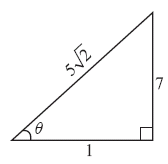
By definition, cot-1x\(\in(0,\pi)\)
Therefore, cot-1\((\frac{1}{7})\) = \(\theta\) implies \(\theta \in(0,\pi)\)
But cot-1\((\frac{1}{7})\) = \(\theta\) implies cot \(\theta\) = \(\frac{1}{7}\) and hence tan \(\theta\) = 7 and \(\theta\) is acute.
Using tan \(\theta\) = \(\frac{7}{1}\), We construct a right triangle as shown .
Then, we have, cos \(\theta\) = \(\frac{1}{5\sqrt2}\).

12th Standard Syllabus & Materials
12th Standard
TN 12th Computer Applications வலையமைப்பு வடமிடல் Sample Question Papers Study Material - QB365 Set A
NEW12th Standard
TN 12th Computer Applications களப்பெயர் முறைமை (DNS) Sample Question Papers Study Material - QB365 Set A
NEW12th Standard
TN 12th Computer Applications வலையமைப்பு எடுத்துக்காட்டுகள் மற்றும் நெறிமுறைகள் Sample Question Papers Study Material - QB365 Set A
NEW12th Standard
TN 12th Computer Applications கணினி வலையமைப்பு ஓர் அறிமுகம் Sample Question Papers Study Material - QB365 Set A



Tamilnadu Stateboard 12th Standard Subjects
Maths

Chemistry

Physics

Biology

Computer Science

Business Maths and Statistics

Economics

Commerce

Accountancy

History

Computer Applications
Biology
Computer Technology
Computer Applications
Computer Science
Business Maths and Statistics
Commerce
Economics
Maths
Chemistry
Physics
Computer Technology
History
Accountancy

Tamil

English

French
Tamilnadu Stateboard Standards

