
 100% FREE ACCESS
12th Standard Syllabus & Materials
12th Standard
TN 12th Computer Applications மின்னணு தரவு பரிமாற்றம் Sample Question Papers Study Material - QB365 Set A
NEW12th Standard
TN 12th Computer Applications மின் - வணிக பாதுகாப்பு அமைப்புகள் Sample Question Papers Study Material - QB365 Set A
NEW12th Standard
TN 12th Computer Applications மின்னணு செலுத்தல் முறைகள் Sample Question Papers Study Material - QB365 Set A
NEW12th Standard
TN 12th Computer Applications மின் - வணிகம் Sample Question Papers Study Material - QB365 Set A
NEW12th Standard
TN 12th Computer Applications திறந்த மூல கருத்துருக்கள் Sample Question Papers Study Material - QB365 Set A
NEW12th Standard
TN 12th Computer Applications வலையமைப்பு வடமிடல் Sample Question Papers Study Material - QB365 Set A

Published on: 02/01/2020
Probability Distributions
Download Tamil Nadu 12th Standard Maths question papers, model tests, one-mark questions, important questions, and public exam papers in PDF format. Free study materials and answer keys for TN State Board students.
Questions + Answers key
Take MCQ Maths Test1.
Find the binomial distribution function for each of the following.
(i) Five fair coins are tossed once and X denotes the number of heads.
(ii) A fair die is rolled 10 times and X denotes the number of times 4 appeared.
2.
If X is the random variable with distribution function F(x) given by,
\(F(x)=\begin{cases} \begin{matrix} 0 & x<0 \end{matrix} \\ \begin{matrix} x & 0\le x<1 \end{matrix} \\ \begin{matrix} 1 & 1\le x \end{matrix} \end{cases}\)
then find
(i) the probability density function f(x)
(ii) P(0.2 ≤ X ≤ 0.7)
3.
A commuter train arrives punctually at a station every half hour. Each morning, a student leaves his house to the train station. Let X denote- the amount of time, in minutes that the student waits for the train from the time he reaches the train station. It is known that the pdf of X is
\(f(x)= \begin{cases}\frac{1}{30} & 0<x<30 \\ 0 & \text { elsewhere }\end{cases}\)
Obtain and interpret the expected value of therandom variable X.
4.
5.
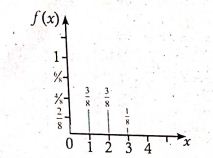
A six sided die is marked ‘1’ on one face, ‘2’ on two of its faces, and ‘3’ on remaining three faces. The die is rolled twice. If X denotes the total score in two throws.
(i) Find the probability mass function.
(ii) Find the cumulative distribution function.
(iii) Find P(3 ≤ X< 6)
(iv) Find P(X ≥ 4) .

6.
Two balls are drawn in succession without replacement from an urn containing four red balls and three black balls. Let X be the possible outcomes drawing red balls. Find the probability mass function and mean for X.
7.
The probability density function of X is given
\(f(x)=\begin{cases} \begin{matrix} { Ke }^{ \frac { -x }{ 3 } } & \begin{matrix} for & x>0 \end{matrix} \end{matrix} \\ \begin{matrix} 0 & \begin{matrix} for & x\le 0 \end{matrix} \end{matrix} \end{cases}\)
Find
(i) the value of k
(ii) the distribution function.
(iii) P(X <3)
(iv) P(5 ≤X)
(v) P(X ≤ 4)
8.
A random variable X has the following probability mass function.
| x | 1 | 2 | 3 | 4 | 5 |
| f(x) | k2 | 2k2 | 3k2 | 2k | 3k |
Find
(i) the value of k
(ii) P(2 \(\le\) X < 5)
(iii) P(3 < X )
9.
Suppose a discrete random variable can only take the values 0, 1, and 2. The probability mass function is defined by
\(\\ \\ \\ \\ \\ f(x)=\begin{cases} \begin{matrix} \frac { { x }^{ 2 }+1 }{ k } & forx=0,1,2 \end{matrix} \\ \begin{matrix} 0 & otherwise \end{matrix} \end{cases}\\ \\ \\ \\ \\ \\ \)
Find
(i) the value of k
(ii) cumulative distribution function
(iii) P(X ≥ 1).
10.
A six sided die is marked '1' on one face, '3' on two of its faces, and '5' on remaining three faces. The die is thrown twice. If X denotes the total score in two throws, find
(i) the probability mass function
(ii) the cumulative distribution function
(iii) P(4 ≤ X < 10)
(iv) P(X ≥ 6)
11.
12.
Let X represent the difference between the number of heads and the number of tails obtained when a coin is tossed n times. Then the possible values of X are
i + 2n, i = 0,1,2... n
2i- n, i = 0,1,2... n
n - i, i = 0,1,2... n
2i + 2n, i = 0, 1, 2...n
1.
(i) Given that five fair coins are tossed once. Since the coins are fair coins the probability of getting an head in a single coin is
\(p=\frac { 1 }{ 2 } \) and \(q=1-p=\frac { 1 }{ 2 } \)
Let X denote the number of heads that appear in five coins. X is binomial random variable that takes on the values 0, 1, 2, 3, 4 and 5 and \(p=\frac { 1 }{ 2 } \) That is \(X\sim B\left( 5,\cfrac { 1 }{ 2 } \right) \)
Therefore the binomial distribution is
\(f(x)=\left( \begin{matrix} n \\ x \end{matrix} \right) p*\left( 1-p \right) ^{ n-x }\), x = 0, 1, 2,..,n
becomes
\(f(x)=\left( \begin{matrix} 5 \\ x \end{matrix} \right) \left( \cfrac { 1 }{ 2 } \right) ^{ x }\left( \cfrac { 1 }{ 2 } \right) ^{ n-x }\), x = 0, 1, 2,..,5
That is
\(f(x)=\left( \begin{matrix} 5 \\ x \end{matrix} \right) \left( \cfrac { 1 }{ 2 } \right) ^{ n }\), x = 0, 1, 2...,n
(ii) A fair die is rolled ten times and X denotes the number of times 4 appeared. X is binomial
random variable that takes on the values 0, 1, 2, 3,...10 , with n = 10 and \(p=\cfrac { 1 }{ 6 } \). That is \(X\sim B\left( 10,\cfrac { 1 }{ 6 } \right) \)
Probability of getting a four in a die is \(p=\frac { 1 }{ 2 } \) and \(q=1-p=\frac { 5 }{ 6 } \)
Therefore the binomial distribution is
\(f(x)=\left( \begin{matrix} 10 \\ x \end{matrix} \right) \left( \cfrac { 1 }{ 6 } \right) ^{ x }\left( \cfrac { 5 }{ 6 } \right) ^{ 10-x }\) x = 0, 1, 2,...,10
2.
(i) Differentiating F(x) with respect to x at continuity points of f(x), we get
\(f(x)={ F }^{ 1 }(x)=\begin{cases} \begin{matrix} 0 & x<0 \end{matrix} \\ \begin{matrix} 1 & 0\le x<1 \end{matrix} \\ \begin{matrix} 0 & x\ge 1 \end{matrix} \end{cases}\)
The pdf f(x) is not continuous at x = 0, or at x = 1. We can define f(0) and f(1) in any manner. Choosing f(0) = 1, and f(1) = 0 .
Therefore the probability density function f(x) is
\(f(x)=\begin{cases} \begin{matrix} 1 & 0\le x<1 \end{matrix} \\ \begin{matrix} 0 & otherwise \end{matrix} \end{cases}\)
(ii) P(0.2 ≤ X ≤ 0.7) = F(0.7) − F(0.2)
= 0.7-0.2 = 0.5
\(P(0.2\le X\le 0.7)=\int _{ 0.2 }^{ 0.7 }{ f(x) } dx=\int _{ 0.2 }^{ 0.7 }{ 1dx } =0.5\)
3.
Expected value = \(\mu=\int_{-\infty}^{\infty} x f(x) d x=\int_{-\infty}^0 x(0) d x+\int_0^{30} \frac{x}{30} d x+\int_{30}^{\infty} x(0) d x\)
\(=\int_0^{30} \frac{x}{30} d x=\frac{1}{60}\left[x^2\right]_0^{30}=15\)
Average delay is 15 minutes.
4.
5.
Since X denotes the total score in two throws, it takes on the values 2, 3, 4, 5 and 6. From the Sample space S, we have

Values of the Random Variable | 2 | 3 | 4 | 5 | 6 | Total |
Number of elements in inverse images | 1 | 4 | 10 | 12 | 9 | 36 |
\(P(X=2)=\frac { 1 }{ 36 }\), \(P(X=3)=\frac { 4 }{ 36 }\)
\(P\left( X=4 \right) =\frac { 10 }{ 36 }\) , \(P(X=5)=\frac { 12 }{ 36 }\) and
\(P(X=6)=\frac { 9 }{ 36 }\)
(i) Probability mass function is

x | 2 | 3 | 4 | 5 | 6 |
f(x) | \(\cfrac { 1 }{ 36 }\) | \(\cfrac { 4 }{ 36 }\) | \(\cfrac { 10 }{ 36 }\) | \(\cfrac { 12}{ 36 }\) | \(\cfrac { 9 }{ 36 }\) |
(ii) Cumulative distribution function By definition of the cumulative distribution function for discrete random variable we have
\(f(x)=P(X\le x)=\underset { x_{ 1 }\le x }{ \Sigma } P(X={ x }_{ 1 })\)
\(P(X=x)= \begin{cases}0, & -\infty<x<\cdots \\ \cdots & \end{cases}\)
\(\begin{aligned} & \left.F(2)=P(X \leq 2)=\sum_{-\infty}^2 P(X=x)=P(X)<2\right)+P(X=2)=0+\frac{1}{36}=\frac{1}{36} \\ & F(3)=P(X \leq 3)=\sum_{-\infty}^3 P(X=x)=P(x<2)+P(X=2)+P(X=3)+P(X=4)=0+\frac{1}{36}+\frac{4}{36}+\frac{10}{36}=\frac{15}{36} \end{aligned}\)
\(\begin{aligned} & F(4)=P(X \leq 3)=\sum_{-\infty}^3 P(X=x)=P(x<2)+P(X=2)+P(X=3)+P(X=4) \\ & 0+\frac{1}{36}+\frac{4}{36}+\frac{10}{36}=\frac{15}{36} \\ & F(5)=P(X \leq 5)=\sum_{-\infty}^5 P(X=x)=P(X<2)+P(X=3)+P(X=4)+P(X=5) \\ & =0+\frac{1}{36}+\frac{4}{36}+\frac{10}{36}+\frac{12}{36}=\frac{27}{36} \end{aligned}\)
\(\begin{aligned} & F(6)=P(X \leq 6)=\sum_{-\infty}^6 P(X=x) \\ & =P(X<2)+P(X=2)+P(X=3)+P(x=4)+P(x=5) P(X=6) \\ & 0+\frac{1}{36}+\frac{4}{36}+\frac{10}{36}+\frac{12}{36}+\frac{9}{36}=1 \end{aligned}\)
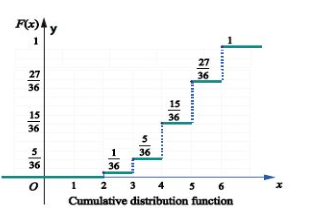
Therefore the cumulative distribution function is
\(F(x)= \begin{cases}0, & -\infty<x<2, \\ \frac{1}{36}, & 2 \leq x<3, \\ \frac{5}{36}, & 3 \leq x<4, \\ \frac{15}{36}, & 4 \leq x<5, \\ \frac{27}{36}, & 5 \leq x<6, \\ 1, & 6 \leq x<\infty .\end{cases}\)
\(\text { (iii) } P(3 \leq X \leq 6)=\sum_{x=3}^5 P\left(X=x_1\right)=P(X=3)+P(X=4)+P(X=5)\)
\(\begin{aligned} & =\frac{4}{36}+\frac{10}{36}+\frac{12}{36}+\frac{26}{36} \\ & \text { (iv) } X \geq 4)=\sum_{x=4}^5 P\left(X=x_1\right) \end{aligned}\)
\(=\frac{10}{36}+\frac{12}{36}+\frac{9}{36}=\frac{31}{36}\)
6.
Let X be the random variablc denotes number of red balls.
Then X take the values 0, 1, 2
Sample space = 7C2 = 21
Let X denote the drawing the red ball.
Then X take the values 0, 1, 2
P(X = 0), X-1 (BB) = 3C2 = 3
P(X = 1), X-1 (BR) = 3C1 x 4C1 = 12
P(X = 2), X-1 (BR) = 3C2 = 6
| Values of random variable | 0 | 1 | 2 | Total |
| Number of elements in inverseimage | 3 | 12 | 6 | 21 |
The probability mass function is
| x | 0 | 1 | 2 |
| f(x) | \(\cfrac { 1 }{ 7 } \) | \(\cfrac { 4 }{ 7 } \) | \(\cfrac { 2 }{ 7 } \) |
Mean :
\(E(x)=\Sigma x.f\left( x \right) \)
= \(0(\frac { 1 }{ 7 } )+1\left( \frac { 4 }{ 7 } \right) +2\left( \frac { 2 }{ 7 } \right) \)
= \(\frac { 4 }{ 7 } +\frac { 4 }{ 7 } =\frac { 8 }{ 7 }\)
7.
Given
\(f(x)=\begin{cases} \begin{matrix} { Ke }^{ \frac { -x }{ 3 } } & \begin{matrix} for & x>0 \end{matrix} \end{matrix} \\ \begin{matrix} 0 & \begin{matrix} for & x\le 0 \end{matrix} \end{matrix} \end{cases}\)
(i) Since f(x) is a probability density function
\(\int _{ -\infty }^{ \infty }{ f(x) } dx=1\)
\(\Rightarrow \int _{ 0 }^{ \infty }{ K.{ e }^{ \frac { -x }{ 3 } } } dx=1\Rightarrow k\frac { \left[ { e }^{ \frac { -x }{ 3 } } \right] ^{ \infty } }{ -\frac { 1 }{ 3 } } \)
\(\Rightarrow -3k\left[ { e }^{ -\infty }-{ e }^{ 0 } \right] =1\) [∵ e∞ = 0, e0 = 1]
\(\Rightarrow 3k=1\Rightarrow k=\frac { 1 }{ 3 } \)
\(\therefore k=\cfrac { 1 }{ 3 } \)
(ii) The distribution function F(x) = \(\int _{ -\infty }^{ x }{ f(u)du } \)
Case 1: x < 0,
\(F(x)=\int _{ -\infty }^{ x }{ f(x)dx=0 } \)
Case 2: x > 0,
\(f(x)=\int _{ -\infty }^{ x }{ f(x)dx } \)
= \(\int _{ -\infty }^{ 0 }{ f(x)dx+\int _{ 0 }^{ x }{ f(x) } dx } \)
= \(0+k\int _{ 0 }^{ x }{ { e }^{ \frac { -x }{ 3 } } } dx\)
= \(\frac { 1 }{ 3 } \left[ \cfrac { { e }^{ \frac { -x }{ 3 } } }{ -\frac { 1 }{ 3 } } \right] =-\left[ { e }^{ -\frac { x }{ 3 } }-{ e }^{ o } \right] \)
= \(-[{ e }^{ -\frac { x }{ 3 } }-1]\)
= \(1-{ e }^{ -\frac { x }{ 3 } }\)
\(\therefore F(x)=\begin{cases} \begin{matrix} 0 & x\le 0 \end{matrix} \\ \begin{matrix} 1-{ e }^{ \frac { -x }{ 3 } } & x>0 \end{matrix} \end{cases}\)
(iii) p(X < 3)
= \(\int _{ 0 }^{ 3 }{ ke^{ -\frac { x }{ 3 } } } dx=\cfrac { 1 }{ 3 } \int _{ 0 }^{ 3 }{ { e }^{ -\frac { x }{ 3 } }dx } \)
= \(\cfrac { 1 }{ 3 } \left[ \frac { { e }^{ -\frac { x }{ 3 } } }{ \frac { -1 }{ 3 } } \right] \)
= -[e-1-e0] = -[e-1-1]
(iv) \(p(5\le X)=p(X\ge 5)=\int _{ 5 }^{ \infty }{ f(x)dx } \)
= \(\int _{ 5 }^{ \infty }{ ke^{ -\frac { x }{ 3 } } } dx=\cfrac { 1 }{ 3 } \cfrac { \left[ { e }^{ -\frac { x }{ 3 } } \right] _{ 5 }^{ \infty } }{ \frac { -1 }{ 3 } } \)
= \(-\left[ { e }^{ -\infty }-e^{ \frac { -3 }{ 5 } } \right] =\left[ 0-{ e }^{ \frac { -5 }{ 3 } } \right] \)
= \({ e }^{ \frac { -5 }{ 3 } }\)
(v) \(p(X\le 4)=\int _{ -\infty }^{ 4 }{ f(x)dx } \)
= \(\int _{ -\infty }^{ 0 }{ f(x)dx+\int _{ 0 }^{ 4 }{ f(x)dx } } \)
= \(0+\int _{ 0 }^{ 4 }{ { ke }^{ -\frac { x }{ 3 } }dx } =k\left[ \frac { { e }^{ -\frac { x }{ 3 } } }{ -\frac { 1 }{ 3 } } \right] _{ 0 }^{ 4 }\)
= \(\cfrac { 1 }{ 3 } \cfrac { \left[ { e }^{ -\frac { x }{ 3 } } \right] _{ 0 }^{ 4 } }{ -\frac { 1 }{ 3 } } =-\left[ { e }^{ \frac { -4 }{ 3 } }-{ e }^{ o } \right] \)
= \(-\left[ { e }^{ \frac { -4 }{ 3 } }-1 \right] =1-{ e }^{ \frac { -4 }{ 3 } }\)
8.
Given probability mass function is
| x | 0 | 1 | 2 | 3 | 4 |
| f(x) | \(\frac{1}{36}\) | \(\frac{2}{36}\) | \(\frac{3}{36}\) | \(\frac{2}{36}\) | \(\frac{3}{36}\) |
(i) Since f(x) is a probability mass function.
\(\sum _{ i=1 }^{ 5 }{ f({ x }_{ i }) } =1\)
⇒ k2 + 2k2 + 3k2 + 2k + 3k = 1
⇒ 6k2 + 5k = 1
⇒ 6k2 + 5k - 1 = 0
⇒ (k + 1) (6k - 1) = 0
⇒ k = -1 or ⇒ \(k=\frac { 1 }{ 6 } \)
⇒ \(k=\frac { 1 }{ 6 } \)
(ii) p(2 ≤ x < 5)
= p(x = 2) + p(x = 3) + p(x = 4)
= 2k2 + 3k2 + 2k = 5k2 + 2k
= \(5\left( \frac { 1 }{ 36 } \right) +2\left( \frac { 1 }{ 6 } \right) \)
= \(\frac { 5 }{ 36 } +\frac { 1 }{ 3 } =\frac { 5+12 }{ 36 } \)
= \(\frac { 17 }{ 36 } \)
(iii) p(3 < x) = p(x > 3)
= p(x = 4) + p(x = 5)
= 2k + 3k = 5k
= \(5\left( \frac { 1 }{ 6 } \right) \)
= \(\frac { 5 }{ 6 } \)
9.
Given
\(\\ \\ \\ \\ \\ f(x)=\begin{cases} \begin{matrix} \frac { { x }^{ 2 }+1 }{ k } & forx=0,1,2 \end{matrix} \\ \begin{matrix} 0 & otherwise \end{matrix} \end{cases}\\ \\ \\ \\ \\ \\ \)
The random variable X take the values 0, 1, 2.
Probability mass function.
| x | 0 | 1 | 2 |
| f(x) | \(\cfrac { 1 }{ k } \) | \(\cfrac { 2 }{ k } \) | \(\cfrac {5 }{ k } \) |
\(\sum _{ i=0 }^{ 2 }{ f(x_{ i })=1\Rightarrow f(0)+f(1)+f(2)=1 } \)
\(\Rightarrow \frac { 0+1 }{ k } +\frac { 1+1 }{ k } +\frac { 4+1 }{ k } \)
\(\Rightarrow \frac { 1 }{ k } +\frac { 2 }{ k } +\frac { 5 }{ k } =1\)
\(\Rightarrow \frac { 8 }{ k } =1\)
\(\Rightarrow k=8\)
(ii) Cumulative distribution function
| x | 0 | 1 | 2 |
| f(x) | \(\cfrac { 1 }{ 8 } \) | \(\cfrac { 2 }{ 8 } \) | 1 |
\(F(0)=P(X<0)\\P(x=0)\\ =\frac { 1 }{ 8 } \)
\(F(1)=P(X = 0)+ P(X = 1)\\
\frac { 1 }{ 8 } +\frac { 2 }{ 8 } =\frac { 3 }{ 8 } \)
\(F(2)=P(X= 0) + P(X = 1) + P(X = 2) = \frac { 1 }{ 8 } +\frac { 2 }{ 8 } +\frac { 5 }{ 8 } =1\)
Cumulative distribution function is
\(f(x)=\begin{cases} \begin{matrix} \frac { 1 }{ 8 } & for & x\le 0 \end{matrix} \\ \begin{matrix} \frac { 2 }{ 8 } +\frac { 1 }{ 8 } & for & \frac { 3 }{ 8 } forx\le 1 \end{matrix} \\ \begin{matrix} \frac { 3 }{ 8 } +\frac { 5 }{ 8 } =1 & for & x\le 2 \end{matrix} \end{cases}\)
(iii) p(x ≥ 1) = p(x = 1) + p(x = 2)
= \(\frac { 2 }{ 8 } +\frac { 5 }{ 8 } \)
\(p(x\ge 1)=\frac { 7 }{ 8 } \)
10.
Let X be the thrown random variable denotes the total in two the thrown a die.
Sample space S
| I/II | 1 | 3 | 3 | 5 | 5 | 5 |
| 1 | 2 | 4 | 4 | 6 | 6 | 6 |
| 3 | 4 | 6 | 6 | 8 | 8 | 8 |
| 3 | 4 | 6 | 6 | 8 | 8 | 8 |
| 5 | 6 | 8 | 8 | 10 | 10 | 10 |
| 5 | 6 | 8 | 8 | 10 | 10 | 10 |
| 5 | 6 | 8 | 8 | 10 | 10 | 10 |
n (S) = 36
X = {2, 4, 6, 8, 10}
| Values of the random variable | 2 | 4 | 6 | 8 | 10 | Total |
| No. of elements in inverse images | 1 | 4 | 10 | 12 | 9 | 36 |
\(p(x=2)=\cfrac { 1 }{ 36 } \)
\(p(x=4)=\cfrac { 4 }{ 36 } \)
\(p(x=6)=\cfrac { 10 }{ 36 } \)
\(p(x=8)=\cfrac { 12 }{ 36 } \)
\(p(x=10)=\cfrac { 9 }{ 36 } \)
(i) Probability mass function is
| x | 2 | 4 | 6 | 8 | 10 |
| f(x) | \(\\ \cfrac { 1 }{ 36 } \) | \(\cfrac { 4 }{ 36 } \) | \(\cfrac { 10 }{ 36 } \) | \(\cfrac { 12 }{ 36 } \) | \(\cfrac { 9 }{ 36 } \) |
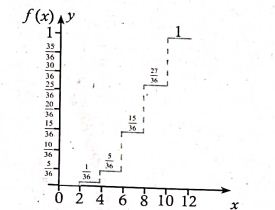
(ii) Cumulative distribution function .
F(x) = p(X ≤ x) = \(\sum_{x_i ≤ x }\)(X = xi)
P(X<2) = 0 for \(\infty\) < x < 2
\(F(2)=\frac { 1 }{ 36 } \)
\(F(4)=\frac { 1 }{ 36 } +\frac { 4 }{ 36 } =\frac { 5 }{ 36 } \)
\(F(6)=\frac { 1 }{ 36 } +\frac { 4 }{ 36 } +\frac { 10 }{ 36 } =\frac { 15 }{ 36 } \)
\(F(8)=\frac { 1 }{ 36 } +\frac { 4 }{ 36 } +\frac { 10 }{ 36 } +\frac { 12 }{ 36 } =\frac { 27 }{ 36 }\)
\(F(10)=\frac { 27 }{ 36 } +\frac { 9 }{ 36 } =\frac { 36 }{ 36 } =1\)
∵ The cumulative distribution function n
\(F(x)=\left\{\begin{array}{lll} 0 & \text { for } & x<2 \\ \frac{1}{36} & \text { for } & x \leq 2 \\ \frac{5}{36} & \text { for } & x \leq 6 \\ \frac{15}{36} & \text { for } & x \leq 8 \\ 1 & \text { for } & x \leq 10 \end{array}\right.\)
(iii) p(4≤ X < 10) = p(x = 4) + p(x = 6) + p(x = 8)
= \(\frac { 4 }{ 36 } +\frac { 10 }{ 36 } +\frac { 12 }{ 36 } +\frac { 26 }{ 36 } =\frac { 13 }{ 18 } \)
(iv) p(x ≥ 6) = p(x = 6) + p(x = 8) + p(x = 10)
= \(\frac { 10 }{ 36 } +\frac { 12 }{ 36 } +\frac { 9 }{ 36 } =\frac { 31 }{ 36 } \)
Sample space = {4 childrens}
11.
(a)
12.
(b)
2i- n, i = 0,1,2... n

12th Standard Syllabus & Materials
12th Standard
TN 12th Computer Applications களப்பெயர் முறைமை (DNS) Sample Question Papers Study Material - QB365 Set A
NEW12th Standard
TN 12th Computer Applications வலையமைப்பு எடுத்துக்காட்டுகள் மற்றும் நெறிமுறைகள் Sample Question Papers Study Material - QB365 Set A
NEW12th Standard
TN 12th Computer Applications கணினி வலையமைப்பு ஓர் அறிமுகம் Sample Question Papers Study Material - QB365 Set A
NEW12th Standard
TN 12th Computer Applications PHP-உடன் MySQL-ஐ இணைத்தல் Sample Question Papers Study Material - QB365 Set A



Tamilnadu Stateboard 12th Standard Subjects
Maths

Chemistry

Physics

Biology

Computer Science

Business Maths and Statistics

Economics

Commerce

Accountancy

History

Computer Applications
Biology
Computer Technology
Computer Applications
Computer Science
Business Maths and Statistics
Commerce
Economics
Maths
Chemistry
Physics
Computer Technology
History
Accountancy

Tamil

English

French
Tamilnadu Stateboard Standards

