
 100% FREE ACCESS
12th Standard Syllabus & Materials
12th Standard
TN 12th Computer Applications மின்னணு தரவு பரிமாற்றம் Sample Question Papers Study Material - QB365 Set A
NEW12th Standard
TN 12th Computer Applications மின் - வணிக பாதுகாப்பு அமைப்புகள் Sample Question Papers Study Material - QB365 Set A
NEW12th Standard
TN 12th Computer Applications மின்னணு செலுத்தல் முறைகள் Sample Question Papers Study Material - QB365 Set A
NEW12th Standard
TN 12th Computer Applications மின் - வணிகம் Sample Question Papers Study Material - QB365 Set A
NEW12th Standard
TN 12th Computer Applications திறந்த மூல கருத்துருக்கள் Sample Question Papers Study Material - QB365 Set A
NEW12th Standard
TN 12th Computer Applications வலையமைப்பு வடமிடல் Sample Question Papers Study Material - QB365 Set A

Published on: 02/11/2019
Probability Distributions
Download Tamil Nadu 12th Standard Maths question papers, model tests, one-mark questions, important questions, and public exam papers in PDF format. Free study materials and answer keys for TN State Board students.
Questions + Answers key
Take MCQ Maths Test1.
In a binomial distribution consisting of 5 independent trials, the probability of 1 and 2 successes are 0.4096 and 0.2048 respectively. Find the mean and variance of the random variables.
2.
If X~ B(n, p) such that 4P(X = 4) = P(X = 2) and n = 6. Find the distribution, mean and standard deviation of X.
3.
A retailer purchases a certain kind of electronic device from a manufacturer. The manufacturer, indicates that the defective rate of the device is 5%. The inspector of the retailer randomly picks 10 items from a shipment. What is the probability that there will be
(i) at least one defective item
(ii) exactly two defective items.
4.
The probability that Mr.Q hits a target at any trial is \(\frac { 1 }{ 4 } \). Suppose he tries at the target 10 times. Find the probability that he hits the target
(i) exactly 4 times
(ii) at least one time.
5.
6.
The probability density function of X is given by \(f(x)=\begin{cases} \begin{matrix} kxe^{ -2x } & forx>0 \end{matrix} \\ \begin{matrix} 0 & for\quad x\le 0 \end{matrix} \end{cases}\) Find the value of k.
7.
8.
Suppose X is the number of tails occurred when three fair coins are tossed once simultaneously. Find the values of the random variable X and number of points in its reverse images.
9.
Compute P(X = k) for the binomial distribution, B(n, p) where
\(P(X=10)=\left( \begin{matrix} 10 \\ 4 \end{matrix} \right) \left( \cfrac { 1 }{ 5 } \right) ^{ 4 }\left( 1-\cfrac { 1 }{ 5 } \right) ^{ 10-4 }\)
10.
The probability density function of X is given
\(f(x)=\begin{cases} \begin{matrix} { Ke }^{ \frac { -x }{ 3 } } & \begin{matrix} for & x>0 \end{matrix} \end{matrix} \\ \begin{matrix} 0 & \begin{matrix} for & x\le 0 \end{matrix} \end{matrix} \end{cases}\)
Find
(i) the value of k
(ii) the distribution function.
(iii) P(X <3)
(iv) P(5 ≤X)
(v) P(X ≤ 4)
11.
Find the probability mass function and cumulative distribution function of number of girl child in families with 4 children, assuming equal probabilities for boys and girls.
12.
A six sided die is marked '1' on one face, '3' on two of its faces, and '5' on remaining three faces. The die is thrown twice. If X denotes the total score in two throws, find
(i) the probability mass function
(ii) the cumulative distribution function
(iii) P(4 ≤ X < 10)
(iv) P(X ≥ 6)
13.
Compute P(X = k) for the binomial distribution, B(n, p) where
n = 9, \(p=\frac { 1 }{ 2 } \), k = 7
14.
For the random variable X with the given probability mass function as below, find the mean and variance
\(f(x)= \begin{cases}2(x-1) & 1<x<2 \\ 0 & \text { otherwise }\end{cases}\)\(\)
15.
For the random variable X with the given probability mass function as below, find the mean and variance
\(f(x)=\left\{\frac{4-x}{6} x=1,2,3\right.\)
1.
n = 5, X B{n, p)
P(X = 1) = 0.4096
P(X = 2) 0.2048
P(X = x) = nCx px qn-x, x = 0, 1, 2, .., n
ஃnC1,p1q4 0.4096
5C1, p2q4 = 0.4096
5C2 p2q3 = 0.2048
5pq4 = 0.4096 .....(1)
10 p2 q3 = 0.2048 ....(2)
Dividing (2) by (1) we get
\(\cfrac { 5{ pq }^{ 4 } }{ 10{ p }^{ 2 }{ q }^{ 3 } } =2\)
q = 4p
q = 4(1- q)
q = 4 - 4q
5q = 4
q = 4/5
\(p=1-q= p=\frac { 1 }{ 5 } \)
\(Mean=np=5\times \frac { 1 }{ 5 } =1\)
\( Variance =n p q=\not 5 \times \frac{1}{\not 5} \times \frac{4}{5}=\frac{4}{5}\)
Distribution
(i) \(P(X=x)= ^5C_{ x }\left( \frac { 1 }{ 5 } \right) ^{ x }\left( \frac { 4 }{ 5 } \right) ^{ 5-x }\) , x = 0,1,2..n
2.
X B(n, p)
Given 4P(X = 4) = P(X = 2) and n = 6.
4. [6C4p4 (1 - p)2] = 6C2p2 q4
⇒ 4p2 = q2
⇒ 4(1-q2) = q2
4(1-2q+q2) = q2
⇒ 3q2 - 8q +4 = 0
⇒ (q - 2)(3q - 2) = 0
\( -q=\frac { 2 }{ 3 } \ \ \ (q\neq2)\)
\(p = 1- q=\cfrac { 1 }{ 3 } \)
Distribution
P(X = x) = nCxpx (1- p)n-x, x = 0, 1,2, ... n
(i) \(P(X=x)= ^6C_{ x }\left( \frac { 1 }{ 3 } \right) ^{ x }\left( \frac { 2 }{ 3 } \right) ^{ 6-x }\) , x = 0,1,2..n
(ii) \(mean=np=6\times \frac { 1 }{ 3 } =2\)
(iii) standard deviation = \(\sqrt { npq } =\sqrt { 2 \times \frac {2}{ 3 } } \)
= \( { \frac { 2 }{ \sqrt 3 } } \)
3.
Let p be the probability that indicates the defective rate of an electronic device
n = 10
\(P=5\%=0.05 \)
q = 1 - p
n = 10, p = 0.05, X ~ B(n, p)
P(X = x) = nCx px qn-x, x = 0, 1,2, .., n
(i) Atleast 1 defective item
P(X ≥ 1) = 1 - P(X < 1)
= 1-P(X = 0)
= 1-10C0 (0.05)0 (0.95)10
P(X ≥1) = 1 - (0.95)10
(ii) Exactly two defective items
P(X = 2) =10C2(0.05)2 (0.95)8
4.
Given P (hitting the target) = \(\frac { 1 }{ 4 } \Rightarrow P=\frac { 1 }{ 4 } \)
n = 10,
(i) P(X = 4)
\(P(X+4)=\left( \begin{matrix} n \\ x \end{matrix} \right) { p }^{ x }(1-p)^{ n-x },x\)
= 0,1,2,...n
(i) Probability of hitting the target exactly 4 times
P(X = 4) = \(^{10}{ C }_{ 4 } \times\left( \begin{matrix} 1 \\ 4 \end{matrix} \right) ^{ 4 }\times \left( \cfrac { 3 }{ 4 } \right) ^{ 6 }\)
\( =\frac{10 \times 9 \times 8 \times 7}{4 \times 3 \times 2} \times \frac{1}{4^{4}} \times \frac{3^{6}}{4^{6}} \\ =210 \times \frac{3^{6}}{4^{10}} \)
(ii) Probability of hitting atleast one time
= P(X≥1) = 1-P(x<1)
= 1-P(X = 0)
\( =1-{ }^{10} \mathrm{C}_{0} \times\left(\frac{1}{4}\right)^{0} \times\left(\frac{3}{4}\right)^{10} \\ =1-\frac{3^{10}}{4^{10}} \)
5.
6.
Given \(f(x)=\begin{cases} \begin{matrix} kxe^{ -2x } & forx>0 \end{matrix} \\ \begin{matrix} 0 & for\quad x\le 0 \end{matrix} \end{cases}\)
Since the given function is a probability density function
\(\int _{ -\infty }^{ \infty }{ f(x)dx } \) = 1
\(\Rightarrow k\int _{ 0 }^{ \infty }{ { xe }^{ -2x }dx=1 } \)
\(\Rightarrow k \frac { 1! }{ \left( 2 \right) ^{ 2 } } =1\)
[\(\int _{ 0 }^{ \infty }{ { x }^{ n }e^{ -ax } } =\frac { n! }{ { a }^{ +1 } } \), Here a = 2, n = 1]
\(\Rightarrow \frac { k }{ 4 } =1\\ \Rightarrow k=4\)
7.
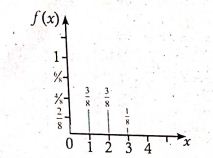
8.
Let X be the random variable of number of tails when three coins tossed.
S = {HHH, HHT, THH, HTH, HTT, THT, TTH,TTT}
n(S) = 8
Let X denote the number of tarits occured.
X-1 (0) {HHH} = 1
X-1 (1) = {HHT, THT, HTH} = 3
X-1 (2) =, {HTT, THT, TTH} = 3
X-1 (3) = {TTT} = 1
ஃ X takes the values 0, 1, 2, 3.
Values of random variable X | 0 | 1 | 2 | 3 | Total |
Number of elements in reverse images | 1 | 3 | 3 | 1 | 8 |
9.
\(
\mathrm{n}=10, \mathrm{p}=\frac{1}{5}, \mathrm{k}=4
\)
\( \mathrm{P}(\mathrm{X}=\mathrm{x})={ }^{\mathrm{n}} \mathrm{C}_{\mathrm{x}} \mathrm{p}^{\mathrm{x}} \mathrm{q}^{\mathrm{n}-\mathrm{x}}, \mathrm{x}=0,1,2, \ldots, \mathrm{n}
\)
\( \mathrm{p}=\frac{1}{5} \)
\( \mathrm{q}=1-\mathrm{p}=1-\frac{1}{5}=\frac{4}{5}
\)
\( \mathrm{P}(\mathrm{X}=4)={ }^{10} \mathrm{C}_{4}\left(\frac{1}{5}\right)^{4}\left(\frac{4}{5}\right)^{6}
\)
\( =210 \times\left(\frac{1}{5}\right)^{4}\left(\frac{4}{5}\right)^{6}
\)
\( =210 \times \frac{4^{6}}{5^{10}}\)
10.
Given
\(f(x)=\begin{cases} \begin{matrix} { Ke }^{ \frac { -x }{ 3 } } & \begin{matrix} for & x>0 \end{matrix} \end{matrix} \\ \begin{matrix} 0 & \begin{matrix} for & x\le 0 \end{matrix} \end{matrix} \end{cases}\)
(i) Since f(x) is a probability density function
\(\int _{ -\infty }^{ \infty }{ f(x) } dx=1\)
\(\Rightarrow \int _{ 0 }^{ \infty }{ K.{ e }^{ \frac { -x }{ 3 } } } dx=1\Rightarrow k\frac { \left[ { e }^{ \frac { -x }{ 3 } } \right] ^{ \infty } }{ -\frac { 1 }{ 3 } } \)
\(\Rightarrow -3k\left[ { e }^{ -\infty }-{ e }^{ 0 } \right] =1\) [∵ e∞ = 0, e0 = 1]
\(\Rightarrow 3k=1\Rightarrow k=\frac { 1 }{ 3 } \)
\(\therefore k=\cfrac { 1 }{ 3 } \)
(ii) The distribution function F(x) = \(\int _{ -\infty }^{ x }{ f(u)du } \)
Case 1: x < 0,
\(F(x)=\int _{ -\infty }^{ x }{ f(x)dx=0 } \)
Case 2: x > 0,
\(f(x)=\int _{ -\infty }^{ x }{ f(x)dx } \)
= \(\int _{ -\infty }^{ 0 }{ f(x)dx+\int _{ 0 }^{ x }{ f(x) } dx } \)
= \(0+k\int _{ 0 }^{ x }{ { e }^{ \frac { -x }{ 3 } } } dx\)
= \(\frac { 1 }{ 3 } \left[ \cfrac { { e }^{ \frac { -x }{ 3 } } }{ -\frac { 1 }{ 3 } } \right] =-\left[ { e }^{ -\frac { x }{ 3 } }-{ e }^{ o } \right] \)
= \(-[{ e }^{ -\frac { x }{ 3 } }-1]\)
= \(1-{ e }^{ -\frac { x }{ 3 } }\)
\(\therefore F(x)=\begin{cases} \begin{matrix} 0 & x\le 0 \end{matrix} \\ \begin{matrix} 1-{ e }^{ \frac { -x }{ 3 } } & x>0 \end{matrix} \end{cases}\)
(iii) p(X < 3)
= \(\int _{ 0 }^{ 3 }{ ke^{ -\frac { x }{ 3 } } } dx=\cfrac { 1 }{ 3 } \int _{ 0 }^{ 3 }{ { e }^{ -\frac { x }{ 3 } }dx } \)
= \(\cfrac { 1 }{ 3 } \left[ \frac { { e }^{ -\frac { x }{ 3 } } }{ \frac { -1 }{ 3 } } \right] \)
= -[e-1-e0] = -[e-1-1]
(iv) \(p(5\le X)=p(X\ge 5)=\int _{ 5 }^{ \infty }{ f(x)dx } \)
= \(\int _{ 5 }^{ \infty }{ ke^{ -\frac { x }{ 3 } } } dx=\cfrac { 1 }{ 3 } \cfrac { \left[ { e }^{ -\frac { x }{ 3 } } \right] _{ 5 }^{ \infty } }{ \frac { -1 }{ 3 } } \)
= \(-\left[ { e }^{ -\infty }-e^{ \frac { -3 }{ 5 } } \right] =\left[ 0-{ e }^{ \frac { -5 }{ 3 } } \right] \)
= \({ e }^{ \frac { -5 }{ 3 } }\)
(v) \(p(X\le 4)=\int _{ -\infty }^{ 4 }{ f(x)dx } \)
= \(\int _{ -\infty }^{ 0 }{ f(x)dx+\int _{ 0 }^{ 4 }{ f(x)dx } } \)
= \(0+\int _{ 0 }^{ 4 }{ { ke }^{ -\frac { x }{ 3 } }dx } =k\left[ \frac { { e }^{ -\frac { x }{ 3 } } }{ -\frac { 1 }{ 3 } } \right] _{ 0 }^{ 4 }\)
= \(\cfrac { 1 }{ 3 } \cfrac { \left[ { e }^{ -\frac { x }{ 3 } } \right] _{ 0 }^{ 4 } }{ -\frac { 1 }{ 3 } } =-\left[ { e }^{ \frac { -4 }{ 3 } }-{ e }^{ o } \right] \)
= \(-\left[ { e }^{ \frac { -4 }{ 3 } }-1 \right] =1-{ e }^{ \frac { -4 }{ 3 } }\)
11.
Let X be the random variable denotes number of| girl child among 4 children
X = {0, 1, 2, 3, 4}
X =2) (0) {BBBB}
X(1) = {GBBB, BGBB, BBGB, BBBG}
X(2) = {GGBB, BBGG, GBGB, BGBG, BGGB, GBBG}
X(3) = {BGGG, GGGB, GBGG, GGBG}
X(4) = {GGGG}
| Values of the random variable | 0 | 1 | 2 | 3 | 4 | Total |
| No. of elements in inverse images | 1 | 4 | 6 | 4 | 1 | 16 |
(i) Probability mass function
| x | 0 | 1 | 2 | 3 | 4 | Total |
| f(x) | \(\\ \cfrac { 1 }{16 } \) | \(\cfrac { 4 }{ 16 } \) | \(\cfrac { 6 }{ 16 } \) | \(\cfrac { 4 }{ 16 } \) | \(\\ \cfrac { 1 }{16 } \) | 1 |
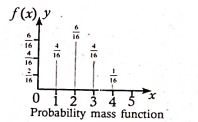
(ii) Cumulative distribution function
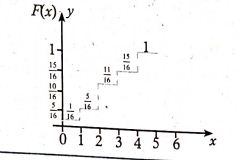
F(x) = p(X ≤ x) = \(\sum_{x_i ≤ x }\)P(X = xi)
P(X<0) = 0 for -\(\infty\) < x < 0
\(F(0)=\frac { 1 }{ 16 } \)
\(F(1)=\frac { 1 }{ 16 } +\frac { 1 }{ 4 } =\frac { 5 }{ 16 } \)
\(F(2)=\frac { 5 }{ 16 } +\frac { 3 }{ 8 } =\frac { 5 }{ 16 } +\frac { 6 }{ 16 } =\frac { 11 }{ 16 } \)
\(F(3)=\frac { 11 }{ 6 } +\frac { 1 }{ 4 } =\frac { 11 }{ 16 } +\frac { 4 }{ 16 } =\frac { 15 }{ 16 } \)
\(F(4)=\frac { 15 }{ 16 } +\frac { 1 }{ 16 } =\frac { 16 }{ 16 } =1\)
\(F(x)=\left\{\begin{array}{lll} \frac{0}{16} & \text { for } & x<0 \\ \frac{1}{16} & \text { for } & x \leq 0 \\ \frac{5}{16} & \text { for } & x \leq 1 \\ \frac{11}{16} & \text { for } & x \leq 2 \\ \frac{15}{16} & \text { for } & x \leq 3 \\ 1 & \text { for } & x \leq 4 \end{array}\right.\)
12.
Let X be the thrown random variable denotes the total in two the thrown a die.
Sample space S
| I/II | 1 | 3 | 3 | 5 | 5 | 5 |
| 1 | 2 | 4 | 4 | 6 | 6 | 6 |
| 3 | 4 | 6 | 6 | 8 | 8 | 8 |
| 3 | 4 | 6 | 6 | 8 | 8 | 8 |
| 5 | 6 | 8 | 8 | 10 | 10 | 10 |
| 5 | 6 | 8 | 8 | 10 | 10 | 10 |
| 5 | 6 | 8 | 8 | 10 | 10 | 10 |
n (S) = 36
X = {2, 4, 6, 8, 10}
| Values of the random variable | 2 | 4 | 6 | 8 | 10 | Total |
| No. of elements in inverse images | 1 | 4 | 10 | 12 | 9 | 36 |
\(p(x=2)=\cfrac { 1 }{ 36 } \)
\(p(x=4)=\cfrac { 4 }{ 36 } \)
\(p(x=6)=\cfrac { 10 }{ 36 } \)
\(p(x=8)=\cfrac { 12 }{ 36 } \)
\(p(x=10)=\cfrac { 9 }{ 36 } \)
(i) Probability mass function is
| x | 2 | 4 | 6 | 8 | 10 |
| f(x) | \(\\ \cfrac { 1 }{ 36 } \) | \(\cfrac { 4 }{ 36 } \) | \(\cfrac { 10 }{ 36 } \) | \(\cfrac { 12 }{ 36 } \) | \(\cfrac { 9 }{ 36 } \) |
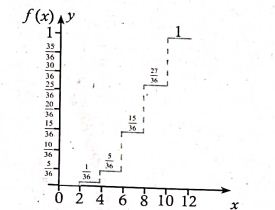
(ii) Cumulative distribution function .
F(x) = p(X ≤ x) = \(\sum_{x_i ≤ x }\)(X = xi)
P(X<2) = 0 for \(\infty\) < x < 2
\(F(2)=\frac { 1 }{ 36 } \)
\(F(4)=\frac { 1 }{ 36 } +\frac { 4 }{ 36 } =\frac { 5 }{ 36 } \)
\(F(6)=\frac { 1 }{ 36 } +\frac { 4 }{ 36 } +\frac { 10 }{ 36 } =\frac { 15 }{ 36 } \)
\(F(8)=\frac { 1 }{ 36 } +\frac { 4 }{ 36 } +\frac { 10 }{ 36 } +\frac { 12 }{ 36 } =\frac { 27 }{ 36 }\)
\(F(10)=\frac { 27 }{ 36 } +\frac { 9 }{ 36 } =\frac { 36 }{ 36 } =1\)
∵ The cumulative distribution function n
\(F(x)=\left\{\begin{array}{lll} 0 & \text { for } & x<2 \\ \frac{1}{36} & \text { for } & x \leq 2 \\ \frac{5}{36} & \text { for } & x \leq 6 \\ \frac{15}{36} & \text { for } & x \leq 8 \\ 1 & \text { for } & x \leq 10 \end{array}\right.\)
(iii) p(4≤ X < 10) = p(x = 4) + p(x = 6) + p(x = 8)
= \(\frac { 4 }{ 36 } +\frac { 10 }{ 36 } +\frac { 12 }{ 36 } +\frac { 26 }{ 36 } =\frac { 13 }{ 18 } \)
(iv) p(x ≥ 6) = p(x = 6) + p(x = 8) + p(x = 10)
= \(\frac { 10 }{ 36 } +\frac { 12 }{ 36 } +\frac { 9 }{ 36 } =\frac { 31 }{ 36 } \)
Sample space = {4 childrens}
13.
\(\mathrm{n}=9, \mathrm{p}=\frac{1}{2}, \mathrm{k}=7
\)
\(
\mathrm{P}(X=x)={ }^{n} C_{x} p^{x} q^{n-x}, x=0,1,2, \ldots, n
\)
\(p =\frac{1}{2}
\)
\(q =1-p=\frac{1}{2} \)
\(P(X=7) ={ }^{9} C_{7}\left(\frac{1}{2}\right)^{7}\left(\frac{1}{2}\right)^{2}
\)
\( =\frac{9 \times 8}{2} \times \frac{1}{2^{9}} \)
\( =36 \times \frac{1}{512}=\frac{9}{128}
\)
14.
\(\)\(Mean=E(X)=\int _{ 1 }^{ 2 }{ f(x)dx=\int _{ 1 }^{ 2 }{ 2((x-1)dx } }\)
\(=2\left[\frac{8}{3}-\frac{4}{2}-\frac{1}{3}+\frac{1}{2}\right]\)
\(=2\left(\frac{7}{3}-\frac{3}{2}\right)\)
\(=2 \times \frac{5}{6}\)
\(=\frac{5}{3}\)
\(E({ x }^{ 2 })=\int _{ 1 }^{ 2 }{ { x }^{ 2 }f(x)dx }\)
= \(\int _{ 1 }^{ 2 }{ { x }^{ 2 }.2\left( x-1 \right) } dx\)
= \(2\int _{ 1 }^{ 2 }{ ({ x }^{ 3 }-{ x }^{ 2 })dx }\)
= \(2\left[ \frac { { x }^{ 4 } }{ 4 } -\frac { { x }^{ 3 } }{ 3 } \right] _{ 1 }^{ 2 }\)
= \(2\left[ \left( 4-\frac { 8 }{ 3 } \right) -\left( \frac { 1 }{ 4 } -\frac { 1 }{ 3 } \right) \right]\)
= \(2\left[ \frac { 4 }{ 3 } +\frac { 1 }{ 12 } \right] =2\left[ \frac { 16+1 }{ 12 } \right]\)
= \(\frac { 17 }{ 6 }\)
ஃ Var(X) = E(X2) - [E(X)]2
= \(\frac { 17 }{ 6 } -(\frac{5}{ 3 }^{ 2 })=\frac { 17 }{ 6 } -\frac { 25 }{ 9 }\)
= \(\frac{51-50}{18}\)
= \(\frac{1}{18}\)
15.
Given
\(f(x)=\cfrac { 4-x }{ 6 } \)
\(f(x)=\cfrac { 4-1 }{ 6 } =\cfrac { 3 }{ 6 } =\cfrac { 1 }{ 2 } \)
\(f(2)=\cfrac { 4-2 }{ 6 } =\cfrac { 2 }{ 6 } =\cfrac { 1 }{ 3 } \)
\(f(3)=\cfrac { 4-3 }{ 6 } =\cfrac { 1 }{ 6 } \)
ஃ The probability mass function is
| x | 1 | 2 | 3 |
| f(x) | \(\cfrac { 1 }{ 2 } \) | \(\cfrac { 1 }{ 3 } \) | \(\cfrac { 1 }{ 6 } \) |
Mean \(E(X)=\Sigma xf(x)\)
= \(1\left( \cfrac { 1 }{ 2 } \right) +2\left( \cfrac { 1 }{ 3 } \right) +3\left( \cfrac { 1 }{ 6 } \right) \)
= \(\cfrac { 1 }{ 2 } +\cfrac { 2 }{ 3 } +\cfrac { 3 }{ 6 } =\cfrac { 3+4+6 }{ 6 } \)
= \(\cfrac { 10 }{ 6 } =\cfrac { 5 }{ 3 } =1.67\)
\(E({ x }^{ 2 })=\Sigma { x }^{ 2 }f(x)\)
= \({ 1 }^{ 2 }\left( \cfrac { 1 }{ 2 } \right) +{ 2 }^{ 2 }\left( \cfrac { 1 }{ 3 } \right) +3^{ 2 }\left( \cfrac { 1 }{ 6 } \right) \)
= \(\cfrac { 1 }{ 2 } +\cfrac { 4 }{ 9 } +\cfrac { 9 }{ 6 } =\cfrac { 3+8+9 }{ 6 } \)
= \(\cfrac { 20 }{ 6 } =\cfrac { 10 }{ 3 } =3.33\)
var(X) E(X2) - [E(X)]2
= \(\cfrac { 10 }{ 3 } -\left( \cfrac { 5 }{ 3 } \right) ^{ 2 }=\cfrac { 10 }{ 3 } -\cfrac { 25 }{ 9 } \)
= \(\cfrac { 30-25 }{ 9 } =\cfrac { 5 }{ 9 } =0.54\)

12th Standard Syllabus & Materials
12th Standard
TN 12th Computer Applications களப்பெயர் முறைமை (DNS) Sample Question Papers Study Material - QB365 Set A
NEW12th Standard
TN 12th Computer Applications வலையமைப்பு எடுத்துக்காட்டுகள் மற்றும் நெறிமுறைகள் Sample Question Papers Study Material - QB365 Set A
NEW12th Standard
TN 12th Computer Applications கணினி வலையமைப்பு ஓர் அறிமுகம் Sample Question Papers Study Material - QB365 Set A
NEW12th Standard
TN 12th Computer Applications PHP-உடன் MySQL-ஐ இணைத்தல் Sample Question Papers Study Material - QB365 Set A



Tamilnadu Stateboard 12th Standard Subjects
Maths

Chemistry

Physics

Biology

Computer Science

Business Maths and Statistics

Economics

Commerce

Accountancy

History

Computer Applications
Biology
Computer Technology
Computer Applications
Computer Science
Business Maths and Statistics
Commerce
Economics
Maths
Chemistry
Physics
Computer Technology
History
Accountancy

Tamil

English

French
Tamilnadu Stateboard Standards

