
 100% FREE ACCESS
12th Standard Syllabus & Materials
12th Standard
TN 12th Computer Applications மின்னணு தரவு பரிமாற்றம் Sample Question Papers Study Material - QB365 Set A
NEW12th Standard
TN 12th Computer Applications மின் - வணிக பாதுகாப்பு அமைப்புகள் Sample Question Papers Study Material - QB365 Set A
NEW12th Standard
TN 12th Computer Applications மின்னணு செலுத்தல் முறைகள் Sample Question Papers Study Material - QB365 Set A
NEW12th Standard
TN 12th Computer Applications மின் - வணிகம் Sample Question Papers Study Material - QB365 Set A
NEW12th Standard
TN 12th Computer Applications திறந்த மூல கருத்துருக்கள் Sample Question Papers Study Material - QB365 Set A
NEW12th Standard
TN 12th Computer Applications வலையமைப்பு வடமிடல் Sample Question Papers Study Material - QB365 Set A

Published on: 17/01/2020
Download Tamil Nadu 12th Standard Maths question papers, model tests, one-mark questions, important questions, and public exam papers in PDF format. Free study materials and answer keys for TN State Board students.
Questions + Answers key
Take MCQ Maths Test1.
The slope of the tangent at p(x,y) on the curve is -\(\left( \frac { y+3 }{ x+2 } \right) \). If the curve passes through the origin, find the equation of the curve.
2.
Let S be a non-empty set and 0 be a binary operation on s defined by x 0 y = x; x, Y \(\in \) s. Determine whether 0 is commutative and association.
3.
Using integration, find the area of the triangle with sides y = 2x + 1, y = 3x + 1 and x = 4.
4.
Let w(x, y, z) = \(\frac { 1 }{ \sqrt { { x }^{ 2 }+{ y }^{ 2 }+{ z }^{ 2 } } } ,(x,y,z)\neq (0,0,0)\). Show that \(\frac { { \partial }^{ 2 }w }{ \partial { x }^{ 2 } } +\frac { { \partial }^{ 2 }w }{ \partial { y }^{ 2 } } +\frac { { \partial }^{ 2 }w }{ \partial { z }^{ 2 } } =0\)
5.
Suppose the amount of milk sold daily at a milk booth is distributed with a minimum of 200 Iitres and a maximum of 600 litres with probability density function
\(\begin{cases} \begin{matrix} k & 200\le x\le 600 \end{matrix} \\ \begin{matrix} 0 & otherwise \end{matrix} \end{cases}\)
Find
(i) the value of k
(ii) the distribution function
(iii) the probability that daily sales will fall between 300 litres and 500 litres?
6.
Solve the differential equation (y2-2xy) dx = (x2-2xy) dy
7.
A beacon makes one revolution every 10 seconds. It is located on a ship which is anchored 5 km from a straight shore line. How fast is the beam moving along the shore line when it makes an angle of 45° with the shore?
8.
Identify the type of conic and find centre, foci, vertices, and directrices of each of the following :
\(\frac { { \left( y-2 \right) }^{ 2 } }{ 25 } \frac { { \left( x+1 \right) }^{ 2 } }{ 16 } =1\)
9.
Verify that arg(1+i) + arg(1-i) = arg[(1+i) (1-i)]
10.
A kho-kho player In a practice session while running realises that the sum of tne distances from the two kho-kho poles from him is always 8m. Find the equation of the path traced by him of the distance between the poles is 6m.
11.
Find the domain of the following functions
(i) f(x) = sin-1(2x - 3)
(ii) f(x) = sin-1x + cos x
12.
ABCD is a quadrilateral with \(\overset { \rightarrow }{ AB } =\overset { \rightarrow }{ \alpha } \) and \(\overset { \rightarrow }{ AD } =\overset { \rightarrow }{ \beta } \) and \(\overset { \rightarrow }{ AC } =2\overset { \rightarrow }{ \alpha } +3\overset { \rightarrow }{ \beta } \). If the area of the quadrilateral is λ times the area of the parallelogram with \(\overset { \rightarrow }{ AB } \) and \(\overset { \rightarrow }{ AD } \) as adjacent sides, then prove that \(\lambda =\frac { 5 }{ 2 } \)
13.
Show that the equations -2x + y + z = a, x - 2y + z = b, x + y -2z = c are consistent only if a + b + c = 0.
14.
Find the fourth roots of unity.
15.
If a1, a2, a3, ... an is an arithmetic progression with common difference d, prove that tan\( \left[ tan^{ -1 }\left( \frac { d }{ 1+{ a }_{ 1 }{ a }_{ 2 } } \right) +tan^{ -1 }\left( \frac { d }{ 1+{ a }_{ 2 }{ a }_{ 3 } } \right) +....tan^{ -1 }\left( \frac { d }{ 1+{ a }_{ n }{ a }_{ n-1 } } \right) \right] =\frac { { a }_{ n }-{ a }_{ 1 } }{ 1+{ a }_{ 1 }{ a }_{ n } } \)
16.
Discuss the maximum possible number of positive and negative roots of the polynomial equations x2−5x+6 and x2−5x+16 . Also draw rough sketch of the graphs
17.
It is known that the roots of the equation x3- 6x2- 4x + 24 = 0 are in arithmetic progression. Find its roots.
18.
The solution of sec2x tan y dx + sec2y tan x dy = 0 is _________
tan x+tan y = c
sec x + sec y = c
tan x tan y = c
sec x- sec y = c
19.
In (S, *), is defined by x * y = x where x, y \(\in \) S, then
associative
Commutative
associative and commutative
neither associative nor commutative
20.
21.
If u = sin-1 \(\left( \frac { { x }^{ 4 }+{ y }^{ 4 } }{ { x }^{ 2 }+{ y }^{ 2 } } \right) \) and f = sin u then f is a homogeneous function of degree ..................
0
1
2
4
22.
The statement "If f has a local extremum at c and if f'(c) exists then f'(c) = 0" is ________
the extreme value theorem
Fermat's theorem
Law of mean
Rolle's theorem
23.
In the last column of the truth table for ¬( p ∨ ¬q) the number of final outcomes of the truth value 'F' are
1
2
3
4
24.
The value of \(\int _{ 0 }^{ 1 }{ { ({ sin }^{ -1 }x) }^{ 2 } } dx\) is
\(\frac { { \pi }^{ 2 } }{ 4 } -1\)
\(\frac { { \pi }^{ 2 } }{ 4 } +2\)
\(\frac { { \pi }^{ 2 } }{ 4 } +1\)
\(\frac { { \pi }^{ 2 } }{ 4 } -2\)
25.
If w (x, y, z) = x2 (y - z) + y2 (z - x) + z2(x - y), then \(\frac { { \partial }w }{ \partial x } +\frac { \partial w }{ \partial y } +\frac { \partial w }{ \partial z } \) is
xy + yz + zx
x(y + z)
y(z + x)
0
26.
27.
The integrating factor of the differential equation \(\frac{d y}{d x}+P(x) y=Q(x)\) is x, then P(x)
x
\(\frac { { x }^{ 2 } }{ 2 } \)
\(\frac{1}{x}\)
\(\frac{1}{x^2}\)
28.
The number given by the Rolle's theorem for the functlon x3 - 3x2, x ∈ [0, 3] is
1
\(\sqrt { 2 } \)
\(\frac { 3 }{ 2 } \)
2
29.
If x = cos θ + i sin θ, then xn + \(\frac { 1 }{ { x }^{ n } } \) is ______
2 cos nθ
2 i sin nθ
2n cosθ
2n i sinθ
30.
In a \(\Delta ABC\) if C is a right angle, then \({ tan }^{ -1 }\left( \frac { a }{ b+c } \right) +{ tan }^{ -1 }\left( \frac { b }{ c+a } \right) =\) ________
\(\frac { \pi }{ 3 } \)
\(\frac { \pi }{ 4 } \)
\(\frac { 5\pi }{ 2 } \)
\(\frac { \pi }{ 6 } \)
31.
If A = [2 0 1] then the rank of AAT is ______
1
2
3
0
32.
If the equation ax2+ bx+c = 0(a > 0) has two roots ∝ and β such that ∝ <- 2 and β > 2, then __________
b2-4ac = 0
b2 - 4ac <0
b2 - 4ac >0
b2 - 4ac ≥ 0
33.
If A = \(\left[ \begin{matrix} 2 & 0 \\ 1 & 5 \end{matrix} \right] \) and B = \(\left[ \begin{matrix} 1 & 4 \\ 2 & 0 \end{matrix} \right] \) then |adj (AB)| =
-40
-80
-60
-20
34.
Distance from the origin to the plane 3x − 6y + 2z + 7 = 0 is
0
1
2
3
35.
If the two tangents drawn from a point P to the parabola y2 = 4x are at right angles then the locus of P is
2x + 1 = 0
x = −1
2x −1 = 0
x = 1
36.
\(\sin ^{-1}(\cos x)=\frac{\pi}{2}-x\) is valid for
\(-\pi \le x\le 0\)
\(0 \le x\le \pi\)
\(-\frac { \pi }{ 2 } \le x\le \frac { \pi }{ 2 } \)
\(-\frac { \pi }{ 4 } \le x\le \frac { 3\pi }{ 4 } \)
37.
A polynomial equation in x of degree n always has
n distinct roots
n real roots
n complex roots
at most one root
38.
Let G = {1, w, w2) where w is a complex cube root of unity. Then find the universe of w2. Under usual multiplication.
39.
Evaluate \(\int _{ 1 }^{ 2 }{ \frac { 3x }{ { 9x }^{ 2 }-1 } dx } \)
40.
A particle moves in a line so that x =\(\sqrt { t } \). Show that the acceleration is negative and proportional to the cube of the velocity.
41.
For the random variable X with the given probability mass function as below, find the mean and variance
\(f(x)=\left\{\frac{4-x}{6} x=1,2,3\right.\)
42.
Find df for f(x) = x2 + 3x and evaluate it for
x = 3 and dx = 0.02
43.
Show that x2 + y2 = r2, where r is a constant, is a solution of the differential equation \(\frac { dy }{ dx } \) = -\(\frac { x }{ y } \).
44.
Find the locus of a point which divides so that the sum of its distances from (-4, 0) and (4, 0) is 10 units.
45.
Find value of a for which the sum of the squares of the equation x2 - (a- 2) x - a -1 = 0 assumes the least value.
46.
Show that the system of equations is inconsistent. 2x + 5y= 7, 6x + 15y = 13.
47.
Find the volume of the parallelepiped whose coterminous edges are represented by the vectors \(-6\hat { i } +14\hat { j } +10\hat { k } ,14\hat { i } -10\hat { j } -6\hat { k } \) and \(2\hat { i } +4\hat { j } -2\hat { k } \)
48.
In (z, *) where * is defined as a * b = a + b + 2. Verify the commutative and associative axiom.
49.
Evaluate \(\int _{ 0 }^{ 1 }{ { xe }^{ -2x } } dx\)
50.
Suppose f(x) is a differentiable function for all x with f'(x) ≤ 29 and f(2) = 17. What is the maximum value of f(7)?
51.
Prove that \({ tan }^{ -1 }\sqrt { x } =\frac { 1 }{ 2 } { cos }^{ -1 }={ \frac { 1 }{ 2 } { cos }^{ -1 }\left( \frac { 1-x }{ 1+x } \right) ,x\in \left| 0,1 \right| }\)
52.
Find the Cartesian form of the equation of the plane \(\overset { \rightarrow }{ r } =\left( s-2t \right) \overset { \wedge }{ i } +\left( 3-t \right) \overset { \wedge }{ j } +\left( 2s+t \right) \overset { \wedge }{ k } \)
53.
Verify (AB)-1 = B-1 A-1 for A =\(\left[ \begin{matrix} 2 & 1 \\ 5 & 3 \end{matrix} \right] \) and B =\(\left[ \begin{matrix} 4 & 5 \\ 3 & 4 \end{matrix} \right] \).
54.
Solve: 2x+2x-1+2x-2 = 7x+7x-1+7x-2
1.
Given \(\frac { dy }{ dx } =-\left( \frac { y+3 }{ x+2 } \right) \)
⇒ \(\frac { dy }{ y+3 } =-\frac { dx }{ x+2 } \)
⇒ \(\int { \frac { dy }{ y+3 } } =-\int { \frac { dx }{ x+2 } } \)
⇒ log(y + 3) = -log (x + 2) + log c
⇒ log(y + 3) + log (x + 2) = log c
⇒ log(x + 2) (y + 3) = log c
⇒ (x+2)(y+3) = c ..(1)
Since the curve passes through (0, 0)
(0 + 2)(0 + 3) = c ⇒ c = 6
(1) becomes,
(x + 2)(y + 3) = 6
⇒ xy + 3x + 2y + 6 = 6
⇒ xy + 3x + 2y = 0
2.
Given s is a non-empty set and x 0 y = x, x,y \(\in \) s y0x = y
x0u ≠ y0x ⇒ is not commutative
Now, x0(y0z) = x0y = x
and (x0y) 0 z = x0z = x
x0(y0z) = (y0z) 0 z
0 is associative.
3.
Given sides are y = 2x + 1.....(1)
y = 3x + 1...(2)
x = 4...(3)
Solving (1) & (2), x = 0, y = 1
Solving (2) & (3), x = 4, y = 13
Solving (1) & (3), x = 4, y = 9
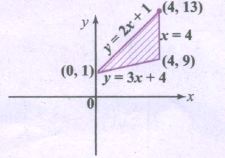
∴ Required area \(\int _{ 0 }^{ 4 }{ (3x+1) } dx-\int _{ 0 }^{ 4 }{ (2x+1) } dx\)
\({ =\left( \frac { { 3x }^{ 2 } }{ 2 } +x \right) }_{ 0 }^{ 4 }-{ \left( \frac { { 2x }^{ 2 } }{ 2 } +x \right) }_{ 0 }^{ 4 }\)
\(=\left( \frac { 48 }{ 2 } +4 \right) -(16+4)=28-20\)
Area = 8 sq. units
4.
Given w(x, y, z) = \(\frac { 1 }{ \sqrt { { x }^{ 2 }+{ y }^{ 2 }+{ z }^{ 2 } } }\)
= (x2 + y2 + z2) -\(\frac12\)
\(\frac { \partial w }{ \partial x } =\frac { -1 }{ 2 } ({ x^{ 2 }+{ y }^{ 2 }+{ z }^{ 2 }) }^{ -\frac { 3 }{ 2 } }(2x)\)
= (-x2 + y2 + z2) -\(\frac12\)
\(\frac { { \partial }^{ 2 }w }{ \partial { x }^{ 2 } } =\frac { \partial }{ \partial x } \left( \frac { \partial w }{ \partial x } \right) \)
= -[x\(\left( \frac { -3 }{ 2 } \right) \)( x2 + y2 +z2)\(-\frac32\)
\((\not 2 x)+\left(x^{2}+y^{2}+z^{2}\right)^{\frac{3}{2}}\)
= (x2 + y2 + z2)-\(\frac52\) [-3x2 + x2 +y + z2]
= - (x2 + y2 + z2)-\(\frac52\) [y2 + z2 - 2x2] ....(1)
\(\frac { \partial w }{ \partial y } =\frac { -1 }{ 2 } ({ x^{ 2 }+{ y }^{ 2 }+{ z }^{ 2 }) }^{ -\frac { 3 }{ 2 } }(2y)\)
= -y(x2 +y2 + z2)-\(\frac32\)
\(\frac { { \partial }^{ 2 }w }{ \partial { y }^{ 2 } } =\frac { \partial }{ \partial y } \left( \frac { \partial w }{ \partial y } \right) \)
\(=-\left[y\left(\frac{-3}{\not 2}\right)\left(x^{2}+y^{2}+z^{2}\right)^{\frac{5}{2}}(\not 2 y)+\left(x^{2}+y^{2}+z^{2}\right)^{\frac{3}{2}}(1)\right]\)
= -(x2 + y2 + z2)-\(\frac52 \)
= -(x2 + y2 + z2)-\(\frac52 \) [3y2 + x2 + y2 + z2]
= -(x2 + y2 + z2)-\(\frac52 \) [x2 + y2 + 2z2] ....(2)
Now \(\frac { \partial w }{ \partial z } =\frac { -1 }{ 2 } ({ x^{ 2 }+{ y }^{ 2 }+{ z }^{ 2 }) }^{ -\frac { 3 }{ 2 } }(2z)\)
= -z(x2 + y2 + z2)-\(\frac32 \)
∴ \(\frac { { \partial }^{ 2 }w }{ \partial { z }^{ 2 } } \) = -(x2 + y2 + z2)-\(\frac52 \) [x2 + y2 - 2z2] ...(3)
(1)+(2)+(3)⟶
∴ \(\frac { { \partial }^{ 2 }w }{ \partial { x }^{ 2 } } +\frac { { \partial }^{ 2 }w }{ \partial { y }^{ 2 } } +\frac { { \partial }^{ 2 }w }{ \partial { y }^{ 2 } } \) = -(x2 + y2 + z2)-\(\frac52 \) [y2 + z2 - 2x2 + x2 + z2 - 2y + x2+ y-2z2]
= -(x2 + y2 + z2)-\(\frac52 \)(0) = 0
Hence proved
5.
Given \(\begin{cases} \begin{matrix} k & 200\le x\le 600 \end{matrix} \\ \begin{matrix} 0 & otherwise \end{matrix} \end{cases}\)
(i) Since f{x) is a probability density function
\(\int _{ -\infty }^{ \infty }{ f(x)d=1\Rightarrow \int _{ 200 }^{ 600 }{ kda } =1 } \)
\(\Rightarrow k[x]_{ 200 }^{ 600 }=1\Rightarrow k(600-200)=1\)
400 k = 1
\(\Rightarrow k=\frac { 1 }{ 400 } \)
(ii) The distribution function
= \(\int _{ -\infty }^{ x }{ f(u) } du\)
Case 1: x < 200
\(F(x) =\int _{ -\infty }^{ u }{ du } =0\)
Case 1: x < 200 ≤ x ≤ 600
\(\int _{ -\infty }^{ x }{ f(u) } du\)
\(F(x)=\int _{ -\infty }^{ 200 }{ f(u)du } =+\int _{ 200 }^{ x }{ f(u)du } \)
= \( =\frac { 1 }{ 400 }(x-200) =\frac { x }{ 400 } =\frac { 1 }{ 2 } \)
Case 3: x > 600
\(F(x) =\int _{ -\infty }^{ u }{ du } =0\)
\(f(x)= \begin{cases}0, & x<200 \\ \frac{x}{400}-\frac{1}{2}, & 200 \leq x \leq 600 \\ 0, & x>600\end{cases}\)
(iii) P(300 < x < 500)
= \(\int _{ 300 }^{ 500 }{ kdx=\frac { 1 }{ 400 } \left[ x \right] _{ 300 }^{ 500 } } \)
= \(\frac { 1 }{ 400 } \left[ 500-300 \right] =\frac { 200 }{ 400 } =\frac { 1 }{ 2 } \)
6.
\(\Rightarrow \frac { dy }{ dx } =\frac { { y }^{ 2 }-2xy }{ { x }^{ 2 }-2xy }\) ...(1)
This is a homogeneous differential equation
\(\therefore put\ y=vx\Rightarrow \frac { dy }{ dx } =v+x\frac { dv }{ dx }\)
\(\therefore\) (1) becomes,
\(v+x\frac { dv }{ dx } =\frac { { v }^{ 2 }{ x }^{ 2 }-2xvx }{ { x }^{ 2 }-2xvx }\)
\(=\frac{x^z\left(v^2-2 v\right)}{x^z(1-2 v)}\)
\(\Rightarrow x\frac { dv }{ dx } =\frac { { v }^{ 2 }-2v }{ 1-2v } -v\)
\(=\frac { { v }^{ 2 }-2v-v+2{ v }^{ 2 } }{ 1-2v }\)
\(=\frac { { 3v }^{ 2 }-3v }{ 1-2v }\)
Separating the variables we get,
\(\frac { 1-2v }{ 3{ v }^{ 2 }-3v } dv=\frac { dx }{ x }\)
\(\frac { 6v-3 }{ 3{ v }^{ 2 }-3v } dv=-3\frac { dx }{ x }\)
Integrating on both sides,
\(\int \frac{(2 v-1) d v}{\left(v^2-v\right)} =\int-3 \frac{d x}{x}\)
\(\log \left(v^2-v\right) =-3 \log x+\log \mathrm{c}\)
\(\log \left(v^2-v\right)+\log \left(x^3\right) =\log \mathrm{c}\)
\(\left(v^2-v\right)\left(x^3\right) =\mathrm{c}\)
\(\left(\frac{y^2}{x^2}-\frac{y}{x}\right) x^3 =c\)
\(x y^2-x^2 \mathrm{y} =\mathrm{c}\)
7.
Since the beacon makes one revolution (360°) in 10 sec.
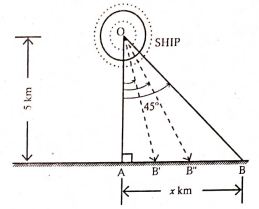
At the point of observation, let 0 be the angle of deviation of the beacon of light from OA.
Let AB x km,when \(\angle\)AOB = 0
\(\frac { d\theta }{ dt } =\frac { 2\pi }{ 10 } \)
\(=\frac { \pi }{ 5 } \) rad /sec.
Let AB = x
Then, tan θ \( =\frac { x }{ 5 } \)
x = 5 tan θ
We know that velocity = \(\frac { dx }{ dt } \)
Differentiating (1) with respect to 't' we get,
\(\frac { dx }{ dt } =5{ sec }^{ 2 }\theta ,\frac { d\theta }{ dt } \)
\(=5({ sec }^{ 2 }{ 45 }^{ o })\left( \frac { \pi }{ 5 } \right) \)
\(=5({ \sqrt { 2 } })^{ 2 }\left( \frac { \pi }{ 5 } \right) \)
\(=5(2)\left( \frac { \pi }{ 5 } \right) \)
= 2π km/sec.
8.
\(\frac { { (y-2) }^{ 2 } }{ 25 } -\frac { ({ x+1) }^{ 2 } }{ 16 } =1\)
Given equatlon is \(\frac { { (y-2) }^{ 2 } }{ 25 } -\frac { ({ x+1) }^{ 2 } }{ 16 } =1\)
Thi is an equation of the hyperbola where transverse axis is parallel to y-axis.
∴ a2 = 25, b2 = 16
⇒ c2 - a2 + b2 = 25 +16 = 41
⇒ c = \(\sqrt { 41 } \)
\(e =\sqrt { 1-\frac { { b }^{ 2 } }{ { a }^{ 2 } } } =\sqrt { 1+\frac { 16 }{ 25 } } =\sqrt { \frac { 41 }{ 25 } } =\frac { \sqrt { 41 } }{ 5 } \)
(a) Center is (-1, 2) ⇒ h = -1, k = 2
(b) Foci are (h, k + c), (h, k- c)
⇒ (-1, 2 + \(\sqrt { 41 } \)), (-1, 2 - \(\sqrt { 41 } \))
(c) Vertices are (h, k + a), (h, k-a)
⇒ (-1, 2 + 5), (-1, 2 - 5)
= (-1, 7), (-1, -3)
(d) Equation of directrices are
\(y-2=\pm \frac { 5 }{ \frac { \sqrt { 41 } }{ 5 } } \)
\(\Rightarrow y-2=\pm \frac { 25 }{ \sqrt { 41 } } \)
\(\Rightarrow y=2+\frac { 25 }{ \sqrt { 41 } } \) and
\( y=2-\frac { 25 }{ \sqrt { 41 } } \)
9.
arg(1+i) + arg(1-i) = arg[(1+i) (1-i)]
LHS = arg (1+i) + arg(1-i)
1+i = \(\sqrt { 2 } \left( \frac { 1 }{ \sqrt { 2 } } +\frac { i }{ \sqrt { 2 } } \right) \)
= \(\sqrt { 2 } \left( cos\frac { \pi }{ 4 } +isin\frac { \pi }{ 4 } \right) \)
∴ arg (1+i) = π/4
-1+i =\(\sqrt { 2 } \left( \frac { -1 }{ \sqrt { 2 } } +\frac { i }{ \sqrt { 2 } } \right) \)
= \(\sqrt { 2 } \left( cos3\frac { \pi }{ 4 } +isin3\frac { \pi }{ 4 } \right) \)
∴ (-1+i) = 3\(\frac { \pi }{ 4 } \)
∴ LHS = \(\frac { \pi }{ 4 } +\frac { 3\pi }{ 4 } =\frac { 4\pi }{ 4 } =\pi \)
RHS = arg[(1+i) (-1+i)]
= arg[-1-i + i + i2]
= (-1-i + i-1) = arg(-2)
= arg(2) - (1) = 2 arg(-1)
= 2 (cos π + isin π) = π
∴ LHS = RHS
10.
Given F1P + F2P = 8
By the focal property of ellipse
F1P + F2P = 2a
∴ 2a = 8 ⇒ a = 4
and distance between the foci = F1F2 = 6
2ae = 6 ⇒ ae = 3
∴ 4(e) = 3 ⇒ e \(\frac34\)
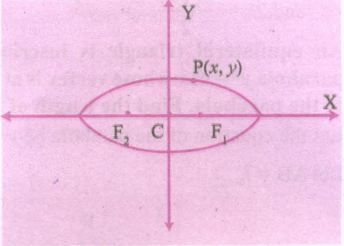
∴ b2 = a2(1- e2)
= \(16\left( { 1-\left( \frac { 3 }{ 4 } \right) }^{ 2 } \right) =16\left( 1-\frac { 9 }{ 10 } \right) =16\left( \frac { 7 }{ 16 } \right) =7\)
∴ The path traced by him is an ellipse and its equation is \(\frac { { x }^{ 2 } }{ { a }^{ 2 } } +\frac { { y }^{ 2 } }{ { b }^{ 2 } } =1\)
⇒ \(\frac { { x }^{ 2 } }{ 16 } -\frac { { y }^{ 2 } }{ 7 } \) = 1
11.
The domain of sin-1x is [-1, 1]
\(\therefore\) f(x) = sin-1(2x - 3) is defined for all x, satisfying
\(-1\le 2x-3\le 1\)
\(\Rightarrow 3-1\le 2x\le 1+3\)
\(\Rightarrow 2\le 2x\le 4\Rightarrow 1\le x\le 2\Rightarrow x\epsilon \left[ 1,2 \right] \)
\(\therefore\) Domain of f(x) = sin-1(2x - 3) is [1, 2].
(ii) The domain of f(x) is [-1, 1] and that of cosx is R
\(\therefore\) Domain of f(x) = sin-1x + cos x is
\(\left[ -1,1 \right] \cap R=\left[ -1,1 \right] \)
12.
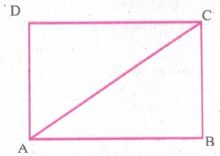
Given \(\overset { \rightarrow }{ AB } =\overset { \rightarrow }{ \alpha } \), \(\overset { \rightarrow }{ AD } =\overset { \rightarrow }{ \beta } \) and \(\overset { \rightarrow }{ AC } =2\overset { \rightarrow }{ \alpha } +3\overset { \rightarrow }{ \beta } \)
Area of the quadrilateral ABCD
∴ = are of ∆ ABC + area of ∆ ACD
\(=\frac { 1 }{ 2 } \left| \overset { \rightarrow }{ AB } \times \overset { \rightarrow }{ AC } \right| +\frac { 1 }{ 2 } \left| \overset { \rightarrow }{ AC } \times \overset { \rightarrow }{ AD } \right| \)
\(=\frac { 1 }{ 2 } \left| \overset { \rightarrow }{ \alpha } \times \left( 2\overset { \rightarrow }{ \alpha } +3\overset { \rightarrow }{ \beta } \right) \right| +\frac { 1 }{ 2 } \left| \left( 2\overset { \rightarrow }{ \alpha } +3\overset { \rightarrow }{ \beta } \right) \times \overset { \rightarrow }{ \beta } \right| \)
\(=\frac { 1 }{ 2 } \left| 2\left( \overset { \rightarrow }{ \alpha } \times \overset { \rightarrow }{ \alpha } \right) +3\left( \overset { \rightarrow }{ \alpha } \times \overset { \rightarrow }{ \beta } \right) \right| +\frac { 1 }{ 2 } \left| 2\left( \overset { \rightarrow }{ \alpha } \times \overset { \rightarrow }{ \beta } \right) +3\left( \overset { \rightarrow }{ \beta } \times \overset { \rightarrow }{ \beta } \right) \right| \)
\(=\frac { 1 }{ 2 } \left| 3\left( \overset { \rightarrow }{ \alpha } \times \overset { \rightarrow }{ \beta } \right) \right| +\frac { 1 }{ 2 } \left| 2\left( \overset { \rightarrow }{ \alpha } \times \overset { \rightarrow }{ \beta } \right) \right| \quad \quad \quad \left[ \because \overset { \rightarrow }{ \alpha } \times \overset { \rightarrow }{ \alpha } =\overset { \rightarrow }{ \beta } \times \overset { \rightarrow }{ \beta } =0 \right] \)
\(=\left( \frac { 3 }{ 2 } +\frac { 2 }{ 2 } \right) \left( \overset { \rightarrow }{ \alpha } \times \overset { \rightarrow }{ \beta } \right) =\left( \frac { 5 }{ 2 } \right) \left| \overset { \rightarrow }{ \alpha } \times \overset { \rightarrow }{ \beta } \right| \quad \quad (1)\)
Now, Area of the parallelogram with \(\overset { \rightarrow }{ AB } \) and \(\overset { \rightarrow }{ AD } \) as
adjacent sides = \(\left| \overset { \rightarrow }{ AB } \times \overset { \rightarrow }{ AD } \right| =\left| \overset { \rightarrow }{ \alpha } \times \overset { \rightarrow }{ \beta } \right| .... (2)\)
From (1) & (2), \(\frac { 5 }{ 2 } \left| \overset { \rightarrow }{ \alpha } \times \overset { \rightarrow }{ \beta } \right| =\lambda \left| \overset { \rightarrow }{ \alpha } \times \overset { \rightarrow }{ \beta } \right| \) [Given]
\(\lambda =\frac { 5 }{ 2 } \)
13.
Augmented matrix [A|B] is \(\left[ \begin{matrix} -2 & 1 & 1 \\ 1 & -2 & 1 \\ 1 & 1 & -2 \end{matrix}|\begin{matrix} a \\ b \\ c \end{matrix} \right] \)
[A|B]\(\overset { { R }_{ 1 }\leftrightarrow { R }_{ 2 } }{ \longrightarrow } \left[ \begin{matrix} 1 & -2 & 1 \\ -2 & 1 & 1 \\ 1 & 1 & -2 \end{matrix}|\begin{matrix} b \\ a \\ c \end{matrix} \right] \)
\(\overset { { R }_{ 2 }\rightarrow { R }_{ 2 }+2{ R }_{ 1 }\\ { R }_{ 3 }\rightarrow { R }_{ 3 }+{ R }_{ 1 } }{ \longrightarrow } \left[ \begin{matrix} 1 & -2 & 1 \\ 0 & -3 & 3 \\ 0 & 3 & -3 \end{matrix}|\begin{matrix} b \\ a+2b \\ c-b \end{matrix} \right] \)
\(\overset { { R }_{ 3 }\rightarrow { R }_{ 3 }+{ R }_{ 2 } }{ \longrightarrow } \left[ \begin{matrix} 1 & -2 & 1 \\ 0 & -3 & 3 \\ 0 & 0 & 0 \end{matrix}|\begin{matrix} b \\ c+2b \\ a+b+c \end{matrix} \right] \)
Here \(\rho\) (A) = 2
The given system is consistent only when \(\rho\)([A|B]) = 2\(\rho\)([A|B]) = 2 only if a + b + c = 0 Hence proved.
14.
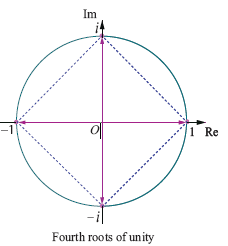
We have to find \(1^{\frac{1}{4}}\). Let z4 = \(1^{\frac{1}{4}}\). Then z4 = 1.
In polar form, the equation z = 1 can be written as
\(z^4=cos\left( 0+2k\pi \right) +isin\left( 0+2k\pi \right) ={ e }^{ i2k\pi }\), k = 0, 1, 2,...
Therefore,\({ \left( z \right) }^{ \frac { 1 }{ 4 } }=cos\left( \frac { 2k\pi }{ 4 } \right) +isin\left( \frac { 2k\pi }{ 4 } \right) ={ e }^{ i\frac { 2k\pi }{ 4 } }\), k=0,1,2,3.
Taking k = 0, 1, 2, 3, we get
k = 0, z = cos 0 + isin 0 = 1
k = 1, \(z=cos\left( \frac { \pi }{ 2 } \right) +isin\left( \frac { \pi }{ 2 } \right) =i\)
k = 2, \(z=cos\pi +isin\pi =-1\)
k = 3, \(z=cos\frac { 3\pi }{ 2 } +isin\frac { 3\pi }{ 2 } =-cos\frac { \pi }{ 2 } -isin\frac { \pi }{ 2 } =-i\)
Fourth roots of unity are 1, i, −1, −i \(\Rightarrow\) 1, \(\omega \), \({ \omega }^{ 2 }\) and \({ \omega }^{ 3 }\), where \(\omega ={ e }^{ i\frac { 2\pi }{ 4 } }=i\)
15.
Now, \(tan^{ -1 }\left( \frac { d }{ 1+{ a }_{ 1 }{ a }_{ 2 } } \right) =tan^{ -1 }\frac { { a }_{ n }-{ a }_{ 1 } }{ 1+{ a }_{ 1 }{ a }_{ n } } =tan^{ -1 }{ a }_{ 2 }-tan^{ -1 }{ a }_{ 1 }\)
Similarly, \(tan^{ -1 }\left( \frac { d }{ 1+{ a }_{ 1 }{ a }_{ 2 } } \right) =tan^{ -1 }\left( \frac { { a }_{ n }-{ a }_{ 1 } }{ 1+{ a }_{ 1 }{ a }_{ n } } \right) =tan^{ -1 }{ a }_{ 3 }-tan^{ -1 }{ a }_{ 2 }\)
Continuing inductively, we get
\(tan^{ -1 }\left( \frac { d }{ 1+{ a }_{ n }{ a }_{ n-1 } } \right) =tan^{ -1 }\left( \frac { { a }_{ n }-{ a }_{ n-1 } }{ 1+{ a }_{ n }{ a }_{ n-1 } } \right) =tan^{ -1 }{ a }_{ n }-tan^{ -1 }{ a }_{ n-1 }\)
Adding vertically, we get
\(tan^{ -1 }\left( \frac { d }{ 1+{ a }_{ 1 }{ a }_{ 2 } } \right) +tan^{ -1 }\left( \frac { d }{ 1+{ a }_{ 2 }{ a }_{ 3 } } \right) +....+tan^{ -1 }\left( \frac { d }{ 1+{ a }_{ n }{ a }_{ n-1 } } \right) tan[tan^{ -1 }{ a }_{ n }-{ tan }^{ -1 }{ a }_{ 1 }]\\ \)
\(tan\left[ tan^{ -1 }\left( \frac { d }{ 1+{ a }_{ 1 }{ a }_{ 2 } } \right) +tan^{ -1 }\left( \frac { d }{ 1+{ a }_{ 2 }{ a }_{ 3 } } \right) +...+tan^{ -1 }\left( \frac { d }{ 1+{ a }_{ n }{ a }_{ n-1 } } \right) \right] =tan\left[ tan^{ -1 }{ a }_{ n }-tan^{ -1 }a_{ 1 } \right] \)\(=\left[ tan^{ -1 }\left( \frac { { a }_{ n }-{ a }_{ 1 } }{ 1+{ a }_{ 1 }{ a }_{ n } } \right) \right] =\frac { { a }_{ n }-{ a }_{ 1 } }{ 1+{ a }_{ 1 }{ a }_{ n } } \)
16.
x = 1
y = x2 -5x + 6
y = 1 -5 + 6 = 2
x = 2
y = 4 -10 + 6 = 0
x = 0
y = 6
x = 3
y = 9 -15 + 6 = 12
x = -1
y = 1 + 5 + 6 = 12
x = 4
y = 16 - 20 + 6 = 2
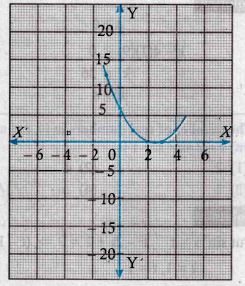
(1, 2), (0, 6), (-1, 12)
P(x) = (x2-5x + 6) (x2-5x+16)
= x4- 5x3+16x2-5x+25x2- 80x + 6x2- 30x + 96 = 0
x4-10x3+ 47x2 -110x + 96 = 0
It has two sign changes
\(\therefore\) it has two positive real roots
P(-x) = x4-10x3+ 47x2 -110x + 96
It has no sign changes, no negative real roots
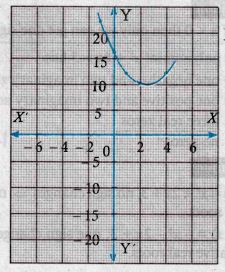
y = x2- 5x + 16
| x | 0 | 1 | -1 | 2 | 4 |
| y | 16 | 12 | 23 | 10 | 12 |
17.
Let the roots be a−d, a, a+d.
Then the sum of the roots is 3a which is equal to 6 from the given equation.
Thus 3a = 6 and hence a = 2.
The product of the roots is a3− ad2 which is equal to −24 from the given equation.
Substituting the value of a, we get 8−2d2 = −24 and hence d = ±4.
If we take d = 4 we get −2, 2, 6 as roots and if we take d = −4, we get 6, 2, −2 as roots (same roots given in reverse order) of the equation.
18.
(c)
tan x tan y = c
19.
(a)
associative
20.
(d)
21.
(c)
2
22.
(b)
Fermat's theorem
23.
(c)
3
24.
(d)
\(\frac { { \pi }^{ 2 } }{ 4 } -2\)
25.
(d)
0
26.
(b)
27.
(c)
\(\frac{1}{x}\)
28.
(d)
2
29.
(a)
2 cos nθ
30.
(b)
\(\frac { \pi }{ 4 } \)
31.
(a)
1
32.
(c)
b2 - 4ac >0
33.
(b)
-80
34.
(b)
1
35.
(b)
x = −1
36.
(b)
\(0 \le x\le \pi\)
37.
(c)
n complex roots
38.
Clearly 1 is the identity element of G
w2 . a-1 = e ⇒ w2 . a-1 = a-1 = w
Since w2 . w = w3 = 1
Inverse of w2 is w.
39.
Let I = \(\int _{ 1 }^{ 2 }{ \frac { 3x }{ { 9x }^{ 2 }-1 } dx } \) ⇒ IA3| = \(\left| I \right| \)
Put t = 9x2 - 1 ⇒ dt = 18x dx
\(\frac{d t}{6}=3 x d x\)
| x | 1 | 2 |
| t | 9 | 35 |
∴ \(\int _{ 8 }^{ 35 }{ \frac { dt }{ 6t } } \)
= \(\frac { 1 }{ 6 } { \left[ log \ t \right] }_{ 8 }^{ 35 }\)
= \(\frac { 1 }{ 6 } [log35-log8]\)
= \(\frac { 1 }{ 6 } \left[ log\left( \frac { 35 }{ 8 } \right) \right] \)
40.
x =\(\sqrt { t } \)
V = \(\frac { dx }{ dt } =\frac { 1 }{ 2 } t^{ -\frac { 1 }{ 2 } }\) ..(1)
Acceleration = \(\frac { { d }^{ 2 }x }{ { dt }^{ 2 } } =\frac { 1 }{ 2 } \left( -\frac { 1 }{ 2 } t^{ -\frac { 3 }{ 2 } } \right) =\frac { -t^{ -\frac { 3 }{ 2 } } }{ 4 } \)
∴ Acceleration is negative
Acceleration = \(-\frac { 1 }{ 4 } \left( { t }^{ -\frac { 1 }{ 2 } } \right) ^{ 3 }\)
= \(-2\left( \frac { 1 }{ 2 } t^{ -\frac { 1 }{ 2 } } \right) ^{ 3 }\) = 2V3 [using (1)]
Hence, acceleration is negative proportional to the cube of the velocity.
41.
Given
\(f(x)=\cfrac { 4-x }{ 6 } \)
\(f(x)=\cfrac { 4-1 }{ 6 } =\cfrac { 3 }{ 6 } =\cfrac { 1 }{ 2 } \)
\(f(2)=\cfrac { 4-2 }{ 6 } =\cfrac { 2 }{ 6 } =\cfrac { 1 }{ 3 } \)
\(f(3)=\cfrac { 4-3 }{ 6 } =\cfrac { 1 }{ 6 } \)
ஃ The probability mass function is
| x | 1 | 2 | 3 |
| f(x) | \(\cfrac { 1 }{ 2 } \) | \(\cfrac { 1 }{ 3 } \) | \(\cfrac { 1 }{ 6 } \) |
Mean \(E(X)=\Sigma xf(x)\)
= \(1\left( \cfrac { 1 }{ 2 } \right) +2\left( \cfrac { 1 }{ 3 } \right) +3\left( \cfrac { 1 }{ 6 } \right) \)
= \(\cfrac { 1 }{ 2 } +\cfrac { 2 }{ 3 } +\cfrac { 3 }{ 6 } =\cfrac { 3+4+6 }{ 6 } \)
= \(\cfrac { 10 }{ 6 } =\cfrac { 5 }{ 3 } =1.67\)
\(E({ x }^{ 2 })=\Sigma { x }^{ 2 }f(x)\)
= \({ 1 }^{ 2 }\left( \cfrac { 1 }{ 2 } \right) +{ 2 }^{ 2 }\left( \cfrac { 1 }{ 3 } \right) +3^{ 2 }\left( \cfrac { 1 }{ 6 } \right) \)
= \(\cfrac { 1 }{ 2 } +\cfrac { 4 }{ 9 } +\cfrac { 9 }{ 6 } =\cfrac { 3+8+9 }{ 6 } \)
= \(\cfrac { 20 }{ 6 } =\cfrac { 10 }{ 3 } =3.33\)
var(X) E(X2) - [E(X)]2
= \(\cfrac { 10 }{ 3 } -\left( \cfrac { 5 }{ 3 } \right) ^{ 2 }=\cfrac { 10 }{ 3 } -\cfrac { 25 }{ 9 } \)
= \(\cfrac { 30-25 }{ 9 } =\cfrac { 5 }{ 9 } =0.54\)
42.
x = 3 and dx = 0.02
When x = 3 and dx = 0.02,
df = (6 + 3) (0.02)
= 9(0.02) = 0.18
43.
Given that x2 + y2 = r2, r∈R ...(1)
The given equation contains exactly one arbitrary constant.
So, we have to differentiate the given equation once. Differentiate (1) with respect to x, we get
2x +2y\(\frac{dy}{dx}\) = 0 which implies \(\frac{dy}{dx}\) = \(-\frac{x}{y}\)
Thus, x2 + y2 = r2 satisfies the differential equation \(\frac { dy }{ dx } \) = -\(\frac { x }{ y } \).
Hence, x2 + y2 = r2 is a solution of the differential equation \(\frac { dy }{ dx } \) = -\(\frac { x }{ y } \).
44.
Let P(x, y) be the movable point.
By focal property of ellipse, PA + PB = 2a
∴ 2a = 10 ⇒ a = 5
Since focus is (4, 0), ae = 4 ⇒ 5e = 4 ⇒ e = \(\frac45\)
Also b2 = a2(1 - e2) = 25\(\left( 1-\frac { 16 }{ 25 } \right) =25\left( \frac { 9 }{ 25 } \right) \) = 9
Equation of ellipse is \(\frac { { x }^{ 2 } }{ { a }^{ 2 } } +\frac { { y }^{ 2 } }{ { b }^{ 2 } } =1\)
\(\frac { { x }^{ 2 } }{ 25 } +\frac { { y }^{ 2 } }{ 9 } =1\)
45.
Let ∝, β are the roots of the equation
Sum of the roots \(\alpha +\beta =\frac { -b }{ a } \)
\(=\frac { [-(a-2)] }{ 1 } =a-2\)
Product of the roots \(=\alpha \beta =\frac { c }{ a } \)
\(=\frac { -(a+1) }{ 1 } =-(a+1)\)
we have \({ \alpha }^{ 2 }{ \beta }^{ 2 }=({ \alpha +\beta ) }^{ 2 }-2\alpha \beta \)
\(={ (a-2) }^{ 2 }+2(a+1)\)
\(={ a }^{ 2 }-4a+4+2a+2\)
\(=(a-1{ ) }^{ 2 }+5\)
Thus \(\\ { \alpha }^{ 2 }+{ \beta }^{ 2 }\) is least if a = 1
46.
Agumented matrix
[A|B] \(\left[ \begin{matrix} 2 & 5 \\ 6 & 15 \end{matrix}|\begin{matrix} 7 \\ 13 \end{matrix} \right] \overset { { R }_{ 2 }\rightarrow { R }_{ 2 }-3{ R }_{ 1 } }{ \longrightarrow } \left[ \begin{matrix} 2 & 5 \\ 0 & 0 \end{matrix}|\begin{matrix} 7 \\ -8 \end{matrix} \right] \)
Here \(\rho\) (A) = 2 and \(\rho\)([A|B]) = 3
∴ \(\rho\) (a) ≠ \(\rho\) ([AIB])
Hence the system is inconsistent.
47.
Let \(\vec { a } =-6\hat { i } +14\hat { j } +10\hat { k } \), \(\vec { b } =14\hat { i } -10\hat { j } -6\hat { k } \) and \(\vec { c } =2\hat { i } +4\hat { j } -2\hat { k } \)
Volume of the parallelepiped having \(\vec { a } ,\vec { b } \) and \(\vec { c } \) as its co-terminus edges is \(\vec { a } .(\vec { b } \times \vec { c } )\).
∴ \(\vec { a } .(\vec { b } \times \vec { c } )=\left| \begin{matrix} -6 & 14 & 10 \\ 14 & -10 & -6 \\ 2 & 4 & -2 \end{matrix} \right| \)
= \(-6\left| \begin{matrix} -10 & -6 \\ 4 & -2 \end{matrix} \right| -14\left| \begin{matrix} 14 & -6 \\ 2 & -2 \end{matrix} \right| +10\left| \begin{matrix} 14 & -10 \\ 2 & 4 \end{matrix} \right| \)
= -6(20 + 24) - 14(-28 + 12) + 10(56 + 20)
= -6(44) -14(-16) + 10(76)
= -264 + 224 + 760 = 720.
∴ Volume of the required parallelepiped = 720 cubic units.
48.
(a) Let a, b \(\in \) 2.
The a * b = a + b + z = b + a + z = b * a
(z, *) has commutative property.
(b) Let a, b, c \(\in \) G
(a * b) * c = (a+b+2) * c = a + b + 2 + c + 2
= a + b + c + 4
∴ z is associate under *.
49.
u = x; v = e-2x
u' = 1; \({ v }_{ 1 }=\frac { { e }^{ -2x } }{ -2 } \)
\({ v }_{ 2 }=\frac { { e }^{ -2x } }{ 4 } \)
Bernoulli's formula
\(\int { uv\ dx={ uv }^{ (1) }-{ uv }^{ (2) } } \)
\(\therefore \int _{ 0 }^{ 1 }{ { xe }^{ -2x } } dx={ \left[ x\left( \frac { { e }^{ -2x } }{ -2 } \right) -1\left( \frac { { e }^{ -2x } }{ 4 } \right) \right] }_{ 0 }^{ 1 }\)
= \(-{ \left[ \frac { x }{ 2 } { e }^{ -2x }+\frac { { e }^{ -2x } }{ 4 } \right] }_{ 0 }^{ 1 }\)
= \({ -e }^{ -2x }{ \left[ \frac { x }{ 2 } +\frac { 1 }{ 4 } \right] }_{ 0 }^{ 1 }\)
= \({ -e }^{ -2 }\left( \frac { 1 }{ 2 } +\frac { 1 }{ 4 } \right) +{ e }^{ 0 }\left( 0+\frac { 1 }{ 4 } \right) \)
= \(-{ e }^{ -2 }\left( \frac { 3 }{ 4 } \right) +\frac { 1 }{ 4 } =\frac { 1 }{ 4 } (1-{ 3e }^{ -2 })\)
50.
By the mean value theorem we have, there exists 'c'∈(2, 7) such that,
\(\frac { f(7)-f(2) }{ 7-2 } \) = f'(c) ≤ 29
Hence, f(7) ≤ 5× 29 +17 = 162
Therefore, the maximum value of f (7) is 162.
51.
LHS = \({ tan }^{ -1 }\sqrt { x } =\frac { 1 }{ 2 } .2{ tan }^{ -1 }\left( \sqrt { x } \right) \)
= \(\frac { 1 }{ 2 } .\left( 2{ tan }^{ -1 }\left( \sqrt { x } \right) \right) =\frac { 1 }{ 2 } { cos }^{ -1 }\left( \cfrac { 1-\left( \sqrt { x } \right) ^{ 2 } }{ 1+\left( \sqrt { x } \right) ^{ 2 } } \right) \)
\(\left[ \because {2 tan }^{ -1 }x={ cos }^{ -1 }\left( \frac { 1-{ x }^{ 2 } }{ 1+{ x }^{ 2 } } \right) \right] \)
= \(\frac { 1 }{ 2 } { cos }^{ -1 }\left( \frac { 1-x }{ 1+x } \right) \)
= RHS
Hence proved .
52.
Let \(\overset { \rightarrow }{ r } =x\overset { \wedge }{ i } +y\overset { \wedge }{ j } +z\overset { \wedge }{ k } \)
\(\therefore x\overset { \wedge }{ i } +y\overset { \wedge }{ j } +z\overset { \wedge }{ k } =\left( s-2t \right) \overset { \wedge }{ i } +\left( 3-t \right) \overset { \wedge }{ j } +\left( 2s+t \right) \overset { \wedge }{ k } \)
Equating the co-efficients of like components both sides,
We get, x = s - 2t
y = 3 - t
z = 2s + t
Eliminating x and t using determinates we get
\(\left| \begin{matrix} x \\ y-3 \\ z \end{matrix}\begin{matrix} 1 \\ 0 \\ 2 \end{matrix}\begin{matrix} -2 \\ -1 \\ 1 \end{matrix} \right| =0\)
⇒ x (0+2) -1(y - 3 + z) -2 (2y - 6 - 0) = 0
⇒ 2x - y + 3 - z- 4y + 12 = 0
⇒ 2x - 5y - z + 15 = 0
53.
AB =\(\left[ \begin{matrix} 2 & 1 \\ 5 & 3 \end{matrix} \right] \left[ \begin{matrix} 4 & 5 \\ 3 & 4 \end{matrix} \right] =\left[ \begin{matrix} 8+3 & 10+4 \\ 20+9 & 25+12 \end{matrix} \right] \)
=\(\left[ \begin{matrix} 11 & 14 \\ 29 & 37 \end{matrix} \right]\)
|AB| =\(\left[ \begin{matrix} 11 & 14 \\ 29 & 37 \end{matrix} \right]\)
= 407 - 406 = 1 ≠ 0
(AB)-1 = \(\frac { 1 }{ |AB| } \) adj(AB)
= \(\frac { 1 }{ 1 } \left[ \begin{matrix} 11 & 14 \\ 29 & 37 \end{matrix} \right] \)
= \(\left[ \begin{matrix} 37 & -14 \\ -29 & 11 \end{matrix} \right] \) ....(1)
|A| =\(\left[ \begin{matrix} 2 & 1 \\ 5 & 3 \end{matrix} \right] \) = 6 - 5 =1
|B| =\(\left[ \begin{matrix} 4 & 5 \\ 3 & 4 \end{matrix} \right] \) = 16 - 15 = 1
B-1 = \(\frac { 1 }{ |B| } adjB=\left[ \begin{matrix} 4 & -5 \\ -3 & 4 \end{matrix} \right] \)
A-1 = \(\frac { 1 }{ |A| } adjA=\left[ \begin{matrix} 3 & -1 \\ -5 & 2 \end{matrix} \right] \)
∴ B-1A-1 =\(\left[ \begin{matrix} 4 & -5 \\ -3 & 4 \end{matrix} \right] \left[ \begin{matrix} 3 & -1 \\ -5 & 2 \end{matrix} \right] \)
=\(\\ \left[ \begin{matrix} 12+25 & -4-10 \\ -9-20 & 3+8 \end{matrix} \right] \)
=\(\left[ \begin{matrix} 37 & -14 \\ -29 & 11 \end{matrix} \right] \)....(2)
From (1) and (2), (AB)-1 = B-1A-1
54.
The given equation can be written as
\({ 2 }^{ z }\left( 1+\frac { 1 }{ 2 } +\frac { 1 }{ 4 } \right) ={ 7 }^{ x }\left( 1+\frac { 1 }{ 7 } +\frac { 1 }{ 49 } \right) \)
\(\Rightarrow { 2 }^{ x }\left( \frac { 8+4+2 }{ 8 } \right) ={ 7 }^{ x }\left( \frac { 49+7+1 }{ 49 } \right) \)
\(\Rightarrow { 2 }^{ x }\left( \frac { 7 }{ 4 } \right) ={ 7 }^{ x }\left( \frac { 57 }{ 49 } \right) \Rightarrow \frac { 7 }{ 4 } \times \frac { 49 }{ 57 } =\frac { { 7 }^{ x } }{ { 2 }^{ x } } \)
\(\Rightarrow \frac { 7 }{ 4 } \times \frac { 49 }{ 57 } ={ \left( \frac { 7 }{ 4 } \right) }^{ x }\Rightarrow \frac { { 7 }^{ 3 } }{ 4\times 57 } ={ \left( \frac { 7 }{ 4 } \right) }^{ x }\)
\(\Rightarrow xlog\left( \frac { 7 }{ 4 } \right) =3log\ 7-log4-log57\)
\(\Rightarrow x=\frac { 3log7-log4-log57 }{ log\left( \frac { 7 }{ 2 } \right) } \)

12th Standard Syllabus & Materials
12th Standard
TN 12th Computer Applications களப்பெயர் முறைமை (DNS) Sample Question Papers Study Material - QB365 Set A
NEW12th Standard
TN 12th Computer Applications வலையமைப்பு எடுத்துக்காட்டுகள் மற்றும் நெறிமுறைகள் Sample Question Papers Study Material - QB365 Set A
NEW12th Standard
TN 12th Computer Applications கணினி வலையமைப்பு ஓர் அறிமுகம் Sample Question Papers Study Material - QB365 Set A
NEW12th Standard
TN 12th Computer Applications PHP-உடன் MySQL-ஐ இணைத்தல் Sample Question Papers Study Material - QB365 Set A



Tamilnadu Stateboard 12th Standard Subjects
Maths

Chemistry

Physics

Biology

Computer Science

Business Maths and Statistics

Economics

Commerce

Accountancy

History

Computer Applications
Biology
Computer Technology
Computer Applications
Computer Science
Business Maths and Statistics
Commerce
Economics
Maths
Chemistry
Physics
Computer Technology
History
Accountancy

Tamil

English

French
Tamilnadu Stateboard Standards

