
 100% FREE ACCESS
12th Standard Syllabus & Materials
12th Standard
TN 12th Maths Applications of Matrices and Determinants Sample Question Papers Study Material - QB365 Set A
NEW12th Standard
TN 12th Computer Applications மின்னணு தரவு பரிமாற்றம் Sample Question Papers Study Material - QB365 Set A
NEW12th Standard
TN 12th Computer Applications மின் - வணிக பாதுகாப்பு அமைப்புகள் Sample Question Papers Study Material - QB365 Set A
NEW12th Standard
TN 12th Computer Applications மின்னணு செலுத்தல் முறைகள் Sample Question Papers Study Material - QB365 Set A
NEW12th Standard
TN 12th Computer Applications மின் - வணிகம் Sample Question Papers Study Material - QB365 Set A
NEW12th Standard
TN 12th Computer Applications திறந்த மூல கருத்துருக்கள் Sample Question Papers Study Material - QB365 Set A

Published on: 13/09/2019
Download Tamil Nadu 12th Standard Maths question papers, model tests, one-mark questions, important questions, and public exam papers in PDF format. Free study materials and answer keys for TN State Board students.
Questions + Answers key
Take MCQ Maths Test1.
If \(\left| \overset { \rightarrow }{ A } \right| =\overset { \wedge }{ i } +\overset { \wedge }{ j } +\overset { \wedge }{ k } \) and \(\overset { \wedge }{ i } =\overset { \wedge }{ j } -\overset { \wedge }{ k } \) are two given vector, then find a vector B satisfying the equations \(\overset { \rightarrow }{ A } \times \overset { \rightarrow }{ B } \)= \(\overset { \rightarrow }{ C } \) and \(\overset { \rightarrow }{ A } \).\(\overset { \rightarrow }{ B } \) = 3
2.
Show that \(\left( \frac { i+\sqrt { 3 } }{ -i+\sqrt { 3 } } \right) ^{ 2\omega }+\left( \frac { i-\sqrt { 3 } }{ i+\sqrt { 3 } } \right) ^{ 2\omega }\) = -1
3.
If \({ tan }^{ -1 }\left( \frac { \sqrt { 1+{ x }^{ 2 } } -\sqrt { 1-{ x }^{ 2 } } }{ \sqrt { 1+{ x }^{ 2 } } +\sqrt { 1-{ x }^{ 2 } } } \right) =a\) than prove that x2 = sin 2a
4.
Solve: \({ tan }^{ -1 }\left( \cfrac { x-1 }{ x-2 } \right) +{ tan }^{ -1 }\left( \cfrac { x+1 }{ x+2 } \right) =\cfrac { \pi }{ 4 } \)
5.
Show that the lines \(\vec { r } =(6\hat { i } +\hat { j } +2\hat { k } )+s(\hat { i } +2\hat { j } -3\hat { k } )\) and \(\vec { r } =(3\hat { i } +2\hat { j } -2\hat { k } )+t(2\hat { i } +4\hat { j } -5\hat { k } )\) are skew lines and hence find the shortest distance between them.
6.
Find the value of k for which the equations
kx - 2y + z = 1, x - 2ky + z = -2, x - 2y + kz = 1 have
(i) no solution
(ii) unique solution
(iii) infinitely many solution
7.
(a) If A = \(\left[ \begin{matrix} -5 & 1 & 3 \\ 7 & 1 & -5 \\ 1 & -1 & 1 \end{matrix} \right] \) and B = \(\left[ \begin{matrix} 1 & 1 & 2 \\ 3 & 2 & 1 \\ 2 & 1 & 3 \end{matrix} \right] \), find the products AB and BA and hence solve the system of equations x + y + 2z = 1, 3x + 2y + z = 7, 2x + y + 3z = 2.
8.
If 2+i and 3-\(\sqrt{2}\) are roots of the equation x6-13x5+ 62x4-126x3+ 65x2+127x-140 = 0, find all roots.
9.
If A = \(\left[ \begin{matrix} 8 & -6 & 2 \\ -6 & 7 & -4 \\ 2 & -4 & 3 \end{matrix} \right] \), verify that A(adj A) = (adj A)A = |A| I3.
10.
Find the value of the complex number (i25)3.
11.
If \({ cot }^{ -1 }\left( \frac { 1 }{ 7 } \right) =\theta \) find the value of cos \(\theta \)
12.
Find the parametric form of vector equation of a line passing through a point (2, -1, 3) and parallel to line \({ \overset { \rightarrow }{ r } }=\left( \overset { \wedge }{ i } +\overset { \wedge }{ j } \right) +t\left( 2\overset { \wedge }{ i } +\overset { \wedge }{ j } -2\overset { \wedge }{ k } \right) \)
13.
Identify the type of conic section for each of the equations.
3x2+3y2−4x+3y+10 = 0
14.
If A is symmetric, prove that then adj A is also symmetric.
15.
Find the condition for the line lx + my + n = 0 is tangent to the circle x2 + y2 = a2
16.
Prove by vector method, that in a right angled triangle the square of the hypotenuse is equal to the sum of the square of the other two sides.
17.
Solve 2x - 3y = 7, 4x - 6y = 14 by Gaussian Jordan method.
18.
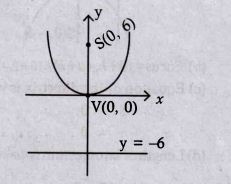
Find the vertex, focus, equation of directrix and length of the latus rectum of the following:
x2 = 24y
19.
Which one of the points i, −2 + i, and 3 is farthest from the origin?
20.
If cot-1\(\frac{1}{7}=\theta\), find the value of cos \(\theta\).
21.
Verify (AB)-1 = B-1A-1 with A = \(\left[ \begin{matrix} 0 & -3 \\ 1 & 4 \end{matrix} \right] \), B = \(\left[ \begin{matrix} -2 & -3 \\ 0 & -1 \end{matrix} \right] \).
22.
23.
If z = \(\frac { 1 }{ (2+3i)^{ 2 } } \) then |z| = ____________
\(\frac { 1 }{ 13 } \)
\(\frac { 1 }{ 5} \)
\(\frac { 1 }{ 12 } \)
none of these
24.
If \(\left| \overset { \rightarrow }{ a } \times \overset { \rightarrow }{ b } \right| =\overset { \rightarrow }{ a } .\overset { \rightarrow }{ b } \), then the angle between the vector \(\overset { \rightarrow }{ a } \) and \(\overset { \rightarrow }{ b } \) is _____________
\(\frac { \pi }{ 4 } \)
\(\frac { \pi }{ 3 } \)
\(\frac { \pi }{ 6 } \)
\(\frac { \pi }{ 2 } \)
25.
If \(\overset { \rightarrow }{ d } =\overset { \rightarrow }{ a } \times \left( \overset { \rightarrow }{ b } \times \overset { \rightarrow }{ c } \right) +\overset { \rightarrow }{ b } \times \left( \overset { \rightarrow }{ c } \times \overset { \rightarrow }{ a } \right) +\overset { \rightarrow }{ c } \times \left( \overset { \rightarrow }{ a } +\overset { \rightarrow }{ b } \right) \), then __________
\(\left| \overset { \rightarrow }{ d } \right| \)
\(\overset { \rightarrow }{ d } =\overset { \rightarrow }{ a } +\overset { \rightarrow }{ b } +\overset { \rightarrow }{ c } \)
\(\overset { \rightarrow }{ d } =\overset { \rightarrow }{ 0 } \)
a, b, c are coplanar
26.
If e1, e2 are eccentricities of the ellipse \(\frac { { x }^{ 2 } }{ { a }^{ 2 } } +\frac { { y }^{ 2 } }{ { b }^{ 2 } } \) = 1 and the hyperbola \(\frac { { x }^{ 2 } }{ { a }^{ 2 } } +\frac { { y }^{ 2 } }{ { b }^{ 2 } } \) = 1 then
\({ e }_{ 1 }^{ 2 }\) - \({ e }_{ 2 }^{ 2 }\) = 1
\({ e }_{ 1 }^{ 2 }\) + \({ e }_{ 2 }^{ 2 }\) = 1
\({ e }_{ 1 }^{ 2 }\) - \({ e }_{ 2 }^{ 2 }\) = 2
\({ e }_{ 1 }^{ 2 }\) - \({ e }_{ 2 }^{ 2 }\) = 2
27.
The angle between the tangents drawn from (1, 4) to the parabola y2 = 4x is __________
\(\frac { \pi }{ 2 } \)
\(\frac { \pi }{ 3 } \)
\(\frac { \pi }{ 5 } \)
\(\frac { \pi }{ 5 } \)
28.
When the eccentricity of a ellipse becomes zero, then it becomes a __________
straight line
circle
point
parabola
29.
The value of \({ sin }^{ -1 }\left( cos\frac { 33\pi }{ 5 } \right) \) is________
\(\frac { 3\pi }{ 5 } \)
\(\frac { -\pi }{ 10 } \)
\(\frac { \pi }{ 10 } \)
\(\frac { 7\pi }{ 5 } \)
30.
31.
If \(\rho\) (A) = \(\rho\) ([A/B]) = number of unknowns, then the system is _________--
consistent and has infinitely many solutions
consistent
inconsistent
consistent and has unique solution
32.
If AT is the transpose of a square matrix A, then ___________
|A| ≠ |AT|
|A| = |AT|
|A| + |AT| =0
|A| = |AT| only
33.
34.
If A = \(\left[ \begin{matrix} 1 & \tan { \frac { \theta }{ 2 } } \\ -\tan { \frac { \theta }{ 2 } } & 1 \end{matrix} \right] \) and AB = I2, then B =
\(\left( \cos ^{ 2 }{ \frac { \theta }{ 2 } } \right) A\)
\(\left( \cos ^{ 2 }{ \frac { \theta }{ 2 } } \right) { A }^{ T }\)
\(\left( \cos ^{ 2 }{ \theta } \right) I\)
(Sin2\(\frac { \theta }{ 2 } \))A
35.
36.
If \(\vec { a } \) and \(\vec { b } \) are unit vectors such that \([\vec { a } ,\vec { b },\vec { a } \times \vec { b } ]=\frac { 1}{ 4 } \), then the angle between \(\vec { a } \) and \(\vec { b } \) is
\(\frac { \pi }{ 6 } \)
\(\frac { \pi }{ 4 } \)
\(\frac { \pi }{ 3 } \)
\(\frac { \pi }{ 2 } \)
37.
If the coordinates at one end of a diameter of the circle x2 + y2 − 8x − 4y + c = 0 are (11, 2), the coordinates of the other end are
(-5, 2)
(-3, 2)
(5, -2)
(-2, 5)
38.
sin-1(2cos2x-1)+cos-1(1-2sin2x)=
\(\frac{\pi}{2}\)
\(\frac{\pi}{3}\)
\(\frac{\pi}{4}\)
\(\frac{\pi}{6}\)
39.
If sin-1 x+sin-1 y+sin-1 \(z = \frac{3\pi}{2}\), the value of x2017+y2018+z2019\(-\frac { 9 }{ { x }^{ 101 }+{ y }^{ 101 }+{ z }^{ 101 } } \)is
0
1
2
3
40.
If f and g are polynomials of degrees m and n respectively, and if h(x) = (f o g)(x), then the degree of h is
mn
m+n
mn
nm
1.
Let \(\overset { \rightarrow }{ B } =x\overset { \wedge }{ i } +y\overset { \wedge }{ j } +z\overset { \wedge }{ k } \)
Given \(\overset { \rightarrow }{ A } \times \overset { \rightarrow }{ B } =\overset { \rightarrow }{ C } \Rightarrow \left| \begin{matrix} \overset { \wedge }{ i } \\ 1 \\ x \end{matrix}\begin{matrix} \overset { \wedge }{ j } \\ 1 \\ y \end{matrix}\begin{matrix} \overset { \wedge }{ k } \\ 1 \\ z \end{matrix} \right| =\overset { \wedge }{ j } -\overset { \wedge }{ k } \)
\(\Rightarrow \overset { \wedge }{ i } (z-y)-\overset { \wedge }{ j } (z-x)+\overset { \wedge }{ k } (y-x)\quad \overset { \wedge }{ j } -\overset { \wedge }{ k } \)
Equating the like components on both sides, we get
z - y = 0 .....(1)
x - y = 1 .....(2)
y - x = -1 .....(3)
Also, \(\overset { \rightarrow }{ A } .\overset { \rightarrow }{ B } =3\Rightarrow \left( \overset { \wedge }{ i } +\overset { \wedge }{ j } +\overset { \wedge }{ k } \right) .\left( x\overset { \wedge }{ i } +y\overset { \wedge }{ j } +z\overset { \wedge }{ k } \right) =3\)
⇒ x + y + z = 3 ....(4)
Solving (1), (2), (3) and (4), we get \(x=\frac { 5 }{ 3 } ,y=\frac { 2 }{ 3 } \)and \(z=\frac { 2 }{ 3 } \)
\(\therefore \overset { \rightarrow }{ B } =\frac { 5 }{ 3 } \overset { \wedge }{ i } +\frac { 2 }{ 3 } \overset { \wedge }{ j } +\frac { 2 }{ 3 } \overset { \wedge }{ k } \)
2.
LHS = \(\left( \frac { i+\sqrt { 3 } }{ -i+\sqrt { 3 } } \right) ^{ 2\omega }+\left( \frac { i-\sqrt { 3 } }{ i+\sqrt { 3 } } \right) ^{ 2\omega }\)
= \(\left( \frac { \sqrt { 3 } +i }{ \sqrt { 3 } -i } \times \frac { \sqrt { 3 } +i }{ \sqrt { 3 } +i } \right) ^{ 2\omega }+\left( \frac { -\sqrt { 3 } +i }{ \sqrt { 3 } +i } \times \frac { \sqrt { 3 } -i }{ \sqrt { 3 } -1 } \right) ^{ 2\omega }\)
= \(\left( \frac { 3-1+2\sqrt { 3 } i }{ 3+1 } \right) ^{ 2\omega }+\left( \frac { -3+1+2\sqrt { 3 } i }{ 3+1 } \right) ^{ 2\omega }\)
= \(\left( \frac { 2+2\sqrt { 3 } i }{ 4 } \right) ^{ 2\omega }+\left( \frac { -2+2\sqrt { 3 } i }{ 4 } \right) ^{ 2\omega }\)
= \(\left( \frac { 1+\sqrt { 3 } i }{ 2 } \right) ^{ 2\omega }+\left( \frac { -2+2\sqrt { 3 } i }{ 2 } \right) ^{ 2\omega }\)
=\(\left[ -\left( \frac { -1-\sqrt { 3 } i }{ 2 } \right) \right] ^{ 2\omega }+\left[ \frac { -1+\sqrt { 3 } i }{ 2 } \right] ^{ 2\omega }\)
= (-ω2)2ω+(ω)2ω
[∴ ω = \(\frac { -1+i\sqrt { 3 } }{ 2 } \), ω2 = \(\frac { -1-i\sqrt { 3 } }{ 2 } \)]
= ω4ω+ω2ω
= (ω3)133. ω1 + (ω3)66.ω2
= 1.ω+1.ω2 [∴ 1+ω+ω2 = 0 & ω3 = 1]
= ω + ω2
= -1 = RHS
3.
Given \({ tan }^{ -1 }\left( \frac { \sqrt { 1+{ x }^{ 2 } } -\sqrt { 1-{ x }^{ 2 } } }{ \sqrt { 1+{ x }^{ 2 } } +\sqrt { 1-{ x }^{ 2 } } } \right) =a\)
\(\Rightarrow \frac { \left( \sqrt { 1+{ x }^{ 2 } } -\sqrt { 1-{ x }^{ 2 } } \right) \left( \sqrt { 1+{ x }^{ 2 } } +\sqrt { 1-{ x }^{ 2 } } \right) }{ \left( \sqrt { 1+{ x }^{ 3 } } -\sqrt { 1-{ x }^{ 2 } } \right) \left( \sqrt { 1+{ x }^{ 2 } } +\sqrt { 1-{ x }^{ 2 } } \right) } \)
= \(\frac { tan\alpha +1 }{ tan\alpha -1 } \)
\(\Rightarrow \frac { 2\sqrt { 1+{ x }^{ 2 } } }{ -2\sqrt { 1-{ x }^{ 2 } } } =\frac { tan\alpha +1 }{ tan\alpha -1 } \)
\(\Rightarrow \sqrt { \frac { 1-{ x }^{ 2 } }{ 1+{ x }^{ 2 } } } =\frac { 1-tan\alpha }{ 1+tan\alpha } \)
\(\Rightarrow \sqrt { \frac { 1-{ x }^{ 2 } }{ 1+{ x }^{ 2 } } } =\frac { cos\alpha -sin\alpha }{ cos\alpha +sin\alpha } \)
\(\Rightarrow \frac { 1-{ x }^{ 2 } }{ 1+{ x }^{ 2 } } \left( \frac { cos\alpha -sin\alpha }{ cos\alpha +sin\alpha } \right) ^{ 2 }\)
\(\Rightarrow \frac { 1-{ x }^{ 2 } }{ 1+{ x }^{ 2 } } =\frac { 1-sin2\alpha }{ 1+sin2\alpha } \Rightarrow { x }^{ 2 }=sin2\alpha \)
4.
\({ tan }^{ -1 }\left( { \frac { x-1 }{ x-2 } } \right) +{ tan }^{ -1 }\left( \frac { x+1 }{ x+2 } \right) =\frac { \pi }{ 4 }\)
\(\Rightarrow { tan }^{ -1 }\left( \cfrac { \frac { x-1 }{ x-2 } +\frac { x+1 }{ x+2 } }{ 1-\left( \frac { x-1 }{ x-2 } \right) \left( \frac { x+1 }{ x+2 } \right) } \right) =\frac { \pi }{ 4 }\)
\(\begin{aligned}
& \Rightarrow\left(\frac{\frac{(x-1)(x+2)+(x+1)(x-2)}{(x-2)(x+2)-(x-1)(x+1)}}{\frac{(x-2)(x+2)}{(x+2)}}\right)=\tan \frac{\pi}{4}=1 \\
& \Rightarrow \quad \frac{x^2+x-2+x^2-x-2}{\left(x^2-4\right)-\left(x^2-1\right)}=1
\end{aligned}\)
\(\Rightarrow \frac { 2{ x }^{ 2 }-4 }{ { x }^{ 2 }-4-{ x }^{ 2 }+1 } =1\)
\(\Rightarrow\) 2x2- 4 = -3
\(\Rightarrow\) 2x2- 4 = -3
\(\Rightarrow\) 2x2 = -3 + 4 = 1
\(\Rightarrow\) \({ x }^{ 2 }=\frac { 1 }{ 2 }\)
\(\Rightarrow\) \(x=\frac { 1 }{ \sqrt { 2 } }\)
5.
Given lines are
\(\vec { r } =(6\hat { i } +\hat { j } +2\hat { k } )+s(\hat { i } +2\hat { j } -3\hat { k } )\)
\(\vec { a } =6\hat { i } +\hat { j } +2\hat { k } ,\vec { b } =\hat { i } +2\hat { j } -3\hat { k } \)
and \(\vec { r } =(3\hat { i } +2\hat { j } -2\hat { k } )+t(2\hat { i } +4\hat { j } -5\hat { k } )\)
\(\vec { c } =3\hat { i } +2\hat { j } -2\hat { k } \quad and\quad \vec d = 2\hat { i } +4\hat { j } -5\hat { k } \)
Since \(\vec { b } \neq \vec { d } \), they are not parallel and they do not intersect.
Hence the given lines are skew lines.
Shortest distance between the two skew lines
\(\delta =\frac { |(\vec { c } -\vec { a } ).(\vec { b } \times \vec { d } )| }{ |(\vec { b } \times \vec { d } )| } \)
\(\vec { b } \times \vec { d } =\left| \begin{matrix} \hat { i } & \hat { j } & \hat { k } \\ 1 & 2 & -3 \\ 2 & 4 & -5 \end{matrix} \right| \)
\(=\hat { i } (-10+12)-\hat { j } (-5+6)+\hat { k } (4-4)\)
\(=2\hat { i } -\hat { j } \Rightarrow |\vec { b } \times \vec { d } |\quad \sqrt { { 2 }^{ 2 }++(-1)^{ 2 } } =\sqrt { 5 } \)
\(\vec { c } =\vec { a } =(3\hat { i } +2\hat { j } -2\hat { k } )-(6\hat { i } +\hat { j } +2\hat { k } )\)
\(=-3\hat { i } +\hat { j } -4\hat { k } \)
\(\therefore (\vec { c } -\vec { a } ).(\vec { b } \times \vec { d } )=(-3\hat { i } +\hat { j } -4\hat { k } ).(2\hat { i } -\hat { j } )\)
= -6-1 = -7
\(\therefore \delta =\frac { |-7| }{ \sqrt { 5 } } =\frac { 7 }{ \sqrt { 5 } } units\)
6.
kx-2y+z = 1, -2ky+z = -2, x-2y+k = 1
The matrix form of the system is AX = B where
\(\left[ \begin{matrix} k & -2 & 1 \\ 1 & -2k & 1 \\ 1 & -2 & k \end{matrix} \right] ,X=\left[ \begin{matrix} x \\ y \\ z \end{matrix} \right] ,B=\left[ \begin{matrix} 1 \\ -2 \\ 1 \end{matrix} \right] \)
Applying elementary row operation on the augment matrix [A|B] we get
[A|B] =\(\left[ \begin{matrix} k & -2 & 1 \\ 1 & -2k & 1 \\ 1 & -2 & k \end{matrix}|\begin{matrix} 1 \\ -2 \\ 1 \end{matrix} \right] \overset { { R }_{ 1 }\leftrightarrow { R }_{ 3 } }{ \longrightarrow } \left[ \begin{matrix} 1 & -2 & k \\ 1 & -2k & 1 \\ k & -2 & k \end{matrix}|\begin{matrix} 1 \\ -2 \\ 1 \end{matrix} \right] \)
\(\overset { { R }_{ 2 }\rightarrow { R }_{ 2 }+{ R }_{ 1 }\\ { R }_{ 3 }\rightarrow { R }_{ 3 }-k{ R }_{ 1 } }{ \longrightarrow } \left[ \begin{matrix} 1 & -2 & k \\ 1 & -2k+2 & k \\ 0 & -2+2k & 1-k^{ 2 } \end{matrix}|\begin{matrix} 1 \\ - \\ 1-k \end{matrix} \right] \)
\(\overset { { R }_{ 3 }\rightarrow { R }_{ 3 }+{ R }_{ 2 } }{ \longrightarrow } \left[ \begin{matrix} 1 & -2 & k \\ 0 & -2k+2 & k \\ 0 & 0 & 1-k^{ 2 } \end{matrix}|\begin{matrix} 1 \\ -3 \\ 1-k \end{matrix} \right] \)
\(\rightarrow \left[ \begin{matrix} 1 & -2 & k \\ 0 & -2k+2 & 1-k \\ 0 & 0 & { k }^{ 2 }-k+2 \end{matrix}\begin{matrix} 1 \\ -3 \\ -k-2 \end{matrix} \right] \)
\(\rightarrow \left[ \begin{matrix} 1 & -2 & k \\ 0 & -2k+2 & 1-k \\ 0 & 0 & (k+2)(1-k) \end{matrix}|\begin{matrix} 1 \\ -3 \\ -k-2 \end{matrix} \right] \).........(1)
Case (i): when k = 1
\([A|B]\rightarrow \left[ \begin{matrix} 1 & -2 & 1 \\ 0 & 0 & 0 \\ 0 & 0 & 0 \end{matrix}\begin{matrix} 1 \\ -3 \\ -3 \end{matrix} \right] \overset { { R }_{ 3 }\rightarrow { R }_{ 3 }-{ R }_{ 2 } }{ \longrightarrow } \left[ \begin{matrix} 1 & -2 & 1 \\ 0 & 0 & 0 \\ 0 & 0 & 0 \end{matrix}|\begin{matrix} 1 \\ -3 \\ 0 \end{matrix} \right] \)
Here \(\rho \)(A) = 3 and \(\rho \)[A|B] = 3
So, \(\rho \)(A) ≠ \(\rho \)[A|B] ⇒ The system has no solution
Case (ii): when k ≠ 2, k ≠ -2
\(\left[ \begin{matrix} 1 & -2 & k \\ 0 & -2k+2 & 1-k \\ 0 & 0 & not\quad zero \end{matrix}|\begin{matrix} 1 \\ -3 \\ not\quad zero \end{matrix} \right] \)
⇒ \(\rho \)(A) = 3 and \(\rho \)[A|B] = 3
so, \(\rho \)(A) =\(\rho \)[A|B] = 3 = the number of unknowns Hence, the system has unique solution.
Case (iii): when k = -2
\(\rho [A|B]\rightarrow \left[ \begin{matrix} 1 \\ 1 \\ 0 \end{matrix}\begin{matrix} -2 \\ 6 \\ 0 \end{matrix}\begin{matrix} -2 \\ 3 \\ 0 \end{matrix}\begin{matrix} 1 \\ -3 \\ 0 \end{matrix} \right] \)
Here \(\rho \) (A) = 2 and \(\rho \)[A|B] = 2
∴ \(\rho \)(A) = \(\rho \)[A|B] = 2<3 the number of unknowns so the system is consistent with infinitely many solutions.
7.
Given A =\(\left[ \begin{matrix} -5 & 1 & 3 \\ 7 & 1 & -5 \\ 1 & -1 & 1 \end{matrix} \right] \), B=\(\left[ \begin{matrix} 1 & 1 & 2 \\ 3 & 2 & 1 \\ 2 & 1 & 3 \end{matrix} \right] \)
AB =\(\left[ \begin{matrix} -5 & 1 & 3 \\ 7 & 1 & -5 \\ 1 & -1 & 1 \end{matrix} \right] \left[ \begin{matrix} 1 & 1 & 2 \\ 3 & 2 & 1 \\ 2 & 1 & 3 \end{matrix} \right] \)
=\(\left[ \begin{matrix} -5+3+6 & -5+2+3 & -10+1+9 \\ 7+3-10 & 7+2-3 & 14+1-15 \\ 1-3+2 & 1-2+1 & 2-1+3 \end{matrix} \right] \)
=\(\left[ \begin{matrix} 4 & 0 & 0 \\ 0 & 4 & 0 \\ 0 & 0 & 4 \end{matrix} \right] \)= 4. I3
BA =\(\left[ \begin{matrix} 1 & 1 & 2 \\ 3 & 2 & 1 \\ 2 & 1 & 3 \end{matrix} \right] \left[ \begin{matrix} -5 & 1 & 3 \\ 7 & 1 & -5 \\ 1 & -1 & 1 \end{matrix} \right] \)
=\(\left[ \begin{matrix} -5+7+2 & 1+1-2 & 3-5+2 \\ -15+14+1 & 3+2-1 & 9-10+1 \\ -10+7+3 & 2+1-3 & 6-5+3 \end{matrix} \right] \)
=\(\left[ \begin{matrix} 4 & 0 & 0 \\ 0 & 4 & 0 \\ 0 & 0 & 4 \end{matrix} \right] \)= 4. I3.
So, we get AB = BA = 4. I3
⇒ \(\left( \frac { 1 }{ 4 } A \right) B=B\left( \frac { 1 }{ 4 } A \right) =1\)
⇒ B-1 = \(\frac { 1 }{ 4 } \) = 1
Writing the given set of equations in matrix form we get,
\(\left[ \begin{matrix} 1 & 1 & 2 \\ 3 & 2 & 1 \\ 2 & 1 & 3 \end{matrix} \right] \left[ \begin{matrix} x \\ y \\ z \end{matrix} \right] =\left[ \begin{matrix} 1 \\ 7 \\ 2 \end{matrix} \right] \)
⇒ \(B=\left[ \begin{matrix} x \\ y \\ z \end{matrix} \right] =\left[ \begin{matrix} 1 \\ 7 \\ 2 \end{matrix} \right] \)
⇒ \(\left[ \begin{matrix} x \\ y \\ z \end{matrix} \right] ={ B }^{ -1 }\left[ \begin{matrix} 1 \\ 7 \\ 2 \end{matrix} \right] =\left[ \frac { 1 }{ 4 } A \right] \left[ \begin{matrix} 1 \\ 7 \\ 2 \end{matrix} \right] \)
= \(\frac { 1 }{ 4 } \left[ \begin{matrix} -5 & 1 & 3 \\ 7 & 1 & -5 \\ 1 & -1 & 1 \end{matrix} \right] \left[ \begin{matrix} 1 \\ 7 \\ 2 \end{matrix} \right] \)
= \(\frac { 1 }{ 4 } \left[ \begin{matrix} -5+7+6 \\ 7+7-10 \\ 1-7+2 \end{matrix} \right] =\frac { 1 }{ 4 } \left[ \begin{matrix} 8 \\ 4 \\ -4 \end{matrix} \right] =\left[ \begin{matrix} 2 \\ 1 \\ -1 \end{matrix} \right] \)
∴ x = 2, y = 1, z = -1
Hence, the solution set is {2, 1, - 1}.
8.
Since the coefficients of the equation are all rational numbers, 2+i and 3-\(\sqrt{2}\) are roots, we get 2-i and 3+\(\sqrt{2}\) are also roots of the given equation. Thus (x-(2+i)), (x-(2-i)), (x-(3-\(\sqrt{2}\))) and (x-(3+\(\sqrt{2}\))) are factors. Thus their product.
((x-(2+i))(x-(2-i))(x-(3-\(\sqrt{2}\)))(x-(3+\(\sqrt{2}\))) is a factor of the given polynomial equation.
That is, (x2-4x+5)(x2-6x+7) is a factor. Dividing the given polynomial equation by this factor, we get the other factor as (x2-3x-4) which implies that 4 and −1 are the other two roots. Thus
2+i, 2-i, 3+\(\sqrt{2}\), 3-\(\sqrt{2}\), -1, and 4 are the roots of the given polynomial equation.
9.
We find that |A| = \(\left| \begin{matrix} 8 & -6 & 2 \\ -6 & 7 & 4 \\ 2 & -4 & 3 \end{matrix} \right| \) = 8(21 - 16) + 6(-18 + 8) + 2(24 - 14) = 40 - 60 + 20 = 0
By the definition of adjoint, we get
adj A = \({ \left[ \begin{matrix} \left( 21-16 \right) & -\left( -18+8 \right) & \left( 24-14 \right) \\ -\left( -18+8 \right) & \left( 24-4 \right) & -\left( 32+12 \right) \\ \left( 24-14 \right) & -\left( -32+12 \right) & \left( 56-36 \right) \end{matrix} \right] }^{ T }=\left[ \begin{matrix} 5 & 10 & 10 \\ 10 & 20 & 20 \\ 10 & 20 & 20 \end{matrix} \right] \)
So, we get
A(adj A) = \(\left[ \begin{matrix} 8 & -6 & 2 \\ -6 & 7 & -4 \\ 2 & -4 & 3 \end{matrix} \right] \left[ \begin{matrix} 5 & 10 & 10 \\ 10 & 20 & 20 \\ 10 & 20 & 20 \end{matrix} \right] \)
= \(\left[ \begin{matrix} 40-60+20 & 80-120+40 & 80-120+40 \\ -30+70-40 & -60+140-80 & -60+140-80 \\ 10-40+30 & 20-80+60 & 20-80+60 \end{matrix} \right] =\left[ \begin{matrix} 0 & 0 & 0 \\ 0 & 0 & 0 \\ 0 & 0 & 0 \end{matrix} \right] \) = 0I3 = |A|I3,
Similarly, we get
(adj A)A = \(\left[ \begin{matrix} 5 & 10 & 10 \\ 10 & 20 & 20 \\ 10 & 20 & 20 \end{matrix} \right] \left[ \begin{matrix} 8 & -6 & 2 \\ -6 & 7 & -4 \\ 2 & -4 & 3 \end{matrix} \right] \)
= \(\left[ \begin{matrix} 40-60+20 & -30+70-40 & 10-40+30 \\ 80-120+40 & -60+140-80 & 20-80+60 \\ 80-120+40 & -60+140-80 & 20-80+60 \end{matrix} \right] =\left[ \begin{matrix} 0 & 0 & 0 \\ 0 & 0 & 0 \\ 0 & 0 & 0 \end{matrix} \right] \) = 0I3 = |A|I3.
Hence, A(adj A) = (adj A)A = |A|I3.
10.
i25 = (i4)6 \(\times\) i1 = i6 \(\times\) i = i
∴ |i25| = |i| = 1
11.
Given
\({ cot }^{ -1 }\left( \frac { 1 }{ 7 } \right) =0\Rightarrow \theta =\frac { 1 }{ 7 } \)
\(\Rightarrow tan\theta =7\)
\(\Rightarrow sec\theta =\sqrt { 1+{ tan }^{ 2 }\theta } =\sqrt { 1+{ 7 }^{ 2 } } =\sqrt { 50 } =5\sqrt { 2 } \)
\(\Rightarrow cos\theta ={ \frac { 1 }{ 5\sqrt { 2 } } }\)
12.
The parametric form of vector equation of a line passing through a point \(\left( \overset { \rightarrow }{ a } \right) \) and parallel to \(\overset { \rightarrow }{ b } \) is
\({ \overset { \rightarrow }{ r } }=\overset { \rightarrow }{ a } +t\overset { \rightarrow }{ b } \), t ∈ R
⇒ Here \(\overset { \rightarrow }{ a } =2\overset { \wedge }{ i } -\overset { \wedge }{ j } +3\overset { \wedge }{ k } \) and \(\overset { \rightarrow }{ b } =2\overset { \wedge }{ i } +\overset { \wedge }{ j } -2\overset { \wedge }{ k } \)
\(\therefore { \overset { \rightarrow }{ r } }=\left( 2\overset { \wedge }{ i } -\overset { \wedge }{ j } +3\overset { \wedge }{ k } \right) +t\left( 2\overset { \wedge }{ i } +\overset { \wedge }{ j } -2\overset { \wedge }{ k } \right) \), t ∈ R which is the required equation of a line.
13.
Here A = 3, B = 0, C = 3, D = -4, E = 3 and F = 10
A = C and B = 0 (No xy term)
Hence, the given equations represents a circle.
14.
Suppose A is symmetric. Then, AT = A and so, by theorem (vi), we get
adj(AT) = (adj A)T ⇒ adj A = (adj A)T ⇒ adj A is symmetric.
15.
Given line in Ix + my + n = 0 ....(1)
tangent at (x1, y1) to the circle x2 + y2 = 92 is
xx1 + yy1= a2 ...(2)
Comparing the co-efficients of like terms in (1)
and (2), we get, \(\frac { { x }_{ 1 } }{ l } =\frac { { y }_{ 1 } }{ m } =\frac { -{ { a }^{ 2 } } }{ n } \)
\({ x }_{ 1 }=\frac { -{ a }^{ 2 }l }{ n } \), and \({ y }_{ 1 }=\frac { -{ a }^{ 2 }m }{ n } \)
Since (x1 , y1) is a point on the circle, x21 + y21 = a2
\(\left( \frac { -{ a }^{ 2 }l }{ n } \right) +\left( \frac { -{ a }^{ 2 }m }{ n } \right) ={ a }^{ 2 }\)
\(\frac { -{ a }^{ 4 }{ l }^{ 2 } }{ { n }^{ 2 } } +\frac { { a }^{ 4 }{ m }^{ 2 } }{ { n }^{ 2 } } ={ a }^{ 2 }\)
⇒ \(-{ a }^{ 4 }{ l }^{ 2 }+{ a }^{ 4 }{ m }^{ 2 }={ a }^{ 2 }\)
\({ a }^{ 2 }({ l }^{ 2 }+{ m }^{ 2 })=1\)
16.
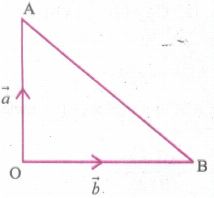
Let AOB be right angled triangle, right angled at O.
Take O as origin.
Then \(\overset { \rightarrow }{ OA } =\overset { \rightarrow }{ a } ,\overset { \rightarrow }{ OB } =\overset { \rightarrow }{ b } \)
\(\therefore \overset { \rightarrow }{ AB } =\overset { \rightarrow }{ OB } -\overset { \rightarrow }{ OA } =\overset { \rightarrow }{ b } -\overset { \rightarrow }{ a } \)
\(\therefore \overset { \rightarrow }{ OA } \bot \overset { \rightarrow }{ OA } =\overset { \rightarrow }{ a } \bot \overset { \rightarrow }{ b } \Rightarrow \overset { \rightarrow }{ a } .\overset { \rightarrow }{ b } =0\)
\(\therefore { AB }^{ 2 }={ \left| \overset { \rightarrow }{ AB } \right| }^{ 2 }=\overset { \rightarrow }{ AB } .\overset { \rightarrow }{ AB } \)
\(=0=\left( \overset { \rightarrow }{ b } -\overset { \rightarrow }{ a } \right) .\left( \overset { \rightarrow }{ b } -\overset { \rightarrow }{ a } \right) \)
\(=\overset { \rightarrow }{ b } .\overset { \rightarrow }{ b } -\overset { \rightarrow }{ b } .\overset { \rightarrow }{ a } -\overset { \rightarrow }{ a } .\overset { \rightarrow }{ b } +\overset { \rightarrow }{ a } .\overset { \rightarrow }{ a } \)
\(={ \left| \overset { \rightarrow }{ b } \right| }^{ 2 }-2\overset { \rightarrow }{ a } .\overset { \rightarrow }{ b } +{ \left| \overset { \rightarrow }{ a } \right| }^{ 2 }\)
= OB2 - 0 + OA2 \(\left[ \because \overset { \rightarrow }{ a } .\overset { \rightarrow }{ b } =0 \right] \)
⇒ AB2 = OA2 + OB2
Hence the Pythagoras theorem
17.
The matrix from of the system of equations is
\(\left[ \begin{matrix} 2 & -3 \\ 4 & -6 \end{matrix} \right] \left[ \begin{matrix} x \\ y \end{matrix} \right] =\left[ \begin{matrix} 7 \\ 14 \end{matrix} \right] \) ⇒ AX = B where
A =\(\left[ \begin{matrix} 2 & -3 \\ 4 & -6 \end{matrix} \right] ,X=\left[ \begin{matrix} x \\ y \end{matrix} \right] \) and B =\(\left[ \begin{matrix} 7 \\ 14 \end{matrix} \right] \)
Transforming augmented matrix to row-echelon form we get
[A|B] =\(\left[ \begin{matrix} 2 & -3 \\ 4 & -6 \end{matrix} \right] \left[ \begin{matrix} x \\ y \end{matrix} \right] \overset { { R }_{ 2 }\rightarrow { R }_{ 2 }-2{ R }_{ 1 } }{ \longrightarrow } \left[ \begin{matrix} 2 & -3 \\ 0 & 0 \end{matrix}|\begin{matrix} 7 \\ 0 \end{matrix} \right] \)
Here \(\rho\) (A) = \(\rho\) [A|B] = 1
∴ \(\rho\) (A) = \(\rho\) [A|B] = 1 < the number of unknowns, the system is consistent and has one parameter family of solutions
∴ Put y = t, where t \(\in \) R
Writing the row-echelon form to equations we get
2x - 3y = 7
∴ 2x - 3t = 7
⇒ 2x = 7 + 3t
⇒ x = \(\frac { 1 }{ 2 } \)(7 + 3t)
∴ Solution set is {\(\frac { 1 }{ 2 } \)(7+3t), t} where t \(\in \) R.
18.
x2 = 24y
The given parabola is open upward parabola and 4a = 24 ⇒ a = 6.
(a) Vertex is (0, 0)
⇒ h = 0, k = 0
(b) focus is (0 + h, a + k)
⇒ (0 + 0, 6 + 0) = (0, 6)
(c) Equation of directrix is y = k - a
⇒ y = 0 - 6 ⇒ y = -6
(d) Length of latus rectum is 4a = 24
19.
The distance between origin to z = i, −2 + i, and 3 are
|z| = |i| = 1
|z| = |−2+i| = \(\sqrt { \left( -2 \right) ^{ 2 }+{ 1 }^{ 2 } } =\sqrt { 5 }\)
|z| = |3| = 3
Since \(1<\sqrt { 5 } <3\), the farthest point from the origin is 3 .
20.
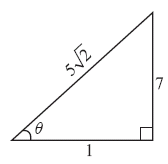
By definition, cot-1x\(\in(0,\pi)\)
Therefore, cot-1\((\frac{1}{7})\) = \(\theta\) implies \(\theta \in(0,\pi)\)
But cot-1\((\frac{1}{7})\) = \(\theta\) implies cot \(\theta\) = \(\frac{1}{7}\) and hence tan \(\theta\) = 7 and \(\theta\) is acute.
Using tan \(\theta\) = \(\frac{7}{1}\), We construct a right triangle as shown .
Then, we have, cos \(\theta\) = \(\frac{1}{5\sqrt2}\).
21.
We get AB = \(\left[ \begin{matrix} 0 & -3 \\ 1 & 4 \end{matrix} \right] \left[ \begin{matrix} -2 & -3 \\ 0 & -1 \end{matrix} \right] =\left[ \begin{matrix} 0+0 & 0+3 \\ -2+0 & -3-4 \end{matrix} \right] =\left[ \begin{matrix} 0 & 3 \\ -2 & -7 \end{matrix} \right] \)
(AB)-1 = \(\frac { 1 }{ \left( 0+6 \right) } \left[ \begin{matrix} -7 & -3 \\ 2 & 0 \end{matrix} \right] =\frac { 1 }{ 6 } \left[ \begin{matrix} -7 & -3 \\ 2 & 0 \end{matrix} \right] \)...(1)
A-1 = \(\frac { 1 }{ \left( 0+3 \right) } \left[ \begin{matrix} 4 & 3 \\ -1 & 0 \end{matrix} \right] =\frac { 1 }{ 3 } \left[ \begin{matrix} 4 & 3 \\ -1 & 0 \end{matrix} \right] \)
B-1 = \(\frac { 1 }{ \left( 2-0 \right) } \left[ \begin{matrix} -1 & 3 \\ 0 & -2 \end{matrix} \right] =\frac { 1 }{ 2 } \left[ \begin{matrix} -1 & 3 \\ 0 & -2 \end{matrix} \right] \)
B-1A-1 = \(\frac { 1 }{ 2 } \left[ \begin{matrix} -1 & 3 \\ 0 & -2 \end{matrix} \right] \frac { 1 }{ 3 } \left[ \begin{matrix} 4 & 3 \\ -1 & 0 \end{matrix} \right] =\frac { 1 }{ 6 } \left[ \begin{matrix} -7 & -3 \\ 2 & 0 \end{matrix} \right] \) ...(2).
As the matrices in (1) and (2) are same, (AB)−1 = B−1A−1 is verified.
22.
(b)
23.
(a)
\(\frac { 1 }{ 13 } \)
24.
(a)
\(\frac { \pi }{ 4 } \)
25.
(c)
\(\overset { \rightarrow }{ d } =\overset { \rightarrow }{ 0 } \)
26.
(b)
\({ e }_{ 1 }^{ 2 }\) + \({ e }_{ 2 }^{ 2 }\) = 1
27.
(b)
\(\frac { \pi }{ 3 } \)
28.
(b)
circle
29.
(b)
\(\frac { -\pi }{ 10 } \)
30.
(b)
31.
(d)
consistent and has unique solution
32.
(b)
|A| = |AT|
33.
(a)
34.
(b)
\(\left( \cos ^{ 2 }{ \frac { \theta }{ 2 } } \right) { A }^{ T }\)
35.
(a)
36.
(a)
\(\frac { \pi }{ 6 } \)
37.
(b)
(-3, 2)
38.
(a)
\(\frac{\pi}{2}\)
39.
(a)
0
40.
(a)
mn

12th Standard Syllabus & Materials
12th Standard
TN 12th Computer Applications வலையமைப்பு வடமிடல் Sample Question Papers Study Material - QB365 Set A
NEW12th Standard
TN 12th Computer Applications களப்பெயர் முறைமை (DNS) Sample Question Papers Study Material - QB365 Set A
NEW12th Standard
TN 12th Computer Applications வலையமைப்பு எடுத்துக்காட்டுகள் மற்றும் நெறிமுறைகள் Sample Question Papers Study Material - QB365 Set A
NEW12th Standard
TN 12th Computer Applications கணினி வலையமைப்பு ஓர் அறிமுகம் Sample Question Papers Study Material - QB365 Set A



Tamilnadu Stateboard 12th Standard Subjects
Maths

Chemistry

Physics

Biology

Computer Science

Business Maths and Statistics

Economics

Commerce

Accountancy

History

Computer Applications
Biology
Computer Technology
Computer Applications
Computer Science
Business Maths and Statistics
Commerce
Economics
Maths
Chemistry
Physics
Computer Technology
History
Accountancy

Tamil

English

French
Tamilnadu Stateboard Standards

