
 100% FREE ACCESS
12th Standard Syllabus & Materials
12th Standard
TN 12th Computer Applications மின்னணு தரவு பரிமாற்றம் Sample Question Papers Study Material - QB365 Set A
NEW12th Standard
TN 12th Computer Applications மின் - வணிக பாதுகாப்பு அமைப்புகள் Sample Question Papers Study Material - QB365 Set A
NEW12th Standard
TN 12th Computer Applications மின்னணு செலுத்தல் முறைகள் Sample Question Papers Study Material - QB365 Set A
NEW12th Standard
TN 12th Computer Applications மின் - வணிகம் Sample Question Papers Study Material - QB365 Set A
NEW12th Standard
TN 12th Computer Applications திறந்த மூல கருத்துருக்கள் Sample Question Papers Study Material - QB365 Set A
NEW12th Standard
TN 12th Computer Applications வலையமைப்பு வடமிடல் Sample Question Papers Study Material - QB365 Set A

Published on: 21/09/2019
Download Tamil Nadu 12th Standard Maths question papers, model tests, one-mark questions, important questions, and public exam papers in PDF format. Free study materials and answer keys for TN State Board students.
Questions + Answers key
Take MCQ Maths Test1.
Find the acute angle between the following lines
2x = 3y = −z and 6x = − y = −4z.
2.
If z = 2−2i, find the rotation of z by θ radians in the counter clockwise direction about the origin when \(\theta =\frac { \pi }{ 3 } \).
3.
Find the following \(\left| \frac { 2+i }{ -1+2i } \right| \)
4.
Prove that \(\left[ \begin{matrix} \cos { \theta } & -\sin { \theta } \\ \sin { \theta } & \cos { \theta } \end{matrix} \right] \) is orthogonal.
5.
Find the general equation of the circle whose diameter is the line segment joining the points (−4, −2) and (1, 1) is x2+y2+5x+3y+6=0
6.
Solve sin-1 x > cos-1x
7.
If A = \(\left[ \begin{matrix} 3 & 2 \\ 7 & 5 \end{matrix} \right] \) and B = \(\left[ \begin{matrix} -1 & -3 \\ 5 & 2 \end{matrix} \right] \), verify that (AB)-1 = B-1A-1
8.
If A = \(\left[ \begin{matrix} 4 & 3 \\ 2 & 5 \end{matrix} \right] \), find x and y such that A2 + xA + yI2 = O2. Hence, find A-1.
9.
Find the centre and radius of the circle 3x2 + (a + 1)y2 + 6x − 9y + a + 4 = 0.
10.
Construct a cubic equation with roots 1, 2 and 3
11.
If z1 = 3, z2 = -7i, and z3 = 5 + 4i, show that z1(z2 + z3) = z1 z2 + z1 z3
12.
ABCD is a quadrilateral with \(\overset { \rightarrow }{ AB } =\overset { \rightarrow }{ \alpha } \) and \(\overset { \rightarrow }{ AD } =\overset { \rightarrow }{ \beta } \) and \(\overset { \rightarrow }{ AC } =2\overset { \rightarrow }{ \alpha } +3\overset { \rightarrow }{ \beta } \). If the area of the quadrilateral is λ times the area of the parallelogram with \(\overset { \rightarrow }{ AB } \) and \(\overset { \rightarrow }{ AD } \) as adjacent sides, then prove that \(\lambda =\frac { 5 }{ 2 } \)
13.
Find all cube roots of \(\sqrt { 3 } +i\)
14.
Solve tan-1\(\left( \frac { 1-x }{ 1+x } \right) =\frac { 1 }{ 2 } { tan }^{ -1 }\) x for x > 0
15.
Solve the equation x4-9x2+20 = 0.
16.
17.
The number of solutions of the system of equations 2x+y = 4, x - 2y = 2, 3x + 5y = 6 is ____________
0
1
2
infinitely many
18.
If the length of the perpendicular from the origin to the plane 2x + 3y + λz =1, λ > 0 is \(\frac{1}{5}\), then the value of λ is
\(2\sqrt { 3 } \)
\(3\sqrt { 2 } \)
0
1
19.
If \(\vec { a } \times (\vec { b } \times \vec { c } )=(\vec { a } \times \vec { b } )\times \vec { c } \) where \(\vec { a } ,\vec { b } ,\vec { c } \) are any three vectors such that \(\vec{b} \cdot \vec{c} \neq 0 \text { and } \vec{a} \cdot \vec{b} \neq 0\), then \(\vec { a } \) and \(\vec { c } \) are
perpendicular
parallel
inclined at an angle \(\frac{\pi}{3}\)
inclined at an angle \(\frac{\pi}{6}\)
20.
If x + y = k is a normal to the parabola y2 = 12x, then the value of k is
3
-1
1
9
21.
The radius of the circle 3x2 + by2 + 4bx − 6by + b2 = 0 is
1
3
\( \sqrt {10}\)
\( \sqrt {11}\)
22.
If sin-1 x+sin-1 y+sin-1 \(z = \frac{3\pi}{2}\), the value of x2017+y2018+z2019\(-\frac { 9 }{ { x }^{ 101 }+{ y }^{ 101 }+{ z }^{ 101 } } \)is
0
1
2
3
23.
According to the rational root theorem, which number is not possible rational zero of 4x7 + 2x4 - 10x3 - 5?
-1
\(\frac { 5 }{ 4 } \)
\(\frac { 4 }{ 5 } \)
5
24.
The value of \(\sum_{n=1}^{13}\left(i^{n}+i^{n-1}\right)\) is
1+ i
i
1
0
25.
\(\left| -\sqrt { 3 } +i \right| \)
26.
Im(z)
27.
\({ sin }^{ -1 }\left( sin\frac { 2\pi }{ 3 } \right) \)
28.
(adj A)T
29.
p(x) = xn.p\(\left( \frac { 1 }{ x } \right) \)
1.
2x = 3y = −z \(\Rightarrow \frac{x}{3}=\frac{y}{2}=\frac{-z}{6}\) (Dividing by 6 all)
\(\Rightarrow \frac{x-0}{3}=\frac{y-0}{2}=
\frac{z-0}{-6}\)....(1)
6x = -y = -4z \(\Rightarrow \frac{x}{2}=\frac{-y}{12}=\frac{-z}{3} \) (Dividing by 6 all)
\(\Rightarrow \frac{x-0}{2}=\frac{y-0}{-12}=\frac{z-0}{-3}\) ....(2)
From (1) & (2), we get
\(\vec b = 3\vec i+2\vec j- 6\vec k\)and \( \vec d = 2\vec i-12\vec j- 3\vec k\)
Angle between lines (1) and (2) = Angle between \(\vec b\ and\ \vec d\)
Acute angle between lines cos 0 = \(\frac{|\vec b . \vec d|}{|\vec b||\vec d|}
\)
\(\vec b . \vec d \)= (\(\vec b = 3\vec i+2\vec j- 6\vec k\)). (\( 2\vec i-12\vec j- 3\vec k\))
6-24+18 = 0
\( \cos \theta=0 \)
\(\theta=\frac{\pi}{2} \text { or } 90^{\circ}\)
2.
\(\theta =\frac { \pi }{ 3 } \)
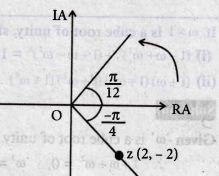
Given z = 2-2i
θ = \(\frac { \pi }{ 3 } \)
Let z = 2-2i = r(cos θ + i sin θ)
r =\(\sqrt { { 2 }^{ 2 }+(-2)^{ 2 } } =\sqrt { 4+4 } =\sqrt { 8 } =2\sqrt { 2 } \)
α = \(\\ tan^{ -1 }\left| \frac { y }{ x } \right| =tan^{ -1 }\left| \frac { -2 }{ 2 } \right| \)
= tan-1(1) = \(\frac { \pi }{ 4 } \)
The complex number 2-2i lie in the IV quadrant
∴ θ = -α = - \(\frac { \pi }{ 4 } \) [∵ x is +ve, y is -ve]
∴ 2-2i = 2\(\sqrt{2}\)\(\left[ cos\left( -\frac { \pi }{ 4 } \right) +isin\left( -\frac { \pi }{ 4 } \right) \right] \)
Z = \(2\sqrt { 2 } { e }^{ -i\frac { \pi }{ 4 } }\) ......... (1) [By uler'e formula]
Th rotation of z by θ radians in the counter clockwise direction about the origin in zeiθ
∴ Rotaton of z is \(z{ e }^{ i\frac { \pi }{ 3 } }\)
= \(2\sqrt { 2 } { e }^{ -i\frac { \pi }{ 4 } }.{ e }^{ i\frac { \pi }{ 3 } }\) [using (1)]
= \(2\sqrt { 2 } \left[ { e }^{ \left( i\frac { \pi }{ 3 } -\frac { \pi }{ 4 } \right) } \right] =2\sqrt { 2 } e^{ i\frac { \pi }{ 12 } }\)
3.
\(\left| \frac { 2+i }{ -1+2i } \right| =\frac { \left| 2+i \right| }{ \left| -1+2i \right| } =\frac { \sqrt { { 2 }^{ 2 }+{ 1 }^{ 2 } } }{ \sqrt { \left( -1 \right) ^{ 2 }+{ 2 }^{ 2 } } } =1\) \(\left( \because \left| \frac { { z }_{ 1 } }{ { z }_{ 2 } } \right| =\left| \frac { { z }_{ 1 } }{ { z }_{ 2 } } \right| ,{ z }_{ 2 }\neq 0 \right) \)
4.
Let A = \(\left[ \begin{matrix} \cos { \theta } & -\sin { \theta } \\ \sin { \theta } & \cos { \theta } \end{matrix} \right] \). Then, AT = \({ \left[ \begin{matrix} \cos { \theta } & -\sin { \theta } \\ \sin { \theta } & \cos { \theta } \end{matrix} \right] }^{ T }=\left[ \begin{matrix} \cos { \theta } & \sin { \theta } \\ -\sin { \theta } & \cos { \theta } \end{matrix} \right] \)
So, we get
AAT = \({ \left[ \begin{matrix} \cos { \theta } & -\sin { \theta } \\ \sin { \theta } & \cos { \theta } \end{matrix} \right] }\left[ \begin{matrix} \cos { \theta } & \sin { \theta } \\ -\sin { \theta } & \cos { \theta } \end{matrix} \right] \)
= \(\left[ \begin{matrix} \cos ^{ 2 }{ \theta +\sin ^{ 2 }{ \theta } } & \cos { \theta \sin { \theta } } -\sin { \theta \cos { \theta } } \\ \sin { \theta \cos { \theta -\cos { \theta \sin { \theta } } } } & \sin ^{ 2 }{ \theta } +\cos ^{ 2 }{ \theta } \end{matrix} \right] =\left[ \begin{matrix} 1 & 0 \\ 0 & 1 \end{matrix} \right] \) = I2
Similarly, we get ATA = I2. Hence AAT = ATA = I2 ⇒ A is orthogonal.
5.
Equation of the circle with end points of the diameter as (x1, y1) and (x2, y2) given in theorem is
(x−x1)(x−x2)+(y−y1)(y−y2) = 0
(x+4)(x−1)+(y+2)(y−1) = 0
x2 + y2 + 3x + y − 6 = 0 which is the required equation of the circle.
6.
Given that sin-1x > cos-1x. Note that -1\(\le x\le\)
Adding both sides by sin-1x, we get
sin-1 x + sin-1 x > x cos-1 x + sin-1x, Which resucess to 2 sin-1 x > \(\frac{\pi}{2}\)
As sine function increases in the interval \(\left[ -\frac { \pi }{ 2 }, \frac { \pi }{ 2 } \right] \), we have x > sin\(\frac{\pi}{4} or x> \frac{1}{\sqrt2}\)
Thus, the solution set is the interval \(\left[ \frac { 1 }{ \sqrt { 2 } } ,1 \right] \)
7.
Given A =\(\left[ \begin{matrix} 3 & 2 \\ 7 & 5 \end{matrix} \right] \) and B =\(\left[ \begin{matrix} -1 & -3 \\ 5 & 2 \end{matrix} \right] \)
AB =\(\left[ \begin{matrix} 3 & 2 \\ 7 & 5 \end{matrix} \right] \left[ \begin{matrix} -1 & -3 \\ 5 & 2 \end{matrix} \right] =\left[ \begin{matrix} -3+10 & -9+4 \\ -7+25 & -21+10 \end{matrix} \right] \)
=\(\left[ \begin{matrix} 7 & -5 \\ 18 & -11 \end{matrix} \right] \)
|AB| = -77+90 = 13 ≠ 0 ⇒ (AB)-1 exists
|A| = 15-14 = 1 ≠ 0 ⇒ A-1 exists
|B| = -2+15 = 13 ≠ 0 ⇒ B-1 exists
(AB)-1 = \(\frac { 1 }{ |AB| } adj(AB)=\frac { 1 }{ 13 } \left( \begin{matrix} -11 & 5 \\ -18 & 7 \end{matrix} \right) \) ...............(1)
B-1 = \(\frac { 1 }{ |B| } adj(B)=\frac { 1 }{ 13 } \left( \begin{matrix} 2 & 3 \\ -5 & -1 \end{matrix} \right) \)
A-1 = \(\frac { 1 }{ |A| } \)(adj A)
= \(\frac { 1 }{ 1 } \left( \begin{matrix} 5 & -2 \\ -7 & 3 \end{matrix} \right) =\left( \begin{matrix} 5 & -2 \\ -7 & 3 \end{matrix} \right) \)
∴ B-1A-1 = \(\frac { 1 }{ 13 } \left( \begin{matrix} 2 & 3 \\ -5 & -1 \end{matrix} \right) \left( \begin{matrix} 5 & -2 \\ -7 & 3 \end{matrix} \right) \)
= \(\frac { 1 }{ 13 } \left( \begin{matrix} 10-21 & -4+9 \\ -25+7 & 10-3 \end{matrix} \right) \)
= \(\frac { 1 }{ 13 } \left( \begin{matrix} -11 & 5 \\ -18 & 7 \end{matrix} \right) \) ..............(2)
From (1) or (2) it is proved that
(AB)-1 = B-1 A-1
8.
Since A2 = \(\left[ \begin{matrix} 4 & 3 \\ 2 & 5 \end{matrix} \right] \left[ \begin{matrix} 4 & 3 \\ 2 & 5 \end{matrix} \right] =\left[ \begin{matrix} 22 & 27 \\ 18 & 31 \end{matrix} \right] \).
A2 + xA + yI2 = O2 ⇒ \(\left[ \begin{matrix} 22 & 27 \\ 18 & 31 \end{matrix} \right] +x\left[ \begin{matrix} 4 & 3 \\ 2 & 5 \end{matrix} \right] +y\left[ \begin{matrix} 1 & 0 \\ 0 & 1 \end{matrix} \right] =\left[ \begin{matrix} 0 & 0 \\ 0 & 0 \end{matrix} \right] \)
⇒ \(\left[ \begin{matrix} 22+4x+y & 27+3x \\ 18+2x & 31+5x+y \end{matrix} \right] =\left[ \begin{matrix} 0 & 0 \\ 0 & 0 \end{matrix} \right] \).
So, we get 22 + 4x + y = 0, 31 + 5x + y = 0, 27 + 3x = 0 and 18 + 2x = 0.
Hence x = −9 and y = 14. Then, we get A2 - 9A + 14I2 = O2.
Postmultiplying this equation by A-1, we get A - 9I2 + 14A-1 = O2. Hence, we get
A-1 = \(\frac { 1 }{ 14 } \) (9I2 - A) = \(\frac { 1 }{ 14 } \left( 9\left[ \begin{matrix} 1 & 0 \\ 0 & 1 \end{matrix} \right] -\left[ \begin{matrix} 4 & 3 \\ 2 & 5 \end{matrix} \right] \right) =\frac { 1 }{ 14 } \left[ \begin{matrix} 5 & -3 \\ -2 & 4 \end{matrix} \right] \).
9.
Coefficient of x2 = Coefficient of y2 (characteristic (ii) for a second degree equation to represent a circle).
That is, 3 = a + 1 and a = 2 .
Therefore the equation of the circle is
3x2 + 3y2 + 6x − 9y + 6 = 0
x2 + y2 + 2x − 3y + 2 = 0
So, centre is \(\left( -1,\frac { 3 }{ 2 } \right) \) and radius r =\(\sqrt { 1+\frac { 9 }{ 4 } -2 } \)
=\(\sqrt { \frac { 5 }{ 2 } } \)
10.
Given roots are 1, 2 and 3
Here a = 1, β = 2 and ૪ = 3
A cubic polynomial equation whose roots are α, β, ૪ is
x3-(α+β+૪)+x2(αβ+β૪+૪α)x-∝β૪ = 0
⇒ x3-(1+1+2)x2(2+6+3)x-6 = 0
⇒ x3-6x2+11x-6 = 0
11.
z1(z2 + z3) = z1z2 + z1z3
Given z1= 3, z2 = -7i, z3 = 5+4i
LHS = z1(z2 + z3)
= 3 [-7i + 5 + 4i]
= 3[5-3i]
= 15-9i
RHS = z1z2 + z1z3
= 3(-7i) + 3(5 + 4i)
= -21i +15 +12i
= -9i +15
= 15-9i
LHS = RHS
∴ z1(z1 + z3) = z1z2 + z1z3
Hence proved
12.
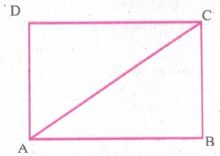
Given \(\overset { \rightarrow }{ AB } =\overset { \rightarrow }{ \alpha } \), \(\overset { \rightarrow }{ AD } =\overset { \rightarrow }{ \beta } \) and \(\overset { \rightarrow }{ AC } =2\overset { \rightarrow }{ \alpha } +3\overset { \rightarrow }{ \beta } \)
Area of the quadrilateral ABCD
∴ = are of ∆ ABC + area of ∆ ACD
\(=\frac { 1 }{ 2 } \left| \overset { \rightarrow }{ AB } \times \overset { \rightarrow }{ AC } \right| +\frac { 1 }{ 2 } \left| \overset { \rightarrow }{ AC } \times \overset { \rightarrow }{ AD } \right| \)
\(=\frac { 1 }{ 2 } \left| \overset { \rightarrow }{ \alpha } \times \left( 2\overset { \rightarrow }{ \alpha } +3\overset { \rightarrow }{ \beta } \right) \right| +\frac { 1 }{ 2 } \left| \left( 2\overset { \rightarrow }{ \alpha } +3\overset { \rightarrow }{ \beta } \right) \times \overset { \rightarrow }{ \beta } \right| \)
\(=\frac { 1 }{ 2 } \left| 2\left( \overset { \rightarrow }{ \alpha } \times \overset { \rightarrow }{ \alpha } \right) +3\left( \overset { \rightarrow }{ \alpha } \times \overset { \rightarrow }{ \beta } \right) \right| +\frac { 1 }{ 2 } \left| 2\left( \overset { \rightarrow }{ \alpha } \times \overset { \rightarrow }{ \beta } \right) +3\left( \overset { \rightarrow }{ \beta } \times \overset { \rightarrow }{ \beta } \right) \right| \)
\(=\frac { 1 }{ 2 } \left| 3\left( \overset { \rightarrow }{ \alpha } \times \overset { \rightarrow }{ \beta } \right) \right| +\frac { 1 }{ 2 } \left| 2\left( \overset { \rightarrow }{ \alpha } \times \overset { \rightarrow }{ \beta } \right) \right| \quad \quad \quad \left[ \because \overset { \rightarrow }{ \alpha } \times \overset { \rightarrow }{ \alpha } =\overset { \rightarrow }{ \beta } \times \overset { \rightarrow }{ \beta } =0 \right] \)
\(=\left( \frac { 3 }{ 2 } +\frac { 2 }{ 2 } \right) \left( \overset { \rightarrow }{ \alpha } \times \overset { \rightarrow }{ \beta } \right) =\left( \frac { 5 }{ 2 } \right) \left| \overset { \rightarrow }{ \alpha } \times \overset { \rightarrow }{ \beta } \right| \quad \quad (1)\)
Now, Area of the parallelogram with \(\overset { \rightarrow }{ AB } \) and \(\overset { \rightarrow }{ AD } \) as
adjacent sides = \(\left| \overset { \rightarrow }{ AB } \times \overset { \rightarrow }{ AD } \right| =\left| \overset { \rightarrow }{ \alpha } \times \overset { \rightarrow }{ \beta } \right| .... (2)\)
From (1) & (2), \(\frac { 5 }{ 2 } \left| \overset { \rightarrow }{ \alpha } \times \overset { \rightarrow }{ \beta } \right| =\lambda \left| \overset { \rightarrow }{ \alpha } \times \overset { \rightarrow }{ \beta } \right| \) [Given]
\(\lambda =\frac { 5 }{ 2 } \)
13.
We have to find \((\sqrt{3}+1)^{\frac{1}{3}}\). Let \(z=(\sqrt{3}+i)^{\frac{1}{3}}\). Then \({ z }^{ 3 }=\sqrt { 3 } +i=r\left( cos\theta +isin\theta \right) \)
Then, \(r=\sqrt { 3+1 } =2\) and \(\alpha =\theta =\frac { \pi }{ 6 } \) (\(\because \sqrt{3}+i\) lies in the first quadrant)
Therefore, \({ z }^{ 3 }=\sqrt { 3 } +i=2\left( cos\frac { \pi }{ 6 } +isin\frac { \pi }{ 6 } \right) \)
\(\Rightarrow z=\sqrt [ 3 ]{ 2 } \left( cos\left( \frac { \pi +12k\pi }{ 18 } \right) +isin\left( \frac { \pi +12k\pi }{ 18 } \right) \right) \), k = 0, 1, 2.
Taking k = 0, 1, 2, we get
k = 0, z \(={ 2 }^{ \frac { 1 }{ 3 } }\left( cos\frac { \pi }{ 18 } +sin\frac { \pi }{ 18 } \right) \)
k = 1, \(z={ z }^{ \frac { 1 }{ 3 } }\left( cos\frac { \pi }{ 18 } +sin\frac { \pi }{ 18 } \right) \)
k = 2, \(z={ 2 }^{ \frac { 1 }{ 3 } }\left( cos\frac { 25\pi }{ 18 } +sin\frac { 25\pi }{ 18 } \right) ={ 2 }^{ \frac { 1 }{ 3 } }\left( -cos\frac { 7\pi }{ 18 } -sin\frac { 7\pi }{ 18 } \right) \)
14.
tan-1 \(\left( \frac { 1-x }{ 1+x } \right) =\frac { 1 }{ 2 } { tan }^{ -1 }\)x gives tan-1 1-tan-1 x = \(\frac{1}{2}\)tan-1x.
Therefore, \(\frac{\pi}{4}=\frac{3}{2}tan^{-1}\)x, which in turn reduces to tan−1 = \(\frac{\pi}{6}\)
Thus, x = tan\(\frac{\pi}{6}=\frac{1}{\sqrt3}\)
15.
The given equation is
x4- 9x2 + 20 = 0
This is a fourth degree equation. If we replace x2 by y then we get the quadratic equation
y2- 9y + 20 = 0
It is easy to see that 4 and 5 as solutions for y2- 9y + 20 = 0. Now taking x2 = 4 and x2 = 5, we get 2, -2, \(\sqrt{5}\), -\(\sqrt{5}\) as solutions of the given equation.
We note that the technique adopted above can be applied to polynomial equations like x6-17x3+30 = 0, ax2k+ bxk + c = 0 and in general polynomial equations of the form anxkn + an-1xk(n-1) + .... + a1xk + a0 = 0 where k is any positive integer.
16.
(b)
17.
(b)
1
18.
(a)
\(2\sqrt { 3 } \)
19.
(b)
parallel
20.
(d)
9
21.
(c)
\( \sqrt {10}\)
22.
(a)
0
23.
(c)
\(\frac { 4 }{ 5 } \)
24.
(a)
1+ i
25.
2
26.
\(\frac { z-\bar { z } }{ 2 } \)
27.
\(\frac { \pi }{ 3 } \)
28.
adj (AT)
29.
Reciprocal equation of type I

12th Standard Syllabus & Materials
12th Standard
TN 12th Computer Applications களப்பெயர் முறைமை (DNS) Sample Question Papers Study Material - QB365 Set A
NEW12th Standard
TN 12th Computer Applications வலையமைப்பு எடுத்துக்காட்டுகள் மற்றும் நெறிமுறைகள் Sample Question Papers Study Material - QB365 Set A
NEW12th Standard
TN 12th Computer Applications கணினி வலையமைப்பு ஓர் அறிமுகம் Sample Question Papers Study Material - QB365 Set A
NEW12th Standard
TN 12th Computer Applications PHP-உடன் MySQL-ஐ இணைத்தல் Sample Question Papers Study Material - QB365 Set A



Tamilnadu Stateboard 12th Standard Subjects
Maths

Chemistry

Physics

Biology

Computer Science

Business Maths and Statistics

Economics

Commerce

Accountancy

History

Computer Applications
Biology
Computer Technology
Computer Applications
Computer Science
Business Maths and Statistics
Commerce
Economics
Maths
Chemistry
Physics
Computer Technology
History
Accountancy

Tamil

English

French
Tamilnadu Stateboard Standards

