
 100% FREE ACCESS
12th Standard Syllabus & Materials
12th Standard
TN 12th Computer Applications மின்னணு தரவு பரிமாற்றம் Sample Question Papers Study Material - QB365 Set A
NEW12th Standard
TN 12th Computer Applications மின் - வணிக பாதுகாப்பு அமைப்புகள் Sample Question Papers Study Material - QB365 Set A
NEW12th Standard
TN 12th Computer Applications மின்னணு செலுத்தல் முறைகள் Sample Question Papers Study Material - QB365 Set A
NEW12th Standard
TN 12th Computer Applications மின் - வணிகம் Sample Question Papers Study Material - QB365 Set A
NEW12th Standard
TN 12th Computer Applications திறந்த மூல கருத்துருக்கள் Sample Question Papers Study Material - QB365 Set A
NEW12th Standard
TN 12th Computer Applications வலையமைப்பு வடமிடல் Sample Question Papers Study Material - QB365 Set A

Published on: 29/10/2019
Download Tamil Nadu 12th Standard Maths question papers, model tests, one-mark questions, important questions, and public exam papers in PDF format. Free study materials and answer keys for TN State Board students.
Questions + Answers key
Take MCQ Maths Test1.
Find the modulus and principal argument of the following complex numbers:
\(-\sqrt { 3 } -i\)
2.
If z = 2−2i, find the rotation of z by θ radians in the counter clockwise direction about the origin when \(\theta =\frac { 2\pi }{ 3 } \).
3.
If \(\frac { z+3 }{ z-5i } =\frac { 1+4i }{ 2 } \), find the complex number z in the rectangular form
4.
Find the principal value of
\({ Sin }^{ -1 }\left( \frac { 1 }{ \sqrt { 2 } } \right) \)
5.
Evaluate the following if z = 5−2i and w = −1+3i
z + w
6.
A random variable X has the following probability mass function
| x | 1 | 2 | 3 | 4 | 5 | 6 |
| f(x) | k | 2k | 6k | 5k | 6k | 10k |
Find
(i) P(2 < X < 6)
(ii) P(2 ≤ X < 5)
(iii) P(X ≤4)
(iv) P(3 < X )
7.
A rectangular page is to contain 24 cm2 of print. The margins at the top and bottom of the page are 1.5 cm and the margins at other sides of the page is 1 cm. What should be the dimensions of the page so that the area of the paper used is minimum.
8.
Solve the equations
x4+ 3x3- 3x - 1 = 0
9.
Solve the following system of linear equations by matrix inversion method:
2x + 3y − z = 9, x + y + z = 9, 3x − y − z = −1
10.
If \(\vec { a } =-2\hat { i } +3\hat { j } -2\hat { k } ,\vec { b } =3\hat { i } -\hat { j } +3\hat { k } ,\vec { c } =2\hat { i } -5\hat { j } +\hat { k } \) find \((\vec { a } \times \vec { b } )\times \vec { c } \) and \((\vec { a } \times \vec { b } )\times \vec { c } \). State whether they are equal.
11.
Solve the equation (x-2) (x-7) (x-3) (x+2)+19 = 0
12.
If A = \(\frac { 1 }{ 7 } \left[ \begin{matrix} 6 & -3 & a \\ b & -2 & 6 \\ 2 & c & 3 \end{matrix} \right] \) is orthogonal, find a, b and c , and hence A−1.
13.
Find the equation of the circle passing through the points (1, 1 ), (2, -1 ) and (3, 2) .
14.
Evaluate: \(\\ \\ \int _{ -1 }^{ 1 }{ { e }^{ -\lambda x }(1-{ x }^{ 2 }) } dx\)
15.
A person learnt 100 words for an English test. The number of words the person remembers in t days after learning is given by W(t) = 100 × (1− 0.1t)2, 0 ≤ t ≤ 10. What is the rate at which the person forgets the words 2 days after learning?
16.
Prove that \((\vec { a } .(\vec { b } \times \vec { c } ))\vec { a } =(\vec { a } \times \vec { b } )\times (\vec { a } \times \vec { c } )\)
17.
Using vector method, prove that if the diagonals of a parallelogram are equal, then it is a rectangle
18.
A circle of area 9π square units has two of its diameters along the lines x + y = 5 and x−y = 1. Find the equation of the circle.
19.
If y = 4x + c is a tangent to the circle x2 + y2 = 9, find c
20.
Verify the property (AT)-1 = (A-1)T with A = \(\left[ \begin{matrix} 2 & 9 \\ 1 & 7 \end{matrix} \right] \).
21.
22.
The proposition p ∧ (¬p ∨ q) is
a tautology
a contradiction
logically equivalent to p ∧ q
logically equivalent to p ∨ q
23.
In the last column of the truth table for ¬( p ∨ ¬q) the number of final outcomes of the truth value 'F' are
1
2
3
4
24.
Which one of the following is a binary operation on N?
Subtraction
Multiplication
Division
All the above
25.
26.
If \(\frac{\Gamma(n+2)}{\Gamma(n)}=90\) then n is
10
5
8
9
27.
If \(f(x)=\int_{0}^{x} t \cos t d t, \text { then } \frac{d f}{d x}=\)
cos x - x sin x
sin x + x cos x
x cos x
x sin x
28.
If w (x, y) = xy, x > 0, then \(\frac { \partial w }{ \partial x } \) is equal to
xy log x
y log x
yxy-1
x log y
29.
30.
A random variable X has binomial distribution with n = 25 and p = 0.8 then standard deviation of X is
6
4
3
2
31.
The number of arbitrary constants in the particular solution of a differential equation of third order is
3
2
1
0
32.
The order and degree of the differential equation \(\frac { { d }^{ 2 }y }{ { dx }^{ 2 } } +{ \left( \frac { dy }{ dx } \right) }^{ 1/3 }+{ x }^{ 1/4 }=0\) are respectively
2, 3
3, 3
2, 6
2, 4
33.
34.
If the length of the perpendicular from the origin to the plane 2x + 3y + λz =1, λ > 0 is \(\frac{1}{5}\), then the value of λ is
\(2\sqrt { 3 } \)
\(3\sqrt { 2 } \)
0
1
35.
If \(\vec{a}\) and \(\vec{b}\) are parallel vectors, then \([\vec { a } ,\vec { c } ,\vec { b } ]\) is equal to
2
-1
1
0
36.
If x + y = k is a normal to the parabola y2 = 12x, then the value of k is
3
-1
1
9
37.
The eccentricity of the hyperbola whose latus rectum is 8 and conjugate axis is equal to half the distance between the foci is
\(\frac { 4 }{ 3 } \)
\(\frac { 4 }{ \sqrt { 3 } } \)
\(\frac { 2 }{ \sqrt { 3 } } \)
\(\frac { 3 }{ 2 } \)
38.
39.
40.
The value of \(\sum_{n=1}^{13}\left(i^{n}+i^{n-1}\right)\) is
1+ i
i
1
0
1.
\(-\sqrt { 3 } -i\)
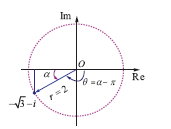
r = 2 and \(\alpha =\frac { \pi }{ 6 } \)
Since the complex number lies in the fourth quadrant, has the principal value
\(\theta =\alpha -\pi =\frac { \pi }{ 6 } -\pi =-\frac { 5\pi }{ 6 } \)
Therefore, the modulus and principal argument of \(-\sqrt { 3 } -i\) are 2 and -\(\frac { 5\pi }{ 6 } \) respectively.
2.
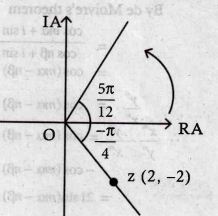
\(\theta =\frac { 2\pi }{ 3 } \)
When θ = \(\frac { \pi }{ 3 } \)
Roration of z is \(ze^{ i\theta }=ze^{ i2\frac { \pi }{ 3 } }\) [using (1)]
= \(2\sqrt { 2 } e^{ -i\frac { \pi }{ 4 } }.{ e }^{ i2\frac { \pi }{ 3 } }\) [using (1)]
= \(2\sqrt { 2 } e^{ i\left( i\frac { \pi }{ 3 } -\frac { \pi }{ 4 } \right) }=2\sqrt { 2 } e^{ i5\frac { \pi }{ 12 } }\)
3.
We have = \(\frac { z+3 }{ z-5i } =\frac { 1+4i }{ 2 } \)
\(\Rightarrow\) 2(z + 3) = (1 + 4i) (z− 5i)
\(\Rightarrow\) 2z + 6 = (1 + 4i)z + 20−5i
\(\Rightarrow\) (2−1−4i)z = 20− 5i− 6
\(\Rightarrow\) \(z=\frac { 14-5i }{ 1-4i } =\frac { \left( 14-5i \right) \left( 1+4i \right) }{ \left( 1-4i \right) \left( 1+4i \right) } =\frac { 34+51i }{ 17 } =2+3i\)
4.
We know that sin-1: [-1, 1] \(\rightarrow \left[ -\frac { \pi }{ 2 } ,\frac { \pi }{ 2 } \right] \)is given by
sin−1x = y if and only if x = sin y for −1\(\le x\le \) and -\(\frac { \pi }{ 2 } \le y \le \frac { \pi }{ 2 } \). Thus,
\({ Sin }^{ -1 }\left( \frac { 1 }{ \sqrt { 2 } } \right) \)= \(\frac{\pi}{4}\), Since \(\frac{\pi}{4}\)\(\in \left[ -\frac { \pi }{ 2 } ,\frac { \pi }{ 2 } \right] \)and sin \(\frac { \pi }{ 4 } =\frac { 1 }{ \sqrt { 2 } } \)
5.
(z+w)
= (5-2i) + (-1+3i)
= (5-1) + i(-2+3)
= 4+i(1)
= 4+i
6.
Since the given function is a probability mass function, the total probability is one. That is \(\underset { x }{ \Sigma } f(x)=1\)
From the given data k + 2k + 6k + 5k + 6k +10k+1
\(30k=1\Rightarrow k=\frac { 1 }{ 30 } \)
Therefore the probability mass function is
| x | 1 | 2 | 3 | 4 | 5 | 6 |
| f(x) | \(\cfrac { 1 }{ 30 } \) | \(\cfrac { 2 }{ 30 } \) | \(\cfrac { 6 }{ 30 } \) | \(\cfrac { 5 }{ 30 } \) | \(\cfrac { 6 }{ 30 } \) | \(\cfrac { 10 }{ 30 } \) |
(i) P(2 < X < 6) = f(3)+ f(4)+ f(5) = \(\frac { 6 }{ 30 } +\frac { 5 }{ 30 } +\frac { 6 }{ 30 } =\frac { 17 }{ 30 } \)
(ii) P(2≤X≤5) = f(2)+f(3)+f(4) = \(\frac { 2 }{ 30 } +\frac { 6 }{ 30 } +\frac { 5 }{ 30 } =\frac { 13 }{ 30 } \)
(iii) P(2≤4) = f(1)+f(2)+f(3)+f(4) = \(\frac { 1 }{ 30 } +\frac { 2 }{ 30 } +\frac { 6 }{ 30 } +\frac { 5 }{ 30 } =\frac { 14 }{ 30 } \)
(iv) P(3>X) = f(4)+f(5)+f(6) = \(\frac { 5 }{ 30 } +\frac { 6 }{ 30 } +\frac { 10 }{ 30 } =\frac { 21 }{ 30 } \)
7.
Let x and y be the length, breadth of the printed rectangular page
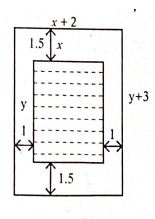
Given xy = 24
\(\Rightarrow y=\frac { 24 }{ x } \) ..(1)
Length of the page with margin
= x+1+1 = x+2
breadth of the page with margin
= y + 1.5 + 1.5 = y + 3
Area of the page = (x + 2) (y + 3)
Let f(x) = (x + 2) (y + 3)
= \((x+2)\left( \frac { 24 }{ x } +3 \right) \)
= \(24+3x+\frac { 48 }{ x } +30\)
= \(3x+\frac { 48 }{ x } +30\)
\(f'\left( x \right) =3-\frac { 48 }{ { x }^{ 2 } } \)
\(\Rightarrow { x }^{ 2 }=16\Rightarrow x=\pm 4\)
ஃ The critical number are 4,-4
\(f''\left( x \right) =-48\left( \frac { -2 }{ { x }^{ 3 } } \right) =\frac { 96 }{ { x }^{ 3 } } \)
\(f''\left( 4 \right) =\frac { 96 }{ 64 } >0\)
ஃ f(x) is minimum when x = 4
When \(x=4,y=\frac { 24 }{ 4 } =6\) [From (1)]
ஃ Length of the page = x + 2 = 4 + 2 = 9 cm
Breadth of the page = y + 3 = 6 + 3 = 6 cm
8.
x4+ 3x3- 3x - 1 = 0
Sum of the co-efficients = 1 + 3 - 3.- 1 = 0
⇒x = 1 is a root ⇒(x - 1) is a factor
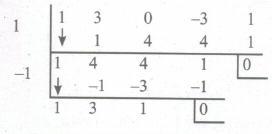
[Using synthetic division]
∴ x = 1, 1 are the roots and the remaining factor
\(\Rightarrow x=\frac { -3\pm \sqrt { 9-4(1)(1) } }{ 2 } \)
\(\Rightarrow x=\frac { -3\pm \sqrt { 5 } }{ 2 } \)
∴ The roots are 1, -1, \(\frac { -3+\sqrt { 5 } }{ 2 } ,\frac { -3-\sqrt { 5 } }{ 2 } \).
9.
2x + 3y - z = 9, x + y + z = 9, 3x - y - z = -1
The matrix form of the system is
\(\left[ \begin{matrix} 2 & 3 & -1 \\ 1 & 1 & 1 \\ 3 & -1 & -1 \end{matrix} \right] \left[ \begin{matrix} x \\ y \\ z \end{matrix} \right] =\left[ \begin{matrix} 9 \\ 9 \\ -1 \end{matrix} \right] \)
⇒ AX = B where A =\(\left[ \begin{matrix} 2 & 3 & -1 \\ 1 & 1 & 1 \\ 3 & -1 & -1 \end{matrix} \right] \)
X =\(\left[ \begin{matrix} x \\ y \\ z \end{matrix} \right] \) and B =\(\left[ \begin{matrix} 9 \\ 9 \\ -1 \end{matrix} \right] \)
⇒ X = A-1N
|A| = \(\left| \begin{matrix} 2 & 3 & -1 \\ 1 & 1 & 1 \\ 3 & -1 & -1 \end{matrix} \right| =2\left| \begin{matrix} 1 & 1 \\ -1 & -1 \end{matrix} \right| -3\left| \begin{matrix} 1 & 1 \\ 3 & -1 \end{matrix} \right| -1\left| \begin{matrix} 1 & 1 \\ 3 & -1 \end{matrix} \right| \)
= 2(-1+1)-3(-1-3)-1(-1-3)
= 0-3(-4) = 12+4 = 16
adj A =\(\left[ \begin{matrix} +\left| \begin{matrix} 1 & 1 \\ -1 & -1 \end{matrix} \right| & -\left| \begin{matrix} 1 & 1 \\ 3 & -1 \end{matrix} \right| & +\left| \begin{matrix} 1 & 1 \\ 3 & -1 \end{matrix} \right| \\ -\left| \begin{matrix} 3 & -1 \\ -1 & -1 \end{matrix} \right| & +\left| \begin{matrix} 2 & -1 \\ 3 & -1 \end{matrix} \right| & -\left| \begin{matrix} 2 & 3 \\ 3 & -1 \end{matrix} \right| \\ +\left| \begin{matrix} 3 & -1 \\ 1 & 1 \end{matrix} \right| & -\left| \begin{matrix} 2 & -1 \\ 1 & 1 \end{matrix} \right| & +\left| \begin{matrix} 2 & 3 \\ 1 & 1 \end{matrix} \right| \end{matrix} \right] \)
=\(\left[ \begin{matrix} +(-1+1) & -(-1-3) & +(-1-3) \\ -(-3-1) & +(2+3) & -(-2-9) \\ +(3+1) & -(2+1) & +(2-3) \end{matrix} \right] ^{ T }\)
=\(\left[ \begin{matrix} 0 & 4 & -4 \\ 4 & 1 & 11 \\ 4 & -3 & -1 \end{matrix} \right] ^{ T }=\left[ \begin{matrix} 0 & 4 & 4 \\ 4 & 1 & -3 \\ -4 & 11 & -1 \end{matrix} \right] \)
∴ A-1 = \(\frac { 1 }{ |A| } adjA\frac { 1 }{ 16 } \left[ \begin{matrix} 0 & 4 & 4 \\ 4 & 1 & -3 \\ -4 & 11 & -1 \end{matrix} \right] \)
∴ X = A-1B = \(\frac { 1 }{ 16 } \left[ \begin{matrix} 0 & 4 & 4 \\ 4 & 1 & -3 \\ -4 & 11 & -1 \end{matrix} \right] \left[ \begin{matrix} 9 \\ 9 \\ -1 \end{matrix} \right] \)
= \(\frac { 1 }{ 16 } \left[ \begin{matrix} 0+36-4 \\ 36+9+3 \\ -36+99+1 \end{matrix} \right] =\frac { 1 }{ 16 } \left[ \begin{matrix} 32 \\ 48 \\ 64 \end{matrix} \right] =\left[ \begin{matrix} 2 \\ 3 \\ 4 \end{matrix} \right] \)
∴ x = 2, y = 3, z = 4
∴ Solution set is {2, 3, 4}
10.
By definition, \(\vec { a } \times \vec { b } \) \(=\left| \begin{matrix} \hat { i } & \hat { j } & \hat { k } \\ -2 & 3 & -2 \\ 3 & -1 & 3 \end{matrix} \right| =7\hat { i } -7\hat { k } \)
Then, \((\vec { a } \times \vec { b } )\times \vec { c } =\left| \begin{matrix} \hat { i } & \hat { j } & \hat { k } \\ 7 & 0 & -7 \\ 2 & -5 & 1 \end{matrix} \right| =-35\hat { i } -21\hat { j } -35\hat { k } \)......(1)
\(\vec { b } \times \vec { c } =\left| \begin{matrix} \hat { i } & \hat { j } & \hat { k } \\ 3 & -1 & 3 \\ 2 & -5 & 1 \end{matrix} \right| =14\hat { i } +3\hat { j } -13\hat { k } \)
\(\vec { a } (\vec { b } \times \vec { c } )=\left| \begin{matrix} \hat { i } & \hat { j } & \hat { k } \\ -2 & 3 & -2 \\ 14 & 3 & -13 \end{matrix} \right| =-33\hat { i } -54\hat { j } -48\hat { k } \)....(2)
Therefore, equations (1) and (2) show that \((\vec { a } \times \vec { b } )\times \vec { c } \)\(\neq \)\((\vec { a } \times \vec { b } )\times \vec { c } \)
11.
We can solve this fourth degree equation by rewriting it suitably and adopting a technique of substitution. Rewriting the equation as
(x−2)(x−3)(x−7)(x+2)+19 = 0
the given equation becomes
(x2−5x+6)(x2−5x−14)+19 = 0 .
If we take x2 − 5x as y, then the equation becomes (y+6)(y−14)+19 = 0;
that is, y2-8y-65 = 0
Solving this we get solutions y = 13 and y = −5. Substituting this we get two quadratic equations
x2-5x-13 = 0 and x2-5x+5 = 0
which can be solved by usual techniques. The solutions obtained for these two equations together give solutions as \(\frac { 5\pm \sqrt { 77 } }{ 2 } ,\frac { 5\pm \sqrt { 5 } }{ 2 } \).
12.
If A is orthogonal, then AAT = ATA = I3. So, we have
AAT = I3 ⇒ \(\frac { 1 }{ 7 } \left[ \begin{matrix} 6 & -3 & a \\ b & -2 & 6 \\ 2 & c & 3 \end{matrix} \right] \frac { 1 }{ 7 } \left[ \begin{matrix} 6 & -3 & a \\ b & -2 & 6 \\ 2 & c & 3 \end{matrix} \right] =\left[ \begin{matrix} 1 & 0 & 0 \\ 0 & 1 & 0 \\ 0 & 0 & 1 \end{matrix} \right] \)
⇒ \(\left[ \begin{matrix} 45+{ a }^{ 2 } & 6b+6+6a & 12-3c+3a \\ 6b+6+6a & { b }^{ 2 }+40 & 2b-2c+18 \\ 12-3c+3a & 2b-2c+18 & { c }^{ 2 }+13 \end{matrix} \right] =49\left[ \begin{matrix} 1 & 0 & 0 \\ 0 & 1 & 0 \\ 0 & 0 & 1 \end{matrix} \right] \)
⇒ \(\left\{ \begin{matrix} 45+{ a }^{ 2 }=49 \\ \begin{matrix} { b }^{ 2 }+40=49 \\ \begin{matrix} { c }^{ 2 }+13=49 \\ \begin{matrix} 6b+6+6a=0 \\ \begin{matrix} 12-3c+3a=0 \\ 2b-2c+18=0 \end{matrix} \end{matrix} \end{matrix} \end{matrix} \end{matrix} \right\} \) ⇒ \(\left\{ \begin{matrix} { a }^{ 2 }=4,{ b }^{ 2 }=9,{ c }^{ 2 }=36 \\ a+b=-1,a-c=-4,b-c=-9 \end{matrix} \right\} \) ⇒ a = 2, b = −3, c = 6
So we get A = \(\frac { 1 }{ 7 } \left[ \begin{matrix} 6 & -3 & 2 \\ -3 & -2 & 6 \\ 2 & 6 & 3 \end{matrix} \right] \) and hence, we get A-1 = AT = \(\frac { 1 }{ 7 } \left[ \begin{matrix} 6 & -3 & 2 \\ -3 & -2 & 6 \\ 2 & 6 & 3 \end{matrix} \right] \).
13.
Let the general equation of the circle be
x2 +y2 +2gx + 2fy + c = 0 ........ (1)
It passes through points (1, 1), (2, -1) and(3, 2) .
Therefore,
2g+2f+c = -2 ........ (2)
4g−2f+c = -5 ........(3)
6g+4f+c = -13 ...... (4)
(2) – (3) gives −2g + 4f = 3 ... (5)
(4) – (3) gives 2g + 6f = -8 ....(6)
(5) + (6) gives f = \(-\frac { 1 }{ 2 } \)
Substituting f = \(-\frac { 1 }{ 2 } \) in (6), g = -\(\frac { 5 }{ 2 } \)
Substituting f = \(-\frac { 1 }{ 2 } \) and g = - \(\frac { 5 }{ 2 } \) in (2), c = 4 .
Therefore the required equation of the circle is
x2+ y2+ 2\(\left( -\frac { 5 }{ 2 } \right) x+2\left( -\frac { 1 }{ 2 } \right) \)y+4 = 0 and x2 + y2 − 5x − y + 4 = 0.
14.
Taking u = 1−x2 and v = e−\(\lambda\)x, and applying the Bernoulli’s formula, we get
\(I=\int _{ -1 }^{ 1 }{ { e }^{ -\lambda x } } (1-{ x }^{ 2 })dx={ \left[ (1-{ x }^{ 2 })\left( \frac { { e }^{ -\lambda x } }{ -\lambda } \right) -(-2x)\left( \frac { { e }^{ -\lambda x } }{ { \lambda }^{ 2 } } \right) +(-2)\left( \frac { { e }^{ -\lambda x } }{ -{ \lambda }^{ 3 } } \right) \right] }_{ -1 }^{ 1 }\)
\(=2\left( \frac { { e }^{ -\lambda } }{ { \lambda }^{ 2 } } \right) +2\left( \frac { { e }^{ -\lambda } }{ { \lambda }^{ 3 } } \right) +2\left( \frac { { e }^{ \lambda } }{ { \lambda }^{ 2 } } \right) -2\left( \frac { { e }^{ \lambda } }{ { \lambda }^{ 3 } } \right) \)
\(=\frac { 2 }{ { \lambda }^{ 2 } } ({ e }^{ \lambda }+{ e }^{ -\lambda })-\frac { 2 }{ { \lambda }^{ 3 } } ({ e }^{ \lambda }-{ e }^{ -\lambda })\)
15.
We have,
\(\frac{d}{dt}W(t)=-20\times(1-0.1t)\)
Therefore at t = 2, \(\frac{d}{dt}W(t)=-16\)
That is, the person forgets at the rate of 16 words after 2 days of studying.
16.
Treating \((\vec { a } \times \vec { b } )\) as the first vector on the right hand side of the given equation and using the vector triple product expansion, we get
\((\vec { a } \times \vec { b } )\times (\vec { a } \times \vec { c } )=((\vec { a } \times \vec { b } ).\vec { c } )\vec { a } -((\vec { a } \times \vec { b } ).\vec { a } )\vec { c } =(\vec { a } .\vec { b } \times \vec { c } ))\vec { a } \)
17.
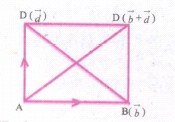
Let ABCD be a parallelogram such that its diagonals AC and BD are equal.
Taking A as the origin, let the p.v. of B and D be \(\vec { b } \)and \(\vec { d } \) respectively.
Then \(\vec { AB } =\vec { b } \) and \(\vec { AD } =\vec { d } \)
Using triangle law of addition of vectors is ΔABC, we get
\(\vec { AB } +\vec { BC } =\vec { AC } \)
⇒ \(\vec { AB } +\vec { AD } =\vec { AC } \)
⇒ \(\vec { b } +\vec { d } =\vec { AC } \)
Using triangle law of addition of vectors in ΔABD, we get \(\vec { AB } +\vec { BD } =\vec { AD } \)
⇒ \(\vec { b } +\vec { BD } =\vec { d } \)
⇒ \(\vec { BD } =\vec { d } -\vec { b } \)
In parallelogram ABCD we have AC = BD
⇒ \(|\vec { AC } |=|\vec { BD } |\)
⇒ \(|\vec { AC } |^{ 2 }=|\vec { BD } |^{ 2 }\)
⇒ \(|\vec { b } +\vec { d } |^{ 2 }=|\vec { d } -\vec { b } |^{ 2 }\)
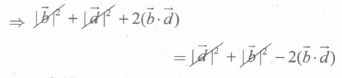
⇒ \(4(\vec { b } .\vec { d } )=0\Rightarrow \vec { b } .\vec { d } =0\)=0
⇒ \(\vec { b } \bot \vec { d } \)
⇒ \(\vec { AB } \bot \vec { AD } \)
Hence, ABCD is a rectangle.
18.
Area of the circle = 9π sq.units

πr2 = 9π ⇒ r2 ⇒ 9 ⇒ r ⇒ 3
Diameters are x + y = 5 ................(1)
and x - y = 1 .................(2)
We know that centre is the point of intersection of diameters.
∴ To find the centre, solve (1) and (2).
JPG.JPG)
⇒ 2x = 6
⇒ x = 3
∴ (1) ⇒ 3 + y = 5
⇒ y = 5 - 3 = 2
∴ Centre is (3, 2)
Hence, equation of the circle is
(x - h)2 + (y - k)2 = r2
⇒ (x - 3)2 + (y - 2)2 = 32
\(\Rightarrow x^{2}-6 x+9+y^{2}-4 y+4=9\)
⇒ x2 + y2 − 6x − 4y + 4 = 0
19.
The condition for the line y = mx + c to be a tangent to the circle x2 + y2 = a2 is c2 = a2(1 + m2) from
Then \(c=\pm \sqrt { 9\left( 1+16 \right) } \)
\(c=\pm 3\sqrt { 17 } \)
20.
For the given A, We get |A| = (2)(7) - (9)(1) = 14 - 9 = 5. So, A-1 = \(\frac { 1 }{ 5 } \left[ \begin{matrix} 7 & -9 \\ -1 & 2 \end{matrix} \right] =\left[ \begin{matrix} \frac { 7 }{ 5 } & -\frac { 9 }{ 5 } \\ -\frac { 1 }{ 5 } & \frac { 2 }{ 5 } \end{matrix} \right] \).
Then, (A-1)T = \(\left[ \begin{matrix} \frac { 7 }{ 5 } & -\frac { 1 }{ 5 } \\ -\frac { 9 }{ 5 } & \frac { 2 }{ 5 } \end{matrix} \right] =\frac { 1 }{ 5 } \left[ \begin{matrix} 7 & -1 \\ -9 & 2 \end{matrix} \right] \). ....(1)
For the given A, We get AT = \(\left[ \begin{matrix} 2 & 1 \\ 9 & 7 \end{matrix} \right] \). So |AT| = (2)(7) - (1)(9) = 5
Then, (AT)-1 = \(\frac { 1 }{ 5 } \left[ \begin{matrix} 7 & -1 \\ -9 & 2 \end{matrix} \right] \). ...(2)
From (1) and (2), we get (A-1)T = (AT)-1. Thus, we have verified the given property.
21.
22.
(c)
logically equivalent to p ∧ q
23.
(c)
3
24.
(b)
Multiplication
25.
(b)
26.
(d)
9
27.
(c)
x cos x
28.
(c)
yxy-1
29.
(b)
30.
(d)
2
31.
(d)
0
32.
(a)
2, 3
33.
(b)
34.
(a)
\(2\sqrt { 3 } \)
35.
(d)
0
36.
(d)
9
37.
(c)
\(\frac { 2 }{ \sqrt { 3 } } \)
38.
(a)
39.
(a)
40.
(a)
1+ i

12th Standard Syllabus & Materials
12th Standard
TN 12th Computer Applications களப்பெயர் முறைமை (DNS) Sample Question Papers Study Material - QB365 Set A
NEW12th Standard
TN 12th Computer Applications வலையமைப்பு எடுத்துக்காட்டுகள் மற்றும் நெறிமுறைகள் Sample Question Papers Study Material - QB365 Set A
NEW12th Standard
TN 12th Computer Applications கணினி வலையமைப்பு ஓர் அறிமுகம் Sample Question Papers Study Material - QB365 Set A
NEW12th Standard
TN 12th Computer Applications PHP-உடன் MySQL-ஐ இணைத்தல் Sample Question Papers Study Material - QB365 Set A



Tamilnadu Stateboard 12th Standard Subjects
Maths

Chemistry

Physics

Biology

Computer Science

Business Maths and Statistics

Economics

Commerce

Accountancy

History

Computer Applications
Biology
Computer Technology
Computer Applications
Computer Science
Business Maths and Statistics
Commerce
Economics
Maths
Chemistry
Physics
Computer Technology
History
Accountancy

Tamil

English

French
Tamilnadu Stateboard Standards

