
 100% FREE ACCESS
12th Standard Syllabus & Materials
12th Standard
TN 12th Maths Applications of Matrices and Determinants Sample Question Papers Study Material - QB365 Set A
NEW12th Standard
TN 12th Computer Applications மின்னணு தரவு பரிமாற்றம் Sample Question Papers Study Material - QB365 Set A
NEW12th Standard
TN 12th Computer Applications மின் - வணிக பாதுகாப்பு அமைப்புகள் Sample Question Papers Study Material - QB365 Set A
NEW12th Standard
TN 12th Computer Applications மின்னணு செலுத்தல் முறைகள் Sample Question Papers Study Material - QB365 Set A
NEW12th Standard
TN 12th Computer Applications மின் - வணிகம் Sample Question Papers Study Material - QB365 Set A
NEW12th Standard
TN 12th Computer Applications திறந்த மூல கருத்துருக்கள் Sample Question Papers Study Material - QB365 Set A

Published on: 02/01/2020
Two Dimensional Analytical Geometry-II
Download Tamil Nadu 12th Standard Maths question papers, model tests, one-mark questions, important questions, and public exam papers in PDF format. Free study materials and answer keys for TN State Board students.
Questions + Answers key
Take MCQ Maths Test1.
Find the eccentricity of the ellipse with foci on x-axis if its latus rectum be equal to one half of its major axis.
2.
For the ellipse x2 + 3y2 = a2, find the length of major and minor axis.
3.
Examine the position of the point (2, 3) with respect to the circle x2 + y2 − 6x − 8y + 12 = 0.
4.
Find the general equation of the circle whose diameter is the line segment joining the points (−4, −2) and (1, 1) is x2+y2+5x+3y+6=0
5.
Show that the line x + y + 1 = 0 touches the hyperbola \(\frac { { x }^{ 2 } }{ 16 } -\frac { { y }^{ 2 } }{ 15 } \) = 1 and find the co-ordinates of the point of contact
6.
Find the value of c if y = x + c is a tangent to the hyperbola 9x2 - 16y2 = 144.
7.
Find the equation of the circle with centre (2, -1) and passing through the point (3, 6) in standard form.
8.
Find the centre and radius of the circle 3x2 + (a + 1)y2 + 6x − 9y + a + 4 = 0.
9.
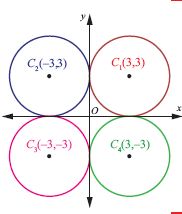
A circle of radius 3 units touches both the axes. Find the equations of all possible circles formed in the general form.
10.
Identify the type of conic and find centre, foci, vertices, and directrices of each of the following :
9x2−y2−36x−6y+18 = 0
11.
The foci of a hyperbola coincides with the foci of the ellipse \(\frac { { x }^{ 2 } }{ 25 } +\frac { y^{ 2 } }{ 9 } =1\). Find the equation of the hyperbola if its eccentricity is 2.
12.
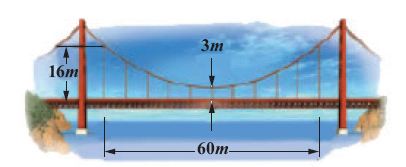
Parabolic cable of a 60m portion of the roadbed of a suspension bridge are positioned as shown below. Vertical Cables are to be spaced every 6m along this portion of the roadbed. Calculate the lengths of first two of these vertical cables from the vertex.
13.
Show that the line x−y+4 = 0 is a tangent to the ellipse x2+3y2 = 12 . Also find the coordinates of the point of contact.
14.
The tangent at any point P on the ellipse \(\frac { { x }^{ 2 } }{ 6 } +\frac { { y }^{ 2 } }{ 3 } \) = 1 whose centre C meets the major axis at T and PN is the perpendicular to the major axis; The CN CT = ______________
\(\sqrt6\)
3
\(\sqrt3\)
6
15.
16.
17.
Equation of tangent at (-4, -4) on x2 = -4y is _____________
2x - y + 4 = 0
2x + y - 4 = 0
2x - y - 12 = 0
2x + y + 4 = 0
18.
The area of quadrilateral formed with foci of the hyperbolas \(\frac{x^{2}}{a^{2}}-\frac{y^{2}}{b^{2}}=1 \text { and } \frac{x^{2}}{a^{2}}-\frac{y^{2}}{b^{2}}=-1\)
4(a2+b2)
2(a2+b2)
a2 +b2
\(\frac { 1 }{ 2 } \)(a2+b2)
19.
The radius of the circle passing through the point(6, 2) two of whose diameter are x + y = 6 and x + 2y = 4 is
10
\( {2} \sqrt {5}\)
6
4
20.
(1) y2 = 4ax
(2) c = \(\frac{a}{m}\)
(3) c2 = a2(1+m2)
(4) \(\left( \frac { a }{ { m }^{ 2 } } ,\frac { 2a }{ m } \right) \)
1.
Let the equation of the ellipse be \(\frac { { x }^{ 2 } }{ { a }^{ 2 } } +\frac { { y }^{ 2 } }{ { b }^{ 2 } } =1\)
Given, length of LR = \(\frac { 1 }{ 2 } \) (Length of major axis)
⇒ \(\frac { { 2b }^{ 2 } }{ a } =\frac { 1 }{ 2 } \) (2a) ⇒ \(\frac { 2{ b }^{ 2 } }{ a } \) = a ⇒ 2b2 = a2
∴ e = \(\sqrt { 1-\frac { { b }^{ 2 } }{ { a }^{ 2 } } } =\sqrt { 1-\frac { { b }^{ 2 } }{ { 2a }^{ 2 } } } =\sqrt { 1-\frac { 1 }{ 2 } } =\sqrt { \frac { 1 }{ 2 } } =\frac { 1 }{ \sqrt { 2 } } \)
2.
Given equation is x2 + 3y2 = a2
\(\div \) a2 we get, \(\frac { { x }^{ 2 } }{ { a }^{ 2 } } +\frac { { y }^{ 2 } }{ \frac { { a }^{ 2 } }{ 3 } } =1\)
Here a2 and b2 = \(\frac{a^2}{3}\) ⇒ b = \(\frac{a}{\sqrt3}\)
Length of major axis is 2a and
Length of minor axis is 2b = \(\frac { 2a }{ \sqrt { 3 } } \times \frac { \sqrt { 3 } }{ \sqrt { 3 } } =\frac { 2a\sqrt { 3 } }{ 3 } \)
3.
Taking (x1, y1) as (2, 3), we get
x12 + y12 + 2gx1+ 2fy1+ c = 22 + 32 − 6 × 2 − 8 × 3 + 12
= 4 + 9 - 12 - 24 + 12
= -11\(<\)0.
Therefore the point (2, 3) lies inside the circle, by theorem.
4.
Equation of the circle with end points of the diameter as (x1, y1) and (x2, y2) given in theorem is
(x−x1)(x−x2)+(y−y1)(y−y2) = 0
(x+4)(x−1)+(y+2)(y−1) = 0
x2 + y2 + 3x + y − 6 = 0 which is the required equation of the circle.
5.
Given line is x + y + 1 = 0
⇒ y = -x-1
m = -1, c = -1
Equation of the hyperbola is \(\frac { { x }^{ 2 } }{ 16 } -\frac { { y }^{ 2 } }{ 15 } \) = 1
a2 = 16, b2 = 15
The condition for the line y = mx + c to be a tangent to the hyperbola is c2 = a2m2 - b2
∴ (-1)2 = 16(-1)2 - 15
1 = 16 -15
1 = 1
Since the condition is satisfied, x + y + 1 = 0 touches the hyperbola \(\frac { { x }^{ 2 } }{ 16 } -\frac { { y }^{ 2 } }{ 15 } \) = 1
The point of contact is \(\left( \frac { -{ a }^{ 2 }m }{ c } ,\frac { -{ b }^{ 2 } }{ c } \right) \) = \(\left( \frac { -16(-1) }{ -1 } ,\frac { -15 }{ -1 } \right) \) = (-16, 15)
Hence, the point of contact is (-16, 15)
6.
Given line is y = x + c
m = 1, c = c
Equation of the hyperbola is 9x2 - 16y2 = 144
\(\div \)144 we get \(\frac { { x }^{ 2 } }{ 16 } +\frac { { y }^{ 2 } }{ 9 } \) = 1
a2 = 16, b2 = 9
The condition for the line y = mx + c to be a tangent to the hyperbola is c2 = a2m2 - b2
∴ c2 = 16(1)2 - 9 = 16 - 9 = 7
∴ c = ±\(\sqrt7\)
7.
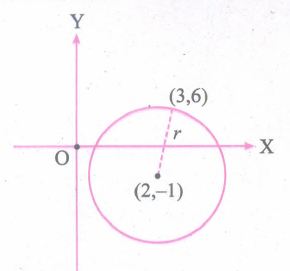
Given centre is (2, -1) and passing through the point (3, 6)
∴ r = distance between (2, -1) and (3, 6)
= \(\sqrt { { (2-3) }^{ 2 }+(-1{ -6) }^{ 2 } } \)
= \(\sqrt { { (-1) }^{ 2 }+({ -7) }^{ 2 } } \)
= \(\sqrt { 1+49 } =\sqrt { 50 } \)
∴ Equation of the circle is
(x - h)2 + (y - k)2 = r2
(x−2)2+(y+1)2 = \({ (\sqrt { 50 } })^{ 2 }\)
(x−2)2+(y+1)2 = 50
8.
Coefficient of x2 = Coefficient of y2 (characteristic (ii) for a second degree equation to represent a circle).
That is, 3 = a + 1 and a = 2 .
Therefore the equation of the circle is
3x2 + 3y2 + 6x − 9y + 6 = 0
x2 + y2 + 2x − 3y + 2 = 0
So, centre is \(\left( -1,\frac { 3 }{ 2 } \right) \) and radius r =\(\sqrt { 1+\frac { 9 }{ 4 } -2 } \)
=\(\sqrt { \frac { 5 }{ 2 } } \)
9.
As the circle touches both the axes, the distance of the centre from both the axes is 3 units, centre can be (±3, ±3) and hence there are four circles with radius 3, and the required equations of the four circles are
x2 + y2 ± 6x ± 6y + 9 = 0.
10.
9x2- y2- 36x - 6y + 18 = 0
Given equation is 9x2- y2- 36x - 6y + 18 = 0
⇒ 9x2 - 36x - (y2 + 6y) = -18
⇒ 9(x2-4x)-(y2+6y) =-18
⇒ 9(x2 - 4x + 4 - 4) - (y2 + 6y + 9 - 9) = -18
⇒ 9(x-2)2-36-(y+3)2+9 =-18
⇒ 9(x-2)2 - (y+3)2 = -18+36-9
⇒ 9(x - 2)2 - (y + 3)2 = 9
Dividing by 9 we get, \(\frac { { (x-2) }^{ 2 } }{ 1 } -\frac { ({ y+3) }^{ 2 } }{ 9 } =1\)
This is an equation of the hyperbola whose transverse axis is parallel to x-axis.
a2 = 1, b2 = 9
∴ c2 = a2 + b2 = 1 + 9 = 10 ⇒ c = \(\sqrt { 10 } \)
\(e=\sqrt {1-\frac { { b }^{ 2 } }{ { a }^{ 2 } }} =\sqrt { 1-\frac { 9 }{ 1 } } =\sqrt { 10 } \)
a) Center is (2, -3)
⇒ h = 2, k = -3
(b) Foci are (h + c, k), (17 - c, k)
⇒ (2 +\(\sqrt { 10 } \), -3), (2 - \(\sqrt { 10 } \), -3)
(c) Vertic ar (h + a, k) (h - a, k)
⇒ (2+ 1,-3), (2-1,-3)
⇒ (3, -3) (1, -3)
(d) Equation of directrices are x - 2 = \(\pm \frac { a }{ e } \)
⇒ \(x-2=\pm \frac { 1 }{ \sqrt { 10 } } \)
\(x=2\pm \frac { 1 }{ \sqrt { 10 } } \)
⇒ \(x=2+\frac { 1 }{ \sqrt { 10 } } \) and \(x=2-\frac { 1 }{ \sqrt { 10 } } \)
11.
Equation of the ellipse is \(\frac { { x }^{ 2 } }{ 25 } +\frac { y^{ 2 } }{ 9 } =1\)
∴ a2 = 25, b2 = 9
∴ e = \(\sqrt { 1-\frac { { b }^{ 2 } }{ { a }^{ 2 } } } =\sqrt { 1-\frac { 9 }{ 25 } } =\sqrt { \frac { 16 }{ 25 } } =\frac { 4 }{ 5 } \)
Focus is (ae, 0) = \(\left( 5\times \frac { 4 }{ 5 } \right) \) = (4, 0)
Since the focus of the hyperbola coincides with the focus of the ellipse, foci of the hyperbola are (±4,0).
Let A be the length of the semi-transverse axis
∴ Ae - 4 ⇒ 2A = \(\frac { 4 }{ e } =\frac { 4 }{ 2 } =2\) [∵ e = 2]
Let B b th length of the semi conjugate axis
B2 = A2(e2 - 1) = 4(4 - 1) = 12
Equation of the hyperbola is \(\frac { { x }^{ 2 } }{ { A }^{ 2 } } -\frac { { y }^{ 2 } }{ { B }^{ 2 } } =1\)
⇒ \(\frac { { x }^{ 2 } }{ 4 } -\frac { { y }^{ 2 } }{ 12 } =1\)
12.
Let the of the parbola be x2 = 4ay (1)
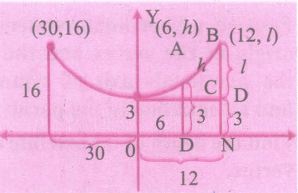
Since (30, 16) is a point on (1),
we get 302 = 4 \(\times\) a \(\times\) 16
⇒ a = \(\frac { 30\times 30 }{ 4\times 16 } =\frac { 225 }{ 16 } \)
∴ becomes, x2 = \({ x }^{ 2 }=\frac { 4\times 225 }{ 16 } y=\frac { 225 }{ 4 } y\)
Let AC = h m and BD = lm
∴ A(6, h) is a point on the parabola [∵ OD = 6]
∴ \({ 6 }^{ 2 }=\frac { 225 }{ 4 } \times h\)
⇒ \(h=\frac { 36\times 4 }{ 225 } \Rightarrow h=0.52\)
∴ AD = 3 + h = 3 + 0.52 = 3.52 m
Also (12, 1) is a point on the parabola
[∵ ON = 6 + 6 = 12]
∴ \({ 12 }^{ 2 }=\frac { 225 }{ 4 } \times l\)
⇒ l = \(\frac { 12\times 12\times 4 }{ 225 } =\frac { 576 }{ 225 } =2.08\) = 5.08 m
Hence the length of first two vertical cables are 3.52 m and 5.08 m.
13.
x2+3y2 = 12
\(\div 12\) we get, \(\frac { { x }^{ 2 } }{ 12 } +\frac { { y }^{ 2 } }{ 4 } =1\)
∴ a2 = 12, b2 = 4
The line x-y+ 4 = 0 can be rewritten as y = x+4.
∴ m = 1, c = 4
The condition for y = mx + 4 to be a tangent to the ellipse is c2 = a2m2 + b2
∴ (4)2 = 12(1)2 + 4
⇒ 16 = 12+4
⇒ 16 = 16
Since the condition is satisfied, the line x - y + 4 = 0 is a tangent to the ellipse x2 + 3y2 = 12.
Also, the point of contact is \(\left( -\frac { { a }^{ 2 }m }{ c } ,\frac { { b }^{ 2 } }{ c } \right) \)
\(\Rightarrow \left( -\frac { 12(1) }{ 4 } ,\frac { 4 }{ 4 } \right) \Rightarrow (-3,1)\)
∴The point of contact is (-3, 1).
14.
(d)
6
15.
(c)
16.
(b)
17.
(a)
2x - y + 4 = 0
18.
(b)
2(a2+b2)
19.
(b)
\( {2} \sqrt {5}\)
20.
(3) c2 = a2(1+m2) 1, 2, 4 are related to parabola

12th Standard Syllabus & Materials
12th Standard
TN 12th Computer Applications வலையமைப்பு வடமிடல் Sample Question Papers Study Material - QB365 Set A
NEW12th Standard
TN 12th Computer Applications களப்பெயர் முறைமை (DNS) Sample Question Papers Study Material - QB365 Set A
NEW12th Standard
TN 12th Computer Applications வலையமைப்பு எடுத்துக்காட்டுகள் மற்றும் நெறிமுறைகள் Sample Question Papers Study Material - QB365 Set A
NEW12th Standard
TN 12th Computer Applications கணினி வலையமைப்பு ஓர் அறிமுகம் Sample Question Papers Study Material - QB365 Set A



Tamilnadu Stateboard 12th Standard Subjects
Maths

Chemistry

Physics

Biology

Computer Science

Business Maths and Statistics

Economics

Commerce

Accountancy

History

Computer Applications
Biology
Computer Technology
Computer Applications
Computer Science
Business Maths and Statistics
Commerce
Economics
Maths
Chemistry
Physics
Computer Technology
History
Accountancy

Tamil

English

French
Tamilnadu Stateboard Standards

