
 100% FREE ACCESS
12th Standard Syllabus & Materials
12th Standard
TN 12th Computer Applications மின்னணு தரவு பரிமாற்றம் Sample Question Papers Study Material - QB365 Set A
NEW12th Standard
TN 12th Computer Applications மின் - வணிக பாதுகாப்பு அமைப்புகள் Sample Question Papers Study Material - QB365 Set A
NEW12th Standard
TN 12th Computer Applications மின்னணு செலுத்தல் முறைகள் Sample Question Papers Study Material - QB365 Set A
NEW12th Standard
TN 12th Computer Applications மின் - வணிகம் Sample Question Papers Study Material - QB365 Set A
NEW12th Standard
TN 12th Computer Applications திறந்த மூல கருத்துருக்கள் Sample Question Papers Study Material - QB365 Set A
NEW12th Standard
TN 12th Computer Applications வலையமைப்பு வடமிடல் Sample Question Papers Study Material - QB365 Set A

Published on: 27/11/2019
Two Dimensional Analytical Geometry II
Download Tamil Nadu 12th Standard Maths question papers, model tests, one-mark questions, important questions, and public exam papers in PDF format. Free study materials and answer keys for TN State Board students.
Questions + Answers key
Take MCQ Maths Test1.
For the hyperbola 3x2 - 6y2 = -18, find the length of transverse and conjugate axes and eccentricity.
2.
Find the equation of the hyperbola with vertices (0, ±4) and foci(0, ±6).
3.
Find the equation of circles that touch both the axes and pass through (-4, -2) in general form.
4.
Obtain the equation of the circles with radius 5 cm and touching x-axis at the origin in general form.
5.
If y = 4x + c is a tangent to the circle x2 + y2 = 9, find c
6.
Find the equations of the tangent and normal to the circle x2 + y2 = 25 at P(-3, 4).
7.
Find the equation of the hyperbola whose vertices are (0, ±7) and e = \(\frac { 4 }{ 3 } \)
8.
Find the locus of a point which divides so that the sum of its distances from (-4, 0) and (4, 0) is 10 units.
9.
Obtain the equation of the circle for which (3, 4) and (2, -7) are the ends of a diameter.
10.
The foci of a hyperbola coincides with the foci of the ellipse \(\frac { { x }^{ 2 } }{ 25 } +\frac { y^{ 2 } }{ 9 } =1\). Find the equation of the hyperbola if its eccentricity is 2.
11.
An equilateral triangle is inscribed in the parabola y2 = 4ax whose vertex is at the vertex of the parabola. Find the length of its side.
12.
Find the equations of tangent and normal to the ellipse x2+4y2 = 32 when \(\theta =\frac { \pi }{ 4 } \)
13.
Find the centre, foci, and eccentricity of the hyperbola 11x2 − 25y2 −44x + 50y −256 = 0
14.
Find the equation of the ellipse whose eccentricity is \(\frac { 1 }{ 2 } \), one of the foci is(2, 3) and a directrix is x = 7. Also find the length of the major and minor axes of the ellipse.
15.
If a parabolic reflector is 20 cm in diameter and 5 cm in diameter and 5 cm deep, then its focus is ____________
(0, 5)
(5, 0)
(10, 0)
(0, 10)
16.
If the normals of the parabola y2 = 4x drawn at the end points of its latus rectum are tangents to the circle (x − 3)2 + (y + 2)2 = r2 , then the value of r2 is
2
3
1
4
17.
If P(x, y) be any point on 16x2 + 25y2 = 400 with foci F1 (3, 0) and F2 (-3, 0) then PF1 + PF2 is
8
6
10
12
18.
The centre of the circle inscribed in a square formed by the lines x2 − 8x − 12 = 0 and y2 − 14y + 45 = 0 is
(4, 7)
(7, 4)
(9, 4)
(4, 9)
19.
The eccentricity of the hyperbola whose latus rectum is 8 and conjugate axis is equal to half the distance between the foci is
\(\frac { 4 }{ 3 } \)
\(\frac { 4 }{ \sqrt { 3 } } \)
\(\frac { 2 }{ \sqrt { 3 } } \)
\(\frac { 3 }{ 2 } \)
1.
Given equation of the hyperbola is
3x2 - 6y2 = -18; \(\div \)by (-18) we get \(\frac{y^2}{3}- \frac{x^2}{6}\) = 1
The transverse axis is long y-axis.
Here a2 = 3, b2 = 6
Length of transverse axis is 2a = 2\(\sqrt { 3 } \)
Length of conjugate axis is 2b = 2\(\sqrt { 3 } \)
\(e=\sqrt { 1+\frac { { b }^{ 2 } }{ { a }^{ 2 } } } =\sqrt { 1+\frac { 6 }{ 3 } } =\sqrt { 1+2 } =\sqrt { 3 } \)
2.
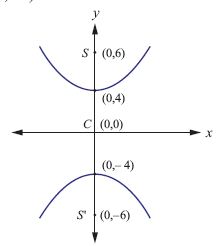
From figure the midpoint of line joining foci is the centre C(0, 0).
Transverse axis is y-axis
AA′ = 2a \(\Rightarrow \) 2a = 8,
SS′ = 2c = 12, c = 6
a = 4
b2 = c2−a2 = 36−16 = 20
Hence the equation of the required hyperbola is \(\frac { { y }^{ 2 } }{ 16 }- \frac { { x }^{ 2 } }{ 20 } =1\)
3.
Since the circles touch both the axes. Its equation will be
(x + a)2 + (y + a)2 = a2 ...............(1)
It passes through (-4, -2)
∴ (-4 + a)2 + (-2 + a)2 = a2
\(16+\not a^{2}+8 a+4+a^{2}+4 a=\not a^{2}\)
⇒ a2 + 12a + 20 = 0
⇒ (a + 10)(a + 2) = 0
a = -10 or -2
.JPG)
Case (i):
When a = -10, (1) becomes
(x + 10)2 + (y + 10)2 = 102
\(\Rightarrow x^{2}+\not 100+20 x+y^{2}+\not 100+20 y=160\)
⇒ x2 + y2+ 20x + 20y + 100 = 0
Case (ii):
When a = -2, (1) becomes
⇒ (x + 2)2 + (y + 2)2 = 22
\(x^{2}+4 x+4+y^{2}+4 y+\not 4 = \not 4\)
x2 + y2+ 4x + 4y + 4 = 0
Hence, equation of the circles are
x2 + y2+ 4x + 4y + 4 = 0
or x2 + y2+ 20x + 20y + 100 = 0
4.
Given r = 5 cm

Since the circle touches the x axis, its centre is (0, ±5)
Equation of the circle is (x - h)2 + (y - k)2 = r2
⇒ (x - 0)2 + (y ± 5)2 = 25
\(\Rightarrow x^{2}+y^{2}+\not 25 \pm 10 y=\not 25\)
⇒ x2+y2+10y = 0
5.
The condition for the line y = mx + c to be a tangent to the circle x2 + y2 = a2 is c2 = a2(1 + m2) from
Then \(c=\pm \sqrt { 9\left( 1+16 \right) } \)
\(c=\pm 3\sqrt { 17 } \)
6.
Equation of tangent to the circle at P(x1, y1 ) is xx1 yy1 = a2
That is, x(−3) + y(4) = 25
−3x + 4y = 25
Equation of normal is xy1 - yx1 = 0
That is, 4x + 3y = 0
7.
Since the vertices are (0, ±7), equation of the hyperbola is \(\frac { { x }^{ 2 } }{ { a }^{ 2 } } +\frac { { y }^{ 2 } }{ { b }^{ 2 } } =1\)
a = 7 and e = \(\frac { 4 }{ 3 } \)
b2 = a2(e2 - 1) = 49\(\left( \frac { 16 }{ 9 } -1 \right) =49\left( \frac { 16-9 }{ 9 } \right) \)
= \(49\left( \frac { 7 }{ 9 } \right) =\frac { 343 }{ 9 } \)
∴ Equation of the hyperbola is \(\frac { { y }^{ 2 } }{ 49 } -\frac { { x }^{ 2 } }{ \frac { 343 }{ 9 } } =1\)
⇒ \(\frac { { y }^{ 2 } }{ 49 } -\frac { 9{ x }^{ 2 } }{ 343 } =1\)
8.
Let P(x, y) be the movable point.
By focal property of ellipse, PA + PB = 2a
∴ 2a = 10 ⇒ a = 5
Since focus is (4, 0), ae = 4 ⇒ 5e = 4 ⇒ e = \(\frac45\)
Also b2 = a2(1 - e2) = 25\(\left( 1-\frac { 16 }{ 25 } \right) =25\left( \frac { 9 }{ 25 } \right) \) = 9
Equation of ellipse is \(\frac { { x }^{ 2 } }{ { a }^{ 2 } } +\frac { { y }^{ 2 } }{ { b }^{ 2 } } =1\)
\(\frac { { x }^{ 2 } }{ 25 } +\frac { { y }^{ 2 } }{ 9 } =1\)
9.
Given ends of diameter are (3, 4)(2, -7)
∴ Equation of the circle is
(x - x1)(x - x2) + (y - y1)(y - y2) = 0
⇒ (x - 3)(x - 2) + (y - 4)(y + 7) = 0
⇒ x2 - 2x - 3x + 6 + y2 + 7y - 4y - 28 = 0
⇒ x2 + y2 − 5x + 3y − 22 = 0
10.
Equation of the ellipse is \(\frac { { x }^{ 2 } }{ 25 } +\frac { y^{ 2 } }{ 9 } =1\)
∴ a2 = 25, b2 = 9
∴ e = \(\sqrt { 1-\frac { { b }^{ 2 } }{ { a }^{ 2 } } } =\sqrt { 1-\frac { 9 }{ 25 } } =\sqrt { \frac { 16 }{ 25 } } =\frac { 4 }{ 5 } \)
Focus is (ae, 0) = \(\left( 5\times \frac { 4 }{ 5 } \right) \) = (4, 0)
Since the focus of the hyperbola coincides with the focus of the ellipse, foci of the hyperbola are (±4,0).
Let A be the length of the semi-transverse axis
∴ Ae - 4 ⇒ 2A = \(\frac { 4 }{ e } =\frac { 4 }{ 2 } =2\) [∵ e = 2]
Let B b th length of the semi conjugate axis
B2 = A2(e2 - 1) = 4(4 - 1) = 12
Equation of the hyperbola is \(\frac { { x }^{ 2 } }{ { A }^{ 2 } } -\frac { { y }^{ 2 } }{ { B }^{ 2 } } =1\)
⇒ \(\frac { { x }^{ 2 } }{ 4 } -\frac { { y }^{ 2 } }{ 12 } =1\)
11.
Let the equation of the parabola be y2 = 4ax
Let AB = I.
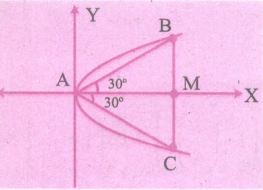
Since ABC is an equilateral triangle,
∠BAM = ∠MAC = 30o
In MBM, cos 30°= \(\frac{AM}{l}\)
⇒ AM = l cos 30° = l\(\left( \frac { \sqrt { 3 } }{ 2 } \right) \)
sin 30o = \(\frac { BM }{ AM } \)
⇒ sin 30o = \(\frac { BM }{ l } \)
⇒ BM = l sin 30o = l\(\left( \frac { 1 }{ 2 } \right) \)
ஃ Co-ordinates of B are (AM, BM) ⇒ \(B\left( \frac { \sqrt { 3 } l }{ 2 } ,\frac { 1 }{ 2 } \right) \)
Also B lies on (1)
\({ \left( \frac { l }{ 2 } \right) }^{ 2 }=4a\left( \frac { \sqrt { 3 } l }{ 2 } \right) \)
⇒ \(\frac { { l }^{ 2 } }{ 4 } =4a\left( \frac { \sqrt { 3 } l }{ 2 } \right) \)
\(\frac { { l }^{ 2 } }{ 4 } =2\sqrt { 3 } al\)
\(\frac { l }{ 4 } =2\sqrt { 3 } \) a ⇒ 1 = 8 \(a\sqrt { 3 } \)
Length of the side of the equilateral triangle is 8 \(a\sqrt { 3 } \) units.
12.
Equation of ellipse is
x2+ 4y2 = 32
\(\frac { { x }^{ 2 } }{ 32 } + \frac { { y }^{ 2 } }{ 8 } =1\)
a2 = 32, b2 = 8
\(a=4\sqrt { 2 } ,b=2\sqrt { 2 } \)
Equation of tangent at \(\theta =\frac { \pi }{ 4 } \) is \(\frac { xcos\frac { \pi }{ 4 } }{ 4\sqrt { 2 } } \frac { ysin\frac { \pi }{ 4 } }{ 2\sqrt { 2 } } =1\)
\(\frac { x }{ 8 } +\frac { y }{ 4 } =1\)
x+2y−8 = 0.
Equation of normal is \(\frac { 4\sqrt { 2X } }{ cos\frac { \pi }{ 4 } } -\frac { 2\sqrt { 2Y } }{ sin\frac { \pi }{ 4 } } =32-8\)
That is 8x-4y = 24
2x-y-6 = 0
Aliter:
At, \(\theta =\frac { \pi }{ 4 } \)
\((a\ cos \theta ,b\ sin \theta )=\left( 4\sqrt { 2 }\ cos\frac { \pi }{ 4 } ,2\sqrt { 2 }\ sin\frac { \pi }{ 4 } \right) \)
= (4, 2)
∴ Equation of tangent at \(\theta =\frac { \pi }{ 4 } \) is same at (4, 2)
Equation of tangent in cartesian form is \(\frac { { xx }_{ 1 } }{ { a }^{ 2 } } +\frac { { yy }_{ 1 } }{ { b }^{ 2 } } =1\)
x+2y−8 = 0
Slope of tangent is -\(\frac { 1 }{ 2 } \)
Slope of normal is 2 Equation of normal is y - 2 = 2(x -4)
y−2x+6 = 0
13.
Rearranging terms in the equation of hyperbola to bring it to standard form,
we have, 11(x2-4x)-25(y2-2y)-256 = 0
11(x− 2)2−25(y−1)2 = 256−44+25
11(x−2 )2− 25 (y−1)2 = 275
\(\frac { { \left( x-2 \right) }^{ 2 } }{ 25 } -\frac { { \left( y-1 \right) }^{ 2 } }{ 11 } =1\)
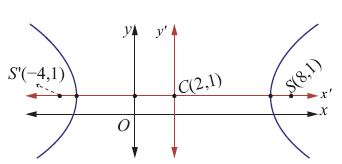
Centre (2, 1) a2 = 25, b2 = 11
c2 = a2 +b2
= 25 +11 = 36
Therefore, c = ±6
and e = \(\frac { c }{ a } =\frac { 6 }{ 5 } \)and the coordinates of foci are(8, 1) and(-4, 1) from figure.
14.
By the definition of a conic \(\frac{SP}{PM}\)= e or SP2 = e2PM2
Then, (x−2)2 + (y−3)2 = \(\frac { 1 }{ 4 } \) (x-7)2
3x2+ 4y2−2x − 24y + 3 = 0
\({ 3\left( x-\frac { 1 }{ 3 } \right) }^{ 2 }+4(y-3)^{ 2 }=3\left( \frac { 1 }{ 9 } \right) +4\times 9-3=\frac { 100 }{ 3 } \)
\(\frac { { \left( x-\frac { 1 }{ 3 } \right) }^{ 2 } }{ \frac { 100 }{ 9 } } +\frac { (y-3{ ) }^{ 2 } }{ \frac { 100 }{ 12 } } \) = 1 which is in the standard form.
Therefore, the length of major axis = 2a = 2\(\sqrt { \frac { 100 }{ 9 } = } \frac { 20 }{ 3 } \) and
the length of minor axis = 2b = 2\(\sqrt { \frac { 100 }{ 12 } = } \frac { 10 }{ \sqrt { 3 } } \).
15.
(b)
(5, 0)
16.
(a)
2
17.
(c)
10
18.
(a)
(4, 7)
19.
(c)
\(\frac { 2 }{ \sqrt { 3 } } \)

12th Standard Syllabus & Materials
12th Standard
TN 12th Computer Applications களப்பெயர் முறைமை (DNS) Sample Question Papers Study Material - QB365 Set A
NEW12th Standard
TN 12th Computer Applications வலையமைப்பு எடுத்துக்காட்டுகள் மற்றும் நெறிமுறைகள் Sample Question Papers Study Material - QB365 Set A
NEW12th Standard
TN 12th Computer Applications கணினி வலையமைப்பு ஓர் அறிமுகம் Sample Question Papers Study Material - QB365 Set A
NEW12th Standard
TN 12th Computer Applications PHP-உடன் MySQL-ஐ இணைத்தல் Sample Question Papers Study Material - QB365 Set A



Tamilnadu Stateboard 12th Standard Subjects
Maths

Chemistry

Physics

Biology

Computer Science

Business Maths and Statistics

Economics

Commerce

Accountancy

History

Computer Applications
Biology
Computer Technology
Computer Applications
Computer Science
Business Maths and Statistics
Commerce
Economics
Maths
Chemistry
Physics
Computer Technology
History
Accountancy

Tamil

English

French
Tamilnadu Stateboard Standards

