
 100% FREE ACCESS
12th Standard Syllabus & Materials
12th Standard
TN 12th Computer Applications மின்னணு தரவு பரிமாற்றம் Sample Question Papers Study Material - QB365 Set A
NEW12th Standard
TN 12th Computer Applications மின் - வணிக பாதுகாப்பு அமைப்புகள் Sample Question Papers Study Material - QB365 Set A
NEW12th Standard
TN 12th Computer Applications மின்னணு செலுத்தல் முறைகள் Sample Question Papers Study Material - QB365 Set A
NEW12th Standard
TN 12th Computer Applications மின் - வணிகம் Sample Question Papers Study Material - QB365 Set A
NEW12th Standard
TN 12th Computer Applications திறந்த மூல கருத்துருக்கள் Sample Question Papers Study Material - QB365 Set A
NEW12th Standard
TN 12th Computer Applications வலையமைப்பு வடமிடல் Sample Question Papers Study Material - QB365 Set A

Published on: 01/10/2019
Two Dimensional Analytical Geometry-II
Download Tamil Nadu 12th Standard Maths question papers, model tests, one-mark questions, important questions, and public exam papers in PDF format. Free study materials and answer keys for TN State Board students.
Questions + Answers key
Take MCQ Maths Test1.
Show that the line x + y + 1 = 0 touches the hyperbola \(\frac { { x }^{ 2 } }{ 16 } -\frac { { y }^{ 2 } }{ 15 } \) = 1 and find the co-ordinates of the point of contact
2.
Find the value of c if y = x + c is a tangent to the hyperbola 9x2 - 16y2 = 144.
3.
For the hyperbola 3x2 - 6y2 = -18, find the length of transverse and conjugate axes and eccentricity.
4.
Find the equation of the hyperbola whose conjugate axis is 5 and the distance between the foci is 13.
5.
Find the equation of the ellipse whose latus rectum is 5 and e = \(\frac { 2 }{ 3 } \)
6.
Find the equation of the ellipse whose e = \(\frac34\), foci ony-axis, centre at origin and passing through (6, 4).
7.
Find the area of th triangle found by the lines Joining the vertex of the parabola x2 = -36y to the ends of the latus rectum.
8.
Find the condition for the line lx + my + n = 0 is tangent to the circle x2 + y2 = a2
9.
Find the value of p so that 3x + 4y - p = 0 is a tangent to the circle x2 +y2 - 64 = 0.
10.
Find the circumference and area of the circle x2 +y2 - 2x + 5y + 7 = 0
1.
Given line is x + y + 1 = 0
⇒ y = -x-1
m = -1, c = -1
Equation of the hyperbola is \(\frac { { x }^{ 2 } }{ 16 } -\frac { { y }^{ 2 } }{ 15 } \) = 1
a2 = 16, b2 = 15
The condition for the line y = mx + c to be a tangent to the hyperbola is c2 = a2m2 - b2
∴ (-1)2 = 16(-1)2 - 15
1 = 16 -15
1 = 1
Since the condition is satisfied, x + y + 1 = 0 touches the hyperbola \(\frac { { x }^{ 2 } }{ 16 } -\frac { { y }^{ 2 } }{ 15 } \) = 1
The point of contact is \(\left( \frac { -{ a }^{ 2 }m }{ c } ,\frac { -{ b }^{ 2 } }{ c } \right) \) = \(\left( \frac { -16(-1) }{ -1 } ,\frac { -15 }{ -1 } \right) \) = (-16, 15)
Hence, the point of contact is (-16, 15)
2.
Given line is y = x + c
m = 1, c = c
Equation of the hyperbola is 9x2 - 16y2 = 144
\(\div \)144 we get \(\frac { { x }^{ 2 } }{ 16 } +\frac { { y }^{ 2 } }{ 9 } \) = 1
a2 = 16, b2 = 9
The condition for the line y = mx + c to be a tangent to the hyperbola is c2 = a2m2 - b2
∴ c2 = 16(1)2 - 9 = 16 - 9 = 7
∴ c = ±\(\sqrt7\)
3.
Given equation of the hyperbola is
3x2 - 6y2 = -18; \(\div \)by (-18) we get \(\frac{y^2}{3}- \frac{x^2}{6}\) = 1
The transverse axis is long y-axis.
Here a2 = 3, b2 = 6
Length of transverse axis is 2a = 2\(\sqrt { 3 } \)
Length of conjugate axis is 2b = 2\(\sqrt { 3 } \)
\(e=\sqrt { 1+\frac { { b }^{ 2 } }{ { a }^{ 2 } } } =\sqrt { 1+\frac { 6 }{ 3 } } =\sqrt { 1+2 } =\sqrt { 3 } \)
4.
Given 2b = 5 and 2ae = 13
b2 = a2( e2 - 1) - b ⇒ a \(\sqrt { { e }^{ 2 }-1 } \)
2b = 5 ⇒ 2a\(\sqrt { { e }^{ 2 }-1 } \) = 5
⇒ 4a2( e2 - 1) = 25 [squaring both sides]
⇒ 4a2e2- 4a2 = 25
⇒ (2ae)2 - 4a2 = 25
⇒ 132-4a2=25 [∵ 2ae=13]
⇒169- 25 = 4a2
⇒ 4a2= 144
⇒ a2= 36
⇒ a = 6
∴ 2b = 5 ⇒ b = \(\frac52\)⇒b2 = \(\frac{25}{4}\)
∴ Equation of the hyperbola is \(\frac { { x }^{ 2 } }{ 36 } -\frac { { y }^{ 2 } }{ \frac { 25 }{ 4 } } =1\)
\(\frac { { x }^{ 2 } }{ 36 } -\frac { { 4y }^{ 2 } }{ 25 } =1\)
5.
Let the equation of the ellipse be \(\frac { { x }^{ 2 } }{ { a }^{ 2 } } +\frac { { y }^{ 2 } }{ { b }^{ 2 } } =1\)
Given e = \(\frac { 2 }{ 3 } \) and \(\frac { 2{ b }^{ 2 } }{ a } \) = 5 ⇒ 2b2 = 5a ...(1)
∴ b2 = a2(1 - e2) = a2 \({ a }^{ 2 }\left( 1-\frac { 4 }{ 9 } \right) ={ a }^{ 2 }\left( \frac { 5 }{ 9 } \right) \)
∴ \({ 2b }^{ 2 }=\frac { 10{ a }^{ 2 } }{ 9 } \) ...(2)
From (1) and (2),
\(\frac { 10{ a }^{ 2 } }{ 9 } \) = 5a ⇒ 10a2 = 45a
10a2 - 45a = 0 ⇒ 5a(2 - 9a) = 0
⇒ a = 0 or a = \(\frac { 9 }{ 2 } \) [∵ a = 0 is not possible]
∴ \({ a }^{ 2 }=\frac { 81 }{ 4 } \)
∴ \(2{ b }^{ 2 }=\frac { 5\times 9 }{ 2 } =\frac { 45 }{ 2 } \Rightarrow { b }^{ 2 }=\frac { 45 }{ 4 } \)
∴ Equation of the ellipse is \(\frac { { x }^{ 2 } }{ \frac { 81 }{ 4 } } +\frac { { y }^{ 2 } }{ \frac { 45 }{ 4 } } =1\)
⇒ \(\frac { 4{ x }^{ 2 } }{ 81 } +\frac { 4{ y }^{ 2 } }{ 45 } =1\)
6.
Since foci are on the y-axis, equation of the ellipse is
\(\frac { { x }^{ 2 } }{ { a }^{ 2 } } +\frac { { y }^{ 2 } }{ { b }^{ 2 } } =1\)(a
b2 = a2(1 - e2) = a2\(\left( 1-\frac { 9 }{ 16 } \right) ={ a }^{ 2 }\left( \frac { 7 }{ 16 } \right) \)
⇒ \(b=\frac { a\sqrt { 7 } }{ 4 } \)
∴ Equation of the ellipse is \(\frac { { x }^{ 2 } }{ \frac { 7{ a }^{ 2 } }{ 16 } } +\frac { { y }^{ 2 } }{ { a }^{ 2 } } =1\)
\(\frac { 16(36) }{ 7{ a }^{ 2 } } +\frac { 16 }{ { a }^{ 2 } } =1\)
This passes through (6, 4)
∴ \(\frac { 16{ x }^{ 2 } }{ { 7 }a^{ 2 } } +\frac { { y }^{ 2 } }{ { a }^{ 2 } } =1\)
⇒ \(\frac { 16 }{ { a }^{ 2 } } \left( \frac { 36 }{ 7 } +1 \right) =1\) ⇒ \(\frac { 36+7 }{ 7 } =\frac { { a }^{ 2 } }{ 16 } \)
⇒ \(\frac { 43 }{ 7 } \times 16={ a }^{ 2 }\Rightarrow { a }^{ 2 }=\frac { 43\times 16 }{ 7 } \)
Substituting \({ a }^{ 2 }=\frac { 43\times 16 }{ 7 } \) is (1) we get,
\(\frac { { x }^{ 2 } }{ 7\left( \frac { 43\times 16 }{ 7 } \right) } +\frac { { y }^{ 2 } }{ \left( \frac { 43\times 16 }{ 7 } \right) } =1\)
\(\frac { { x }^{ 2 } }{ 688 } +\frac { 7{ y }^{ 2 } }{ 688 } =1\)
7.
Given equation is x2 = -36y
focus is (0, -1) = (0, -9) and latus rectum is y = -9 in (1)
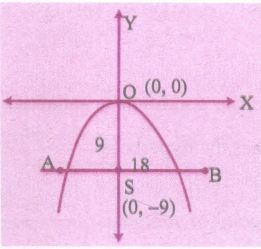
We get, x2 = -36(-9) ⇒ x = \(\sqrt { 36(9) } \) = 6(3) = 18
Area of Δ AOB = 2(area of ΔOSB)
\(=2\left( \frac { 1 }{ 2 } \times b\times h \right) =2\left( \frac { 1 }{ 2 } \times 18\times 9 \right) =162\)
[∵ b = SB = 18, h = OS = 9]
8.
Given line in Ix + my + n = 0 ....(1)
tangent at (x1, y1) to the circle x2 + y2 = 92 is
xx1 + yy1= a2 ...(2)
Comparing the co-efficients of like terms in (1)
and (2), we get, \(\frac { { x }_{ 1 } }{ l } =\frac { { y }_{ 1 } }{ m } =\frac { -{ { a }^{ 2 } } }{ n } \)
\({ x }_{ 1 }=\frac { -{ a }^{ 2 }l }{ n } \), and \({ y }_{ 1 }=\frac { -{ a }^{ 2 }m }{ n } \)
Since (x1 , y1) is a point on the circle, x21 + y21 = a2
\(\left( \frac { -{ a }^{ 2 }l }{ n } \right) +\left( \frac { -{ a }^{ 2 }m }{ n } \right) ={ a }^{ 2 }\)
\(\frac { -{ a }^{ 4 }{ l }^{ 2 } }{ { n }^{ 2 } } +\frac { { a }^{ 4 }{ m }^{ 2 } }{ { n }^{ 2 } } ={ a }^{ 2 }\)
⇒ \(-{ a }^{ 4 }{ l }^{ 2 }+{ a }^{ 4 }{ m }^{ 2 }={ a }^{ 2 }\)
\({ a }^{ 2 }({ l }^{ 2 }+{ m }^{ 2 })=1\)
9.
Equation of circle is x2 + y2 = 64
∴ a2 = 64 ⇒ a = 8
Given line is 3x+ 4y = P
4y = -3x + p
y = \(y=\frac { -3 }{ 4 } x+\frac { p }{ 4 } \)
m = \(\frac { -3 }{ 4 } \) and c = \(\frac { p }{ 4 } \)
The condition for y = mx + c to be a tangent to the circle in c2 = a2(1 + m2).
∴ \({ \left( \frac { p }{ 4 } \right) }^{ 2 }=64\left( 1+\frac { 9 }{ 16 } \right) \)
\(\Rightarrow \frac{p^{2}}{\not 16}=64\left(\frac{16+9}{\not 16}\right) \Rightarrow p^{2}=64(25)\)
\(p=\pm \sqrt { 64(25) } =\pm 8(5)\)
∴ p = ±40
10.
Given equation is x2 + y2 - 2x + 5y + 7 = 0
Here 2g = -2 ⇒ g = -1 ⇒ 2f = 5 ⇒ f = \(\frac { 5 }{ 2 } \)
c = 7
Centre is (-g, -f) = \(\left( 1,\frac { -5 }{ 2 } \right) \)
r = \(\sqrt { { g }^{ 2 }+{ f }^{ 2 }-c } =\sqrt { { 1 }^{ 2 }+{ \left( \frac { -5 }{ 2 } \right) }^{ 2 }-7 } \)
= \(\sqrt { 1+\frac { 25 }{ 4 } -7 } =\sqrt { \frac { 25 }{ 4 } -6 } =\sqrt { \frac { 1 }{ 4 } } =\frac { 1 }{ 2 } \)
∴ Cireumferenee of elrele = 2πr = 2π\(\left( \frac { 1 }{ 2 } \right) \) = π units
Area of the circle = πr2 = π\({ \left( \frac { 1 }{ 2 } \right) }^{ 2 }\) = \(\frac { \pi }{ 4 } \) sq.units

12th Standard Syllabus & Materials
12th Standard
TN 12th Computer Applications களப்பெயர் முறைமை (DNS) Sample Question Papers Study Material - QB365 Set A
NEW12th Standard
TN 12th Computer Applications வலையமைப்பு எடுத்துக்காட்டுகள் மற்றும் நெறிமுறைகள் Sample Question Papers Study Material - QB365 Set A
NEW12th Standard
TN 12th Computer Applications கணினி வலையமைப்பு ஓர் அறிமுகம் Sample Question Papers Study Material - QB365 Set A
NEW12th Standard
TN 12th Computer Applications PHP-உடன் MySQL-ஐ இணைத்தல் Sample Question Papers Study Material - QB365 Set A



Tamilnadu Stateboard 12th Standard Subjects
Maths

Chemistry

Physics

Biology

Computer Science

Business Maths and Statistics

Economics

Commerce

Accountancy

History

Computer Applications
Biology
Computer Technology
Computer Applications
Computer Science
Business Maths and Statistics
Commerce
Economics
Maths
Chemistry
Physics
Computer Technology
History
Accountancy

Tamil

English

French
Tamilnadu Stateboard Standards

