
 100% FREE ACCESS
12th Standard Syllabus & Materials
12th Standard
TN 12th Maths Applications of Matrices and Determinants Sample Question Papers Study Material - QB365 Set A
NEW12th Standard
TN 12th Computer Applications மின்னணு தரவு பரிமாற்றம் Sample Question Papers Study Material - QB365 Set A
NEW12th Standard
TN 12th Computer Applications மின் - வணிக பாதுகாப்பு அமைப்புகள் Sample Question Papers Study Material - QB365 Set A
NEW12th Standard
TN 12th Computer Applications மின்னணு செலுத்தல் முறைகள் Sample Question Papers Study Material - QB365 Set A
NEW12th Standard
TN 12th Computer Applications மின் - வணிகம் Sample Question Papers Study Material - QB365 Set A
NEW12th Standard
TN 12th Computer Applications திறந்த மூல கருத்துருக்கள் Sample Question Papers Study Material - QB365 Set A

Published on: 04/11/2019
Atomic and Nuclear Physics
Download Tamil Nadu 12th Standard Physics question papers, model tests, one-mark questions, important questions, and public exam papers in PDF format. Free study materials and answer keys for TN State Board students.
Questions + Answers key
Take MCQ Physics Test1.
Calculate the amount of energy released when 1 kg of \(_{ 92 }^{ 235 }{ U }\) undergoes fission reaction.
2.
Assuming that energy released by the fission of a single \(_{ 92 }^{ 235 }{ U }\) nucleus is 200MeV, calculate the number of fissions per second required to produce 1-watt power.
3.
Keezhadi ((கீழடி),a small hamlet, has become one of the very important archaeological places of Tamilnadu. It is located in Sivagangai district. A lot of artefacts (gold coins, pottery, beads, iron tools, jewellery and charcoal, etc.) have been unearthed in Keezhadi which have given substantial evidence that an ancient urban civilization had thrived on the banks of river Vaigai. To determine the age of those materials, the charcoal of 200 g sent for carbon dating is given in the following figure (b). The activity of \(_{ 6 }^{ 14 }{ C }\) is found to be 37 decays/s. Calculate the age of charcoal.
.JPG)
Figure (a) Keezhadi – excavation site
.JPG)
Figure (b) – Characol which was sent for carbon dating
4.
A piece of ancient wood shows an activity of 3.9 disintegrations per second per gram of 14C. Calculate the age of the wood. T1/2 of 14C= 5568 years. Activity of fresh 14C= 15.6 disintegrations/s/gram.
5.
About 185 MeV of usable energy is released by the neutron-induced fissioning of a \(_{ 92 }^{ 235 }{ U }\) nucleus. If the reactor using \(_{ 92 }^{ 235 }{ U }\) as fuel continuously generates 100 MW of power, how long will it take for 1 kg of the uranium to be used up?
6.
Radon-222 is a radioactive gas for which the decay constant is 2.1 x 10⁻⁶s-1. If the initial decay rate is 5.6 x 10¹⁰s-1, calculate:
(i) the initial number of radioactive atoms present and
(ii) the time which will elapse before the activity is reduced to one-quarter of Its initial value. Given: loge 2 =0.693.
7.
A radioactive nucleus X converts into stable nucleus Y. Half-life of X is 50 years. Calculate the age of the radioactive sample when the ratio of X and Y is 1:15.
8.
In a nuclear reactor, \(_{ }^{ 235 }U{ }\) undergoes fission liberating 200 MeV of energy. The reactor has a 10% efficiency and produces 1000 MW power. If the reactor is to function for 10 years, find the total mass of uranium required.
9.
Write the application of alpha decay in smoke detectors.
10.
Explain the results of Rutherford α-particle scattering experiment.
1.
235 g of \(_{ 92 }^{ 235 }{ U }\) has 6.02 x 10²³ atoms. In one gram of \(_{ 92 }^{ 235 }{ U }\), the number of atoms is equal to \(\frac { 6.02\times { 10 }^{ 23 } }{ 235 } =2.56\times { 10 }^{ 21 }\)
So the number of atoms in 1 kg of \(_{ 92 }^{ 235 }{ U }\) = 2.56 x 1021 x 1000 = 2.56 x 1024
Each \(_{ 92 }^{ 235 }{ U }\) nucleus releases 200 MeV of energy during the fission. The total energy released by 1kg of \(_{ 92 }^{ 235 }{ U }\) is
Q = 2.56 x 1024 x 200MeV = 5.12 x 1026 MeV
In terms of joules,
Q = 5.12 x 1026 x 1.6 x 10-13 J = 8.192 x 10¹³ J
In terms of Kilowatt hour,
Q = \(\frac { 8.192\times { 10 }^{ 13 } }{ 3.6\times { 10 }^{ 6 } } =2.27\times { 10 }^{ 7 }\) kWh
2.
Energy produced per second in reactor = 1 W = 1 J/s
Energy produced per fission = 200 MeV = 200 x 106 x 1.6 x 10-19 J
= 3.2 x 10¹¹ J
Number of fissions per second required \(=\frac{\text { Energy produced per second in reactor }}{\text { Energy produced per fission }} \)
\(=\frac{1}{3.2 \times 10^{11}}=\frac{10 \times 10^{10}}{3.2}=3.125 \times 10^{10} \)
Number of fissions per second = 3.125 x 10¹⁰
3.
To calculate the age, we need to know the initial activity (R0) of the caracol (when the sample was alive).
The activity R of the sample
R = R0 e-λt ...(1)
To find the time t, rewriting the above equation (1),
\({ e }^{ \lambda t }=\frac { { R }_{ 0 } }{ R } \)
By taking the logarithm on both sides, we get \(t=\frac { 1 }{ \lambda } In\left( \frac { { R }_{ 0 } }{ R } \right) \) ..(2)
Here R = 38 decays/s = 38 Bq.
To find decay constant, we use the equation
\(\lambda =\frac { 0.6931 }{ { T }_{ 1/2 } } =\frac { 0.6931 }{ 5730yr\times 3.156\times { 10 }^{ 7 }s/yr } \)
[∴ 1yr = 365.25 x 24 x 60 x 60 s = 3.156 x 10⁷ s]
λ = 3.83 x 10⁻¹² s−1
To find the initial activity R0, we use the equation R0 = λN0. Here N0 is the number of carbon-14 atoms present in the sample when it was alive. The mass of the charcoal is 200 g. In 12 g of carbon, there are 6.02 x 10²³ carbon atoms. So 200 g contains,
\(\frac { 6.02\times { 10 }^{ 23 }atoms/mol }{ 12g/mol } \times 200\approx 1\times { 10 }^{ 25 }\) atoms
When the tree(sample) was alive, the ratio of \(_{ 6 }^{ 14 }{ C }{ e }\) to \(_{ 6 }^{ 12 }{ C }{ e }\) is 1.3 x 10⁻¹². So the total number of carbon-14 atoms is given by
N0 = 1 x 1025 x 1.3 x 10-12 atoms
The initial activity
R0 = 3.83 x 10-12 x 1.3 x 1013 ≈ 50 decays / s
= 50 Bq
By substituting the value of R0 and λ in the equation (2), we get
\(t=\frac { 1 }{ 3.83\times { 10 }^{ -12 } } \times In\left[ \frac { 50 }{ 37 } \right] \)
\(t=\frac { 0.301 }{ 3.83 } \times { 10 }^{ 12 }\approx 7.86\times { 10 }^{ 10 }\)sec
In years
\(t=\frac { 7.86\times { 10 }^{ 10 }s }{ 3.156\times { 10 }^{ 7 }s/yr } \approx 2500\) years
In fact, the excavated materials were to USA sent for carbon dating by the Archeological Department of Tamilnadu and the report confirmed that the age of Keezhadi artifacts lies between 2200 years to 2500 years (Sangam era- 400 BC to 200 BC). The Keezhadi excavations experimentally proved that urban civilization existed in Tamil Nadu even 2000 years ago!
4.
λN = 3.9
λNo = 1.6
\(\frac { N }{ { N }_{ o } } =\frac { 3.9 }{ 15.6 } =\frac { 1 }{ 4 } ={ e }^{ -\lambda t }\)
\({ e }^{ -\lambda t }=\frac { N }{ { N }_{ o } } =4\)
λt = loge 4
= 2.303 x log104
5.
A number of fissions occurring/s to give an energy output of 100 MW (= 108 Js-1).
= \(\frac { { 10 }^{ 8 }{ Js }^{ -1 } }{ 185\times { 10 }^{ 6 }\times 1.6\times { 10 }^{ -19 }J } \)
= 3.378 x10¹⁸ fission s-1
Number of nuclei contained in 1 kg of \(_{ }^{ 235 }{ U }\)
\(\frac { 1kg }{ 235kg/k \ mol } \times 6.023\times { 10 }^{ 26 }\frac { nuclei }{ k \ mol } \)
= 2.563 x 1024nuclei
Time taken to exhaust 1 kg.of \(_{ }^{ 235 }{ U }\)
= \(\frac { 2.563\times { 10 }^{ 24 } }{ 3.378\times { 10 }^{ 18 } } \) second
= 8.78 days.
6.
(i) Initial decay rate = λN0
5.6 x 1010 = 2.1 X 10⁻⁶No
or N0 = \(\frac { 5.6\times { 10 }^{ 10 } }{ 2.2\times { 10 }^{ -16 } } =2.67\times { 10 }^{ 16 }\)
(ii) Activity at any time t is proportional to the number of atoms present at time t
\(N=\frac { { N }_{ 0 } }{ 4 } \)
Now, \(\frac { { N }_{ 0 } }{ 4 } ={ N }_{ 0 }\) or \({ e }^{ -\lambda t }=4\)
Taking logs, λt = log 4 = 2 loge 2 = 2 x 0.693
\(t=\frac { 2\times 0.693 }{ \lambda } =\frac { 2\times 0.693 }{ 2.1\times { 10 }^{ -6 } } s\)
= 0.66 x 10⁶ s = 6.6 x 10⁵ S
7.
Let the initial number of nuclei X = No
Number of nuclei of X left at any time t = Nx
Number of nuclei of Y at any time t = No-Nx = Ny
Now, NX = N0e-λt
NY = N0 - NX = Noe-λt
It is given that \(\frac { { N }_{ X } }{ { N }_{ Y } } =\frac { 1 }{ 15 } \)
\(\frac { { N }_{ o }{ e }^{ -\lambda t } }{ { N }_{ o }({ 1-e }^{ -\lambda t }) } =\frac { 1 }{ 15 } \ or \ { e }^{ -\lambda t }=1\)
e-λt = 16
\(\lambda t={ log }_{ e }2^{ 4 }=4\times { log }_{ e }2=4\times 0.693\)
\(t=4\times \frac { 0.693 }{ \lambda } \)
\(t=4\times { T }_{ 1/2 }=4\times 50=200\) years
8.
The reactor produces 1000 MW power or 109 W power or 109 Js-1 of power. The reactor is to function for 10 years. Therefore, total energy which the reactor will supply in 10 years is
E = (Power) (time)
= (109 Js-1) (10 x 365 x 24 x 3600 s)
= 3.1536 x 10¹⁷ J.
But since the efficiency of the reactor is only 10%, therefore actual energy needed is 10 times of it or 3.1536 x 10¹⁸ J. One uranium atom liberates 200 MeV of energy or 200 x 1.6 x 10-13 J or 3.2 x 10⁻¹¹ J of energy. So number of uranium atoms needed are
\(\frac { 3.1536\times { 10 }^{ 18 } }{ 3.2\times { 10 }^{ -11 } } =0.9855\times { 10 }^{ 29 }\)
or number of kg-moles of uranium needed are
\(n=\frac { 0.9855\times { 10 }^{ 29 } }{ 6.20\times { 10 }^{ 26 } } =163.7\)
Hence total mass of uranium required is
m = (n) M = (163.7) (235) kg
or m = 38470 kg.
or m = 3.847 x 10⁴ g
9.
(i) The smoke detector uses around 0.2 mg of a man-made weak radioactive isotope called americium \((_{ 95 }^{ 241 }{ Am })\)
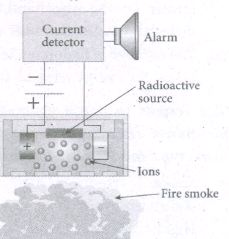
(ii) This radioactive source is placed between two oppositely charged metal plates and α radiations from \(_{ 95 }^{ 241 }{ Am }\) continuously ionize the nitrogen, oxygen molecules in the air space between the plates
(iii) As a result, there will be a continuous flow of small steady currents in the circuit.
(iv) If smoke enters, the radiation is being absorbed by the smoke particles rather than air molecules.
(v) As a result, the ionization and along with it the current is reduced. This drop-in current is detected by the circuit and the alarm starts.
(vi) The radiation dosage emitted by americium is very much less than the safe level, so it can be considered harmless.
10.
(i) In 1911, Geiger and Marsden did a remarkable experiment based on the advice of their teacher Rutherford, which is known as the scattering of alpha particles by gold foil.
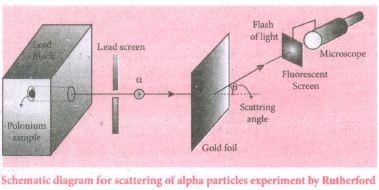
(ii) The experimental arrangement. A source of alpha particles (radioactive material, for example, polonium) is kept inside a thick lead box, with a fine hole.
(iii) The alpha particles coming through the fine hole of the lead box pass through another fine hole made on the lead screen. These particles are now allowed to fall on a thin gold foil and it is observed that the alpha particles passing through gold foil are scattered through different angles.
(iv) A movable screen (from 0° to 180°) which is made up of zinc sulphide (ZnS) is kept on the other side of the gold foil to collect the alpha particles. Whenever alpha particles strike the screen, a flash of light is observed which can be seen through a microscope.
(v) Rutherford proposed an atom model based on the results of alpha scattering. experiment.
(vi) In this experiment, alpha particles (positively charged particles) are allowed to fall on the atoms of a metallic gold foil. The results of this experiment. Rutherford expected the nuclear model, but the experiment showed the model.
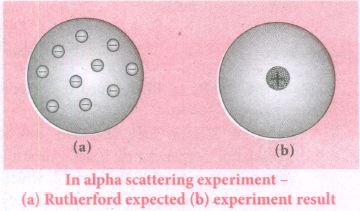
(a) Most of the alpha particles were un-deflected through the gold and went straight.
(b) Some of the alpha particles are deflected through a small angle.
(c) A few alpha particles (one in a thousand) are deflected through an angle more than 90°.
(d) Very few alpha particles returned back (backscattered) that is, deflected back by 180°.

12th Standard Syllabus & Materials
12th Standard
TN 12th Computer Applications வலையமைப்பு வடமிடல் Sample Question Papers Study Material - QB365 Set A
NEW12th Standard
TN 12th Computer Applications களப்பெயர் முறைமை (DNS) Sample Question Papers Study Material - QB365 Set A
NEW12th Standard
TN 12th Computer Applications வலையமைப்பு எடுத்துக்காட்டுகள் மற்றும் நெறிமுறைகள் Sample Question Papers Study Material - QB365 Set A
NEW12th Standard
TN 12th Computer Applications கணினி வலையமைப்பு ஓர் அறிமுகம் Sample Question Papers Study Material - QB365 Set A



Tamilnadu Stateboard 12th Standard Subjects

Maths

Chemistry
Physics

Biology

Computer Science

Business Maths and Statistics

Economics

Commerce

Accountancy

History

Computer Applications
Biology
Computer Technology
Computer Applications
Computer Science
Business Maths and Statistics
Commerce
Economics
Maths
Chemistry
Physics
Computer Technology
History
Accountancy

Tamil

English

French
Tamilnadu Stateboard Standards

