
 100% FREE ACCESS
12th Standard Syllabus & Materials
12th Standard
TN 12th Computer Applications மின்னணு தரவு பரிமாற்றம் Sample Question Papers Study Material - QB365 Set A
NEW12th Standard
TN 12th Computer Applications மின் - வணிக பாதுகாப்பு அமைப்புகள் Sample Question Papers Study Material - QB365 Set A
NEW12th Standard
TN 12th Computer Applications மின்னணு செலுத்தல் முறைகள் Sample Question Papers Study Material - QB365 Set A
NEW12th Standard
TN 12th Computer Applications மின் - வணிகம் Sample Question Papers Study Material - QB365 Set A
NEW12th Standard
TN 12th Computer Applications திறந்த மூல கருத்துருக்கள் Sample Question Papers Study Material - QB365 Set A
NEW12th Standard
TN 12th Computer Applications வலையமைப்பு வடமிடல் Sample Question Papers Study Material - QB365 Set A

Published on: 03/12/2019
Atomic and Nuclear Physics
Download Tamil Nadu 12th Standard Physics question papers, model tests, one-mark questions, important questions, and public exam papers in PDF format. Free study materials and answer keys for TN State Board students.
Questions + Answers key
Take MCQ Physics Test1.
The total energy of electrons in the ground state of a hydrogen atom is -13.6 eV. The k.E of an electron in the first excited state is ____________.
6.8 eV
13.6 eV
1.7 eV
3.4 eV
2.
The ionization energy of hydrogen atom is -13.6e V. The energy corresponding to a transition between 3rd and 4th orbit is ______________.
3.40 eV
1.51 eV
0.85 eV
0.66 eV
3.
The half-life period of a radioactive element A is same as the mean life time of another radioactive element B. Initially both have the same number of atoms. Then _____.
A and B have the same decay rate initially
A and B decay at the same rate always
B will decay at faster rate than A
A will decay at faster rate than B
4.
A radioactive nucleus (initial mass number A and atomic number Z) emits two α-particles and 2 positons. The ratio of number of neutrons to that of proton in the final nucleus will be _____.
\(\frac{A-Z-4}{Z-2}\)
\(\frac{A-Z-2}{Z-6}\)
\(\frac{A-Z-4}{Z-6}\)
\(\frac{A-Z-12}{Z-4}\)
5.
The electric potential of an electron is given by \(V={ V }_{ 0 } \ In\left( \frac { r }{ { r }_{ 0 } } \right) \), where r0 is a constant. If Bohr atom model is valid, then variation of radius of nth orbit rn with the principal quantum number n is _____.
\({ r }_{ n }∝ \frac { 1 }{ n } \)
\({ r }_{ n }∝ n\)
\({ r }_{ n }∝\frac { 1 }{ { n }^{ 2 } } \)
\({ r }_{ n }∝ { n }^{ 2 }\)
6.
What causes the sun to expand?
7.
Why neutrons in the nucleus are stable?
8.
Calculate the number of nuclei of carbon-14 undecayed after 22,920 years if the initial number of carbon-14 atoms is 10,000. The half-life of carbon-14 is 5730 years.
9.
10.
Define atomic mass unit u.
11.
What is isotope? Give an example.
12.
What are radioactive elements? What are the factors that affect radio activity?
13.
With respect to power generation, what are the relative advantages and disadvantages of fusion type and Fission type reactors?
14.
Calculate the radius of the earth if the density of the earth is equal to the density of the nucleus.[mass of earth 5.97 x 1024 kg].
15.
Explain in detail the four fundamental forces in nature.
16.
Discuss the properties of neutrino and its role in beta decay.
17.
Discuss the process of nuclear fission and its properties.
1.
(d)
3.4 eV
2.
(d)
0.66 eV
3.
TA1/2 = ፒB
\(\frac{0.6931}{\lambda_{\mathrm{A}}}=\frac{1}{\lambda_{\mathrm{B}}} \)
\(\lambda_{\mathrm{B}}=\frac{\lambda_{\mathrm{A}}}{0.6931}=1.44 \lambda_{\mathrm{A}}\)
Hence, B will decay at faster rate than A
4.
AZX = 242He + 201e + Ai2iY
\(\frac{N_i}{Z_i}=\frac{(A_i-Z_i)}{Z_i} =\frac{A-8-(Z-6)}{Z-6}=\frac{A-Z-2}{Z-6}\)
5.
Electric potential in nth orbit
\(\mathrm{V} =\mathrm{V}_0 \ln \left(\frac{\mathrm{r}_{\mathrm{n}}}{\mathrm{r}_0}\right) \)
\(=\mathrm{V}_0\left(\ln \mathrm{r}_{\mathrm{n}}-\ln \mathrm{r}_0\right) \)
\(=\mathrm{V}_0 \ln \mathrm{r}_{\mathrm{n}}-\mathrm{V}_0 \ln \mathrm{r}_0\)
\(\left|\mathrm{F}_\epsilon\right|=\mathrm{e} \frac{\mathrm{dv}}{\mathrm{dr}} =\mathrm{e} \frac{\mathrm{d}}{\mathrm{dr}}\left(\mathrm{V}_b / n \mathrm{r}_B-\mathrm{V}_0 / m \mathrm{r}_0\right) \)
\(=\mathrm{c}\left(\frac{\mathrm{V}_0}{\mathrm{r}_n}-0\right)=\frac{\mathrm{eV}}{\mathrm{r}_{\mathrm{n}}} \)
Centripetal force = coulomb force
\(\frac{m v^2}{r_n}=\mathrm{c} \frac{V_0}{r_n} \Rightarrow v=\sqrt{\frac{e V_0}{m}}=\text { constant }\)
Angular momentum,
\(\mathrm{mvr}_n=\frac{\mathrm{nh}}{2 \pi}\)
\(\mathrm{m}, \mathrm{v}, \mathrm{h}, 2 \pi\) are constants
hence, rn ∝ n
6.
When the hydrogen is burnt out, the sun will enter into a new phase called the red giant where helium will fuse to become carbon. During this stage, the sun will expand greatly in size and all its planets will be engulfed in it
7.
Neutrons are stable inside the nucleus. But outside the nucleus they are unstable. If the neutron comes out of the nucleus (free neutron), it decays with the emission of proton, electron, and antineutrino with a half-life of 13 minutes.
8.
To get the time interval in terms of half life, \(n=\frac { t }{ { T }_{ 1/2 } } =\frac { 22,920 \ yr }{ 5730 \ yr } =4\)
The number of nuclei remaining undecayed after 22,920 years,
\(N={ \left( \frac { 1 }{ 2 } \right) }^{ n }{ N }_{ 0 }={ \left( \frac { 1 }{ 2 } \right) }^{ 4 }\times 10,000\)
N = 625
9.
10.
One atomic mass unit (u) is defined as the (1/12)th of the mass of the isotope of carbon \(_{ 6 }^{ 12 }{ C }\)
\(\mathrm{lu}=\frac{\text { mass of }_{6}^{12} \mathrm{C} \text { atom }}{12}=\frac{1.9926 \times 10^{-26}}{12}=1.660 \times 10^{-27} \mathrm{~kg}\)
11.
Isotopes are atoms of the same element having same atomic number Z, but different mass number A.
(Ex: Hydrogen, \(_{ 1 }^{ 1 }{ H }\) ((hydrogen), \(_{ 1 }^{ 2 }{ H }\) (deuterium),and \(_{ 1 }^{ 3 }{ H }\) (tritium))
12.
(i) The phenomenon of spontaneous emission of highly penetrating radiations such as α, β, γ rays by heavy elements having atomic number greater than 82 is called radioactivity and the substances which emit these radiations are called radioactive elements.
(ii) The radioactive phenomenon spontaneous and is unaffected by any external agent like temperature, pressure, and magnetic fields.
13.
(i) Fusion requires high temperature controlled reaction is not yet obtained. Highly sophisticated technology will be required.
(ii) However, the fuel is easily available, cheap and causes very less pollution.
(iii) There is no problem of waste management.
(iv) Fission controlled chain reaction is possible. The technology is well developed and established.
(v) There also exists the problem of waste management.
14.
Density \(\rho=2.3 \times 10^{17} \mathrm{kgm}^{-3}\), Mass M = 5.97 x 1024 kg
\(\rho=\frac{M}{V}=\frac{M}{\frac{4}{3}\pi R^3}\)
\(R=\left[\frac{M}{\frac{4}{3} \pi \rho}\right]^{\frac{1}{3}}=\left[\frac{3 \mathrm{M}}{4 \pi \rho}\right]^{\frac{1}{3}}=\left[\frac{3 \times 5.97 \times 10^{24}}{4 \times 3.14 \times 2.3 \times 10^{17}}\right]^{\frac{1}{3}}=\left[0.62 \times 10^{7}\right]^{\frac{1}{3}}\)
R = 183.7 m
R ≈180 m
15.
Fundamental forces of nature:
(i) It is known that there exists gravitational force between two masses and it is universal in nature. Our planets are bound to the Sun through gravitational force of the Sun.
(ii) ''Force is the external agency applied on a body to change its state of rest and motion"
There are four basic forces in nature.
(a) Gravitational force
(b) Electromagnetic force
(c) Strong nuclear force
(d) Weak nuclear force.
(a) Gravitational force :
(i) It is the force between any two objects in the universe.
(ii) It is an attractive force by virtue of their masses
(iii) By Newton's law of gravitation, the gravitational force is directly proportional to the product of the masses and inversely proportional to the square of the distance between them.
(iv) Gravitational force is the weakest force among the fundamental forces of nature but has the greatest large-scale impact on the universe.
(v) Unlike the other forces, gravity works universally on all matter and energy, and is universally attractive.
(b) Electromagnetic force :
(i) It is the force between charged particles or the force between two current carrying wires.
(ii) It is attractive for unlike charges and repulsive for like charges.
(iii) The electromagnetic force obeys inverse square law.
(iv) It is very strong compared to the gravitational force.
(v) It is the combination of electrostatic and magnetic forces.
(c) Strong nuclear force :
(i) It is the strongest of all the basic forces of nature.
(ii) It, however, has the shortest range, of the order of 10-15 m.
(iii) This force holds the protons and neutrons together in the nucleus of an atom.
(d) Weak nuclear force :
(i) Weak nuclear force is even shorter in range than nuclear force.
(ii) This force plays an important role in beta decay and energy production of stars
(iii) During the fusion of hydrogen into helium in sun, neutrinos and enormous radiations are produced through weak force.
(iv) In our day to - day life, we require these four fundamental forces.
To put it in simple words :
(a) we are in the Earth because of Earth's gravitational attraction on our body.
(b) We are standing on the surface of the earth because of the electromagnetic force between atoms of the surface of the earth with atoms in our foot.
(c) The atoms in our body are stable because of strong nuclear force.
(d) Finally, the lives of species in the earth depend on the solar energy from the sun and it is due to weak force which plays vital role during nuclear fusion reactions going on in the core of the sun.
16.
The neutrino has the following properties:
(i) It has zero charge
(ii) It has an antiparticle called anti-neutrino
(iii) Recent experiments showed that the nutrino has very small mass.
(iv) It interacts very weakly with the matter therefore, it is very difficult to detect it.
(v) In every second trillion of neutrino coming from the sun are passing through our body without any interaction.
Initially, it was thought that during beta decay, a neutron in the parent nucleus is converted to the daughter nuclei by emitting only electron as given by
\({ }_{\mathrm{Z}}^{\mathrm{A}} \mathbf{X} \rightarrow \underset{\mathrm{Z}+1}{\mathrm{~A}} \mathbf{Y}+\mathrm{e}^{-}\)
(i) But the kinetic energy of electron coming out of the nucleus did not match with the experimental results.
(ii) In beta decay, the beta particle (i.e, electron) have a continuous range of energies. But the conservation of energy and momentum gives specific single values for electron energy and the recoiling nucleus Y It seems that the conservation of energy, momentum is violated and could not be explained. So beta decay remained as a puzzle for several years.
(iii) But later w. Pauli proposed a third particle which must be present in beta decay to carry away missing energy and momentum.
(iv) Fermi later named this particle the neutrino.
(v) Finally, the neutrino was detected experimentally in 1956 by Fredrick Reines and Clyde Cowan.
17.
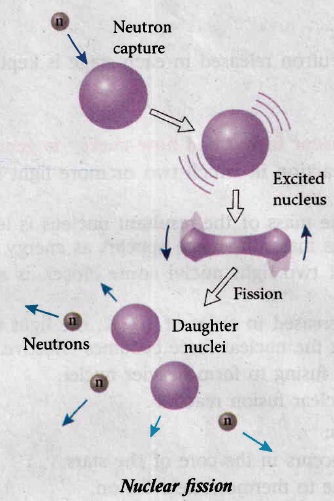
(i) The process of breaking up of the nucleus of a heavier atom into two smaller nuclei with the release of a large amount of energy is called nuclear fission.
Examples :
\(_{ 92 }^{ 235 }{ U+ }_{ 0 }^{ 1 }{ n }\rightarrow _{ 92 }^{ 236 }{ { U }^{ * } }\rightarrow _{ 56 }^{ 141 }{ Ba }+_{ 36 }^{ 92 }{ Kr }+3_{ 0 }^{ 1 }{ n }+Q\)
\(_{ 92 }^{ 235 }{ U+ }_{ 0 }^{ 1 }{ n }\rightarrow _{ 92 }^{ 236 }{ { U }^{ * } }\rightarrow _{ 54 }^{ 140 }Xe+_{ 38 }^{ 94 }{ Sr }+2_{ 0 }^{ 1 }{ n }+Q\)
(ii) When the slow neutron is absorbed by the uranium nuclei, the mass number increases by one and goes to an excited state \(_{ 92 }^{ 235 }{ U }\).
(iii) But this excited state does not last longer than 10-12s and decay into two daughter nuclei along with 2 or 3 neutrons.
Energy released in fission :
(i) We can calculate the energy (Q) released in each uranium fission reaction. We choose the most observed fission reaction which is given in the equation.
\(_{ 92 }^{ 235 }{ U+ }_{ 0 }^{ 1 }{ n }\rightarrow _{ 92 }^{ 236 }{ { U }^{ * } }\rightarrow _{ 56 }^{ 141 }{ Ba }+_{ 36 }^{ 92 }{ Kr }+3_{ 0 }^{ 1 }{ n }+Q\)
Mass of \({ }_{92}^{235} \mathrm{U}\) = 235.045733 u
Mass of \(_{ 0 }^{ 1 }{ n }\) = 1.008665 u
Total mass of reactants = 236.054398 u
Mass of \(_{ 56 }^{ 141 }{ Ba }\) = 140.9177 u
Mass of \(_{ 92 }^{ 36 }{ Kr }\) = 91.8854u
Mass of 3 neutrons = 3.025995 u
The total mass of products = 235.829095 u
Mass detect m =236.054398 u - 235.829095 u
= 0.225303u
So the energy released in each fission
= 0.225303 x 931 MeV = 200.MeV
(ii) This energy first appears as kinetic energy of daughter nuclei and neutrons. But later, this kinetic appears in the form of heat given to the surrounding.
Properties :
(i) The fission is accompanied by the release of neutrons. From each reaction, on an average, 2.5 neutrons are emitted.
(ii) The energy released in the nuclear fission is many times greater than the energy released in chemical reactions.
(iii) Energy released per fission is 200 MeV.

12th Standard Syllabus & Materials
12th Standard
TN 12th Computer Applications களப்பெயர் முறைமை (DNS) Sample Question Papers Study Material - QB365 Set A
NEW12th Standard
TN 12th Computer Applications வலையமைப்பு எடுத்துக்காட்டுகள் மற்றும் நெறிமுறைகள் Sample Question Papers Study Material - QB365 Set A
NEW12th Standard
TN 12th Computer Applications கணினி வலையமைப்பு ஓர் அறிமுகம் Sample Question Papers Study Material - QB365 Set A
NEW12th Standard
TN 12th Computer Applications PHP-உடன் MySQL-ஐ இணைத்தல் Sample Question Papers Study Material - QB365 Set A



Tamilnadu Stateboard 12th Standard Subjects

Maths

Chemistry
Physics

Biology

Computer Science

Business Maths and Statistics

Economics

Commerce

Accountancy

History

Computer Applications
Biology
Computer Technology
Computer Applications
Computer Science
Business Maths and Statistics
Commerce
Economics
Maths
Chemistry
Physics
Computer Technology
History
Accountancy

Tamil

English

French
Tamilnadu Stateboard Standards

