
 100% FREE ACCESS
12th Standard Syllabus & Materials
12th Standard
TN 12th Computer Applications மின்னணு தரவு பரிமாற்றம் Sample Question Papers Study Material - QB365 Set A
NEW12th Standard
TN 12th Computer Applications மின் - வணிக பாதுகாப்பு அமைப்புகள் Sample Question Papers Study Material - QB365 Set A
NEW12th Standard
TN 12th Computer Applications மின்னணு செலுத்தல் முறைகள் Sample Question Papers Study Material - QB365 Set A
NEW12th Standard
TN 12th Computer Applications மின் - வணிகம் Sample Question Papers Study Material - QB365 Set A
NEW12th Standard
TN 12th Computer Applications திறந்த மூல கருத்துருக்கள் Sample Question Papers Study Material - QB365 Set A
NEW12th Standard
TN 12th Computer Applications வலையமைப்பு வடமிடல் Sample Question Papers Study Material - QB365 Set A

Published on: 30/10/2019
Atomic and Nuclear Physics
Download Tamil Nadu 12th Standard Physics question papers, model tests, one-mark questions, important questions, and public exam papers in PDF format. Free study materials and answer keys for TN State Board students.
Questions + Answers key
Take MCQ Physics Test1.
Mp denotes the mass of the proton and Mn denotes mass of a neutron. A given nucleus of binding energy B, contains Z protons and N neutrons. The mass M(N, Z) of the nucleus is given by _____.(where c is the speed of light)
M (N,Z) = NMn + ZMp - Bc2
M (N,Z) = NMn + ZMp + Bc2
M (N,Z) = NMn + ZMp - B/c2
M (N,Z) = NMn + ZMp + B/c2
2.
The nucleus is approximately spherical in shape. Then the surface area of nucleus having mass number A varies as _____.
A2/3
A4/3
A1/3
A5/3
3.
If the nuclear radius of 27Al is 3.6 fermi, the approximate nuclear radius of 64Cu, in femi is _____.
2:4
1.2
4.8
3.6
4.
Atomic number of H-like atom with ionization potential 122.4 V for n = 1 is _____.
1
2
3
4
5.
In a hydrogen atom, the electron revolving in the fourth orbit, has angular momentum equal to _____.
h
\(\frac{h}{\pi}\)
\(\frac{4h}{\pi}\)
\(\frac{2h}{\pi}\)
6.
What is isotope? Give an example.
7.
Define the ionization energy and ionization potential.
8.
Calculate the mass defect and the binding energy per nucleon of the \(_{ 47 }^{ 108 }{ Ag }\) nucleus. [atomic mass of Ag = 107.905949]
9.
Calculate the radius of the earth if the density of the earth is equal to the density of the nucleus.[mass of earth 5.97 x 1024 kg].
10.
Briefly explain the elementary particles present in nature.
11.
Discuss the beta decay process with examples.
12.
Write down the draw backs of Bohr atom model.
13.
Discuss the process of nuclear fission and its properties.
1.
B = ∆m x c2
∆m = \(\frac{B}{c^2}\)
N Mn + Z Mp - M(N,Z) = \(\frac{B}{c^2}\)
N (N,Z) = N Mn + ZMp - \(\frac{B}{c^2}\)
2.
r ∝ A1/3
Surface Area = 4πr2
Hence, Surface Area ∝ A2/3
3.
\(r \propto A^{\frac{1}{3}} \)
\(\frac{r_{\mathrm{Cu}}}{\mathrm{r}_{\mathrm{Al}}}=\frac{\mathrm{A}_{\mathrm{Cu}}^\frac{1}{3}}{\mathrm{~A}_{\mathrm{Al}}^{\frac{1}{3}}}=\frac{4}{3} \)
\(\mathrm{r}_{\mathrm{Cu}}=\frac{4}{3} \times 3.6 \mathrm{~F}=4.8 \mathrm{~F}\)
4.
\(V_{ionisation}=\frac{13.6}{n^2}Z^2 volt\)
\(Z=\sqrt\frac{V\times n^2}{13.6}=\sqrt\frac{122.4 \times I^2}{13.6}=\sqrt{9}=3\)
5.
\(L=\frac{nh}{2\pi}=\frac{4h}{2\pi}=\frac{2h}{\pi}\)
6.
Isotopes are atoms of the same element having same atomic number Z, but different mass number A.
(Ex: Hydrogen, \(_{ 1 }^{ 1 }{ H }\) ((hydrogen), \(_{ 1 }^{ 2 }{ H }\) (deuterium),and \(_{ 1 }^{ 3 }{ H }\) (tritium))
7.
(i) Minimum energy required to remove an electron from an atom in the ground state is known as binding energy or ionization energy.
(ii) Ionization potential is defined as ionization energy per unit charge.
8.
A = 108, Z =47, N = 108 - 47 = 61
mp = 1.007825 u, mn = 1.008665 u, M = 107.905949 u
(a) \(\Delta \mathrm{m}=Z \mathrm{~m}_{\mathrm{P}}+\mathrm{Nm}_{\mathrm{n}}-\mathrm{M} \)
\(\Delta \mathrm{m}\) = (47 x 1 .007825 + 61 x 1 .008665 - 107 .905949)
\(\Delta \mathrm{m}\) = 47.367775 + 61.528565 -107.905949
\(\Delta \mathrm{m}\) = 108.89634 - 107.905949
\(\Delta \mathrm{m}\) = 0.990391 u
\(\mathrm{BE}=\Delta \mathrm{m} \times 931 \mathrm{MeV} \)
BE = 0.990391 x 931 MeV = 922.054 MeV
(c) \(\overline{\mathbf{B E}}=\frac{\mathbf{B E}}{\mathbf{A}} \)
\(\overline{\mathrm{BE}}=\frac{922.054}{108}=8.537 \mathrm{MeV}=8.5 MeV\)
9.
Density \(\rho=2.3 \times 10^{17} \mathrm{kgm}^{-3}\), Mass M = 5.97 x 1024 kg
\(\rho=\frac{M}{V}=\frac{M}{\frac{4}{3}\pi R^3}\)
\(R=\left[\frac{M}{\frac{4}{3} \pi \rho}\right]^{\frac{1}{3}}=\left[\frac{3 \mathrm{M}}{4 \pi \rho}\right]^{\frac{1}{3}}=\left[\frac{3 \times 5.97 \times 10^{24}}{4 \times 3.14 \times 2.3 \times 10^{17}}\right]^{\frac{1}{3}}=\left[0.62 \times 10^{7}\right]^{\frac{1}{3}}\)
R = 183.7 m
R ≈180 m
10.
(i) An atom has a nucleus surrounded by electrons
(ii) Nucleus is made up of protons and neutrons.
(iii) Till 1960s, it was thought that protons, neutrons and electrons are fundamental building blocks of matter.
(iv) In 1964, physicists Murray Gellman and George Zweig theoretically proposed that protons and neutrons are not fundamental particles in fact they are made up of quarks.
(v) These quarks are now considered elementary particles of nature.
(vi) Electrons are fundamental or elementary particles because they are not made up of anything.
(vii) In the year 1968, the quarks were discovered experimentally by Stanford Linear Accelerator Center (SLAC), USA.
(viii) There are six quarks namely, up, down, charm, strange, top and bottom and their antiparticles.
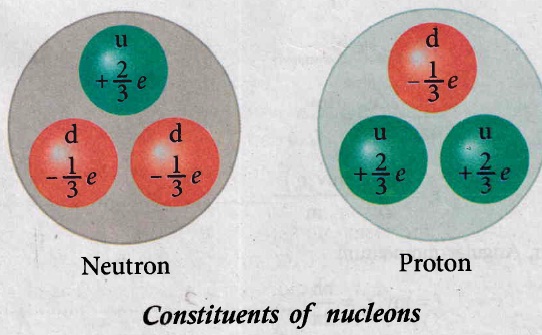
(ix) All these quarks have fractional charges. For example, charge of up quark is + \(\frac23\) e and that of down quark is \(\frac13\) e.
(x) According to quark model, proton is made up of two up quarks and one down quark and neutron is made up of one up quark and two down quarks.
11.
(i) In beta decay, a radioactive nucleus emits either electron or positron. If electron (e-) is emitted, it is called β- decay and if positron (e+) is emitted, it is called β- decay
(ii) The positron is an anti-particle of an electron whose mass is same as that of electron and charge is opposite to that of electron - that is, +e. Both positron and electron are referred to as beta particles.
β- decay:
(iii) β- decay: In β- decay, the atomic number of the nucleus increases by one but mass number remains the same. This decay is represented by
\(_{ Z }^{ A }{ X }\rightarrow _{ Z+1 }^{ A }{ Y+ }{ e }^{ - }+\bar { v } \) ...(1)
(iv) It implies that the element X becomes Y by giving out an electron and antineutrino (⊽).
(v) In other words, In each β- decay, one neutron (n) in the nucleus of X is converted into a proton(p) by emitting an electron (e-) and antineutrino(⊽). It is given by
\(n\rightarrow p+{ e }^{ - }+\bar { v } \)
Example :
\(_{ 6 }^{ 14 }{ C }\rightarrow _{ 7 }^{ 14 }{ N+ }{ e }^{ - }+\overline { v } \)
β+ decay:
(vi) In β+ decay, the atomic number is decreased by one and the mass number remains the same. This decay is represented by
\(_{ Z }^{ A }{ X }\rightarrow _{ Z-1 }^{ A }{ Y+ }{ e }^{ + }+v\)
(vii) It implies that the element X becomes Y by giving out an positron (e+) and neutrino (v),
In otherwords, in each β+ decay, one proton(p) in the nucleus of X is converted into a neutron by emitting a positron (e+) and a neutrino. It is given by
\(p\rightarrow n+{ e }^{ +}+{ v } \)
Example:
\(_{ 11 }^{ 22 }{ Na }\rightarrow _{ 10 }^{ 22 }{ Ne }+{ e }^{ + }+v\)
(viii) However a single proton (not inside any nucleus) cannot have β+ decay due to energy conservation, because neutron mass is larger than proton mass.
(ix) But a single neutron (not inside any nucleus) can have β- decay.
(x) It is important to note that the electron or positron which comes out from nuclei during beta decay never present inside the nuclei rather they are produced during the conversion of neutron into proton or proton into neutron inside the nucleus.
12.
(i) Bohr atom model is valid only for hydrogen atom or hydrogen-like atoms but not for complex atoms.
(ii) Bohr atom model does not explain fine structure of spectral lines.
(iii) Bohr atom model does not explain the intensity variations in the spectral lines.
(iv) The distribution of electrons in atoms is not completely explained by Bohr atom model.
13.
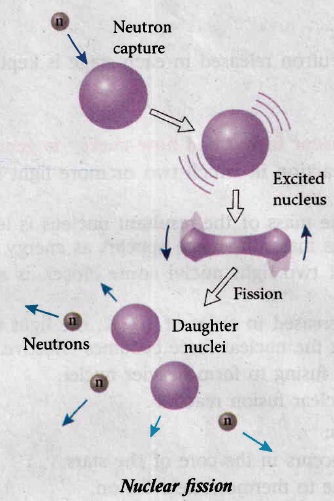
(i) The process of breaking up of the nucleus of a heavier atom into two smaller nuclei with the release of a large amount of energy is called nuclear fission.
Examples :
\(_{ 92 }^{ 235 }{ U+ }_{ 0 }^{ 1 }{ n }\rightarrow _{ 92 }^{ 236 }{ { U }^{ * } }\rightarrow _{ 56 }^{ 141 }{ Ba }+_{ 36 }^{ 92 }{ Kr }+3_{ 0 }^{ 1 }{ n }+Q\)
\(_{ 92 }^{ 235 }{ U+ }_{ 0 }^{ 1 }{ n }\rightarrow _{ 92 }^{ 236 }{ { U }^{ * } }\rightarrow _{ 54 }^{ 140 }Xe+_{ 38 }^{ 94 }{ Sr }+2_{ 0 }^{ 1 }{ n }+Q\)
(ii) When the slow neutron is absorbed by the uranium nuclei, the mass number increases by one and goes to an excited state \(_{ 92 }^{ 235 }{ U }\).
(iii) But this excited state does not last longer than 10-12s and decay into two daughter nuclei along with 2 or 3 neutrons.
Energy released in fission :
(i) We can calculate the energy (Q) released in each uranium fission reaction. We choose the most observed fission reaction which is given in the equation.
\(_{ 92 }^{ 235 }{ U+ }_{ 0 }^{ 1 }{ n }\rightarrow _{ 92 }^{ 236 }{ { U }^{ * } }\rightarrow _{ 56 }^{ 141 }{ Ba }+_{ 36 }^{ 92 }{ Kr }+3_{ 0 }^{ 1 }{ n }+Q\)
Mass of \({ }_{92}^{235} \mathrm{U}\) = 235.045733 u
Mass of \(_{ 0 }^{ 1 }{ n }\) = 1.008665 u
Total mass of reactants = 236.054398 u
Mass of \(_{ 56 }^{ 141 }{ Ba }\) = 140.9177 u
Mass of \(_{ 92 }^{ 36 }{ Kr }\) = 91.8854u
Mass of 3 neutrons = 3.025995 u
The total mass of products = 235.829095 u
Mass detect m =236.054398 u - 235.829095 u
= 0.225303u
So the energy released in each fission
= 0.225303 x 931 MeV = 200.MeV
(ii) This energy first appears as kinetic energy of daughter nuclei and neutrons. But later, this kinetic appears in the form of heat given to the surrounding.
Properties :
(i) The fission is accompanied by the release of neutrons. From each reaction, on an average, 2.5 neutrons are emitted.
(ii) The energy released in the nuclear fission is many times greater than the energy released in chemical reactions.
(iii) Energy released per fission is 200 MeV.

12th Standard Syllabus & Materials
12th Standard
TN 12th Computer Applications களப்பெயர் முறைமை (DNS) Sample Question Papers Study Material - QB365 Set A
NEW12th Standard
TN 12th Computer Applications வலையமைப்பு எடுத்துக்காட்டுகள் மற்றும் நெறிமுறைகள் Sample Question Papers Study Material - QB365 Set A
NEW12th Standard
TN 12th Computer Applications கணினி வலையமைப்பு ஓர் அறிமுகம் Sample Question Papers Study Material - QB365 Set A
NEW12th Standard
TN 12th Computer Applications PHP-உடன் MySQL-ஐ இணைத்தல் Sample Question Papers Study Material - QB365 Set A



Tamilnadu Stateboard 12th Standard Subjects

Maths

Chemistry
Physics

Biology

Computer Science

Business Maths and Statistics

Economics

Commerce

Accountancy

History

Computer Applications
Biology
Computer Technology
Computer Applications
Computer Science
Business Maths and Statistics
Commerce
Economics
Maths
Chemistry
Physics
Computer Technology
History
Accountancy

Tamil

English

French
Tamilnadu Stateboard Standards

