
 100% FREE ACCESS
12th Standard Syllabus & Materials
12th Standard
TN 12th Maths Applications of Matrices and Determinants Sample Question Papers Study Material - QB365 Set A
NEW12th Standard
TN 12th Computer Applications மின்னணு தரவு பரிமாற்றம் Sample Question Papers Study Material - QB365 Set A
NEW12th Standard
TN 12th Computer Applications மின் - வணிக பாதுகாப்பு அமைப்புகள் Sample Question Papers Study Material - QB365 Set A
NEW12th Standard
TN 12th Computer Applications மின்னணு செலுத்தல் முறைகள் Sample Question Papers Study Material - QB365 Set A
NEW12th Standard
TN 12th Computer Applications மின் - வணிகம் Sample Question Papers Study Material - QB365 Set A
NEW12th Standard
TN 12th Computer Applications திறந்த மூல கருத்துருக்கள் Sample Question Papers Study Material - QB365 Set A

Published on: 02/01/2020
Atomic and Nuclear Physics
Download Tamil Nadu 12th Standard Physics question papers, model tests, one-mark questions, important questions, and public exam papers in PDF format. Free study materials and answer keys for TN State Board students.
Questions + Answers key
Take MCQ Physics Test1.
1 Curie is ________________.
activity of 1 g of Uranium
I disintegration / second
3.7 x 10¹⁶ becquerel
1.6 x 10¹² disintegration / second
2.
The explosion of hydrogen bomb is based on the principle of _________________.
uncontrolled fission reaction
nuclear fusion reaction
controlled fission
photo electric effect
3.
The energy of the ground state of hydrogen is -13.6 eV. The energy of the first excited state is _____________.
-27.2 eV
-52.4 eV
-3.4 eV
-6.8 eV
4.
The ground state energy of a hydrogen atom is 13.6 eV. The energy needed to ionize H2 atom from its second excited state ______________.
1.51 eV
3.4 eV
13.6 eV
none
5.
The ratio of the wavelengths radiation emitted for the transition from n = 2 to n = 1 in Li++, He+ and H is _____.
1:2:3
1:4:9
3:2:1
4:9:36
6.
7.
The charge of cathode rays particle is _____.
Positive
negative
neutral
not defined
8.
9.
State the reasons. Why a chain reaction stops?
10.
What is nuclear chain reaction?
11.
Which ray has high ionising power? Why?
12.
In the Bohr atom model, the frequency of transitions is given by the following expression \(v=Rc\left( \frac { 1 }{ { n }^{ 2 } } -\frac { 1 }{ { m }^{ 2 } } \right) \), where n < m, Consider the following transitions:
| Transitions | m➝n |
| 1 | 3➝2 |
| 2 | 2➝1 |
| 3 | 3➝1 |
Show that the frequency of these transitions obey sum rule (which is known as Ritz combination principle)
13.
Consider two hydrogen atoms HA and HB in ground state. Assume that hydrogen atom HA is at rest and hydrogen atom HB is moving with a speed and make head-on collision with the stationary hydrogen atom HA. After the collision, both of them move together. What is minimum value of the kinetic energy of the moving hydrogen atom HB, such that any one of the hydrogen atoms reaches first excitation state.
14.
What are cathode rays?
15.
Write the properties of neutrino?
16.
What does a neutron moderator do?
17.
Write the properties of cathode rays.
18.
Explain the results of Rutherford α-particle scattering experiment.
19.
Discuss the Millikan’s oil drop experiment to determine the charge of an electron.
20.
Explain the J.J. Thomson experiment to determine the specific charge of electron.
21.
| (a) | Breaking nucleus | Nuclear fission |
| (b) | Slow neutrons | 0- 1000 eV |
| (c) | Fast neutrons | 0.5 MeV - 10 MeV |
| (d) | Nuclear fusion | 1.5 x 10⁷ K |
22.
Assertion: Electrons in the atom are held due to coulomb forces.
Reason: The atom is stable only because the centripetal force due to coulomb's law is balanced by the centrifugal force.
Codes:
(a) Assertion and Reason are correct and Reason is the correct explanation of Assertion.
(b) Assertion and Reason are true but Reason is the false explanation of the Assertion.
(c) Assertion is true but Reason is false.
(d) Assertion is false but Reason is true.
23.
CHOOSE THE CORRECT STATEMENTS
(i) Cathode rays produce heat, when allowed to fall on matter.
(ii) Cathode rays produce X-ray, when allowed to fall on material of high atomic weight.
(iii) Cathode rays are positively charged particles
(iv) Cathode ray ionize the gas.
(a) I, II and III only
(b) I, II and IV only
(c) I and II only
(d) II, III and IV only
1.
(c)
3.7 x 10¹⁶ becquerel
2.
(b)
nuclear fusion reaction
3.
(c)
-3.4 eV
4.
(a)
1.51 eV
5.
\(\frac{1}{\lambda}=\mathrm{RZ}^2\left[\frac{1}{\mathrm{n}_1^2}-\frac{1}{\mathrm{n}_2^2}\right] \)
\(\frac{1}{\lambda}=\mathrm{RZ} ^2\left[\frac{1}{1}-\frac{1}{4}\right]=\frac{3}{4} \mathrm{RZ}^2 \)
\(\lambda \propto \frac{1}{Z^2} \)
\(\lambda_{\mathrm{Li}}: \lambda_{\mathrm{H} c}: \lambda_{\mathrm{H}}=\frac{1}{9}: \frac{1}{4}: \frac{1}{1}=4: 9: 36\)
6.
(b)
7.
Cathode rays are stream of negatively charged electron.
8.
(b)
9.
(i) A nuclear chain reaction dies out, when the neutrons produced so fast they escape from the uranium without interacting.
(ii) When the neutrons are lost due to the. extremely small size of uranium (i.e, smaller than critical size).
10.
A nuclear reaction in which the neutron used to carry out the nuclear fission reaction gets multiplied as more and more such fission reaction take place is called a nuclear chain reaction.
11.
(i) Alpha ray has high ionizing power.
(ii) α - particle has a large mass and large nuclear cross-section. So it has high ionizing power.
12.
\(v_{3 \rightarrow 2}=R C\left(\frac{1}{4}-\frac{1}{9}\right)=\frac{5}{36} R C \)
\(v_{2 \rightarrow 1}=R C\left(\frac{1}{1}-\frac{1}{4}\right)=\frac{3}{4} R C \)
\(v_{3 \rightarrow 1}=R C\left(\frac{1}{1}-\frac{1}{9}\right)=\frac{8}{9} R C \)
\(v_{3 \rightarrow 2}+v_{2 \rightarrow 1}=\frac{5}{36} R C+\frac{3}{4} R C =R C\left(\frac{5}{36}+\frac{3}{4}\right)=R C\left(\frac{5+27}{36}\right) \)
\(v_{3 \rightarrow 2}+v_{2 \rightarrow 1}= R C\left(\frac{32}{36}\right)=\frac{8}{9} R C=v_{3 \rightarrow 1} \)
13.
Kinetic energies,
KEAi = 0
KEAf = KEBt
It should obey law of conservation of energy
Total Initial KE = Total final KE
\(\mathrm{KE}_{\mathrm{A}_{i}}+\mathrm{KE}_{\mathrm{B}_{i}}=\mathrm{KE}_{\mathrm{A}_{\mathrm{t}}}+\mathrm{KE}_{\mathrm{B}_{\mathrm{t}}} \)
\(0+\mathrm{KE}_{\mathrm{B}_{i}}=\mathrm{KE}_{\mathrm{A}_{\mathrm{f}}}+\mathrm{KE}_{\mathrm{A}_{t}} \)
\(\mathrm{KE}_{\mathrm{B}_{\mathrm{i}}}=2 \mathrm{KE}_{\mathrm{A}_{\mathrm{f}}} \)
Minimum energy required for excite the hydrogen atom is 10.2eV
Hence minimum Kinetic energy of HB is
\(\mathrm{KE}_{\mathrm{B}_{1}}=2 \times 10.2 \mathrm{eV}=20.4 \mathrm{eV}\)
14.
(i) When the pressure of the gas in discharge tube is reduced to around 0.01 mm of Hg, positive column disappears.
(ii) At this time, a dark space is formed between anode and cathode which is called Crooke's dark space.
(iii) The walls of the tube appear with green colour.
(iv) At this stage, some invisible rays emanate from cathode called cathode rays, which are beam of electrons.
15.
The neutrino has the following properties
(i) It has zero charge
(ii) It has an antiparticle called anti-neutrino.
(iii) Recent experiments showed that the neutrino has very tiny mass
(iv) It interacts very weakly with the matter. Therefore, it is very difficult to detect In fact, in every second, trillions of neutrinos coming from the sun are passing through our body without any interaction.
16.
(i) Moderators: The moderator is a material used to convert fast neutrons into slow neutrons. Usually the moderators are chosen in such a way that it must be very light nucleus having mass comparable to that of neutrons.
(ii) Hence, these light nuclei undergo collision with fast neutrons and the speed of the neutron is reduced.
(iii) A billiard ball striking a stationary billiard ball of equal mass would itself be stopped but the same billiard ball bounces off almost with same speed when it strikes a heavier mass.
(iv) This is the reason for using lighter nuclei as moderators.
17.
(i) Cathode rays possess energy and momentum and travel in a straight line with high speed of the order of 107m s-1or \({ \left( \frac { 1 }{ 10 } \right) }^{ th }\) of the speed of light.
(ii) It can be deflected by application of electric and magnetic fields. The direction of deflection indicates that they are negatively charged particles.
(ii) When the cathode rays are allowed to fall on matter, they produce heat. They affect the photographic plates and also produce fluorescence when they fall on certain crystals and minerals.
(iii) When the cathode rays fall on a material of high atomic weight, x-rays are produced.
(iv) Cathode rays ionize the gas through which they pass.
18.
(i) In 1911, Geiger and Marsden did a remarkable experiment based on the advice of their teacher Rutherford, which is known as the scattering of alpha particles by gold foil.
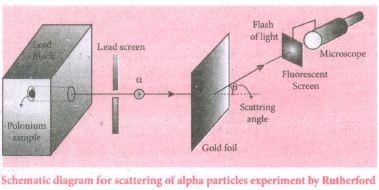
(ii) The experimental arrangement. A source of alpha particles (radioactive material, for example, polonium) is kept inside a thick lead box, with a fine hole.
(iii) The alpha particles coming through the fine hole of the lead box pass through another fine hole made on the lead screen. These particles are now allowed to fall on a thin gold foil and it is observed that the alpha particles passing through gold foil are scattered through different angles.
(iv) A movable screen (from 0° to 180°) which is made up of zinc sulphide (ZnS) is kept on the other side of the gold foil to collect the alpha particles. Whenever alpha particles strike the screen, a flash of light is observed which can be seen through a microscope.
(v) Rutherford proposed an atom model based on the results of alpha scattering. experiment.
(vi) In this experiment, alpha particles (positively charged particles) are allowed to fall on the atoms of a metallic gold foil. The results of this experiment. Rutherford expected the nuclear model, but the experiment showed the model.
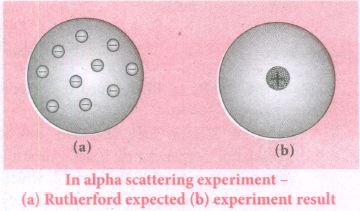
(a) Most of the alpha particles were un-deflected through the gold and went straight.
(b) Some of the alpha particles are deflected through a small angle.
(c) A few alpha particles (one in a thousand) are deflected through an angle more than 90°.
(d) Very few alpha particles returned back (backscattered) that is, deflected back by 180°.
19.
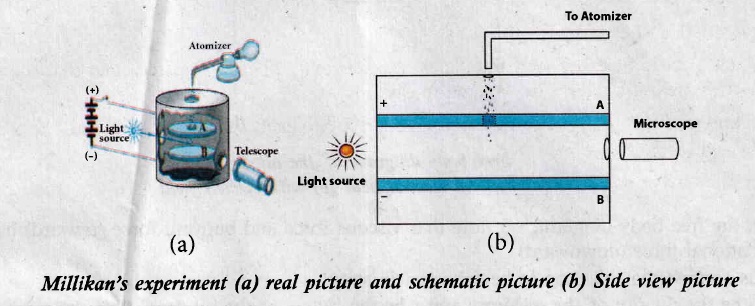
The motion of oil drop inside the chamber can be controlled by adjusting electric field. The oil drop can be moved up or down or even kept balanced in the field of view for sufficiently long time.
Construction:
(i) The apparatus consists of two horizontal circular metal plates A and B each with diameter around 20 cm and are separated by a small distance 1.5 cm.
(ii) These two parallel plates are enclosed in a chamber with glass walls.
(iii) Plates A and B are given a high potential difference around 10 kV such that electric field acts vertically downward
(iv) A small hole is made at the center of the upper plate A.
(v) Atomizer is kept above the hole to spray the liquid.
Working:
(i) When a fine droplet of highly viscous liquid (like glycerine) is sprayed using atomizer, it falls freely downward through the hole under the influence of gravity alone.
(ii) Few oil drops in the chamber can acquire electric charge (negative charge) because of friction with air or passage of x-rays in between the parallel plates.
(iii) The chamber is illuminated by light and oil drops can be seen clearly using microscope.
(iv) These drops can move either upwards or downward.
(v) Let m be the mass of the oil drop and q be its charge. Then the forces acting on the droplet are
(a) gravitational force Fg = mg
(b) electric force Fe = qE
(c) buoyant force Fb
(d) viscous force Fv
(a) Determination of radius of the droplet:
(i) When the electric field is switched off, the oil drop accelerates downwards. Due to presence of air drag forces, the oil drops attain its terminal velocity and moves with constant velocity.
(ii) This velocity can be measured by finding the time taken by the oil drop to fall through a predetermined distance.
.jpg)
(iii) From the free body diagram, we note that viscous force and buoyant force (upward) balance the gravitational force (downward).
(iv) Let us assume that oil drop to be spherical in shape.
(v) Let p be the density of the oil drop, and r be the radius of the oil drop, then the mass of the oil drop, the oil drop can be expressed in terms of its density as, \( \rho=m/v \Rightarrow m=\left(\frac{4}{3} \pi r^{3}\right) \rho\)
∵ (Volume of the sphere, V = \(\frac{4}{3} \pi r^{3})\)
Then gravitational force \(\mathrm{F}_{\mathrm{g}}=\mathrm{mg}=\left(\frac{4}{3} \pi \mathrm{r}^{3}\right) \rho g\)
(vi) Let σ be the density of air, the upthrust force experienced by the oil drop due to displaced air is \(F_{b}=\left(\frac{4}{3} \pi r^{3}\right) σ g\)
(vii) Once the oil drop attains a terminal velocity v, the net downward force acting on the oil drop is equal to the viscous force acting opposite to the direction of motion of the oil drop. From Stokes law, the viscous force on the oil drop is
\(\mathrm{F}_{\mathrm{v}}=6 \pi \eta \mathrm{rv}\)
(ix) From free body diagram, the force balancing equation is,
\(F_{g}=F_{b}+F_{v} \)
\(\left(\frac{4}{3} \pi r^{3}\right) \rho g=\left(\frac{4}{3} \pi r^{3}\right) \sigma g+6 \pi \eta r v \)
\(\frac{4}{3} \pi r^{3}(\rho-\sigma) g=6 \pi \eta r v \)
\(\frac{2}{3} r^{2}(\rho-\sigma) g=3 \eta v \)
Hence radius of the oil drop is \(r=\left[\frac{9 \eta v}{2(\rho-\sigma) g}\right]^{\frac{1}{2}} \ldots\) ........(1)
(b) Determination of electric charge:
(i) Now switch on the electric field.
(ii) Upward electric force on charged oil drops is qE.
(iii) Choose any one drop in the field of view of microscope.
(iv) Strength of the electric field is adjusted to make that particular drop to be stationary.
(v) Being oil drop is at rest, the viscous force acting on the oil drop is zero.
(vi) Then, from the free body diagram.
\(F_{g}=F_{b}+F_{v} \)
\(\left(\frac{4}{3} \pi r^{3}\right) \rho g=\left(\frac{4}{3} \pi r^{3}\right) \sigma g+q E \)
\(\frac{4}{3} \pi r^{3}(\rho-\sigma) g=q E \)
\(q=\frac{4}{3 E} \pi r^{3}(\rho-\sigma) g \ldots \ldots \ldots \ldots \ldots \) (2)
Substituting (1) in (2)
\(q=\frac{18 \pi}{E}\left(\frac{\eta^{3} v^{3}}{2(\rho-\sigma) g}\right)^{\frac{1}{2}}\)
(vii) Millikan repeated this experiment several times and computed the charges on oil drops. He found that the charge of any oil drop can be written as integral multiple of a basic value, -1.6 x 10⁻¹⁹ C which is nothing but the charge of an electron.
20.
Principle:
Cathode rays are deflected in electric and magnetic fields.
By the variation of electric and magnetic fields, mass normalized charge or the specific charge (charge per unit mass) of the cathode rays is measured.
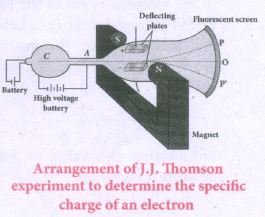
Construction and Working:
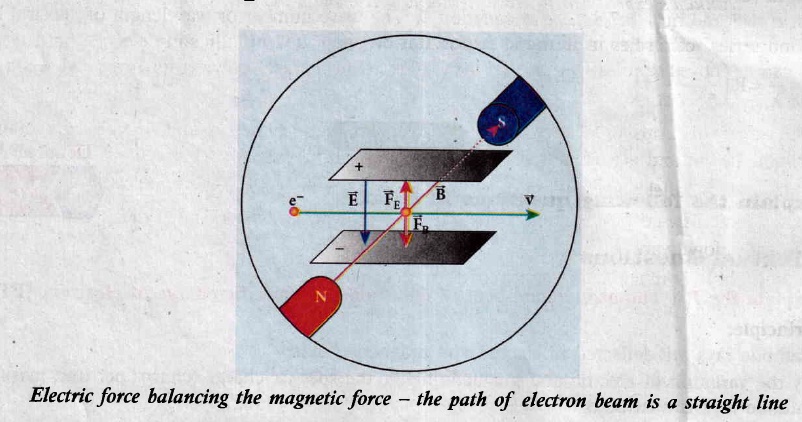
(i) Cathode rays (electron beam) produced at cathode of a highly evacuated discharge tube. Cathode rays are attracted towards anode disc A.
(ii) Pin hole in the anode disc allows only a narrow beam of cathode rays.
(iii) These cathode rays are now allowed to pass through the parallel metal plates, maintained at high voltage.
(iv) Further, discharge tube is kept in between pole pieces of magnet.
(v) Electric and magnetic fields are perpendicular to each other.
(vi) When the cathode rays strike the zinc sulphide coated screen (O), produces scintillation and hence bright spot is observed.
(i) Determination of velocity of cathode rays:
(a) For a fixed electric field between the plates, the magnetic field is adjusted such that the cathode rays (electron beam) strike at the original position O.
(b) This means that the magnitude of electric force is balanced by the magnitude of force due to magnetic field.
(ie) Ee = Bev
\(\Rightarrow v=\frac { E }{ B } \) ...(1)
(ii) Determination of specific charge:
(a) Since accelerated from cathode to anode, the potential energy of the electron beam at the cathode is converted into kinetic energy of the electron beam at the anode.
(b) Let V be the potential difference between anode and cathode, then the potential energy is eV.
Then from law of conservation of energy,
\(eV=\frac { 1 }{ 2 } { mv }^{ 2 } \)
\(\frac { e }{ m } =\frac { { v }^{ 2 } }{ 2V } \) ....(2)
Substituting (1) in (2),
\(\frac { e }{ m } =\frac { 1 }{ 2V } \frac { { E }^{ 2 } }{ { B }^{ 2 } } \)
By substituting known values, we get
\(\frac { e }{ m } =1.7\times { 10 }^{ 11 }{ CKg }^{ -1 }\)
The specific charge \(\frac{\mathrm{e}}{\mathrm{m}}\) is independent of (a) gas used (b) nature of the electrodes
21.
(d) uclear fusion -1.5 x 10⁷ K
22.
(c) Assertion is true but Reason is false
23.
(b) I, II and IV only

12th Standard Syllabus & Materials
12th Standard
TN 12th Computer Applications வலையமைப்பு வடமிடல் Sample Question Papers Study Material - QB365 Set A
NEW12th Standard
TN 12th Computer Applications களப்பெயர் முறைமை (DNS) Sample Question Papers Study Material - QB365 Set A
NEW12th Standard
TN 12th Computer Applications வலையமைப்பு எடுத்துக்காட்டுகள் மற்றும் நெறிமுறைகள் Sample Question Papers Study Material - QB365 Set A
NEW12th Standard
TN 12th Computer Applications கணினி வலையமைப்பு ஓர் அறிமுகம் Sample Question Papers Study Material - QB365 Set A



Tamilnadu Stateboard 12th Standard Subjects

Maths

Chemistry
Physics

Biology

Computer Science

Business Maths and Statistics

Economics

Commerce

Accountancy

History

Computer Applications
Biology
Computer Technology
Computer Applications
Computer Science
Business Maths and Statistics
Commerce
Economics
Maths
Chemistry
Physics
Computer Technology
History
Accountancy

Tamil

English

French
Tamilnadu Stateboard Standards

