
 100% FREE ACCESS
12th Standard Syllabus & Materials
12th Standard
TN 12th Computer Applications மின்னணு தரவு பரிமாற்றம் Sample Question Papers Study Material - QB365 Set A
NEW12th Standard
TN 12th Computer Applications மின் - வணிக பாதுகாப்பு அமைப்புகள் Sample Question Papers Study Material - QB365 Set A
NEW12th Standard
TN 12th Computer Applications மின்னணு செலுத்தல் முறைகள் Sample Question Papers Study Material - QB365 Set A
NEW12th Standard
TN 12th Computer Applications மின் - வணிகம் Sample Question Papers Study Material - QB365 Set A
NEW12th Standard
TN 12th Computer Applications திறந்த மூல கருத்துருக்கள் Sample Question Papers Study Material - QB365 Set A
NEW12th Standard
TN 12th Computer Applications வலையமைப்பு வடமிடல் Sample Question Papers Study Material - QB365 Set A

Published on: 22/01/2020
Atomic and Nuclear physics
Download Tamil Nadu 12th Standard Physics question papers, model tests, one-mark questions, important questions, and public exam papers in PDF format. Free study materials and answer keys for TN State Board students.
Questions + Answers key
Take MCQ Physics Test1.
What is a reactor core?
2.
Comment on the statement - "A nucleus contains to electrons and can eject them"
3.
What are thermal neutrons? Why are neutrons considered as ideal particles for nuclear fission?
4.
Classify the neutrons according to their kinetic energy.
5.
What is the reason for using lighter nuclei as moderators?
6.
A fusion reaction is more energetic than a fission reaction. Why?
7.
Which ray has high ionising power? Why?
8.
What are the constituent particles of neutron and proton?
9.
What is mean life of a radio active nucleus? Give the expression.
10.
What is meant by radioactivity?
11.
What is binding energy of a nucleus? Give its expression.
12.
Define atomic mass unit u.
13.
What is distance of closest approach?
14.
What are cathode rays?
15.
Write down the postulates of Bohr atom model.
1.
The fuel bundles which consist of tiny pellets of uranium oxide are placed in calandria reactor vessel. The part of the reactor vessel which contains the fuel rod is known as reactor core.
2.
It is true that a nucleus contains no electrons as such. However, in the process of -decay, a neutron breaks up as follows.
\(_{ 0 }^{ 1 }{ n\rightarrow }_{ 1 }^{ 1 }{ H+ }_{ -1 }^{ 0 }{ e }+\overline { v } \)
3.
Thermal neutrons are low-energy neutrons having an approximate energy of 0.025 eV. Neutrons are consider as ideal particles for nuclear fission because they are uncharged.
4.
Neutrons are classified according to their kinetic energy as
(i) slow neutrons (0 to 1000 eV)
(ii) fast neutrons (0.5 MeV to 10 MeV).
5.
The moderator is a material used to convert fast neutrons into slow neutrons
(i) A billiard ball striking a stationary billiard ball of equal mass would itself be stopped but the same billiard ball bounces off almost with same speed when it strikes a heavier mass.
(ii) This is the reason for using lighter nuclei as moderators.
6.
In nuclear fusion reaction, the energy liberated per unit mass of the nuclei taking part in the reaction is many times larger than the energy liberated in a fission reaction.
7.
(i) Alpha ray has high ionizing power.
(ii) α - particle has a large mass and large nuclear cross-section. So it has high ionizing power.
8.
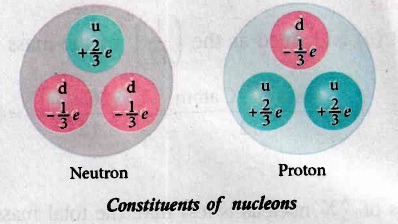
According to quark model,
(i) Proton is made up of two up quarks and one down quark.
(ii) Neutron is made up of one up quark and two down quarks.
9.
The mean life time of the nucleus is the ratio of sum or integration of life times of all nuclei to the total number nuclei present initially.
\(\tau =\frac { 1 }{ \lambda } \)
10.
The phenomenon of spontaneous emission of highly penetrating radiations such as α, β and ⋎ rays by an element is called radioactivity and the substances which emit these radiations are called radioactive elements.
11.
While forming a nucleus, the mass disappear is converted into energy. This energy is called binding energy of a nucleus.
\(\therefore \mathrm{BE}=\left(\mathrm{Zm}_{\mathrm{P}}+\mathrm{Nm}_{\mathrm{n}}-\mathrm{M}\right) \times \mathrm{c}^{2}\)
where, c - velocity of light
12.
One atomic mass unit (u) is defined as the (1/12)th of the mass of the isotope of carbon \(_{ 6 }^{ 12 }{ C }\)
\(\mathrm{lu}=\frac{\text { mass of }_{6}^{12} \mathrm{C} \text { atom }}{12}=\frac{1.9926 \times 10^{-26}}{12}=1.660 \times 10^{-27} \mathrm{~kg}\)
13.
The minimum distance between the centre of the nucleus and the alpha particle just before it gets reflected back through 1800 is defined as the distance of closest approach ro (also known as contact distance).
14.
(i) When the pressure of the gas in discharge tube is reduced to around 0.01 mm of Hg, positive column disappears.
(ii) At this time, a dark space is formed between anode and cathode which is called Crooke's dark space.
(iii) The walls of the tube appear with green colour.
(iv) At this stage, some invisible rays emanate from cathode called cathode rays, which are beam of electrons.
15.
(i) The electron in an atom moves around nucleus in circular orbits under the influence of Coulomb electrostatic force of attraction. This Coulomb force gives necessary centripetal force for the electron to undergo circular motion.
(ii) Electrons in an atom revolve around the nucleus only in certain discrete orbits called stationary orbits where it does not radiate electromagnetic energy. Only those discrete orbits allowed are stable orbits.
(iii) The angular momentum of the electron in these stationary orbits are quantized (ie) L = \(\frac{nh}{2\pi}\) This is known as Bohr quantization condition.
(iv) The energy of the orbits are not continuous but only discrete. This is called quantization of energy.
(v) An electron can jump from one orbit to another orbit by absorbing or emitting a photon whose energy is equal to the difference in energy between the two orbital levels.

12th Standard Syllabus & Materials
12th Standard
TN 12th Computer Applications களப்பெயர் முறைமை (DNS) Sample Question Papers Study Material - QB365 Set A
NEW12th Standard
TN 12th Computer Applications வலையமைப்பு எடுத்துக்காட்டுகள் மற்றும் நெறிமுறைகள் Sample Question Papers Study Material - QB365 Set A
NEW12th Standard
TN 12th Computer Applications கணினி வலையமைப்பு ஓர் அறிமுகம் Sample Question Papers Study Material - QB365 Set A
NEW12th Standard
TN 12th Computer Applications PHP-உடன் MySQL-ஐ இணைத்தல் Sample Question Papers Study Material - QB365 Set A



Tamilnadu Stateboard 12th Standard Subjects

Maths

Chemistry
Physics

Biology

Computer Science

Business Maths and Statistics

Economics

Commerce

Accountancy

History

Computer Applications
Biology
Computer Technology
Computer Applications
Computer Science
Business Maths and Statistics
Commerce
Economics
Maths
Chemistry
Physics
Computer Technology
History
Accountancy

Tamil

English

French
Tamilnadu Stateboard Standards

