
 100% FREE ACCESS
12th Standard Syllabus & Materials
12th Standard
TN 12th Computer Applications மின்னணு தரவு பரிமாற்றம் Sample Question Papers Study Material - QB365 Set A
NEW12th Standard
TN 12th Computer Applications மின் - வணிக பாதுகாப்பு அமைப்புகள் Sample Question Papers Study Material - QB365 Set A
NEW12th Standard
TN 12th Computer Applications மின்னணு செலுத்தல் முறைகள் Sample Question Papers Study Material - QB365 Set A
NEW12th Standard
TN 12th Computer Applications மின் - வணிகம் Sample Question Papers Study Material - QB365 Set A
NEW12th Standard
TN 12th Computer Applications திறந்த மூல கருத்துருக்கள் Sample Question Papers Study Material - QB365 Set A
NEW12th Standard
TN 12th Computer Applications வலையமைப்பு வடமிடல் Sample Question Papers Study Material - QB365 Set A

Published on: 16/09/2019
Electrostatics
Download Tamil Nadu 12th Standard Physics question papers, model tests, one-mark questions, important questions, and public exam papers in PDF format. Free study materials and answer keys for TN State Board students.
Questions + Answers key
Take MCQ Physics Test1.
Distinguish between the electric potential and potential energy and state the relation between them.
2.
Will there be any effect on the potential at the point if the medium around this point is changed?
3.
When we rotate the blades, it starts to rotate as usual. Why it is so?
4.
What is a Capacitor?
5.
What are Non-polar molecules? State examples.
6.
Give a comparison of electrical and gravitional forces?
7.
What is corona discharge?
8.
What is dielectric strength?
9.
What is meant by electrostatic energy density?
10.
What are the properties of an equipotential surface?
11.
What is an equipotential surface?
12.
The electric field lines never intersect. Justify.
13.
What is meant by ‘electric field lines’?
14.
Write down Coulomb’s law in vector form and mention what each term represents.
15.
What is meant by quantisation of charges?
1.
While electric potential is work done per unit charge the potential energy is the total work done in bringing different charges from infinity to their respective positions.
\(V=\frac { { 1 } }{ 4\pi { \varepsilon }_{ 0 }^{ } } .\frac { { q }_{ 1 } }{ r } and\quad U=\frac { { 1 } }{ 4\pi { \varepsilon }_{ 0 }^{ } } .\frac { { q }_{ 1 }{ q }_{ 2 } }{ r } \)
\(U={ q }_{ 2 }\left[ \frac { { 1 } }{ 4\pi { \varepsilon }_{ 0 }^{ } } .\frac { { q }_{ 1 } }{ r } \right] ={ q }_{ 2 }V\)
∴ Electric potential energy = charge q2 x potential due to charge q1 at the location of charge q2.
2.
Yes, If the dielectric constant of the medium is increased, there will be a decrease of potential.
3.
To rotate any object, there must be a torque applied on the object. For the ceiling fan, the initial torque is given by the capacitor widely known as a condenser. If the condenser is faulty, it will not give sufficient initial torque to rotate the blades when the fan is switched on.
4.
Capacitor is a device used to store electric charge and electrical energy.
5.
(i) A non-polar molecule is one in which centers of positive and negative charges coincide. As a result, it has no permanent dipole moment.
(ii) Examples of non-polar molecules are hydrogen (H2), oxygen (O2), and carbon di oxide (CO2).
6.
(i) Both forces obey inverse square law, F∝\(\frac{1}{r^2}\)
(ii) Both forces are proportional to product of masses or charges.
(iii) Both forces are conservative forces.
(iv) Both forces can operate in vacuum.
7.
When an irregular shaped conductor is given positive charge, the electric field near the sharp end is very high and it ionizes the surrounding air. The positive ions are repelled at the sharp edge and negative ions are attracted towards the sharper edge. This reduces the total charge of the conductor near the sharp edge. This is called corona discharge.
8.
i) When the external electric field applied to the dielectric is very large, the bound charges (electrons) become free charges. This is called dielectric breakdown.
ii) The maximum electric field the dielectric can withstand before it breaksdown is called dielectric strength.
9.
The electrostatic energy stored per unit volume of space is called electrostatic energy density.
\(u_E=\frac{1}{2}ε_0E^2\)
10.
(i) The work done to move a charge q between any two points A and B, W = q (VB - VA). If the points A and B lie on the same equipotential surface, work done is zero because VB = VA.
(ii) The electric field is normal to an equipotential surface.
11.
An equipotential surface is a surface on which all the points are at the same electric potential.
12.
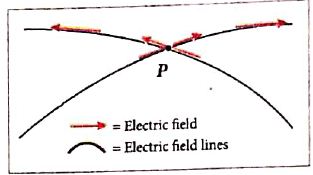
(i) No two electric field lines intersect each other. lf two lines cross at a point, then there will be two different electric field vectors at the same point.
(ii) As a consequence, if some charge is placed in the intersection point, then it has to move in two different directions at the same time, which is physically impossible. Hence electric field lines do not intersect.
13.
Electric field lines are a set of continuous lines which represent the electric field in some region of space visually.
14.
Coulomb's law \(\overrightarrow{F_{21}}=\frac{k q_{1} q_{2}}{r^{2}} \hat{r}_{12}\)
where, q1 - charge; q2 - charge
r - distance between the charges
\(\hat{r}_{12}\)- the unit vector directed from charge q1 to charge q2
k = Proportionality constant
15.
The charge of an electron is the elementary charge in nature. Therefore, charge on any body is the integral multiple of an electron. The charge on any body can be expressed by the formula,
q = ne; where, n is the number of electrons, e is the charge on one electron.
n = 0, ±1, ±2, ±3, ±4, ...
This is called quantization of charge.

12th Standard Syllabus & Materials
12th Standard
TN 12th Computer Applications களப்பெயர் முறைமை (DNS) Sample Question Papers Study Material - QB365 Set A
NEW12th Standard
TN 12th Computer Applications வலையமைப்பு எடுத்துக்காட்டுகள் மற்றும் நெறிமுறைகள் Sample Question Papers Study Material - QB365 Set A
NEW12th Standard
TN 12th Computer Applications கணினி வலையமைப்பு ஓர் அறிமுகம் Sample Question Papers Study Material - QB365 Set A
NEW12th Standard
TN 12th Computer Applications PHP-உடன் MySQL-ஐ இணைத்தல் Sample Question Papers Study Material - QB365 Set A



Tamilnadu Stateboard 12th Standard Subjects

Maths

Chemistry
Physics

Biology

Computer Science

Business Maths and Statistics

Economics

Commerce

Accountancy

History

Computer Applications
Biology
Computer Technology
Computer Applications
Computer Science
Business Maths and Statistics
Commerce
Economics
Maths
Chemistry
Physics
Computer Technology
History
Accountancy

Tamil

English

French
Tamilnadu Stateboard Standards

