
 100% FREE ACCESS
12th Standard Syllabus & Materials
12th Standard
TN 12th Computer Applications மின்னணு தரவு பரிமாற்றம் Sample Question Papers Study Material - QB365 Set A
NEW12th Standard
TN 12th Computer Applications மின் - வணிக பாதுகாப்பு அமைப்புகள் Sample Question Papers Study Material - QB365 Set A
NEW12th Standard
TN 12th Computer Applications மின்னணு செலுத்தல் முறைகள் Sample Question Papers Study Material - QB365 Set A
NEW12th Standard
TN 12th Computer Applications மின் - வணிகம் Sample Question Papers Study Material - QB365 Set A
NEW12th Standard
TN 12th Computer Applications திறந்த மூல கருத்துருக்கள் Sample Question Papers Study Material - QB365 Set A
NEW12th Standard
TN 12th Computer Applications வலையமைப்பு வடமிடல் Sample Question Papers Study Material - QB365 Set A

Published on: 02/01/2020
Communication Systems
Download Tamil Nadu 12th Standard Physics question papers, model tests, one-mark questions, important questions, and public exam papers in PDF format. Free study materials and answer keys for TN State Board students.
Questions + Answers key
Take MCQ Physics Test1.
Write the function of Repeater.
2.
What is transducer?
3.
Define bandwidth of transmission system.
4.
Write the advantages of PM?
5.
Give the factors that are responsible for transmission impairments.
6.
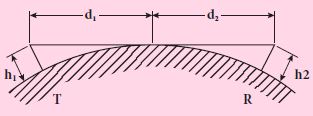
A transmitting antenna has a height of 40 m and the height of the receiving antenna is 30 m. What is the maximum distance between them for line-of-sight communication? The radius of the earth is 6.4 × 10⁶ m.
7.
What are the advantages and Limitations of FM?
8.
Distinguish between wireline and wireless communication? Specify the range of electromagnetic waves in which it is used.
9.
What is RADAR? Explain its function. State its applications
10.
Explain the basic elements of communication system with the necessary block diagram.
11.
Explain the ampitude modulation with necessary diagrams.
12.
The resting frequency of the FM transmitter is 98.5MHz. The allowed minimum and maximum frequency on either side of the center frequency are respectively_____________.
98.400 MHz and 98.600 MHz
98.450 MHz and 98.550 MHz
98.425 MHz and 98.575 MHz
98.425 MHz and 98.575 MHz
13.
The maximum carrier swing allowed in frequency modulation is ________________.
455 kHz
10.7 kHz
75 MHz
150 kHz
14.
The device which is a combination of a receiver and a transmitter is ___________________.
Amplifier
Repeater
Transducer
Modulator
15.
Modulation is the process of superposing _______________.
low frequency audio signal on high frequency radio waves
low frequency radio signal on low frequency audio waves
high frequency radio signal on low frequency audio
high frequency audio signal on low frequency radio waves
16.
The process of increasing the strength of a signal using an electric circuit is called ________________.
amplification
modulation
demodulation
transmission
17.
Assertion: Television signals are received through sky-wave propagation.
Reason: The ionosphere reflects electromagnetic waves of frequencies greater then a certain critical frequency.
Codes:
(a) Assertion and Reason are correct and Reason is the correct explanation of Assertion.
(b) Assertion and Reason are true but Reason is the false explanation of the Assertion.
(c) Assertion is true but Reason is false.
(d) Assertion is false but Reason is false
18.
Choose the Incorrect statements
(a) Input transducer converts variations in physical quantity.
(b) The electrical equivalent of the original information is called the baseband signal
(c) Transducer converts electrical energy into sound energy
(d) Microphone is an example of transducer.
19.
Choose the correct statements
I) Carrier signal does not have information.
II) Carrier wave usually have a much higher frequency.
III) Carrier signal is used ot carry the baseband signal.
IV) Carrier signal cannot be transmuted to long distance with less attenuation.
(a) I, II and III only
(b) I and II only
(c) I and III only
(d) I, II, III and IV
20.
(a) Ground wave propagation - Surface waves
(b) Sky wave propagation - Antenna
(c) Space wave propagation - 50 MHz
(d) Skip distance - No reception
1.
It is a combination of receiver and transistor placed along the path of signal so as to extend the range of the communication system.
2.
A transducer is a device that converts information such as pressurc, temperature, sound, picture etc. into an equivalent electrical signal or vice versa.
3.
The range of frequencies required to transmit a piece of specified information in a particular channel is called channel bandwidth or the bandwidth of the transmission system.
4.
(i) FM signal produced from PM signal is very stable.
(ii) The centre frequency called resting equency is extremely stable
5.
i) Noise : Interference of undesirable electrical signal with the transmitted signal.
ii) Attenuation: Loss of strength of a signal.
iii) Medium : It makes some distortion tothe signal.
6.
The total distance d between the transmitting and receiving antennas will be the sum of the individual distances of coverage.
d = d1 + d2
\(=\sqrt { 2R{ h }_{ 1 } } +\sqrt { 2{ Rh }_{ 2 } } \)
\(=\sqrt { 2R } \left( \sqrt { { h }_{ 1 } } +\sqrt { { h }_{ 2 } } \right) \)
\(=\sqrt { 2\times 6.4\times { 10 }^{ 6 } } \times (\sqrt { 40 } +\sqrt { 30 } )\)
\(=16\times { 10 }^{ 2 }\sqrt { 5 } \times (6.32+5.48)\)
= 42217 m = 42.217 km
7.
Advantages of AM :
(i) Easy transmission and reception
(ii) Lesser bandwidth requirements
(iii) Low cost
Limitations of AM :
i) Noise level is high
i) Low efficiency
ii) Small operating range
8.
| Wireline | Wireless |
|---|---|
| Wireline communication (point-point communication) uses mediums like wires, cables, and optical fibers. | Wireless communication uses free space as a communication medium. |
| These systems cannot be used for long-distance transmission they are connected physically. | The signals are transmitted in the form of electromagnetic waves with the help of a transmitting antenna Hence wireless communication is used for long-distance transmission |
| Examples are telephone, intercom, and cable TV. | Examples are mobile, radio or TV broadcasting, and satellite communication. |
| Wireline up to 100 meters | Wireless up to several thousand kilometers |
It is the maximum distance between the source and the destination up to which the signal is received with sufficient strength.
9.
(i) Radar basically stands for Radio Detection and Ranging System.
(ii) It is one of the important applications of communication systems' and is mainly used to sense, detect, and locate distant objects like aircraft, ships, spacecraft, etc.
(iii) The angle, range, or velocity of the objects that are invisible to the human eye can be determined.
(iii) Radar uses electromagnetic waves for communication. The electromagnetic signal is initially radiated into space by an antenna in all directions.
(iv) When this signal strikes the targeted object, it gets reflected or reradiated in many directions.
(v) This reflected (echo) signal is received by the radar antenna which in turn is delivered to the receiver.
(vi) Then, it is processed and amplified to determine the geographical statistics of the object. The range is determined by calculating the time taken by the signal to travel from RADAR to the target and back.
Applications :
Radars find extensive applications in almost all fields.
(i) In military, it is used for locating and detecting the targets.
(ii) It is used in navigation systems such as ship borne surface search, air search and weapons guidance systems.
(iii) To measure precipitation .rate and wind speed in meteorological observations, Radars are used.
(iv) It is employed to locate and rescue people in emergency situations.
10.
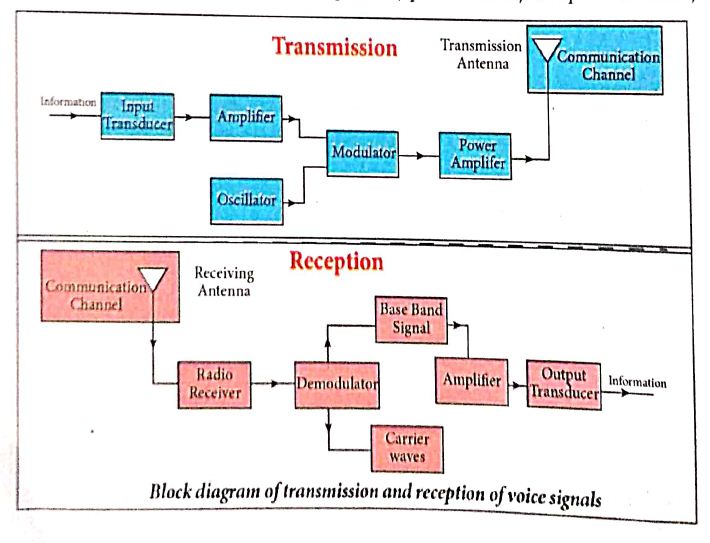
a) Information (Baseband or input signal):
i) Information can be in the form of a sound signal like speech, music, pictures, or computer data which is given as input to the input transducer.
b) Input transducer:
i) It converts the information which is in the form of sound, music, pictures or computer data into corresponding electrical signals.
ii) The electrical equivalent of the original information is called the baseband signal.
iii) The best example is the microphone that converts sound energy into electrical energy.
c) Transmitter
i) It feeds the electrical signal from the transducer to the communication channel
ii) It consists of circuits such as amplifier, oscillator, modulator, and power amplifier.
iii) Amplifier: The transducer output is very weak and is amplified by the amplifier.
iv) Oscillator: It generates high-frequency carrier wave (a sinusoidal wave) for long distance transmission into space. As the energy of a wave is proportional to its frequency, the carrier wave has very high energy.
v) Modulator: It superimposes the baseband signal onto the carrier signal and generates the modulated signal.
vi) Power amplifier: It increases the power level of the electrical signal in order to cover a large distance.
d) Transmitting antenna:
i) It radiates the radio signal into space in all directions.
ii) It travels in the form of electromagnetic waves with the speed of light.
e) Communication channel:
Communication channel is used to carry the electrical signal from transmitter to receiver with less noise or distortion.
Example: Wires, cables, optical fibres in wireline communication and free space in wireless communication.
f) Receiver:
i) The signals that are transmitted through the communication medium are received with the help of a receiving antenna and are fed into the receiver.
ii) The receiver consists of electronic circuits like demodulator, amplifier, detector etc. The demodulator extracts the baseband signal from the carrier signal.
iii) Then the baseband signal is detected and amplified using amplifiers.
iv) Finally, it is fed to the output transducer.
g) Repeaters:
i) Repeaters are used to increase the range or distance through which the signals are sent.
ii) It is a combination of transmitter and receiver.
iii) The signals are received, amplified, and retransmitted with a carrier signal of different frequency to the destination.
iv) The best example is the communication satellite in space
h) Output transducer:
i) It converts the electrical signal back to its original form such as sound, music, pictures or data.
ii) Examples of output transducers are loudspeakers, picture tubes, computer monitor, etc
11.
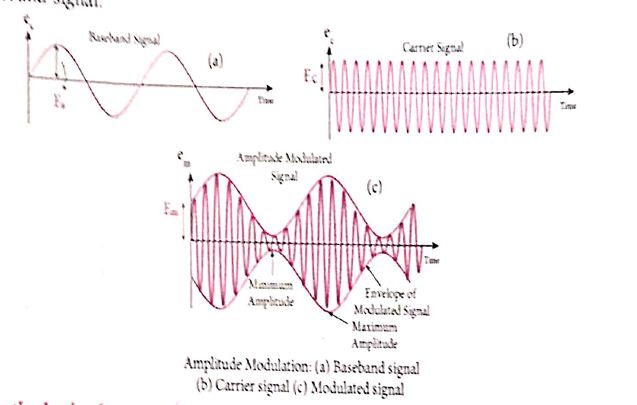
(i) If the amplitude of the carrier signal is modified according to the instantaneous amplitude of the baseband signal, then it is called amplitude modulation Here the frequency and the phase, of the carrier signal remain constant. Amplitude modulation is used in radio and TV broadcasting.
(ii) The signal shown in Figure (a) is the baseband signal that carries information. Figure(b) show the high-frequency carrier signal and Figure (c) gives amplitude modulated signal. We can see that amplitude of the carrier wave is modified in proportion to the amplitude or the baseband signal.
12.
(c)
98.425 MHz and 98.575 MHz
13.
(d)
150 kHz
14.
(b)
Repeater
15.
(a)
low frequency audio signal on high frequency radio waves
16.
(a)
amplification
17.
(a) Assertion and Reason are correct and Reason is the correct explanation of Assertion.
18.
(c) Transducer converts electrical energy into sound energy
19.
(a) I, II and III only
20.
(c) Space wave propagation - 50 MHz

12th Standard Syllabus & Materials
12th Standard
TN 12th Computer Applications களப்பெயர் முறைமை (DNS) Sample Question Papers Study Material - QB365 Set A
NEW12th Standard
TN 12th Computer Applications வலையமைப்பு எடுத்துக்காட்டுகள் மற்றும் நெறிமுறைகள் Sample Question Papers Study Material - QB365 Set A
NEW12th Standard
TN 12th Computer Applications கணினி வலையமைப்பு ஓர் அறிமுகம் Sample Question Papers Study Material - QB365 Set A
NEW12th Standard
TN 12th Computer Applications PHP-உடன் MySQL-ஐ இணைத்தல் Sample Question Papers Study Material - QB365 Set A



Tamilnadu Stateboard 12th Standard Subjects

Maths

Chemistry
Physics

Biology

Computer Science

Business Maths and Statistics

Economics

Commerce

Accountancy

History

Computer Applications
Biology
Computer Technology
Computer Applications
Computer Science
Business Maths and Statistics
Commerce
Economics
Maths
Chemistry
Physics
Computer Technology
History
Accountancy

Tamil

English

French
Tamilnadu Stateboard Standards

