
 100% FREE ACCESS
12th Standard Syllabus & Materials
12th Standard
TN 12th Maths Applications of Matrices and Determinants Sample Question Papers Study Material - QB365 Set A
NEW12th Standard
TN 12th Computer Applications மின்னணு தரவு பரிமாற்றம் Sample Question Papers Study Material - QB365 Set A
NEW12th Standard
TN 12th Computer Applications மின் - வணிக பாதுகாப்பு அமைப்புகள் Sample Question Papers Study Material - QB365 Set A
NEW12th Standard
TN 12th Computer Applications மின்னணு செலுத்தல் முறைகள் Sample Question Papers Study Material - QB365 Set A
NEW12th Standard
TN 12th Computer Applications மின் - வணிகம் Sample Question Papers Study Material - QB365 Set A
NEW12th Standard
TN 12th Computer Applications திறந்த மூல கருத்துருக்கள் Sample Question Papers Study Material - QB365 Set A

Published on: 02/01/2020
Current Electricity
Download Tamil Nadu 12th Standard Physics question papers, model tests, one-mark questions, important questions, and public exam papers in PDF format. Free study materials and answer keys for TN State Board students.
Questions + Answers key
Take MCQ Physics Test1.
Explain Peltier effect.
2.
State Joule's law.
3.
Find the expression for the equivalent emf & internal resistance of the series combination of cells.
4.
Two electric bulbs marked 20 W – 220 V and 100 W – 220 V are connected in series to 440 V supply. Which bulb will get fused?
5.
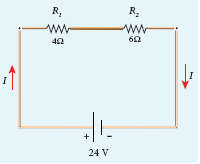
Calculate the equivalent resistance for the circuit which is connected to 24 V battery and also find the potential difference across each resistors in the circuit.
6.
How does the conductivity of a semiconductor change with rise in temperature? Explain.
7.
What do you mean by end resistance? How can it be rectified?
8.
What do you mean by a series combination of cells?
9.
State Kirchhoff ’s current rule.
10.
Write down the various forms of expression for power in electrical circuit.
11.
A battery has an emf of 12 V and connected to a resistor of 3 Ω. The current in the circuit is 3.93 A. Calculate
(a) terminal voltage and the internal resistance of the battery
(b) power delivered by the battery and power delivered to the resistor
12.
If the resistance of coil is 3 Ω at 20oC and α = 0.004/oC then determine its resistance at 100oC.
13.
The emf of a battery is 3 volts and internal resistance 0.125 \(\Omega \) . The difference of potential at the terminal of battery when connected across an external resistance of 1 \(\Omega \) is ______________.
1.67 V
0.67 V
2.67 V
3.67 V
14.
The temperature coefficient of resistance of a wire is 0.00125 per °C. At 20°C, its resistance is 1 Ω. The resistance of the wire will be 2 Ω at ______.
800 °C
700 °C
850 °C
820 °C
15.
In India electricity is supplied for domestic use at 220 V. It is supplied at 110 V in USA. If the resistance of a 60 W bulb for use in India is R, the resistance of a 60 W bulb for use in USA will be ______.
R
2R
\(\frac{R}{4}\)
\(\frac{R}{2}\)
16.
A wire connected to a power supply of 230 V has power dissipation P1. Suppose the wire is cut into two equal pieces and connected parallel to the same power supply. In this case power dissipation is P2. The ratio \(\frac{P_2}{P_1}\) is ______.
1
2
3
4
17.
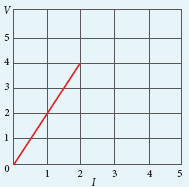
The following graph shows current versus voltage values of some unknown conductor. What is the resistance of this conductor?
2 ohm
4 ohm
8 ohm
1 ohm
18.
Write mathematical relation between
(i) mobility & drift velocity of charge carriers in a conductor
(ii) mobility & relaxation time (or) mean free time.
19.
A conductor of length I is connected to d.c. source of potential V. If the length of the conductor is doubled by treating it, keeping V constant, explain how do the following factors vary in the conductor
(i) Drift velocity.
(ii) Resistor
(iii) Resistivity.
1.
(i) When an electric current is passed through a circuit of a thermocouple, heat is evolved at one junction and absorbed at the other junction. This is known as the Peltier effect.
(ii) In the Cu-Fe thermocouple the junctions A and B are maintained at the same temperature.
(iii) Let a current from a battery flow through the thermocouple. At junction A, where the current flows from Cu to Fe, heat is absorbed and junction A becomes cold.
(iv) At junction B, where the current flows from Fe to Cu heat is liberated and it becomes hot.
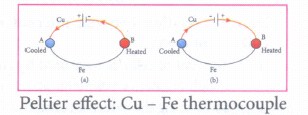
Peltier effect: Cu - Fe thermocouple
(v) When the direction of current is reversed, junction A gets heated and junction B gets cooled as shown in Figure (b).
Hence Peltier effect is reversible.
2.
If a current I flows through a conductor kept across a potential difference V for a time t, the work done or the electric potential energy spent is W = VIt
In the absence of any other external effect, this energy is spent on heating the conductor. The amount of heat(H) produced is H = VIt
For a resistance R,
H = I2 Rt
This relation was experimentally verified by Joule and is known as Joule's law of heating. It states that the heat developed in an electrical circuit due to the flow of current varies directly as
(i) the square of the current
(ii) the resistance of the circuit and
(iii) the time of flow.
3.
(i) Suppose n cells, each of emf \(\xi \) volts and internal resistance r ohms are connected in series with an external resistance R.
(ii) The total emf of the battery = \(n\xi \) The total resistance in the circuit = nr + R By Ohm's law, the current in the circuit is
\(I=\cfrac { totalemf }{ taoal\ resistance } =\cfrac { n\xi }{ nr+R } \)
\(I=\cfrac { n\xi }{ R } =n{ l }_{ 1 }\)
(iii) where II is the current due to a single cell
\(\left( { I }_{ 1 }=\cfrac { \xi }{ R } \right) \)
Thus, if r is negligible when compared to R the current supplied by the battery is n times that supplied by a single cell.
Case (b) If r >> R,\(I=\cfrac { n\xi }{ nr } =\cfrac { \xi }{ r } \)
(iv) It is the current due to a single cell. That is, current due to the whole battery is the same as that due to a single cell and hence there is no advantage in connecting several cells.
(v) Thus series connection of cells is advantageous only when the effective internal resistance of the cells is negligibly small compared with R.
4.
To check which bulb will be fused, the voltage drop across each bulb has to be calculated.
The resistance of a bulb,
\(R=\frac { V^{ 2 } }{ P } =\frac { { (Ratedvoltage) }^{ 2 } }{ Ratedpower } \)
For 20W - 220V bulb,
\({ R }_{ 1 }=\frac { { \left( 220 \right) }^{ 2 } }{ 20 } \Omega =2420\Omega \)
For 100W - 220V bulb,
\({ R }_{ 2 }=\frac { { \left( 220 \right) }^{ 2 } }{ 20 } \Omega =484\Omega \)
Both the bulbs are connected in series. So same current will pass through both the bulbs. The current that passes through the circuit, \(I=\frac { V }{ { R }_{ tot } } \)
Rtot (R1 + R2)
Rtot = (484 + 2420) \(\Omega\) = 2904 \(\Omega\)
\(I=\frac { 440V }{ 2904\Omega } \approx 0.151A\)
The voltage drop across the 20W bulb is
\(V_1=IR_1=\frac { 440V }{ 2904 }\times2420 \approx 366.6V\)
The voltage drop across the 100W bulb is
\({ V }_{ 2 }=I{ R }_{ 2 }=\frac { 440 }{ 2904 } 484\approx 73.3A\)
The 20 W bulb will get fused because the voltage across it is more than the voltage rating.
5.
Since the resistors are connected in series, the effective resistance in the circuit
= 4 Ω + 6 Ω = 10 Ω
The Current I in the circuit =\(\frac { V }{ { R }_{ eq } } =\frac { 24 }{ 10 } =2.4A\)
Voltage across 4Ω resistor
V1= IR1 = 2.4A x 4Ω = 9.6V
Voltage across 6 Ω resistor
V2 = IR2 = 2.4A x 6Ω = 14.4V
6.
The conductivity of a semiconductor increases with rise in temperature. When temperature increases, a large number of covalent bondsbreak. This produces a larger number of charge carriers. So current increases.
7.
The bridge wire is soldered at the ends of the copper strips. Due to imperfect contact, some resistance, might be introduced at the contact. These are called end resistances. This error can be eliminated, if another set of readings are taken with P and Q interchanged and the average value of P is found.
8.
Several cells can be connected to form a battery. In a series connection, the negative terminal of one cell is connected to the positive terminal of the second cell, the negative terminal of second cell is connected to the positive terminal of the third cell, and so on. The free positive terminal of the first cell and the free negative terminal of the last cell become the terminals of the battery.
9.
It states that the algebraic sum of the currents at any junction of a circuit is zero.
10.
(i) Electrical power P = VI
(ii) Erectrical power \(P=V\left(\frac{V}{R}\right)=\frac{V^{2}}{R} \quad \therefore P=\frac{V^{2}}{R}\)
(iii) P = Iv = I(IR) = I2R
(iv) P = I2R
11.
The given values I = 3.93 A, ξ = 12 V,
R = 3 Ω
(a) The terminal voltage of the battery is equal to voltage drop across the resistor
V = IR = 3.93 x 3 = 11.79 V
The internal resistance of the battery,
\(r=\left[ \frac { \xi -V }{ V } \right] R=\left[ \frac { 12-11.79 }{ 11.79 } \right] \times 3=0.05\Omega \)
(b) The power delivered by the battery P = Iξ = 3.93 x 12 = 47.1 W
The power delivered to the resistor = I2 R = 46.3 W
The remaining power = (47.1 – 46.3) = 0.8 W is delivered to the internal resistance and cannot be used to do useful work. (it is equal to I2 r).
12.
R0 = 3 Ω, T = 100oC, T0 = 20oC
α = 0.004/oC, RT = ?
RT = R0(1 + α(T - T0))
R100 = 3(1 + 0.004 x 80)
R100 = 3.96 Ω
13.
(c)
2.67 V
14.
Rt = Ro [1 + α(T2 - T1)
2 = 1[1 + 0.00125(T2 - 293)
I = 5/4 x 10-3 (T2 - 293)
T2 = 1093 K
T2 = 820 oC
15.
\(\mathrm{V}_1 =220 \mathrm{~V}, \quad \mathrm{P}_1=60 \mathrm{~W} \)
\(\mathrm{~V}_{\mathrm{U}} =110 \mathrm{~V}, \mathrm{P}_{\mathrm{U}}=60 \mathrm{~W} \)
\(P =\frac{V^2}{R} \Rightarrow R=\frac{V^2}{P} \)
\(\therefore R_l =\frac{V_I^2}{P_l} \text { Similarly, } \quad \mathrm{R}_U=\frac{V_U^2}{P_U} \)
\(R_l =\frac{220 \times 220}{60} \quad \mathrm{R}_{\mathrm{U}}=\frac{110 \times 110}{60} \)
\(R_I =\frac{48400}{60} \quad R_U=\frac{12100}{60} \)
\(\frac{R_U}{R_l} =\frac{12100}{60} \times \frac{60}{48400}=\frac{1}{4} \)
\(R_U =\frac{R_l}{4}=\frac{R}{4}\)
16.
\(\mathrm{V}=230 \mathrm{~V} \)
\(P=\frac{V^2}{R} \text { since } \mathrm{V} \text { is same } \mathrm{P} \propto \frac{1}{R} \)
\(\frac{1}{R_2}=\frac{1}{\frac{R_1}{2}}+\frac{1}{\frac{R_1}{2}}=\frac{2}{R_1}+\frac{2}{R_1}=\frac{2+2}{R_1} \)
\(\frac{1}{R_2}=\frac{4}{R_1} \)
\(\therefore R_2=\frac{R_1}{4} \)
\(R_1=4 R_2 \)
\(\therefore \frac{P_2}{P_1}=\frac{R_1}{R_2}=\frac{4 R_2}{R_2}=4\)
17.
Resistance, \(R=\frac{V}{I}=\frac{4}{2}=2 \ ohm\)
18.
(i) \(mobility=\cfrac { Drift\ velocity }{ electric\ field } \) (or) \(\mu =\cfrac { { V }_{ d } }{ E } \)
(ii) \({ \mu }_{ d }=\cfrac { eE }{ mL } .\tau \) (or) \(\cfrac { { v }_{ d } }{ E } =\left( \cfrac { e }{ mL } \right) .\tau \)
\(\mu =\cfrac { e }{ mL } .\tau \)
19.
(i) Drift velocity \({ u }_{ d }=\cfrac { ev }{ ml } .\tau \)
When I am doubled, drift velocity, become \(\cfrac { 1 }{ 2 } \) times the original vd
(ii) Resistor \(R=\rho .\cfrac { l }{ A } \)
Resistor becomes doubled i.e. 2 times the original resistors.
(iii) Resistivity is not affected.

12th Standard Syllabus & Materials
12th Standard
TN 12th Computer Applications வலையமைப்பு வடமிடல் Sample Question Papers Study Material - QB365 Set A
NEW12th Standard
TN 12th Computer Applications களப்பெயர் முறைமை (DNS) Sample Question Papers Study Material - QB365 Set A
NEW12th Standard
TN 12th Computer Applications வலையமைப்பு எடுத்துக்காட்டுகள் மற்றும் நெறிமுறைகள் Sample Question Papers Study Material - QB365 Set A
NEW12th Standard
TN 12th Computer Applications கணினி வலையமைப்பு ஓர் அறிமுகம் Sample Question Papers Study Material - QB365 Set A



Tamilnadu Stateboard 12th Standard Subjects

Maths

Chemistry
Physics

Biology

Computer Science

Business Maths and Statistics

Economics

Commerce

Accountancy

History

Computer Applications
Biology
Computer Technology
Computer Applications
Computer Science
Business Maths and Statistics
Commerce
Economics
Maths
Chemistry
Physics
Computer Technology
History
Accountancy

Tamil

English

French
Tamilnadu Stateboard Standards

