
 100% FREE ACCESS
12th Standard Syllabus & Materials
12th Standard
TN 12th Computer Applications மின்னணு தரவு பரிமாற்றம் Sample Question Papers Study Material - QB365 Set A
NEW12th Standard
TN 12th Computer Applications மின் - வணிக பாதுகாப்பு அமைப்புகள் Sample Question Papers Study Material - QB365 Set A
NEW12th Standard
TN 12th Computer Applications மின்னணு செலுத்தல் முறைகள் Sample Question Papers Study Material - QB365 Set A
NEW12th Standard
TN 12th Computer Applications மின் - வணிகம் Sample Question Papers Study Material - QB365 Set A
NEW12th Standard
TN 12th Computer Applications திறந்த மூல கருத்துருக்கள் Sample Question Papers Study Material - QB365 Set A
NEW12th Standard
TN 12th Computer Applications வலையமைப்பு வடமிடல் Sample Question Papers Study Material - QB365 Set A

Published on: 27/09/2019
Current Electricity
Download Tamil Nadu 12th Standard Physics question papers, model tests, one-mark questions, important questions, and public exam papers in PDF format. Free study materials and answer keys for TN State Board students.
Questions + Answers key
Take MCQ Physics Test1.
What is thermoelectric effect?
2.
Define resistance.
3.
Define current.
4.
What is Peltier effect?
5.
What is Seebeck effect?
6.
State Kirchhoff ’s voltage rule.
7.
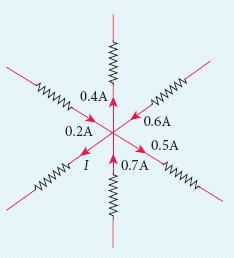
For the given circuit find the value of I.
8.
Determine the number of electrons flowing per second through a conductor, when a current of 32 A flows through it.
9.
Define current density.
10.
State macroscopic form of Ohm’s law.
11.
Distinguish between drift velocity and mobility.
12.
Why current is a scalar?
13.
Two electric bulbs marked 20 W – 220 V and 100 W – 220 V are connected in series to 440 V supply. Which bulb will get fused?
14.
The resistance of a wire is 20 Ω. What will be new resistance, if it is stretched uniformly 8 times its original length?
15.
If the specific resistance of a potentiometer wire is 10-7 Om and current flowing through it is 0.1 amp, cross-sectional area of wire is 10-6 m2, then potential gradient will be ________________.
10-2 v/m
10-4 v/m
10-6 v/m
10-8v/m
16.
The temperature co-efficient of resistance for alloys is _____________.
low
very low
high
very high
17.
18.
The temperature coefficient of resistance of a wire is 0.00125 per °C. At 20°C, its resistance is 1 Ω. The resistance of the wire will be 2 Ω at ______.
800 °C
700 °C
850 °C
820 °C
19.
Two wires of A and B with circular cross section made up of the same material with equal lengths. Suppose RA = 3 RB, then what is the ratio of radius of wire A to that of B?
3
\(\sqrt3\)
\(\frac{1}{\sqrt3}\)
\(\frac{1}{3}\)
20.
A toaster operating at 240 V has a resistance of 120 Ω. The power is ______.
400 W
2 W
480 W
240 W
21.
Obtain the macroscopic form of Ohm’s law from its microscopic form and discuss its limitation.
22.
Energy
23.
Current
24.
Electrical Lamp
25.
Electric furnace
26.
Electric Heaters
1.
Current produces thermal energy, thermal energy may also be suitably used to produce an electromotive force. This is known as thermoelectric effect.
2.
The resistanct is defined as the ratio of potential difference across the given conductor to the current passing through the conductor.
\(R=\cfrac { V }{ I } \)
3.
If a net charge Q passes through any cross section of a conductor in time t, then the current is defined as \(I=\cfrac { Q }{ t } \)
4.
Peltier discovered that, when an electric current is passed through a circuit of a thermocouple heat is evolved at one junction and absorbed at the other junction. This is known as Peltier effect.
5.
Seebeck discovered that in a closed circuit consisting of two dissimilar metals, when the junctions are maintained at different temperature an emf is developed.
6.
It states that in a closed circuit the algebraic sum of the products of the current and resistance of each part of the circuit is equal to the total emf included in the circuit.
7.
Applying Kirchoff’s rule to the point P in the circuit,
The arrows pointing towards P are positive and away from P are negative.
Therefore, 0.2A - 0.4A + 0.6A - 0.5A + 0.7A - I = 0
0.7 A - I = 0
1.5A - 0.9A – I = 0
0.6A - I = 0
I = 0.6 A
8.
I = 32 A , t = 1 s
Charge of an electron, e = 1.6 x 10⁻¹⁹ C
The number of electrons flowing per second, n = ?
\(I=\frac { q }{ t } =\frac { ne }{ t } \)
\(n=\frac { It }{ e } \)
\(n=\frac { 32\times 1 }{ 1.6\times { 10 }^{ -19 }C } \)
n = 20 x 1019 = 2 x 10²⁰ electrons
9.
Current density is J in a conductor is defined as the current flowing per unit area of cross-section of the conductor
\(\therefore J=\cfrac { I }{ A } \)
Where I - current
A - area of cross section
10.
Macroscopic form of Ohm's law is V = IR
Where V - Potential difference
I - current
R - resistance of a conductor.
11.
| S.No | Drift velocity | Mobility |
| (i) | Drift velocity is the average velocity acquired by the electrons inside the conductor when it is subjected to an electric field. | Mobility is defined as the magnitude of the drift velocity per unit electric field. |
| (ii) | Vd = a\(\tau\) (or) Vd = μE. | μ =e\(\tau\)/m (or) u = vd/E. |
| (iii) | Its unit is m / s. | Its unit is m2/ Vs. |
12.
Current is defined as the ratio of the net (i.e. amount of) charge (Q) passing through any cross section of a conductor to time.
\(I=\frac{Q}{t}\)
Since current is the ratio of two scalar quantities, it is a scalar. In addition current I is defined as the scalar product of the current density and area vector at which the charges cross.
I = \(\vec{J}.\vec{A}\)
13.
To check which bulb will be fused, the voltage drop across each bulb has to be calculated.
The resistance of a bulb,
\(R=\frac { V^{ 2 } }{ P } =\frac { { (Ratedvoltage) }^{ 2 } }{ Ratedpower } \)
For 20W - 220V bulb,
\({ R }_{ 1 }=\frac { { \left( 220 \right) }^{ 2 } }{ 20 } \Omega =2420\Omega \)
For 100W - 220V bulb,
\({ R }_{ 2 }=\frac { { \left( 220 \right) }^{ 2 } }{ 20 } \Omega =484\Omega \)
Both the bulbs are connected in series. So same current will pass through both the bulbs. The current that passes through the circuit, \(I=\frac { V }{ { R }_{ tot } } \)
Rtot (R1 + R2)
Rtot = (484 + 2420) \(\Omega\) = 2904 \(\Omega\)
\(I=\frac { 440V }{ 2904\Omega } \approx 0.151A\)
The voltage drop across the 20W bulb is
\(V_1=IR_1=\frac { 440V }{ 2904 }\times2420 \approx 366.6V\)
The voltage drop across the 100W bulb is
\({ V }_{ 2 }=I{ R }_{ 2 }=\frac { 440 }{ 2904 } 484\approx 73.3A\)
The 20 W bulb will get fused because the voltage across it is more than the voltage rating.
14.
R1 = 20 Ω, R2 = ?
Let the original length of the wire (l1) be l.
New length, l2 = 8l1 (i.,e) l2 = 8l
Original resistance, R1 = \(\rho \frac { { l }_{ 1 } }{ { A }_{ 1 } } \)
New resistance R2 = \(\rho \frac { { l }_{ 2 } }{ { A }_{ 2 } } =\frac { \rho (8l) }{ { A }_{ 2 } } \)
Though the wire is stretched, its volume is unchanged.
Initial volume = Final volume
A1l1 = A2l2 , A1l = A2(8l)
\(\frac { { A }_{ 1 } }{ { A }_{ 2 } } =\frac { 8l }{ l } =8\)
By dividing equation R2 by equation R1, we get
\(\frac { { R }_{ 2 } }{ { R }_{ 1 } } =\frac { \rho (8l) }{ { A }_{ 2 } } \times \frac { { A }_{ 1 } }{ \rho l } \)
\(\frac { { R }_{ 2 } }{ { R }_{ 1 } } =\frac { { A }_{ 1 } }{ { A }_{ 2 } } \times 8\)
Substituting the value of \(\frac { { A }_{ 1 } }{ { A }_{ 2 } } \), we get
\(\frac { { R }_{ 2 } }{ { R }_{ 1 } } =8\times 8=64\)
R2 = 64 x 20 = 1280 Ω
Hence, stretching the length of the wire has increased its resistance.
15.
(a)
10-2 v/m
16.
(a)
low
17.
(a)
18.
Rt = Ro [1 + α(T2 - T1)
2 = 1[1 + 0.00125(T2 - 293)
I = 5/4 x 10-3 (T2 - 293)
T2 = 1093 K
T2 = 820 oC
19.
\(R \propto \frac{1}{A}, R \propto \frac{1}{r^2} \)
\(R_A \propto \frac{1}{r_A^2}, R_B \propto \frac{1}{r_B^2} \)
\(\frac{r_A}{r_B}=\left(\frac{R_B}{R_A}\right)^{1 / 2}=\left(\frac{R_B}{3 R_B}\right)^{1 / 2}=\frac{1}{3^{\frac{1}{2}}}=\frac{1}{\sqrt{3}}\)
20.
\(P=\frac{V^2}{R}=\frac{240 \times 240}{120}=480 \ W\)
21.
(i) The ohm's law can be derived from the equation \(J=\sigma E\) Consider a segment of wire of length I and cross-sectional area A as shown in Figure.
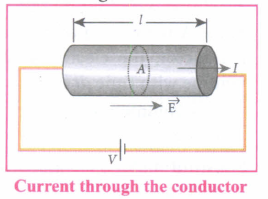
(ii) When a potential difference V is applied across the wire, a net electric field is created in the wire which constitutes the current in the wire.
(iii) For simplicity, we assumed that the electric field is uniform in the entire length of the wire, the potential difference (voltage V) can be written as V = EI
(iv) As we know, the magnitude of current density
\(J=\sigma E=\sigma \cfrac { V }{ l } \)
(v) But \(J=\cfrac { I }{ A } \), so we write the equation as,
\(\cfrac { I }{ A } =\sigma \cfrac { V }{ l } \)
(vi) By rearranging the above equation we get,
\(V=I\left( \cfrac { I }{ \sigma A } \right) \)
(vii) The quantity \(\cfrac { l }{ \sigma A } \)is called resistance of the conductor and it is denoted as R. Note that the resistance is directly proportional to the length of the conductor and inversely proportional to area of cross-section.
(viii) Therefore, the macroscopic form of ohm's law can be stated as V = IR.
22.
joule
23.
ampere
24.
Tungsten
25.
Molybdenum
26.
Nichrome

12th Standard Syllabus & Materials
12th Standard
TN 12th Computer Applications களப்பெயர் முறைமை (DNS) Sample Question Papers Study Material - QB365 Set A
NEW12th Standard
TN 12th Computer Applications வலையமைப்பு எடுத்துக்காட்டுகள் மற்றும் நெறிமுறைகள் Sample Question Papers Study Material - QB365 Set A
NEW12th Standard
TN 12th Computer Applications கணினி வலையமைப்பு ஓர் அறிமுகம் Sample Question Papers Study Material - QB365 Set A
NEW12th Standard
TN 12th Computer Applications PHP-உடன் MySQL-ஐ இணைத்தல் Sample Question Papers Study Material - QB365 Set A



Tamilnadu Stateboard 12th Standard Subjects

Maths

Chemistry
Physics

Biology

Computer Science

Business Maths and Statistics

Economics

Commerce

Accountancy

History

Computer Applications
Biology
Computer Technology
Computer Applications
Computer Science
Business Maths and Statistics
Commerce
Economics
Maths
Chemistry
Physics
Computer Technology
History
Accountancy

Tamil

English

French
Tamilnadu Stateboard Standards

