
 100% FREE ACCESS
12th Standard Syllabus & Materials
12th Standard
TN 12th Computer Applications மின்னணு தரவு பரிமாற்றம் Sample Question Papers Study Material - QB365 Set A
NEW12th Standard
TN 12th Computer Applications மின் - வணிக பாதுகாப்பு அமைப்புகள் Sample Question Papers Study Material - QB365 Set A
NEW12th Standard
TN 12th Computer Applications மின்னணு செலுத்தல் முறைகள் Sample Question Papers Study Material - QB365 Set A
NEW12th Standard
TN 12th Computer Applications மின் - வணிகம் Sample Question Papers Study Material - QB365 Set A
NEW12th Standard
TN 12th Computer Applications திறந்த மூல கருத்துருக்கள் Sample Question Papers Study Material - QB365 Set A
NEW12th Standard
TN 12th Computer Applications வலையமைப்பு வடமிடல் Sample Question Papers Study Material - QB365 Set A

Published on: 06/01/2020
Dual Nature of Radiation and Matter
Download Tamil Nadu 12th Standard Physics question papers, model tests, one-mark questions, important questions, and public exam papers in PDF format. Free study materials and answer keys for TN State Board students.
Questions + Answers key
Take MCQ Physics Test1.
A charged oil drop is suspended in a uniform field of 3 x 10⁴ Vm-1 so that it neither falls nor rises. The charge on the drop will be _____________.
3.3 x 10⁻¹⁸C
3.2 x 10⁻¹⁸C
1.6 x 10⁻¹⁸C
4.8 x 10⁻¹⁸C
2.
Photo electron effect supports quantum nature of light because ___________.
there is a minimum frequency which no photo electrons are emitted
the maximum kinetic energy of photo electrons depends only one the frequency of light and not in intensity
even when the metal surface is faintly illuminated the photoelectrons leave the surface immedietly
All the above
3.
The work function of a metal is hv0. Light of frequency v falls on this metal. The photoelectric effect will take place only if ___________.
v \(\geq\) v0
v > 2vo
vo
v > vo/2
4.
The threshold wavelength for a metal surface whose photoelectric work function is 3.313 eV is _____.
4125 \(\mathring { A } \)
3750\(\mathring { A } \)
6000\(\mathring { A } \)
2062.5\(\mathring { A } \)
5.
In an electron microscope, the electrons are accelerated by a voltage of 14 kV. If the voltage is changed to 224 kV, then the de Broglie wavelength associated with the electrons would _____.
increase by 2 times
decrease by 2 times
decrease by 4 times
increase by 4 times
6.
Do all the electrons that absorb a photon come out as photoelectrons?
7.
Define the term 'stopping potential' in relation to photoelectric effect.
8.
Write the relationship of de Broglie wavelength λ associated with a particle of mass m in terms of its kinetic energy K.
9.
A proton and an electron have same kinetic energy. Which one has greater de Broglie wavelength. Justify.
10.
Give the definition of intensity of light according to quantum concept and its unit.
11.
When an electron in hydrogen atom jumps from the third excited state to the grand state, how would the de Broglie wavelength associated with the electron change? Justify your answer.
12.
Write the application of x-rays.
13.
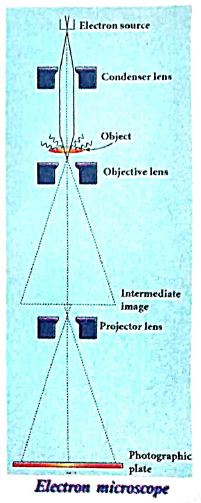
Briefly explain the principle and working of electron microscope.
14.
Explain experimentally observed facts of photoelectric effect with the help of Einstein’s explanation.
15.
Red light however bright it is, cannot produce the emission of electrons from a clean zinc surface, but even weak ultraviolet radiation can do so; why?
16.
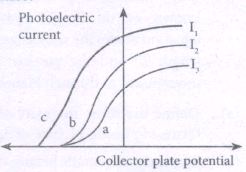
The figure shows a plot of three curves a, b, c showing the variation of photocurrent vs. Collector plate potential for three different intensities I1, I2, and I3 having frequencies v1, v2 and v3 respective incident on a photosensitive surface.
The figure shows a plot of three curves a, b, c showing the variation of photocurrent vs. Collector plate potential for three different intensities I1, I2, and I3 having frequencies v1,v2, and v3 respective incident on a photosensitive surface.
17.
Derive an expression for De Broglie wave length.
18.
When a light of frequency 9 x 10¹⁴ Hz is incident on a metal surface, photoelectrons are emitted with a maximum speed of 8 x 10⁵ m/s. Determine the threshold frequency of the surface.
19.
What should be the velocity of the electron so that its momentum equals that of 4000 Å wavelength photon.
1.
(a)
3.3 x 10⁻¹⁸C
2.
(a)
there is a minimum frequency which no photo electrons are emitted
3.
(a)
v \(\geq\) v0
4.
\(\lambda_0 =\frac{h c}{\phi} \)
\(=\frac{6.626 \times 10^{-34} \times 3 \times 10^8}{3.313 \times 1.6 \times 10^{-19}} \)
\( =\frac{19.8782400}{5.3} \times 10^{-7} \)
\(\lambda_0 =3.750 \times 10^{-7} \simeq 3750 \stackrel{o}A\)
5.
\(\lambda\propto \frac{1}{\sqrt{V}}\)
\(\frac{\lambda_1}{\lambda_2}=\frac{\sqrt{224\times10^3}}{\sqrt{14\times 10^3}}\)
\(=\sqrt{16}=4\)
\(\lambda_{\mathrm{2}}= \frac{\lambda_1}{4}\)
6.
No, most electrons get scattered into the metal. Only a few come out of the surface of the metal.
7.
The minimum retarding (negative) potential of anode of a photoelectric tube fro which photoelectric current stops or becomes zero is called the stopping potential.
8.
de Broglie wavelength \(\lambda=\frac{\mathrm{h}}{\mathrm{mv}}\)
Kinetic energy of electron K \(=\frac{1}{2} m v^{2} \text { (or) } v=\sqrt{\frac{2 K}{m}}\)
Now de Broglie wavelength is \(\lambda=\frac{h}{m v}=\frac{h}{m \sqrt{2 K / m}} \)
\(\lambda=\frac{h}{\sqrt{2 m K}} \)
9.
The de Broglie wavelength associated with the kinetic energy K is \(\lambda=\frac{h}{\sqrt{2 m k}}\)
Where m is the mass of the particle
Since proton and electron have same KE, the wavelength is inversely proportional to square root of the mass \(\lambda \alpha \frac{1}{\sqrt{m}}\)
Mass of proton is 1840 times greater them that of electron. Therefore, de Broglie's wavelength of electron is greater than the proton.
10.
According to quantum concept, intensity of light of given wavelength is defined as the number of energy quanta or photons incident per unit area per unit time, with each photon having same energy. Its unit is Wm-2.
11.
(i) de Broglie wavelength associated with a moving charge particle having a KE 'K' can be given as
λ = \(\frac { h }{ p } =\frac { h }{ \sqrt { 2mK } } \) ......(1) \(\left[ K=\frac { 1 }{ 2 } mv^{ 2 }=\frac { { p }^{ 2 } }{ 2m } \right] \)
(ii) The kinetic energy of the electron in any orbit of the hydrogen atom can be given as
K = -E = -\(\left( \frac { 13.6 }{ { n }^{ 2 } } eV \right) =\frac { 13.6 }{ { n }^{ 2 } } \) ........(2)
(iii) Let K and K4 be the KE of the electron in the ground state and third excited state, where n1 = 1 shows the ground state and n2 = 4 shows the third excited state.
Using the concept of equations (1) & (2), we have
\(\frac { { \lambda }_{ 1 } }{ { \lambda }_{ 4 } } =\sqrt { \frac { { K }_{ 4 } }{ { K }_{ 1 } } } =\sqrt { \frac { { n }_{ 1 }^{ 2 } }{ { n }_{ 2 }^{ 2 } } } \)
\(\frac { { \lambda }_{ 1 } }{ { \lambda }_{ 4 } } =\sqrt { \frac { { 1 }^{ 2 } }{ { 4 }^{ 2 } } } =\frac { 1 }{ 4 } \)
λ = \(\frac { { \lambda }_{ 4 } }{ 4 } \)
i.e., the wavelength in the ground state will decrease.
12.
X-rays are being used in many fields. Let us list a few of them.
(i) Medical diagnosis X-rays can pass through flesh more easily than through bones. Thus an x-ray radiograph containing a deep shadow of the bones and a light shadow of the flesh may be obtained. X-ray radiographs are used to detect fractures, foreign bodies, diseased organs, etc.
(ii) Medical therapy Since x-rays can kill diseased tissues, they are employed to cure skin diseases, malignant tumors, etc.
(iii) Industry X-rays are used to check for flaws in welded joints, motor tires, tennis balls, and wood. At the customs post, they are used for the detection of contraband goods.
(iv) Scientific research X-ray diffraction is an important tool to study the structure of the crystalline materials - that is, the arrangement of atoms and molecules in crystals.
13.
Principle:
(i) The wave nature of the electron is used in the construction of microscope called electron microscope.
(ii)The resolving power of a microscope is inversely proportional to the wavelength of the radiation used for illuminating the object under study.
(iii) Higher magnification as well as higher resolving power can be obtained by employing the waves of shorter wavelengths.
(iv) De Broglie's wavelength of electron is very much less than (a few thousand less) that of the visible light being used in optical microscopes.
(v) As a result, the microscopes employing de Broglie waves of electrons have very much higher resolving power than optical microscope.
(vi) Electron microscopes giving magnification more than 2,00,000 times are common in research laboratories.
Working:
(i) The construction and working of an electron microscope is similar to that of an optical microscope except that in electron microscope focussing of electron beam is done by the electrostatic or magnetic lenses.
(ii) The electron beam passing across a suitably arranged either electric or magnetic fields undergoes divergence or convergence thereby focussing of the beam is done.
(iii) The electrons emitted from the source are accelerated by high potentials.
(iv) The beam is made parallel by magnetic condenser lens; When the beam passes through the sample whose magnified image is needed, the beam carries the image of the sample.
(v) With the help of magnetic objective lens and magnetic projector lens system, the magnified image is obtained on the screen. These electron microscopes are being used in almost all brands of science.
14.
Explanation for the photoelectric effect:
The experimentally observed facts of photoelectric effect can be explained with the help of Einstein's photoelectric equation.
(i) As each incident photon liberates one electron, then the increase of intensity of the light (the number of photons per unit area per unit time) increases the number of electrons emitted thereby increasing the photocurrent. The same has been experimentally observed.
(ii) From Kmax = hv - Φ0, it is evident that Kmax is proportional to the frequency of the light and is independent of intensity of the light.
(iii) As given in equation \({ hv }_{ o }+\cfrac { 1 }{ 2 } { mv }^{ 2 }\) , there must be minimum energy (equal to the work function of the metal) for incident photons to liberate electrons from the metal surface. Below which, emission of electrons is not possible. Correspondingly, there exists minimum frequency called threshold frequency below which there is no photoelectric emission.
(iv) According to quantum concept, the transfer of photon energy to the electrons is instantaneous so that there is no time lag between incidence of photons and ejection of electrons.
Thus, the photoelectric effect is explained on the basis of quantum concept of light.
15.
(i) The photoemission of electrons does not depend on the intensity but it depends on the frequency and hence on the energy of a photon of incident light.
(ii) If the energy of a photon is greater than the work function, the photoemission of electrons results however weak the incident radiation may be.
(iii) The energy of a photon of red light is less than the work function of zinc, so red light cannot emit photoelectrons.
(iv) The energy of a photon of ultraviolet light is greater than the work function of zinc, so ultraviolet light can emit photoelectrons.
16.
Curves a and b have different intensities but the same stopping potential, so curves 'a' and 'b' have the same frequency but different intensities.
17.
i) The momentum of photon of frequency v is given by,
\(p=\frac { hv }{ c } =\frac { h }{ \lambda } \)
ii) The wavelength of a photon in terms of its momentum is,
\(\lambda =\frac { h }{ p } \)
iii) According to de Broglie, the above equation is completely a general one and this is applicable to material particles as well. Therefore, for a particle of mass m traveling with speed u, the wavelength is given by,
\(\lambda =\frac { h }{ mv } =\frac { h }{ p } \)
iv) This wavelength of the matter waves is known as de Broglie wavelength. This equation relates the wave character (the wavelength \(\lambda\)) and the particle character (the momentum p) through Planck's constant.
18.
\(v= 9 \times 10^{14} \mathrm{~Hz} ; \mathrm{V}=8 \times 10^{5} \mathrm{~m} / \mathrm{s} \)
\(\mathrm{E}= \mathrm{h}-\mathrm{h} v_{o} \Rightarrow v_{o}=\frac{\mathrm{h}v-\mathrm{E}}{\mathrm{h}}=\mathrm{V}-\frac{\mathrm{E}}{\mathrm{h}}=\mathrm{V}-\frac{\frac{1}{2} \mathrm{mv}^{2} }{h}\)
\(v_s={9 \times 10^{14}-\frac{\left[\frac{1}{2} \times 9.1 \times 10^{-31} \times\left(8 \times 10^{5}\right)^{2}\right]}{6.626 \times 10^{-34}}}=4.605 \times 10^{14} \)
\( v_{o} \simeq 4.6 \times 10^{14} \mathrm{~Hz} \)
19.
\(\lambda=4000 \stackrel{o}A=4000 \times 10^{-10} \mathrm{~m} \)
\(\lambda=\frac{\mathrm{h}}{\mathrm{mv}}\Rightarrow \mathrm{v }=\frac{\mathrm{h}}{\mathrm{m\lambda}}=\frac{6.626 \times 10^{-34}}{9.1 \times 10^{-31} \times 4000 \times 10^{10}}=1820 \mathrm{~ms}^{-1} \)

12th Standard Syllabus & Materials
12th Standard
TN 12th Computer Applications களப்பெயர் முறைமை (DNS) Sample Question Papers Study Material - QB365 Set A
NEW12th Standard
TN 12th Computer Applications வலையமைப்பு எடுத்துக்காட்டுகள் மற்றும் நெறிமுறைகள் Sample Question Papers Study Material - QB365 Set A
NEW12th Standard
TN 12th Computer Applications கணினி வலையமைப்பு ஓர் அறிமுகம் Sample Question Papers Study Material - QB365 Set A
NEW12th Standard
TN 12th Computer Applications PHP-உடன் MySQL-ஐ இணைத்தல் Sample Question Papers Study Material - QB365 Set A



Tamilnadu Stateboard 12th Standard Subjects

Maths

Chemistry
Physics

Biology

Computer Science

Business Maths and Statistics

Economics

Commerce

Accountancy

History

Computer Applications
Biology
Computer Technology
Computer Applications
Computer Science
Business Maths and Statistics
Commerce
Economics
Maths
Chemistry
Physics
Computer Technology
History
Accountancy

Tamil

English

French
Tamilnadu Stateboard Standards

