
 100% FREE ACCESS
12th Standard Syllabus & Materials
12th Standard
TN 12th Computer Applications மின்னணு தரவு பரிமாற்றம் Sample Question Papers Study Material - QB365 Set A
NEW12th Standard
TN 12th Computer Applications மின் - வணிக பாதுகாப்பு அமைப்புகள் Sample Question Papers Study Material - QB365 Set A
NEW12th Standard
TN 12th Computer Applications மின்னணு செலுத்தல் முறைகள் Sample Question Papers Study Material - QB365 Set A
NEW12th Standard
TN 12th Computer Applications மின் - வணிகம் Sample Question Papers Study Material - QB365 Set A
NEW12th Standard
TN 12th Computer Applications திறந்த மூல கருத்துருக்கள் Sample Question Papers Study Material - QB365 Set A
NEW12th Standard
TN 12th Computer Applications வலையமைப்பு வடமிடல் Sample Question Papers Study Material - QB365 Set A

Published on: 03/12/2019
Dual Nature of Radiation and Matter
Download Tamil Nadu 12th Standard Physics question papers, model tests, one-mark questions, important questions, and public exam papers in PDF format. Free study materials and answer keys for TN State Board students.
Questions + Answers key
Take MCQ Physics Test1.
Light of wavelength falls on a metal having work function \(\frac { { h }_{ c } }{ { \lambda }_{ 0 } } \). Photo electric effect will place only if __________.
λ ≥ λ0
λ ≥ 2λ0
λ ≤ λ0
λ < λ0/2
2.
The work functions for metals A, B and C are 1.92 eV, 2.0 eV and 5.0 eV respectively. The metal/metals which will emit photoelectrons for a radiation of wavelength 4100 Å is/are _____.
A only
both A and B
all these metals
none
3.
The threshold wavelength for a metal surface whose photoelectric work function is 3.313 eV is _____.
4125 \(\mathring { A } \)
3750\(\mathring { A } \)
6000\(\mathring { A } \)
2062.5\(\mathring { A } \)
4.
5.
In an electron microscope, the electrons are accelerated by a voltage of 14 kV. If the voltage is changed to 224 kV, then the de Broglie wavelength associated with the electrons would _____.
increase by 2 times
decrease by 2 times
decrease by 4 times
increase by 4 times
6.
What is photo conductive cell?
7.
What is photo voltaic cell?
8.
An electron and an alpha particle have same kinetic energy. How are the de Broglie wavelengths associated with them related?
9.
What is a photo cell? Mention the different types of photocells.
10.
How does photocurrent vary with the intensity of the incident light?
11.
Write a note on continuous x-ray spectra.
12.
13.
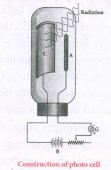
Explain experimentally observed facts of photoelectric effect with the help of Einstein’s explanation.
14.
The frequency V of incident radiation is greater than threshold frequency (vo) in a photocell. How will the stopping potential vary if frequency (v) is increased, keeping other factors constant?
15.
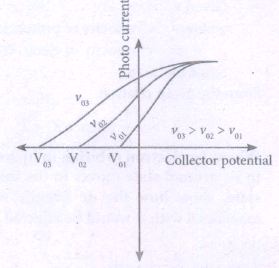
Show the variation of photocurrent with collector plate potential for different frequencies but same intensity of incident radiation.
16.
A proton and an electron have same velocity. Which one has greater de Broglie wavelength and why?
17.
What should be the velocity of the electron so that its momentum equals that of 4000 Å wavelength photon.
1.
(c)
λ ≤ λ0
2.
\(E=\frac{12400 \stackrel{o}A}{4100 \stackrel{o}A}=3.02 eV\)
3.
\(\lambda_0 =\frac{h c}{\phi} \)
\(=\frac{6.626 \times 10^{-34} \times 3 \times 10^8}{3.313 \times 1.6 \times 10^{-19}} \)
\( =\frac{19.8782400}{5.3} \times 10^{-7} \)
\(\lambda_0 =3.750 \times 10^{-7} \simeq 3750 \stackrel{o}A\)
4.
(b)
5.
\(\lambda\propto \frac{1}{\sqrt{V}}\)
\(\frac{\lambda_1}{\lambda_2}=\frac{\sqrt{224\times10^3}}{\sqrt{14\times 10^3}}\)
\(=\sqrt{16}=4\)
\(\lambda_{\mathrm{2}}= \frac{\lambda_1}{4}\)
6.
The resistance of the semiconductor changes in accordance with the radiant energy incident on it.
7.
Sensitive element made of semiconductor is used which generates voltage proportional to the intensity of light or other radiations.
8.
The de Broglie wavelength associated with the kinetic energy k is given as \(\lambda=\frac{h}{\sqrt{2 m k}}\) , where m is the mass of the particle.
Therefore \(\lambda_{\mathrm{e}}=\frac{\mathrm{h}}{\sqrt{2 \mathrm{~m}_{\mathrm{e}} \mathrm{k}_{\mathrm{e}}}} \text { and } \lambda_{\alpha}=\frac{\mathrm{h}}{\sqrt{2 \mathrm{~m}_{\alpha} \mathrm{k}_{\alpha}}} \text {. But } \mathrm{k}_{\mathrm{e}}=\mathrm{k}_{\alpha} . \)
Therefore \(\frac{\lambda_{\mathrm{e}}}{\lambda_{\alpha}}=\sqrt{\frac{\mathrm{m}_{\alpha}}{\mathrm{m}_{\mathrm{e}}}} \mathrm{m}_{\alpha}>\mathrm{m}_{\mathrm{e}^{*}} \text {. Therefore, } \lambda_{\mathrm{e}}>\lambda_{\alpha^{\circ}}\)
9.
Photo cell is a device which converts light energy into electrical energy. It works on the principle of photo electric effect. When light is incident on photosensitive materials, their electric properties will get affected, based on which Photo cells are classified into three types. They are
(i) Photo emissive cell
(ii) Photo voltaic cell
(iii) Photo conductive cell
10.
The photocurrent, (ie. the number of electrons emitted per second) is directly proportional to the intensity of the incident light.
11.
i) When a fast-moving electron penetrates and approaches a target nucleus, the interaction between the electron and the nucleus either accelerates or decelerates it which results in a change of path of the electron.
ii) The radiation produced from such decelerating electrons is called Bremsstrahlung or braking radiation.
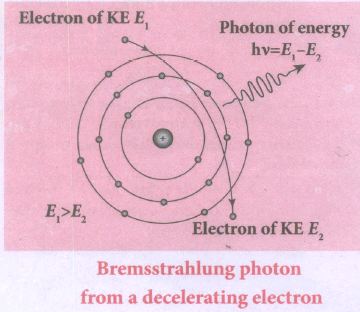
iii) The energy of the photon emitted is equal to the loss of kinetic energy of the electron
iv) Since an electron may lose part or all of its energy to the photon, the photons are emitted with all possible energies (or frequencies).
v) The continuous x-ray spectrum is due to such radiations
vi) When an electron gives up all its energy, then the photon is emitted with the highest frequency vo (or lowest wavelength \(\lambda\)o).
vii) The initial kinetic energy of an electron is given by eV where V is the accelerating voltage. Therefore, we have
\({ hv }_{ 0 }=eV(or)\frac { hc }{ { \lambda }_{ 0 } } =eV\)
\(\\ { \lambda }_{ 0 }=\frac { hc }{ eV } \)
viii) Where \({ \lambda }_{ 0 }\) is the cut-off wavelength. Substituting the known values in the above equation, we get
\({ \lambda }_{ 0 }=\frac { 12400 }{ V } \)Å ...(1)
The relation given by equation (1) is known as the Duane - Hunt formula.
ix) The value \({ \lambda }_{ 0 }\)depends only on the accelerating potential and is the same for all targets.
x) This is in good agreement with the experimental results.
xi) Thus, the production of continuous x-ray spectrum and the origin of cut-off wavelength can be explained on the basis of the photon theory of radiation.
12.
13.
Explanation for the photoelectric effect:
The experimentally observed facts of photoelectric effect can be explained with the help of Einstein's photoelectric equation.
(i) As each incident photon liberates one electron, then the increase of intensity of the light (the number of photons per unit area per unit time) increases the number of electrons emitted thereby increasing the photocurrent. The same has been experimentally observed.
(ii) From Kmax = hv - Φ0, it is evident that Kmax is proportional to the frequency of the light and is independent of intensity of the light.
(iii) As given in equation \({ hv }_{ o }+\cfrac { 1 }{ 2 } { mv }^{ 2 }\) , there must be minimum energy (equal to the work function of the metal) for incident photons to liberate electrons from the metal surface. Below which, emission of electrons is not possible. Correspondingly, there exists minimum frequency called threshold frequency below which there is no photoelectric emission.
(iv) According to quantum concept, the transfer of photon energy to the electrons is instantaneous so that there is no time lag between incidence of photons and ejection of electrons.
Thus, the photoelectric effect is explained on the basis of quantum concept of light.
14.
From Einstein's photoelectric equation, stopping potential Vo is
eVo = hv - hvo Vo = \(\frac{h}{e}(v-v_o)\)
Given > vo, so with increase of frequency v, stopping potential increases.
15.
16.
de Broglie wavelength (\(\lambda\)) is given is \(\lambda\) = \(\frac{h}{m}\)
Given vp = ve
where vp = velocity
ve = velocity of electron
Since mp > me
From the given relation
\(\lambda \alpha \frac { 1 }{ m } ,hence\quad { \lambda }_{ p }<{ \lambda }_{ e }\)
17.
\(\lambda=4000 \stackrel{o}A=4000 \times 10^{-10} \mathrm{~m} \)
\(\lambda=\frac{\mathrm{h}}{\mathrm{mv}}\Rightarrow \mathrm{v }=\frac{\mathrm{h}}{\mathrm{m\lambda}}=\frac{6.626 \times 10^{-34}}{9.1 \times 10^{-31} \times 4000 \times 10^{10}}=1820 \mathrm{~ms}^{-1} \)

12th Standard Syllabus & Materials
12th Standard
TN 12th Computer Applications களப்பெயர் முறைமை (DNS) Sample Question Papers Study Material - QB365 Set A
NEW12th Standard
TN 12th Computer Applications வலையமைப்பு எடுத்துக்காட்டுகள் மற்றும் நெறிமுறைகள் Sample Question Papers Study Material - QB365 Set A
NEW12th Standard
TN 12th Computer Applications கணினி வலையமைப்பு ஓர் அறிமுகம் Sample Question Papers Study Material - QB365 Set A
NEW12th Standard
TN 12th Computer Applications PHP-உடன் MySQL-ஐ இணைத்தல் Sample Question Papers Study Material - QB365 Set A



Tamilnadu Stateboard 12th Standard Subjects

Maths

Chemistry
Physics

Biology

Computer Science

Business Maths and Statistics

Economics

Commerce

Accountancy

History

Computer Applications
Biology
Computer Technology
Computer Applications
Computer Science
Business Maths and Statistics
Commerce
Economics
Maths
Chemistry
Physics
Computer Technology
History
Accountancy

Tamil

English

French
Tamilnadu Stateboard Standards

