
 100% FREE ACCESS
12th Standard Syllabus & Materials
12th Standard
TN 12th Computer Applications மின்னணு தரவு பரிமாற்றம் Sample Question Papers Study Material - QB365 Set A
NEW12th Standard
TN 12th Computer Applications மின் - வணிக பாதுகாப்பு அமைப்புகள் Sample Question Papers Study Material - QB365 Set A
NEW12th Standard
TN 12th Computer Applications மின்னணு செலுத்தல் முறைகள் Sample Question Papers Study Material - QB365 Set A
NEW12th Standard
TN 12th Computer Applications மின் - வணிகம் Sample Question Papers Study Material - QB365 Set A
NEW12th Standard
TN 12th Computer Applications திறந்த மூல கருத்துருக்கள் Sample Question Papers Study Material - QB365 Set A
NEW12th Standard
TN 12th Computer Applications வலையமைப்பு வடமிடல் Sample Question Papers Study Material - QB365 Set A

Published on: 02/01/2020
Dual Nature of Radiation and Matter
Download Tamil Nadu 12th Standard Physics question papers, model tests, one-mark questions, important questions, and public exam papers in PDF format. Free study materials and answer keys for TN State Board students.
Questions + Answers key
Take MCQ Physics Test1.
The minimum amount of energy required to liberate a photo electron from the metal surface is called as ________
cut-off energy
work function
threshold potential
potential energy
2.
The work function of a metal is hv0. Light of frequency v falls on this metal. The photoelectric effect will take place only if ___________.
v \(\geq\) v0
v > 2vo
vo
v > vo/2
3.
P and E denote the linear momentum and energy of a photon. If the wavelength is decreased ____________.
Both P and E increase
P increases and E decreases
P decreases and E increases
both P & E decrease
4.
In an electron microscope, the electrons are accelerated by a voltage of 14 kV. If the voltage is changed to 224 kV, then the de Broglie wavelength associated with the electrons would _____.
increase by 2 times
decrease by 2 times
decrease by 4 times
increase by 4 times
5.
The wavelength λe of an electron and λp of a photon of same energy E are related by _____.
λp ∝ λe
\({ \lambda }_{ p }∝ \sqrt { { \lambda }_{ e } } \)
\({ \lambda }_{ p }∝ \frac { 1 }{ \sqrt { { \lambda }_{ e } } } \)
\({ \lambda }_{ p }∝ { \lambda }_{ e }^{ 2 }\)
6.
Give example for photosensitive materials Why is called so?
7.
What is surface barrier?
8.
Calculate the maximum kinetic energy and maximum velocity of the photoelectrons emitted when the stopping potential is 81 V for the photoelectric emission experiment.
9.
How many photons per second emanate from a 50 mW laser of 640 nm?
10.
What is photoelectric effect?
11.
Define work function of a metal. Give its unit.
12.
Why do metals have a large number of free electrons?
13.
What do you mean by electron emission? Explain briefly various methods of electron emission.
14.
| (a) | Bremsstrahlung radiation | - | Breaking radiation |
| (b) | Neutron diffraction | - | Crystal structure |
| (c) | Nature of light | - | Polarization |
| (d) | Photo sensitive material | - | Carbon |
15.
Assertion: Electromagnetic radiations are regarded as waves.
Reason: Because they exhibit interference, diffraction and polarization under some suitable circumstances.
Codes:
(a) Assertion and Reason are correct and Reason is the correct explanation of Assertion.
(b) Assertion and Reason are true but Reason is the false explanation of the Assertion.
(c) Assertion is true but Reason is false.
(d) Assertion is false but Reason is true.
16.
Correct Statement:
(I) Metal selected for electron emission should have low work function.
(II) Potential barrier presents leaving free electron from the metallic surface
(III) Potential barrier created by the positive nuclei of the metal
(IV) Electron in the outermost shells are tightly pound to the nucleus.
(a) I and II only
(b) II and III only
(c) I, II and III only
(d) I, II, III and IV
17.
Correct Statement:
(I) Cadmium show photoelectric emission for ultraviolet light.
(II) Photosensitive materials eject photo electrons
(III) The photo current becomes zero at a particular negative potential
(IV) The liberation of electrons from any surface of a substance is electron emission.
(a) I, II, III and IV
(b) I and II only
(c) I and III only
(d) I, II and III only
18.
Give the applications photocell.
19.
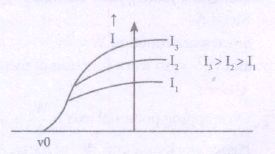
(i) Draw a graph showing variation of photoelectric current (I) with anode potential (V) for different intensities of incident radiation. Name the characteristic of the incident radiation that is kept constant in this experiment.
(ii) If the potential difference used to accelerate electrons is doubled, by what factor does the de-Broglie wavelength associated with the electrons change?
20.
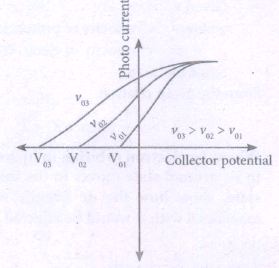
Show the variation of photocurrent with collector plate potential for different frequencies but same intensity of incident radiation.
1.
(b)
work function
2.
(a)
v \(\geq\) v0
3.
(a)
Both P and E increase
4.
\(\lambda\propto \frac{1}{\sqrt{V}}\)
\(\frac{\lambda_1}{\lambda_2}=\frac{\sqrt{224\times10^3}}{\sqrt{14\times 10^3}}\)
\(=\sqrt{16}=4\)
\(\lambda_{\mathrm{2}}= \frac{\lambda_1}{4}\)
5.
\(\mathrm{E}_{\mathrm{p}} =\frac{\mathrm{hc}}{\lambda_{\mathrm{p}}} \)
\(\mathrm{E}_{\mathrm{e}} =\frac{\mathrm{h}^2}{2 \mathrm{~m} \lambda_{\mathrm{e}}^2} \)
\(\frac{\mathrm{hc}}{\lambda_{\mathrm{p}}} =\frac{\mathrm{h}^2}{2 \mathrm{~m} \lambda_{\mathrm{e}}^2} \)
\(\lambda_{\mathrm{p}} \propto \lambda_{\mathrm{e}}^{{ }^2}\)
6.
(i) Metals like cadmium, zinc, magnesium, alkali metals lithium, sodium, caesium respond to visible light.
(ii) The materials which eject photoelectrons upon irradiation of electromagnetic wave of suitable wavelength are called photosensitive materials.
7.
The potential barrier which prevents free electrons from leaving the metallic surface is called surface barrier.
8.
V = 81 V
∴ K = eV = 1.6 x 10-19 x 81 = 1.296 x 10-17 = 1.3 x 10⁻¹⁷ J
\({ V }=\sqrt \frac {2K}{m}\sqrt { \cfrac { 2\times 1.3\times { 10 }^{ -17 } }{ 9.1\times { 10 }^{ -31 } } } =5.345 \times 10^6 ms^{-1} \)
v = 5.345 x 10⁶ m s-1, K = 1.3 x 10⁻¹⁷ J
9.
P = 50 mW; λ = 640nm = 640 x 10-9 m
P = 50 x 10-3W
\(n=\cfrac { hc }{ \lambda } = \frac{6.626 \times10^{-34} \times 3 \times 10^8}{640 \times 10{-9}}=3.106 \times 10^{-19}J\)
\(n=\frac{E}{hv}=\cfrac { 50\times { 10 }^{ -3 } }{ 3.106\times { 10 }^{ -19 } } = 1.61\times 10^{17} s^{-1}\)
n = 1.61 x 10¹⁷ s-I
10.
The ejection of electrons from the metal plate when illuminated by light or any electromagnetic radiation of suitable wavelength (or frequency) is called photoelectric effect.
11.
The minimum energy needed for an electron to escape from the metal surface is called work function of that metal.
Unit: electron volt (eV).
12.
In metals, the electrons in the outer most shells are loosely bound to the nucleus. Even at room temperature, these large number of electrons which are moving inside the metal in random manner and they cannot leave the surface of metal. So that metals have a large number of free electrons.
13.
(i) In metals, the electrons in the outer most shells are loosely bound to the nucleus. Even at room temperature, there are a large number of free electrons which are moving inside the metal in a random manner. Through they move freely inside the metal they cannot leave the surface of the metal. The reason is that when free electrons reach the surface of the metal they are attracted by the positive nuclei of the metal. It is attractive pull which will not allow free electrons to leave the metallic surface at room temperature.
(ii) In order to leave the metallic surface, the free electrons must cross a potential barrier created by the positive nuclei of the metal. The potential barrier. which prevents free electrons from leading the metallic surface is called surface barrier.
(iii) Whenever an additional energy is given to the free electrons, they will have sufficient energy to cross the surface barrier. And they escape from the metallic surface. The liberation of electrons from any surface of a substance is called electron emission.
(iv) The minimum energy needed for an electron to escape from the metal surface is called work function of that metal.
(a) Thermionic emission
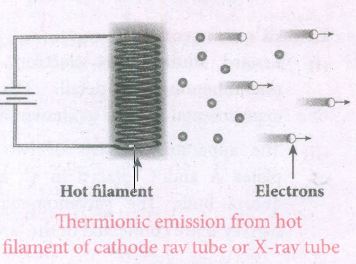
(i) When a metal is heated to a high temperature, the free electrons on the surface of the metal get sufficient energy in the form of thermal energy so that they are emitted from the metallic surface. This type of emission is known a thermonic emission.
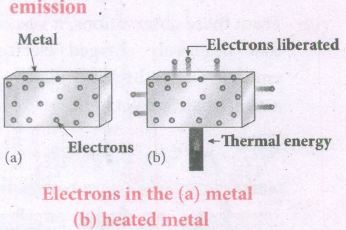
(ii) The intensity of the thermionic emission (the number of electrons emitted) depends on the metal used and its temperature.
(iii) Examples: cathode ray tubes, electron microscopes, X-ray tubes etc.
(b) Field emission
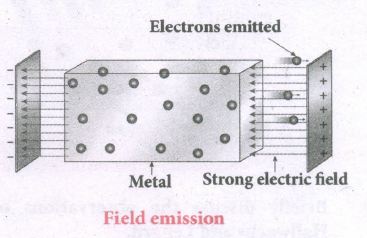
(i) Electric field emission occurs when a very strong electric field is applied across the metal.
(ii) This strong field pulls the free electrons and helps them to overcome the surface barrier of the metal.
(iii) Ex: Field ermssion scanning electron microscopes, Field-emission display etc.
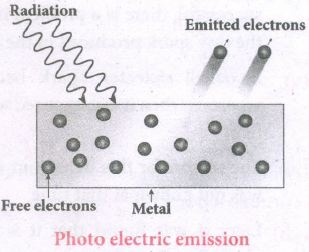
(c) Photo electric emission
(i) When an electromagnetic radiation of suitable frequency is incident on the surface of the metal, the energy is transferred from the radiation to the free electrons.
(ii) Hence, the free electrons get sufficient energy to cross the surface barrier and the photo electric emission takes place.
(iii) The number of electrons emitted depend on the intensity of the incident radiation.
(iv) Examples: Photo diodes, photo electric cells etc.
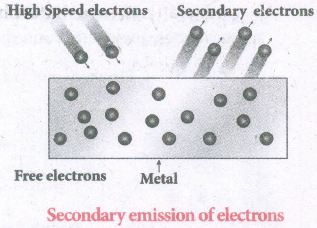
(d) Secondary emission
(i) When a beam of fast-moving electrons strikes the surface of the metal, the kinetic energy of the striking electrons is transferred to the free electrons on the metal surface.
(ii) Thus the free electrons get sufficient kinetic energy so that the secondary emission of electron occurs.
(iii) Examples: Image intensifiers, photo multiplier tubes etc.
14.
Photo sensitive material - Carbon
15.
(a) Assertion and Reason are correct and Reason is the correct explanation of Assertion.
16.
I, II and III only
17.
I, II, III and IV
18.
(i) Photo cells are used as switches and sensors.
(ii) Automatic switch on and off of street lights.
(iii) They are used for reproduction of sound in motion pictures
(iv) They are used as timers to measure the speed of athletes during a race.
(v) In photography, they are used to measure the intensity of the given light and to calculate the exact time of exposure.
19.
1) The frequency of incident radiation was kept constant.
2) de Broglie wavelength,
\(\lambda =\frac { h }{ \sqrt { 2mqV } } \alpha \frac { 1 }{ V } \)
If potential difference V is doubled, the de-Broglie wavelength is decreased to \(\frac { 1 }{ \sqrt { 2 } } \) time.
20.

12th Standard Syllabus & Materials
12th Standard
TN 12th Computer Applications களப்பெயர் முறைமை (DNS) Sample Question Papers Study Material - QB365 Set A
NEW12th Standard
TN 12th Computer Applications வலையமைப்பு எடுத்துக்காட்டுகள் மற்றும் நெறிமுறைகள் Sample Question Papers Study Material - QB365 Set A
NEW12th Standard
TN 12th Computer Applications கணினி வலையமைப்பு ஓர் அறிமுகம் Sample Question Papers Study Material - QB365 Set A
NEW12th Standard
TN 12th Computer Applications PHP-உடன் MySQL-ஐ இணைத்தல் Sample Question Papers Study Material - QB365 Set A



Tamilnadu Stateboard 12th Standard Subjects

Maths

Chemistry
Physics

Biology

Computer Science

Business Maths and Statistics

Economics

Commerce

Accountancy

History

Computer Applications
Biology
Computer Technology
Computer Applications
Computer Science
Business Maths and Statistics
Commerce
Economics
Maths
Chemistry
Physics
Computer Technology
History
Accountancy

Tamil

English

French
Tamilnadu Stateboard Standards

