
 100% FREE ACCESS
12th Standard Syllabus & Materials
12th Standard
TN 12th Computer Applications மின்னணு தரவு பரிமாற்றம் Sample Question Papers Study Material - QB365 Set A
NEW12th Standard
TN 12th Computer Applications மின் - வணிக பாதுகாப்பு அமைப்புகள் Sample Question Papers Study Material - QB365 Set A
NEW12th Standard
TN 12th Computer Applications மின்னணு செலுத்தல் முறைகள் Sample Question Papers Study Material - QB365 Set A
NEW12th Standard
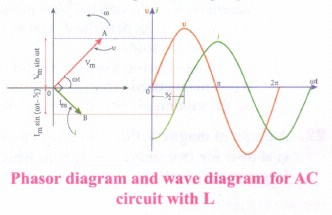
TN 12th Computer Applications மின் - வணிகம் Sample Question Papers Study Material - QB365 Set A
NEW12th Standard
TN 12th Computer Applications திறந்த மூல கருத்துருக்கள் Sample Question Papers Study Material - QB365 Set A
NEW12th Standard
TN 12th Computer Applications வலையமைப்பு வடமிடல் Sample Question Papers Study Material - QB365 Set A

Published on: 02/01/2020
Electromagnetic Induction and Alternating Current
Download Tamil Nadu 12th Standard Physics question papers, model tests, one-mark questions, important questions, and public exam papers in PDF format. Free study materials and answer keys for TN State Board students.
Questions + Answers key
Take MCQ Physics Test1.
Define Magnetic Flux.
2.
A straight metal wire crosses a magnetic field of flux 4 mWb in a time 0.4 s. Find the magnitude of the emf induced in the wire.
3.
A square coil of side 30 cm with 500 turns is kept in a uniform magnetic field of 0.4 T. The plane of the coil is inclined at an angle of 30o to the field. Calculate the magnetic flux through the coil.
4.
State Fleming’s right hand rule.
5.
6.
A circular antenna of area 3 m2 is installed at a place in Madurai. The plane of the area of antenna is inclined at 47o with the direction of Earth’s magnetic field. If the magnitude of Earth’s field at that place is 4.1 x 10⁻⁵ T find the magnetic flux linked with the antenna.
7.
What is the phase relation between current and emf in an AC circuit containing a cpacitor only? Sketch a graph showing the variation the reactance of a capacitor with frequency.
8.
How does the capacitive reactance depend on frequency? & What is the reactance of a capacitor at hertz to the study at?
9.
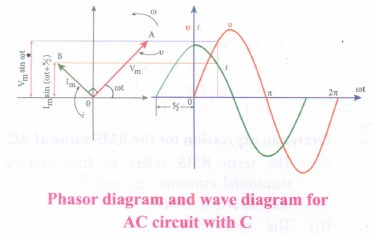
What is the phase relationship between current & voltage in an inductive? Draw
(i) Phosor diagram and
(ii) wave diagram.
10.
What is Phasort and How to draw phasor diagram.
11.
Distinguish between average & rms value of an AC.
12.
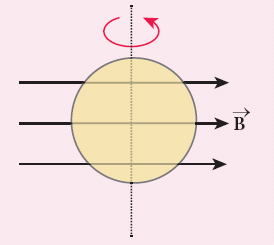
A circular loop of area 5 x 10⁻² m2 rotates in a uniform magnetic field of 0.2T. If the loop rotates about its diameter which is perpendicular to the magnetic field as shown in figure. Find the magnetic flux linked with the loop when its plane is
(i) normal to the field
(ii) inclined 60o to the field and
(iii) parallel to the field.
13.
In an a.c. dynamo, the induced current is _________ in nature.
alternating
increasing
decreasing
constant
14.
The generator rule is ____________.
Fleming's left hand rule
Fleming's right hand rule
Maxwell's right hand cork screw rule
Right hand palm rule
15.
Energy or workdone is stored in an inductor as ____________.
electrical energy
magnetic potential energy
electrical potential energy
heat energy
16.
Transformer works on _____________.
AC only
DC only
both AC and DC
AC more effectively than DC
17.
\(\frac{20}{\pi^2}H\) inductor is connected to a capacitor of capacitance C. The value of C in order to impart maximum power at 50 Hz is
50 μF
0.5 μF
500 μF
5 μF
18.
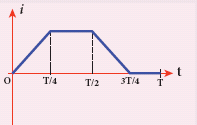
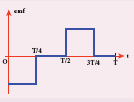
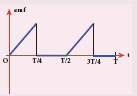
The current i flowing in a coil varies with time as shown in the figure. The variation of induced emf with time would be
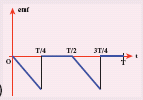
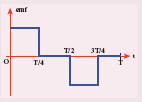
19.
When the current changes from +2A to −2A in 0.05 s, an emf of 8 V is induced in a coil. The co-efficient of self-induction of the coil is
0.2H
0.4H
0.8H
0.1H
20.
The flux linked with a coil at any instant t is given by \(\Phi\)B = 10t2 − 50t + 250. The induced emf at t = 3s is
−190 V
−10 V
10 V
190 V
21.
An electron moves on a straight line path XY as shown in the figure. The coil abcd is adjacent to the path of the electron. What will be the direction of current, if any, induced in the coil?
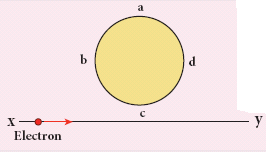
The current will reverse its direction as the electron goes past the coil
No current will be induced
abcd
adcb
22.
(a) Inductive reactance
(b) Self Inductance
(c) Capacitive reactance
(d) resistance
23.
(a) Hysteresis loss
(b) Copper loss
(c) Flux loss
(d) Power loss
1.
The magnetic flux through an area A in a magnetic field is defined as the number of magnetic field lines passing through that area normally and is given by the equation.
\({ \Phi }_{ B }=\int _{ A }^{ }{ \vec { B } .d\vec { A } =BAcos\theta } \)
where the integral is taken over the area A and θ is the angle between the direction of the magnetic field and the outward normal to the area.
2.
Change in magnetic flux, dф = 4 x 10⁻³ Wb
Change in time, dt = 0.4 s
Magnitude of Induced emf \(= |\frac { -d\Phi }{ dt }|=\frac { d\Phi }{ dt }\)
\(=\frac { 4\times 10^{ -3 } }{ 0.4 } \) = 10 x 10-3 V = 10 mv
∴ Magnitude of induced emf =10 mV
3.
Number of turns, N = 500
Area of cross section, A = 30 x 30 x 10-4
= 900 x 10-4 m2
Magnetic field, B = 0.4 T
Angle of inclination θ = 900 - 300= 600
∴ Magnetic flux Φ = NAB cos θ
∴ Φ = 500 x 900 x 10-4 x 0.4 x cos600
= 45 x 104 x 10-4 x 4 x 10-1 x \(\frac{1}{2}\)
Φ= 9 x 10-1 = 9.0 Wb
∴ Magnetic flux Φ = 9.0 Wb
4.
The thumb, index finger and middle finger of right hand are stretched out in mutually perpendicular directions. If the index finger points the direction of the magnetic field and the thumb indicates the direction of motion of the conductor, then the middle finger will indicate the direction of the induced current.
5.
6.
B = 4.1 x 10⁻⁵ T; θ = 90o – 47o = 43° ;
A = 3m2
We know that \(\Phi_{B}=B A \cos \theta\)
\(\Phi_{\mathrm{B}}\) = 4.1 x 10–5 x 3 x cos 43o
= 4.1 x 10–5 x 3 x 0.7314
= 89.96 \(\mu \mathrm{Wb}\).
7.
Current lags behind the applied voltage by \(\frac{\pi}{2}\) in an inductive circuit.
8.
Current leads the applied voltage by \(\frac{\pi}{2}\) in a capacitive circuit.
This is the resistance offered by the capacitor, called capacitive reactance (Xc). It measured in ohm.
\({ X }_{ c }=\frac { 1 }{ \omega C } \)
The capacitive reactance (Xc) varies inversely as the frequency. For a steady current, f = 0
∴\({ X }_{ c }=\frac { 1 }{ \omega C } -\frac { 1 }{ 2\pi fC } =\frac { 1 }{ 0 } =\infty \)
Thus a capacitive circuit offers infinite resistance to the steady current.
9.
Current lags behind the applied voltage \(\frac{\pi}{2}\) in an inductive circuit. This fact is depicted in the phasor diagram. In the wave diagram also, it is seen that current lags the voltage by 90°.
10.
Phasor: A sinusoidal alternating voltage (or current) can be represented by a vector that rotates about the origin in an anti-clockwise direction at a constant angular velocity ω. Such a rotating vector is called a phasor. A phasor is drawn in such a way that
(i) the length of the line segment equals the peak value Vm (or Im) of the alternating voltage (or current)
(ii) its angular velocity w is equal to the angular frequency of the alternating voltage (or current)
(iii) the projection of phasor on any vertical axis gives the instantaneous value of the alternating voltage (or current)
(iv) the angle between the phasor and the axis of reference (positive x-axis) indicates the phase of the alternating voltage (or current).
The notion of phasors is introduced to analyze the phase relationship between voltage and current in different AC circuits.
Phasor diagram
The diagram which shows various phasors and their phase relations is called the phasor diagram.
11.
|
Average value |
RMS value |
|---|---|
| The average value of alternating current is defined as the average of all values of current over a positive half-cycle or negative half-cycle. | The root means a square value of an alternating current is defined as the square root of the mean of the squares of all currents over one cycle. |
| Average value of AC, Iav = \(\frac { 2{ I }_{ m } }{ \pi } \) | \(\frac { { I }_{ m } }{ { \sqrt { 2 } } } \) |
| Iav = 0.6371m | Irms = 0.707Vm |
12.
A = 5 x 10⁻² m2; B = 0.2 T
(i) θ = 0°;
\({ \Phi }_{ B }=BAcos\theta =0.2\times 5\times { 10 }^{ -2 }\times { cos }0^{ o }\)
\({ \Phi }_{ B }=1\times { 10 }^{ -2 }Wb\)
(ii) θ = 90° – 60° = 30°;
\(\Phi_B\) = BAcosθ = 0.2 x 5 x 10-2 x cos 30o
\({ \Phi }_{ B }=1\times { 10 }^{ -2 }\times \frac { \sqrt { 3 } }{ 2 } =8.66\times { 10 }^{ -3 }Wb\)
(iii) θ = 90°;
\({ \Phi }_{ B }\) = BA cos90o = 0
13.
(a)
alternating
14.
(b)
Fleming's right hand rule
15.
(b)
magnetic potential energy
16.
(a)
AC only
17.
\(L=\frac{20}{\pi^2} \mathrm{H}, \mathrm{f}=50 \mathrm{~Hz} \)
\(f=\frac{1}{2 \pi \sqrt{L C}} \)
\(50=\frac{1}{2 \pi \sqrt{\frac{20}{\pi^2} \times C}} \)
\(50=\frac{1}{2 \times \sqrt{20 C}} \)
\(\therefore(50)^2=\frac{1}{4 \times 20 C} \)
\(\therefore C=\frac{1}{2500 \times 4 \times 20}=5 \times 10^{-6}=5 \mu \mathrm{F}\)
18.
Solution
e = -L\(\frac{dl}{dt}\)
19.
\(\text {emf } e=8 \mathrm{~V} \)
\(d I=I_1-I_0=2-(-2)=4 \mathrm{~A} \)
\(\text {dt }=0.05 \mathrm{~s} \)
\(L=\frac{-e}{d I / d t}=\frac{-8}{4 / 0.05} \)
\(=\frac{-8 \times 0.05}{4}=\frac{-0.40}{4} \)
=-0.1 H
-ve sign indicates that self-induced emf always opposes the current w.r.t. time.
20.
\(\phi_B =10 t^2-50 t+250 \)
\(e =\frac{-d \phi_B}{d t} \)
\(=\frac{-d}{d t}\left(10 t^2-50 t+250\right) \)
=-(20 t - 50)
=-20 t + 50
When, t = 3 s, e =-20(3) + 50 = -60 + 50
e = -10V
21.
The direction of conventional current is always opposite to the direction of flow of electrons.
22.
(b) Self Inductance
23.
(d) Power loss

12th Standard Syllabus & Materials
12th Standard
TN 12th Computer Applications களப்பெயர் முறைமை (DNS) Sample Question Papers Study Material - QB365 Set A
NEW12th Standard
TN 12th Computer Applications வலையமைப்பு எடுத்துக்காட்டுகள் மற்றும் நெறிமுறைகள் Sample Question Papers Study Material - QB365 Set A
NEW12th Standard
TN 12th Computer Applications கணினி வலையமைப்பு ஓர் அறிமுகம் Sample Question Papers Study Material - QB365 Set A
NEW12th Standard
TN 12th Computer Applications PHP-உடன் MySQL-ஐ இணைத்தல் Sample Question Papers Study Material - QB365 Set A



Tamilnadu Stateboard 12th Standard Subjects

Maths

Chemistry
Physics

Biology

Computer Science

Business Maths and Statistics

Economics

Commerce

Accountancy

History

Computer Applications
Biology
Computer Technology
Computer Applications
Computer Science
Business Maths and Statistics
Commerce
Economics
Maths
Chemistry
Physics
Computer Technology
History
Accountancy

Tamil

English

French
Tamilnadu Stateboard Standards

