
 100% FREE ACCESS
12th Standard Syllabus & Materials
12th Standard
TN 12th Computer Applications மின்னணு தரவு பரிமாற்றம் Sample Question Papers Study Material - QB365 Set A
NEW12th Standard
TN 12th Computer Applications மின் - வணிக பாதுகாப்பு அமைப்புகள் Sample Question Papers Study Material - QB365 Set A
NEW12th Standard
TN 12th Computer Applications மின்னணு செலுத்தல் முறைகள் Sample Question Papers Study Material - QB365 Set A
NEW12th Standard
TN 12th Computer Applications மின் - வணிகம் Sample Question Papers Study Material - QB365 Set A
NEW12th Standard
TN 12th Computer Applications திறந்த மூல கருத்துருக்கள் Sample Question Papers Study Material - QB365 Set A
NEW12th Standard
TN 12th Computer Applications வலையமைப்பு வடமிடல் Sample Question Papers Study Material - QB365 Set A

Published on: 27/11/2019
Electromagnetic Induction and Alternating Current
Download Tamil Nadu 12th Standard Physics question papers, model tests, one-mark questions, important questions, and public exam papers in PDF format. Free study materials and answer keys for TN State Board students.
Questions + Answers key
Take MCQ Physics Test1.
Does the current in an a.c circuit lag lead or remain in phase with the applied voltage. When
(i) γ = γr
(ii) γ < γr
(iii) γ > γr
Where γr is the resonant frequency?
2.
What is phasor?
3.
When does the phenomenon of resonance is possibble in the circuit?
4.
Define average value of an alternating current.
5.
List out the advantages of stationary armature-rotating field system of AC generator.
6.
A closed coil of 40 turns and of area 200 cm2, is rotated in a magnetic field of flux density 2 Wb m–2. It rotates from a position where its plane makes an angle of 30o with the field to a position perpendicular to the field in a time 0.2 s. Find the magnitude of the emf induced in the coil due to its rotation.
7.
A cylindrical bar magnet is kept along the axis of a circular solenoid. If the magnet is rotated about its axis, find out whether an electric current is induced in the coil.
8.
What is impedance? When does LCR circuit have minimum impedance?
9.
Give and explain the mechanical analogy of LC oscillations by qualitative treatment.
10.
Distinguish between average & rms value of an AC.
11.
A capacitor of capacitance \(\frac { { 10 }^{ -4 } }{ \pi } F\), an inductor of inductance \(\frac { 2 }{ \pi } H\) and a resistor of resistance 100 Ω are connected to form a series RLC circuit. When an AC supply of 220 V, 50 Hz is applied to the circuit, determine
(i) the impedance of the circuit
(ii) the peak value of current flowing in the circuit
(iii) the power factor of the circuit and
(iv) the power factor of the circuit at resonance.
12.
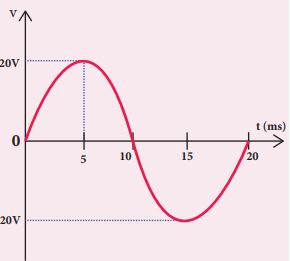
Write down the equation for a sinusoidal voltage of 50 Hz and its peak value is 20 V. Draw the corresponding voltage versus time graph.
13.
If a secondary coil has 40 turns, and a primary coil with 20 turns is charged with 50V of potential difference, then potential difference in secondary would be ________________.
50 V
25 V
60 V
100 V
14.
The self-inductance of a straight conductor is ________________.
zero
infinity
very large
very small
15.
16.
When the current changes from +2A to −2A in 0.05 s, an emf of 8 V is induced in a coil. The co-efficient of self-induction of the coil is
0.2H
0.4H
0.8H
0.1H
17.
The flux linked with a coil at any instant t is given by \(\Phi\)B = 10t2 − 50t + 250. The induced emf at t = 3s is
−190 V
−10 V
10 V
190 V
18.
Calculate the instantaneous voltage for AC supply of 220 V and 50 Hz.
19.
The instantaneous voltage from an ac source is given by V = 300 sin 314t. What is the rms voltage of the sauce? Find its peak voltage and frequency of the sauce?
1.
(i) γ = γr occurs when XL = XC. Then the circuit becomes purely resistive. So current and voltage will be in the same phase.
(ii) XL = 2π γL and \({ X }_{ c }=\frac { 1 }{ 2\pi \gamma c } \)
When γ = γr, XL is small and Xc is large the circuit is capacitive, so current leads the voltage in phase.
The circuit is inductive. So current lags behind the voltage in phase.
2.
A quantity which varies sinusoidally with time and represented as the projection of a rotating vector is called phasor.
3.
The phenomenon of electrical resonance is possible when the circuit contains both L and C. Only then does the voltage across L and C cancels one another when VL and VC are 1800 out of phase and the circuit becomes purely resistive. This implies that resonance will not occur in RL and RC circuits.
4.
The average value of alternating current is defined as the average of all values of current over a positive half-cycle or negative half-cycle.
5.
(i) The current is drawn directly from fixed terminals on the stator without the use of brush contacts.
(ii) The insulation of stationary armature winding is easier.
(iii) The number of sliding contacts (slip rings) is reduced. Moreover, the sliding contacts are used for low-voltage DC Source.
(iv) Armature windings can be constructed more rigidly to prevent deformation due to any mechanical stress.
6.
N = 40 turns; B = 2 Wb m-2
A = 200 cm2 = 200 x 10-4 m2;
Initial flux, \(\Phi_i\) = BA cos\(\theta\)
= 2 x 200 x 10-4 x cos60o
since θ = 90°− 30°= 60°
\(\Phi_i\)= 2 x 10⁻² Wb
Final flux, \(\Phi_f\) = BA cos\(\theta\)
= 2 x 200 x 10-4 x cos0o since \(\theta\) = 0o
\(\Phi_f\) = 4 x 10⁻²Wb
Magnitude of the induced emf is
\(ε =N\frac { d{ \Phi }_{ B } }{ dt } \)
\(=\frac { 40\times (4\times { 10 }^{ -2 }-2\times { 10 }^{ -2 }) }{ 0.2 } =4V\)
7.
The magnetic field of a cylindrical magnet is symmetrical about its axis. As the magnet is rotated along the axis of the solenoid, there is no induced current in the solenoid because the flux linked with the solenoid does not change due to the rotation of the magnet.
8.
(i) The total resistance offered to the flow of current due to resistance R, inductive resistance XL, and capacitive reactance Xc in a circuit is called impedance.
It is given by \(z=\sqrt { { R }^{ 2 }+({ { X }_{ L }-{ X }_{ C }) }^{ 2 } } \)
(ii) At resonance, when XL= XC
9.
(i) The electromagnetic oscillations of LC system can be compared with the mechanical oscillations of a spring-mass system.
(ii) There are two forms of energy involved in LC oscillations. One is electrical energy of the charged capacitor; the other magnetic energy of the inductor carrying current.
(iii) Likewise, the mechanical energy of the spring-mass system exists in two forms; the potential energy of the compressed or extended spring and the kinetic energy of the mass. The Table lists these two pairs of energy.
(iv) By examining, the analogies between the various quantities can be understood and these correspondences.
(v) The angular frequency of oscillations of a spring-mass is given by equation
\(\omega =\sqrt { \frac { k }{ m } } \)
k ⟶ \(\frac { 1 }{ C } \) and m ⟶ L. Therefore, the angular frequency of LC oscillations is given by
ω = \(\frac { 1 }{ \sqrt { LC } } \)
10.
|
Average value |
RMS value |
|---|---|
| The average value of alternating current is defined as the average of all values of current over a positive half-cycle or negative half-cycle. | The root means a square value of an alternating current is defined as the square root of the mean of the squares of all currents over one cycle. |
| Average value of AC, Iav = \(\frac { 2{ I }_{ m } }{ \pi } \) | \(\frac { { I }_{ m } }{ { \sqrt { 2 } } } \) |
| Iav = 0.6371m | Irms = 0.707Vm |
11.
L = \(\frac { 2 }{ \pi } \)H; C = \(\frac { { 10 }^{ -4 } }{ \pi } F\); R = 100Ω
VRMS = 220 V; f = 50Hz
XL= 2πfl = 2π x 50 x \(\frac { 2 }{ \pi } \) = 200Ω
Xc = \(\frac { 1 }{ 2\pi fC } =\frac { 1 }{ 2\pi \times 50\times \frac { 10^{ -4 } }{ \pi } } 100 \Omega\)
(i) Impedance, Z = \(\sqrt { { R }^{ 2 }+({ X }_{ L }-{ X }_{ C })^2 } \)
=\(\sqrt { 100^{ 2 }+(200-100)^{ 2 } } \) = 141.4Ω
(ii) Peak value of current,
Im = \(\frac { { v }_{ m } }{ Z } =\frac { \sqrt { 2 } V_{ RMS } }{ Z } \)
= \(\frac { \sqrt { 2 } \times 220 }{ 141.4 } \) = 2.2 A
(iii) Power factor of the circuit
\(cos\phi =\frac { R }{ Z } =\frac { 100 }{ 141.4 } \)= 0.707
(iv) Power factor at resonance
\(cos\phi =\frac { R }{ Z } =\frac { R }{ R } \) = 1
12.
f = 50Hz ; Vm = 20V
Instantaneous voltage, υ = Vm sinωt
= Vm sin2πvt
= 20sin(2π x 50)t = 20sin(100 x 3.14)t
υ = 20sin 314t
Time for one cycle, \(T=\frac { 1 }{ f } =\frac { 1 }{ 50 } =0.02s\)
= 20 x 10−3 s = 20ms
The wave form is given below
13.
(d)
100 V
14.
(a)
zero
15.
(a)
16.
\(\text {emf } e=8 \mathrm{~V} \)
\(d I=I_1-I_0=2-(-2)=4 \mathrm{~A} \)
\(\text {dt }=0.05 \mathrm{~s} \)
\(L=\frac{-e}{d I / d t}=\frac{-8}{4 / 0.05} \)
\(=\frac{-8 \times 0.05}{4}=\frac{-0.40}{4} \)
=-0.1 H
-ve sign indicates that self-induced emf always opposes the current w.r.t. time.
17.
\(\phi_B =10 t^2-50 t+250 \)
\(e =\frac{-d \phi_B}{d t} \)
\(=\frac{-d}{d t}\left(10 t^2-50 t+250\right) \)
=-(20 t - 50)
=-20 t + 50
When, t = 3 s, e =-20(3) + 50 = -60 + 50
e = -10V
18.
Given: Ev = 220 V
⋎ = 50 Hz
E = ?
To find:
We can use Ev = \(\frac { { E }_{ m } }{ \sqrt { 2 } } \)
Em = \(\sqrt2\) x Ev
= \(\sqrt2\) x 220
= 311.08 V
∴ Instantaneous Voltage E = Em sin ωt
E = Em sin (2πγ)t
= 311 sin (2ㅠ x 50)t
= 311 sin 100 πt.
19.
Given: The maximum value of voltage Vm = 300V
Angle frequency of ac voltage w = 21t ⋎ = 314
RMS value of the source Vrms = ?
V = 300 sin 314t.
To find:
Peak voltage Vm= 300V, frequency ⋎ =?
Solution:
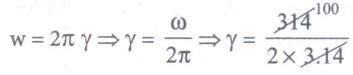
⋎ = 50 Hz.
RMS voltage, Vrm = \(\frac { { V }_{ m } }{ \sqrt { 2 } } \)
= 0.707 X 300 = 212.1 V
Vrms = 212.1 V.

12th Standard Syllabus & Materials
12th Standard
TN 12th Computer Applications களப்பெயர் முறைமை (DNS) Sample Question Papers Study Material - QB365 Set A
NEW12th Standard
TN 12th Computer Applications வலையமைப்பு எடுத்துக்காட்டுகள் மற்றும் நெறிமுறைகள் Sample Question Papers Study Material - QB365 Set A
NEW12th Standard
TN 12th Computer Applications கணினி வலையமைப்பு ஓர் அறிமுகம் Sample Question Papers Study Material - QB365 Set A
NEW12th Standard
TN 12th Computer Applications PHP-உடன் MySQL-ஐ இணைத்தல் Sample Question Papers Study Material - QB365 Set A



Tamilnadu Stateboard 12th Standard Subjects

Maths

Chemistry
Physics

Biology

Computer Science

Business Maths and Statistics

Economics

Commerce

Accountancy

History

Computer Applications
Biology
Computer Technology
Computer Applications
Computer Science
Business Maths and Statistics
Commerce
Economics
Maths
Chemistry
Physics
Computer Technology
History
Accountancy

Tamil

English

French
Tamilnadu Stateboard Standards

