
 100% FREE ACCESS
12th Standard Syllabus & Materials
12th Standard
TN 12th Computer Applications மின்னணு தரவு பரிமாற்றம் Sample Question Papers Study Material - QB365 Set A
NEW12th Standard
TN 12th Computer Applications மின் - வணிக பாதுகாப்பு அமைப்புகள் Sample Question Papers Study Material - QB365 Set A
NEW12th Standard
TN 12th Computer Applications மின்னணு செலுத்தல் முறைகள் Sample Question Papers Study Material - QB365 Set A
NEW12th Standard
TN 12th Computer Applications மின் - வணிகம் Sample Question Papers Study Material - QB365 Set A
NEW12th Standard
TN 12th Computer Applications திறந்த மூல கருத்துருக்கள் Sample Question Papers Study Material - QB365 Set A
NEW12th Standard
TN 12th Computer Applications வலையமைப்பு வடமிடல் Sample Question Papers Study Material - QB365 Set A

Published on: 22/01/2020
Electromagnetic Induction and Alternating Current
Download Tamil Nadu 12th Standard Physics question papers, model tests, one-mark questions, important questions, and public exam papers in PDF format. Free study materials and answer keys for TN State Board students.
Questions + Answers key
Take MCQ Physics Test1.
Does the current in an a.c circuit lag lead or remain in phase with the applied voltage. When
(i) γ = γr
(ii) γ < γr
(iii) γ > γr
Where γr is the resonant frequency?
2.
Draw a graph showing the variation of reactance of
(i) a capacitor and
(ii) an inductor with the frequency of an a.c circuit.
3.
State the law that gives the polarity of the induced emf.
4.
What is the signifienance of Quality factor or Q-factor.
5.
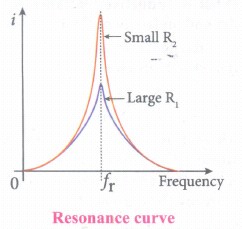
Draw a graph showing variation of current with changing frequency of applied voltage in a series LCR circuit for two different values of resistance R1 & R2 (I1 > I2) fr - resonant frequency.
6.
What is inductive reactance X1? How does it depend on the frequency and give its unit?
7.
Explain the use of transformers in long distance transmission of electric power.
8.
What are LC oscillations?
9.
What is meant by wattles current?
10.
How will you define RMS value of an alternating current?
11.
List out the advantages of stationary armature-rotating field system of AC generator.
12.
What do you mean by self-induction?
13.
Mention the ways of producing induced emf.
14.
State Faraday’s laws of electromagnetic induction.
15.
What is meant by electromagnetic induction?
1.
(i) γ = γr occurs when XL = XC. Then the circuit becomes purely resistive. So current and voltage will be in the same phase.
(ii) XL = 2π γL and \({ X }_{ c }=\frac { 1 }{ 2\pi \gamma c } \)
When γ = γr, XL is small and Xc is large the circuit is capacitive, so current leads the voltage in phase.
The circuit is inductive. So current lags behind the voltage in phase.
2.
(i) Capacitive reactance \({ X }_{ c }=\frac { 1 }{ 2\pi \gamma c } \)
\({ X }_{ c }\alpha \frac { 1 }{ \gamma } \)
The graph between γ and XL
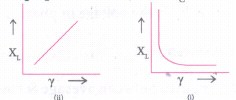
(ii) Inductive reactance XL = 2πγL
XL α γ
3.
Lenz's law the polarity of the induced emf is such that it tends to produce current which oppose the change in magnetic flux that produces it.
4.
The current in the series RLC circuit becomes maximum at resonance. Due to the increase in current, the voltage across L and C are also increased. This magnification of voltages at series resonance is termed as Q-factor. It gives a measure of sharpness of current peak in the resanance condition of LCT circuit
5.
The maximum current at series resonance is limited by the resistance of the circuit. For smaller resistance, a larger current with a sharper curve is obtained and vice versa.
6.
The resistance offered by the inductor, called inductive reactance (XL). It is measured in ohm.
XL = ωL
XL = 2πfL
where f is the frequency of the alternating current. For a steady current, f = 0. Therefore, XL = 0. Thus an ideal inductor offers no resistance to steady DC current.
7.
At the transmitting point, the voltage is increased and the corresponding current is decreased by using a step-up transformer. Then it is transmitted through transmission lines. This reduced current at high voltage reaches the destination without any appreciable loss. At the receiving point, the voltage is decreased and the current is increased to appropriate values by using a step-down transformer, and then it is given to consumers.
8.
Whenever energy is given to a circuit containing a pure indicator L and a capacitor of capacitance C, the energy oscillates back and fourth between the magnetic field of the indicator and the electric field of the capacitor. Thus the electrical oscillations of definite frequency are generated. these oscillations are called LC oscillations.
9.
The current in an AC circuit is said to be wattless current if the power consumed by it is zero.
10.
RMS value is also defined as that value of the steady current which when flowing through a given circuit for a given time produces the same amount of heat as produced by the alternating current when flowing through the same Circuit for the same time. (or)
The root mean square value of an alternating current is defined as the square root of the mean of the squares of all currents over one cycle
\(I_{RMS}=\sqrt\frac{\text {Area of one cycle of squared wave}}{\text {Base length of one cycle}}\)
11.
(i) The current is drawn directly from fixed terminals on the stator without the use of brush contacts.
(ii) The insulation of stationary armature winding is easier.
(iii) The number of sliding contacts (slip rings) is reduced. Moreover, the sliding contacts are used for low-voltage DC Source.
(iv) Armature windings can be constructed more rigidly to prevent deformation due to any mechanical stress.
12.
An electric current flowing through a coil will set up a magnetic field around it. Therefore the magnetic flux of the magnetic field is linked with that coil it self. If this flux is changed by changing the current, an emf is induced in that same coil. This phenomenon is known as self-induction.
13.
Emf can be produced by changing magnetic flux in any of the following ways:
(i) By changing the magnetic field B
(ii) By changing the area A of the coil and
(iii) By changing the relative orientation θ of the coil with magnetic field.
14.
First law:
Whenever magnetic flux linked with a closed circuit changes, an emf is induced in the circuit. Which lasts in the circuit as long as the magnetic flux is changing.
Second law:
The magnitude of induced emf in a closed circuit is equal to the time rate of change of magnetic flux linked with the circuit.
15.
Whenever the magnetic flux linked with a closed coil changes, an emf is induced and hence an electric current flows in the circuit. This current is called an induced current and the emf giving rise to such current is called an induced emf. This phenomenon is known as electromagnetic induction.

12th Standard Syllabus & Materials
12th Standard
TN 12th Computer Applications களப்பெயர் முறைமை (DNS) Sample Question Papers Study Material - QB365 Set A
NEW12th Standard
TN 12th Computer Applications வலையமைப்பு எடுத்துக்காட்டுகள் மற்றும் நெறிமுறைகள் Sample Question Papers Study Material - QB365 Set A
NEW12th Standard
TN 12th Computer Applications கணினி வலையமைப்பு ஓர் அறிமுகம் Sample Question Papers Study Material - QB365 Set A
NEW12th Standard
TN 12th Computer Applications PHP-உடன் MySQL-ஐ இணைத்தல் Sample Question Papers Study Material - QB365 Set A



Tamilnadu Stateboard 12th Standard Subjects

Maths

Chemistry
Physics

Biology

Computer Science

Business Maths and Statistics

Economics

Commerce

Accountancy

History

Computer Applications
Biology
Computer Technology
Computer Applications
Computer Science
Business Maths and Statistics
Commerce
Economics
Maths
Chemistry
Physics
Computer Technology
History
Accountancy

Tamil

English

French
Tamilnadu Stateboard Standards

