
 100% FREE ACCESS
12th Standard Syllabus & Materials
12th Standard
TN 12th Computer Applications மின்னணு தரவு பரிமாற்றம் Sample Question Papers Study Material - QB365 Set A
NEW12th Standard
TN 12th Computer Applications மின் - வணிக பாதுகாப்பு அமைப்புகள் Sample Question Papers Study Material - QB365 Set A
NEW12th Standard
TN 12th Computer Applications மின்னணு செலுத்தல் முறைகள் Sample Question Papers Study Material - QB365 Set A
NEW12th Standard
TN 12th Computer Applications மின் - வணிகம் Sample Question Papers Study Material - QB365 Set A
NEW12th Standard
TN 12th Computer Applications திறந்த மூல கருத்துருக்கள் Sample Question Papers Study Material - QB365 Set A
NEW12th Standard
TN 12th Computer Applications வலையமைப்பு வடமிடல் Sample Question Papers Study Material - QB365 Set A

Published on: 02/01/2020
Electromagnetic Waves
Download Tamil Nadu 12th Standard Physics question papers, model tests, one-mark questions, important questions, and public exam papers in PDF format. Free study materials and answer keys for TN State Board students.
Questions + Answers key
Take MCQ Physics Test1.
Which of the following electromagnetic radiations is used for viewing objects through fog
microwave
gamma rays
X- rays
infrared
2.
If the amplitude of the magnetic field is 3 x 10⁻⁶ T, then amplitude of the electric field for a electromagnetic waves is _____.
100 V m−1
300 V m-1
600 V m-1
900 V m-1
3.
4.
What is the orgin of displacement currtent?
5.
Draw a diagram depicting oscillating electric and magnetic field of an electromagnetic wave.
6.
Arrange the Electromagnetic waves in order of
(i) increasing frequency
(ii) decreasing wavelength.
7.
(i) In which situation is there a displacement current but no conduction current?
(ii) Find the displacement current across the plate of the capacitor whose charging current is 0.25 A.
8.
Explain the concept of intensity of electromagnetic waves.
9.
Write down the integral form of modified Ampere’s circuital law.
10.
Name the parts of Electromagnetic spectrum which is
(i) used to destroy becteria.
(ii) produced by where is a sudden deceleration of high speed electrons.
(iii) used in food industry.
11.
Discuss briefly the experiment conducted by Hertz to produce and detect electromagnetic spectrum.
12.
Show how to generalize Ampere's circuital law to include the term due to displacement current?
13.
Explain the Maxwell’s modification of Ampere’s circuital law.
14.
(a) Interference
(b) Polarisation
(c) Diffraction
(d) Photoelectric effect
15.
(a) Radio waves
(b) Microwaves
(c) Visible Light waves
(d) Ultrasonic waves
16.
a. Ampere - maxwell's law \(\oint { \overrightarrow { B } .\overrightarrow { dl } } \)
b. Faraday's law \(\oint { \overrightarrow { E } .\overrightarrow { dl } } \)
c. Gauss's law \(\oint { \overrightarrow { E } .\overrightarrow { dA } } \)
d. Ohm's law \(\oint { \overrightarrow { B } .\overrightarrow { dA } } \)
Which one is incorrect pair?
17.
Assertion: Microwaves do not obey reflection and polarization.
Reason: Gamma rays are used in radiotherapy for cancer treatment.
Codes:
(a) Assertion and Reason are correct and Reason is the correct explanation of Assertion.
(b) Assertion and Reason are true but Reason is the false explanation of the Assertion.
(c) Assertion is true but Reason is false.
(d) Assertion is false but Reason is true.
18.
Assertion: Electromagnetic waves carries not only energy and momentum but also angular momentum.
Reason: Electromagnetic waves cannot be polarized.
Codes:
(a) Assertion and Reason are correct and Reason is the correct explanation of Assertion.
(b) Assertion and Reason are true but Reason is the false explanation of the Assertion.
(c) Assertion is true but Reason is false.
(d) Assertion is false but Reason is true.
19.
(I) : Electromagnetic wave is a mechanical wave.
(II) : The energy crossing per unit area per unit time and perpendicular to the direction of propagation of electromagnetic wave is called intensity.
Which one is correct?
(a) I only
(b) II only
(c) both are correct
(d) None
1.
(d)
infrared
2.
Bo = 3 x 10⁻⁶T
Amplitude of electric field, Eo = Boc
Eo = 3 x 10-6 x 3 x 108 = 900V m -1
3.
(b)
4.
Displacement of does not arise due to motion of charge carries but it arises due to time variation of electric flux.
5.
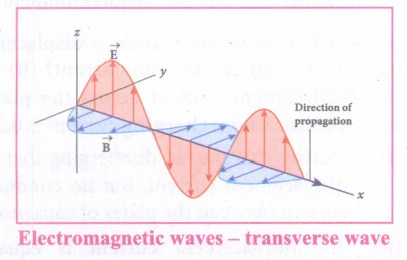
6.
૪ - rays, microwaves, IR, UV rays.
(i) Microwaves < IR < UV < ૪ - rays
(ii) Microwaves < IR > UV > ૪ - rays.
7.
(i) During charging or discharging there is a displacement current, but no conduction current between the plates of the capacitor.
(ii) The displacement current is equal to conduction current Id = Ic, so Id = 0.25 A.
8.
The energy crossing per unit area per unit time and perpendicular to the direction of propagation of the electromagnetic wave is called the intensity.
Intensity, I = [u] c or \(I=\frac { total\ electromagnetic\ energy(U) }{ Surface\ area(A)\times time(t) } \)
\(=\frac { Power(P) }{ Surfacearea(A) } \)
9.
\(\oint _l\vec{B} \cdot \overrightarrow{d l}=\mu_{o} i_{\text {c }}+\mu_{o} \varepsilon_{o} \frac{d}{d t} \oint _s \vec{E} \cdot \overrightarrow{d A}\)
10.
(i) u - v rays
(ii) X - rays
(iii) ૪ - rays.
11.
i) Maxwell's prediction was experimentally confirmed by Heinrich Rudolf Hertz in 1888. The experimental set up used is shown in Figure.
ii) It consists of two metal electrodes which are made of small spherical metals. These are connected to larger spheres and the ends of them are connected to induction coil with very large number of turns. This is to produce very high electromotive force (emf).
iii) Since the coil is maintained at very high potential, air between the electrodes gets ionized and spark (spark means discharge of electricity) is produced.
iv) The gap between electrode (ring type - not completely closed and has a small gap in between) kept at a distance also gets spark. This implies that the energy is transmitted from electrode to the receiver (ring electrode) as a wave, known as electromagnetic waves.
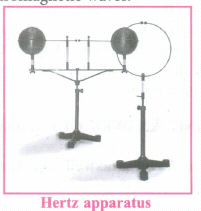
v) If the receiver is rotated by 90° - then no spark is observed by the receiver. This confirms that electromagnetic waves are transverse waves as predicted by Maxwell.
vi) Hertz detected radio waves and also computed the speed of radio waves which is equal to the speed of light (3 x 10⁸m S-1).
12.
According to Ampere's circuital law,
\(\oint _{ s }^{ }{ \overrightarrow { B } .\overrightarrow { dl } } ={ \mu }_{ 0 }I\quad ...(1)\)
As the current flows across the area bounded by loop S1, so
\(\oint _{ { s }_{ 1 },s }^{ }{ \overrightarrow { B } .\overrightarrow { dl } } ={ \mu }_{ 0 }I\quad ...(2)\)
But the area bounded by S2 lies in the region between the plates capacitor where no current flows across it.
\(\therefore \oint _{ { s }_{ 1 } }^{ }{ \overrightarrow { B } .\overrightarrow { dl } } =0\)
Consider that loops enclosing S1 & S2 are infinitesimally close to each other. Then
\(\oint _{ { s }_{ 1 } }^{ }{ \overrightarrow { B } .\overrightarrow { dl } } =\oint _{ { s }_{ 2 } }^{ }{ \overrightarrow { B } .\overrightarrow { dl } } \)
This equation is inconsistent with equations (2) & (3). To remove this maxwell said that a changing electric field (during charging) between the capacitor plates must induce a magnetic field which in turn must be associated with current Id.
\({ I }_{ d }={ \varepsilon }_{ 0 }\left( \frac { d{ \phi }_{ E } }{ dt } \right) \) [\(\frac { d{ \phi }_{ E } }{ dt } \) change in electric flux]
The total current must be
I = Iconduction + Idisplacement
\({ I }_{ c }={ \varepsilon }_{ 0 }\frac { d{ \phi }_{ E } }{ dt } \)
Hence the generalized from of Ampere's circuital law is
\(\oint _{ s }^{ }{ \overrightarrow { B } .\overrightarrow { dl } } ={ \mu }_{ 0 }\left[ { I }_{ c }+{ \varepsilon }_{ 0 }\frac { d{ \phi }_{ E } }{ dt } \right] \)
13.
(i) We have stated Ampere's law as \(\oint \vec{B} \cdot \overrightarrow{d l}=\mu_oi\)
(ii) Where, i is the electric current crossing a surface bounded by a closed curve and the line integral of \(\vec{B}\) is calculated along that closed curve. This equation is valid only when the electric field at the surface does not change with time.
(iii) Maxwell strongly believed that when the time varying magnetic field produces an electric field, the time varying electric field must produce a magnetic field.
(iv) To understand how a varying electric field produces magnetic field, let us consider a situation of charging a parallel plate capacitor.
.JPG)
(v) Let ic be the conduction current. To calculate the magnetic field at P (fig. 1 ) an amperian loop. S1 is drawn. Applying Ampere circuital law for the surface S1, we get
\(\oint \vec{B} \cdot \overrightarrow{d l}=\mu_0 i_c\) Where, \(\mu_0\) is permeability of free space.
(vi) Applying the same for the surface S2, we get \(\oint \vec{B} \cdot \overrightarrow{d l}=0.\)
Because the surface S2 nowhere touches the wire carrying conduction current. Therefore for the point P at one surface (S1) it has some value and at another surface (S2) it has zero value.
(vii) So, Maxwell believed that there must be a current associated with the changing electric field in between the capacitor and he called that current as displacement current.
(viii) Applying Gauss law to the electric flux between the plates of the capacitor \(\phi_E=\oint \vec{E} \cdot \overrightarrow{\mathrm{dA}}=E A=\frac{q}{\varepsilon_0}\) where, A is the area of the plate.
The change in electric flux is \(\frac{d \phi_F}{d t}=\frac{1}{\varepsilon_0} \frac{d q}{d t} (or) \frac{\mathrm{dq}}{\mathrm{dt}}=\mathrm{i}_{\mathrm{d}}=\varepsilon_0 \frac{\mathrm{d} \phi_{\mathrm{E}}}{\mathrm{dt}}\), where id is the displacement current.
(ix) The displacement current can be defined as the current which comes into play in the region in which the electric field and electric flux are changing with time.
(x) So, Maxwell modified Ampere's law \(\oint_{l} \vec{B} \cdot d \vec{l}=\mu_{0} i_c+\mu_{0}-i_d\) which means the total current enclosed by the surface is sum of conduction current and displacement current.
14.
(d) Photoelectric effect
15.
(d) Ultrasonic waves
16.
d. Ohm's law \(\oint { \overrightarrow { B } .\overrightarrow { dA } } \)
17.
(d) Assertion is false but Reason is true.
18.
(c) Assertion is true but Reason is false
19.
(b) II only

12th Standard Syllabus & Materials
12th Standard
TN 12th Computer Applications களப்பெயர் முறைமை (DNS) Sample Question Papers Study Material - QB365 Set A
NEW12th Standard
TN 12th Computer Applications வலையமைப்பு எடுத்துக்காட்டுகள் மற்றும் நெறிமுறைகள் Sample Question Papers Study Material - QB365 Set A
NEW12th Standard
TN 12th Computer Applications கணினி வலையமைப்பு ஓர் அறிமுகம் Sample Question Papers Study Material - QB365 Set A
NEW12th Standard
TN 12th Computer Applications PHP-உடன் MySQL-ஐ இணைத்தல் Sample Question Papers Study Material - QB365 Set A



Tamilnadu Stateboard 12th Standard Subjects

Maths

Chemistry
Physics

Biology

Computer Science

Business Maths and Statistics

Economics

Commerce

Accountancy

History

Computer Applications
Biology
Computer Technology
Computer Applications
Computer Science
Business Maths and Statistics
Commerce
Economics
Maths
Chemistry
Physics
Computer Technology
History
Accountancy

Tamil

English

French
Tamilnadu Stateboard Standards

