
 100% FREE ACCESS
12th Standard Syllabus & Materials
12th Standard
TN 12th Maths Applications of Matrices and Determinants Sample Question Papers Study Material - QB365 Set A
NEW12th Standard
TN 12th Computer Applications மின்னணு தரவு பரிமாற்றம் Sample Question Papers Study Material - QB365 Set A
NEW12th Standard
TN 12th Computer Applications மின் - வணிக பாதுகாப்பு அமைப்புகள் Sample Question Papers Study Material - QB365 Set A
NEW12th Standard
TN 12th Computer Applications மின்னணு செலுத்தல் முறைகள் Sample Question Papers Study Material - QB365 Set A
NEW12th Standard
TN 12th Computer Applications மின் - வணிகம் Sample Question Papers Study Material - QB365 Set A
NEW12th Standard
TN 12th Computer Applications திறந்த மூல கருத்துருக்கள் Sample Question Papers Study Material - QB365 Set A

Published on: 21/11/2019
Electrostatics
Download Tamil Nadu 12th Standard Physics question papers, model tests, one-mark questions, important questions, and public exam papers in PDF format. Free study materials and answer keys for TN State Board students.
Questions + Answers key
Take MCQ Physics Test1.
Write the special features of Gauss law.
2.
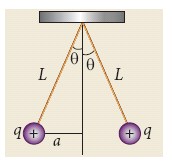
Two small-sized identical equally charged spheres, each having mass 1 g are hanging in equilibrium as shown in the figure. The length of each string is 10 cm and the angle θ is 30° with the vertical. Calculate the magnitude of the charge in each sphere. (Take g = 10 ms−2)
3.
What is the electric flux through a cube of side 1 cm which encloses on electric dipole?
4.
When we rotate the blades, it starts to rotate as usual. Why it is so?
5.
Write the general definition of electric dipole moment for a collection of point charge.
6.
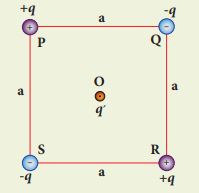
Four charges are arranged at the corners of the square PQRS of side an as shown in the figure.
(a) Find the work required to assemble these charges in the given configuration.
(b) Suppose a charge q is brought to the center of the square, by keeping the four charges fixed at the corners, how much extra work is required for this?
7.
The relative permittivity of water is _______.
εr = 70
εr = 75
εr = 80
εr = 85
8.
An electric field \(\vec { E } =10x\hat { i } \) exists in a certain region of space. Then the potential difference V = Vo – VA, where Vo is the potential at the origin and VA is the potential at x = 2 m is _____.
10 V
-20 V
+20 V
-10 V
9.
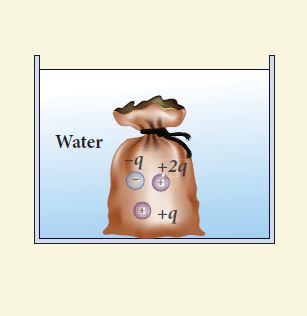
The total electric flux for the following closed surface which is kept inside water
\(\frac { 80q }{ { \varepsilon }_{ 0 } } \)
\(\frac { q }{ { 40\varepsilon }_{ 0 } } \)
\(\frac { q }{ { 80\varepsilon }_{ 0 } } \)
\(\frac { q }{ { 160\varepsilon }_{ 0 } } \)
10.
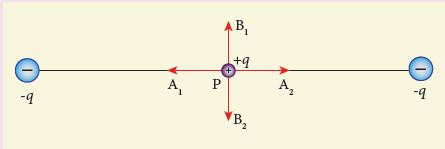
Two identical point charges of magnitude –q are fixed as shown in the figure below. A third charge +q is placed midway between the two charges at the point P. Suppose this charge +q is displaced a small distance from the point P in the directions indicated by the arrows, in which direction(s) will +q be stable with respect to the displacement?
A1 and A2
B1 and B2
both directions
No stable
11.
A polythene piece rubbed with wool is found to have a negative charge of 3 x 10⁻⁷ C. Estimate the number of electrons transferred from which to which?
12.
Explain in detail how charges are distributed in a conductor, and the principle behind the lightning conductor.
1.
(i) The total electric flux through the closed surface depends only on the charges enclosed by the surface and the charges present outside the surface will not contribute to the flux and the shape of the closed surface which can be chosen arbitrarily.
(ii) The total electric flux is independent of the location of the charges inside the closed surface.
(iii) To arnve at equation \(\Phi =\oint { \overset { \rightarrow }{ E } .d\overset { \rightarrow }{ A } } =\frac { { Q }_{ encl } }{ { \varepsilon }_{ 0 } } \) is chosen a spherical surface. This imaginary surface is called a Gaussian surface. The shape of the Gaussian surface to be chosen depends on the type of charge configuration and the kind of symmetry existing in that charge configuration. The electric field is spherically symmetric for a point charge, therefore spherical Gaussian surface is chosen. cylindrical and planar Gaussian surfaces can be chosen for other kinds of charge configurations.
(iv) In the L.H.S of equation \(\Phi =\oint { \overset { \rightarrow }{ E } .d\overset { \rightarrow }{ A } } =\frac { { Q }_{ encl } }{ { \varepsilon }_{ 0 } } \) the electric field \(\overset { \rightarrow }{ E } \) is due to charges present inside and outside the Gaussian surface but the charge Qencl denotes the charges which lie only inside the Gaussian surface.
(v) The Gaussian surface cannot pass through any discrete charge but it can pass through continuous charge distributions. It is because, very close to the discrete charges, the electric field is not well defined.
(vi) Gauss law is another form of Coulomb's law and it is also applicable to the charges in motion. Because of this reason, Gauss law is treated as much more general law than Coulomb's law.
2.
If the two spheres are neutral, the angle between them will be 0o when hanged vertically. Since they are positively charged spheres, there will be a repulsive force between them and they will be at equilibrium with each other at an angle of 30° with the vertical. At equilibrium, each charge experiences zero net force in each direction. We can draw a free-body diagram for one of the charged spheres and apply Newton’s second law for both vertical and horizontal directions.
The free-body diagram is shown below
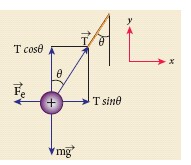
In the x-direction, the acceleration of the charged sphere is zero.
Using Newton’s second law \((\vec { { F }_{ tot }= } m\vec { a } )\), we have
T sinθ\(\hat { i } \) - Fe\(\hat { i } \) =0
T sinθ = Fe ......(1)
Here T is the tension acting on the charge due to the string and Fe is the electrostatic force between the two charges.
In the y-direction also, the net acceleration experienced by the charge is zero
Tcosθ\(\hat { j } \) - mg\(\hat { j } \) = 0
Tcosθ = mg ..(2)
By dividing equation (1) by equation (2),
tanθ = \(\frac { { F }_{ e } }{ mg } \) .....(3)
Since they are equally charged, the magnitude of the electrostatic force is
\({ F }_{ e }=k\frac { { q }^{ 2 } }{ { r }^{ 2 } } \) where k=\(\frac { 1 }{ 4\pi { \varepsilon }_{ 0 } } \)
Here r = 2a = 2Lsinθ. By substituting these values in equation (3),
tanθ = k\(\frac { { q }^{ 2 } }{ mg(2Lsin\theta )^{ 2 } } \) ..........(4)
Rearranging the equation (4) to get q
q = 2 Lsinθ\(\\ \sqrt { \frac { mgtan\theta }{ k } } \)
= 2 x 0.1 x sin 30o x \(\sqrt { \frac { 10^{ -3 }\times 10\times { tan30 }^{ 0 } }{ 9\times 10^{ 9 } } } \)
q = 8.01 x 10⁻⁸C = 80.1 nC
3.
Net electric flux is zero because
(i) It is independent to the shape and size
(ii) Net charge of the electric dipole is zero.
4.
To rotate any object, there must be a torque applied on the object. For the ceiling fan, the initial torque is given by the capacitor widely known as a condenser. If the condenser is faulty, it will not give sufficient initial torque to rotate the blades when the fan is switched on.
5.
For a collection of n point charges, the electric dipole moment is defined as follows, \(\vec{p}=\stackrel{i=n} \sum _{i=1}q_i\vec{r}_i\) where, \(\vec{r}_i\) is the position vector of charge qi from the origin.
6.
(a) The work done to arrange the charges in the corners of the square is independent of the way they are arranged. We can follow any order.
(i) First, the charge +q is brought to the corner P. This requires no work since no charge is already present, WP = 0
(ii) Work required to bring the charge –q to the corner Q = (-q) x potential at a point Q due to +q located at a point P
WQ = -q x \(\frac { 1 }{ 4\pi { \varepsilon }_{ 0 } } \frac { q }{ a } =-\frac { 1 }{ 4\pi { \varepsilon }_{ 0 } } \frac { q^{ 2 } }{ a } \)
(iii) Work required to bring the charge +q to the corner R = q x potential at the point R due to charges at the point P and Q.
WR = q x \(\frac { 1 }{ 4\pi { \varepsilon }_{ 0 } } \left( -\frac { q }{ a } +\frac { q }{ \sqrt { 2 } a } \right) \)
= \(\frac { 1 }{ 4\pi { \varepsilon }_{ 0 } } \frac { { q }^{ 2 } }{ a } \left( -1+\frac { 1 }{ \sqrt { 2 } } \right) \)
(iv) Work required to bring the fourth charge –q at the position S = q × potential at the point S due the all the three charges at the point P, Q and R.
Ws = - q x \(\frac { 1 }{ 4\pi { \varepsilon }_{ 0 } } \left( \frac { q }{ a } +\frac { q }{ a } -\frac { q }{ \sqrt { 2 } a } \right) \)
Ws = \(-\frac { 1 }{ 4\pi { \varepsilon }_{ 0 } } \frac { q^2 }{ a } \left( 2-\frac { 1 }{ \sqrt { 2 } } \right) \)
(b) Work required to bring the charge q′ to the center of the square = q′ x potential at the center point O due to all the four charges in the four corners.
The potential created by the two +q charges are canceled by the potential created by the -q charges which are located in the opposite corners. Therefore the net electric potential at the center O due to all the charges in the corners is zero.
Hence no work is required to bring any charge to the point O. Physically this implies that if any charge q′ when brought close to O, then it moves to the point O without any external force.
7.
(c)
εr = 80
8.
\(\vec {E}\) = 10x\(\hat{i},\) when x = 2 m
\(\vec {E}\) = 10 x 2 x \(\hat{i}\) = 20\(\hat{i}\)
Since, \(E=\frac{-dV}{dx}\therefore V=+20 V\)
9.
\(Φ=\frac { q_{net} }{ { \varepsilon }_{ 0 } } \)
qnet = - q + q + 2q = 2q
Relative permittivity of water = 80
\(\therefore Φ=\frac { q }{{ \varepsilon }_{ r } { \varepsilon }_{ 0 } } \)
\(=\frac{2q}{{ 80 \times \varepsilon }_{ 0 }}=\frac{q}{{ 40 \varepsilon }_{ 0 }}\)
10.
The charge + q will be stable between B1 and B2 with respect to the displacement.
11.
Here, q = -3 x 10⁻⁷ C
Charge of one electron, e = -1.6 x 10⁻¹⁹ C
Number of electrons transferred from wool to
polythenepiece, n = \(\frac{q}{e}\)\(=\frac { -3\times { 10 }^{ -7 }C }{ -1.6\times { 10 }^{ -19 }C } \)
= 1.875 x 10¹²
12.
Distribution of charges in a conductor:
(i) Consider two conducting spheres A and B of radii r1 and r2 respectively connected to each other by a thin conducting wire as shown in the Figure. The distance between the spheres is much greater than the radii of either spheres.
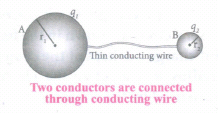
(ii) If a charge Q is introduced into any one of the spheres, this charge Q is redistributed into both the spheres such that the electrostatic potential is same in both the spheres. They are now uniformly charged and attain electrostatic equilibrium. Let q1 be the charge residing on the surface of sphere A and q2 is the charge residing on the surface of sphere B such that Q = q1 + q2, The charges are distributed only on the surface and there is no net charge inside the conductor.
The electrostatic potential at the surface of the sphere A is given by
\({ V }_{ A }=\frac { 1 }{ 4\pi { \varepsilon }_{ 0 } } \frac { { q }_{ 1 } }{ { r }_{ 1} } \quad \quad ...(1)\)
(iii) The electrostatic potential at the surface of the sphere B is given by ,
\({ V }_{ B }=\frac { 1 }{ 4\pi { \varepsilon }_{ 0 } } \frac { { q }_{ 2 } }{ { r }_{ 2 } } \) ...(2)
iv) The surface of the conductor is an equipotential. Since the spheres are connected by the conducting wire, the surfaces of both the spheres together form an equipotential surface.
This implies that
VA= VB
or \(\frac { { q }_{ 1 } }{ { r }_{ 1 } } =\frac { { q }_{ 2 } }{ { r }_{ 2 } } \) ...(3)
v) Let us take the charge density on the surface of sphere A and charge density on the surface of sphere B is σ2.This implies that q1 = 4πr12σ1 and 4πr22σ2 substituting these values into equation (3), we get
σ1r1 = σ2r2 ...(4)
from which we conclude that σr = constant ...(5)
Lightning conductor:
It is used to protect tall buildings from lightning strikes.
Principle:
(i) Action at points (or) corona discharge.
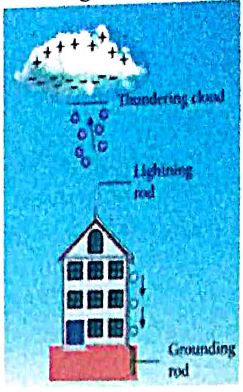
(ii) This device consists of a long thick copper rod passing from top of the building to the ground.
(iii) The upper end of the rod has a sharp spike or a sharp needle as shown in Figure.
(iv) The lower end of the rod is connected to copper plate which is buried deep into the ground.
(v) When a negatively charged cloud is passing above the building, it causes a positive charge on the spike. Since the induced charge density on thin sharp spike is large, it results in a corona discharge. This positive Charge ionizes the surrounding air which in turn neutralizes the negative charge in the cloud.
(vi) The negative charge pushed to the spikes passes through the copper rod and is safely diverted to the Earth. The lightning arrester does not stop the lightning; rather it diverts the lightning to the ground safely.

12th Standard Syllabus & Materials
12th Standard
TN 12th Computer Applications வலையமைப்பு வடமிடல் Sample Question Papers Study Material - QB365 Set A
NEW12th Standard
TN 12th Computer Applications களப்பெயர் முறைமை (DNS) Sample Question Papers Study Material - QB365 Set A
NEW12th Standard
TN 12th Computer Applications வலையமைப்பு எடுத்துக்காட்டுகள் மற்றும் நெறிமுறைகள் Sample Question Papers Study Material - QB365 Set A
NEW12th Standard
TN 12th Computer Applications கணினி வலையமைப்பு ஓர் அறிமுகம் Sample Question Papers Study Material - QB365 Set A



Tamilnadu Stateboard 12th Standard Subjects

Maths

Chemistry
Physics

Biology

Computer Science

Business Maths and Statistics

Economics

Commerce

Accountancy

History

Computer Applications
Biology
Computer Technology
Computer Applications
Computer Science
Business Maths and Statistics
Commerce
Economics
Maths
Chemistry
Physics
Computer Technology
History
Accountancy

Tamil

English

French
Tamilnadu Stateboard Standards

