
 100% FREE ACCESS
12th Standard Syllabus & Materials
12th Standard
TN 12th Computer Applications மின்னணு தரவு பரிமாற்றம் Sample Question Papers Study Material - QB365 Set A
NEW12th Standard
TN 12th Computer Applications மின் - வணிக பாதுகாப்பு அமைப்புகள் Sample Question Papers Study Material - QB365 Set A
NEW12th Standard
TN 12th Computer Applications மின்னணு செலுத்தல் முறைகள் Sample Question Papers Study Material - QB365 Set A
NEW12th Standard
TN 12th Computer Applications மின் - வணிகம் Sample Question Papers Study Material - QB365 Set A
NEW12th Standard
TN 12th Computer Applications திறந்த மூல கருத்துருக்கள் Sample Question Papers Study Material - QB365 Set A
NEW12th Standard
TN 12th Computer Applications வலையமைப்பு வடமிடல் Sample Question Papers Study Material - QB365 Set A

Published on: 06/01/2020
Electrostatics
Download Tamil Nadu 12th Standard Physics question papers, model tests, one-mark questions, important questions, and public exam papers in PDF format. Free study materials and answer keys for TN State Board students.
Questions + Answers key
Take MCQ Physics Test1.
Define and derive an expression for the energy density in parallel plate capacitor.
2.
Deduce electric flus for closed surfaces.
3.
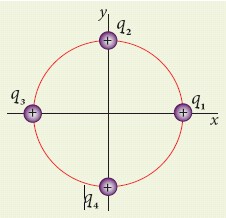
Consider four equal charges q1, q2, q3 and q4 = q = +1 μC located at four different points on a circle of radius 1m, as shown in the figure. Calculate the total force acting on the charge q1 due to all the other charges.
4.
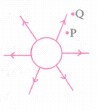
What is the work zone by the field in moving a small positive charge from A to P? Given reason.
5.
A sphere of charge +Q is fixed. A smaller sphere of charge +q is placed near the larger sphere and released from rest. The small sphere will move away from large sphere with
a. decreasing velocity & decreasing acceleration.
b. decreasing velocity & increasing acceleration.
c. decreasing velocity & constant acceleration
d. increasing velocity & decreasing acceleration
e. increasing velocity & increasing acceleration
Which of the above statement is correct? Explain.
6.
What is meant by dielectric breakdown?
7.
What is an equipotential surface?
8.
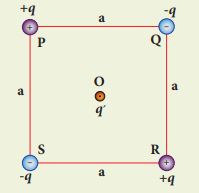
Four charges are arranged at the corners of the square PQRS of side an as shown in the figure.
(a) Find the work required to assemble these charges in the given configuration.
(b) Suppose a charge q is brought to the center of the square, by keeping the four charges fixed at the corners, how much extra work is required for this?
9.
The value of constant 'K' in coulomb law is _____________.
0.9 x 10⁹ Nm2 C2
9 x 10⁻⁹ Nm2C2
9 x 10⁹ Nm-2 C-2
9 x 10⁹ Nm2 C-2
10.
Two points A and B are maintained at a potential of 7 V and -4 V respectively. The work done in moving 50 electrons from A to B is _______.
8.80 x 10⁻¹⁷ J
-8.80 x 10⁻¹⁷ J
4.40 x 10⁻¹⁷ J
5.80 x 10⁻¹⁷ J
11.
Two identical conducting balls having positive charges q1 and q2 are separated by a centre to centre distance r. If they are made to touch each other and then separated to the same distance, the force between them will be _____.
less than before
same as before
more than before
zero
12.
13.
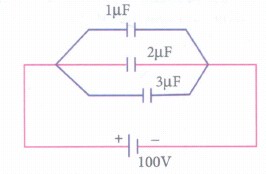
In the circuit shown in figure. Find
(i) The equivalent capacitance and
(ii) The charge stored in each capacitor
14.
An infinite number of charges each equal to q are placed along X-axis at x = 1, x = 2, x = 3, x = 4, x = 8 and soon. Find the electric field at the point x = 0 due to this set up of charges.
15.
A polythene piece rubbed with wool is found to have a negative charge of 3 x 10⁻⁷ C. Estimate the number of electrons transferred from which to which?
16.
Calculate the electric field due to a dipole on its axial line and equatorial plane.
17.
How do we determine the electric field due to a continuous charge distribution? Explain.
1.
Energy stored in the capacitor
\(U=\frac { 1 }{ 2 } { Cv }^{ 2 }\quad \quad ...(1)\)
This is rewritten as using \(C=\frac { { \varepsilon }_{ 0 }A }{ d } \& Ed=V\)
\(U=\frac { 1 }{ 2 } \left( \frac { { \varepsilon }_{ 0 }A }{ d } \right) { (Ed })^{ 2 }=\frac { 1 }{ 2 } { \varepsilon }_{ 0 }(Ad)\quad { E }^{ 2 }...(2)\)
where Ad = volume of the space between the capacitor plates. The energy stored per unit volume of space is defined as energy density \({ U }_{ E }=\frac { U }{ Volume } \) From equation (4),
We get
\({ u }_{ E }=\frac { 1 }{ 2 } { \varepsilon }_{ 0 }{ E }^{ 2 }\quad \quad \quad \quad \quad ...(3)\)
(iv) The energy density depends only on the electric field and not on the size of the plates of the capacitor.
2.
(i) A closed surface is present in the region of the non-uniform electric field as shown in Figure (a). The total electric flux over this closed surface is written as
\({ \Phi }_{ E }=\oint { \overset { \rightarrow }{ E } } .d\overset { \rightarrow }{ A } \quad \quad \quad \quad ...(1)\)
(ii) Note the difference between equations \({ \Phi }_{ E }=\int { \overset { \rightarrow }{ E } . } d\overset { \rightarrow }{ A } \) and (1). The integration in equation (1) is a closed surface integration and for each areal element, the outward normal is the direction of d\(\overset { \rightarrow }{ A } \) as shown in the Figure (b).
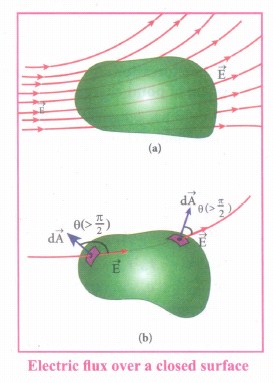
(iii) The total electric flux over a closed surface can be negative, positive or zero. In the Figure (b), it is shown that in one area element, the angle between d\(\overset { \rightarrow }{ A } \) and \(\overset { \rightarrow }{ E } \) is less than 90°, then the electric flux is positive and in another areal element, the angle between d\(\overset { \rightarrow }{ A } \) and \(\overset { \rightarrow }{ E } \) is greater than 90°, then the electric flux is negative.
(iv) In general, the electric flux is negative if the electric field lines enter the closed surface and positive if the electric field lines leave the closed surface.
3.
According to the superposition principle, the total electrostatic force on charge q1 is the vector sum of the forces due to the other charges,
\(\vec { { F }_{ 1 }^{ tot } } =\bar { { F }_{ 12 } } +\bar { { F }_{ 13 } } +\bar { F_{ 14 } } \)
The following diagram shows the direction of each force on the charge q1.
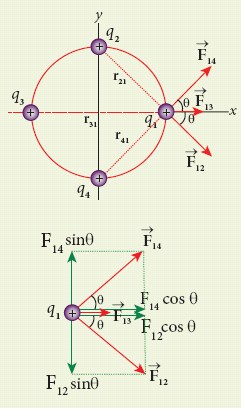
The charges q2 and q4 are equi-distant from q1. As a result the strengths (magnitude) of the forces \(\vec { { F }_{ 12 } } \) and \(\vec { { F }_{ 14 } } \) are the same even though their directions are different. Therefore the vectors representing these two forces are drawn with equal lengths. But the charge q3 is located farther compared to q2 and q4. Since the strength of the electrostatic force decreases as distance increases, the strength of the force \(\vec { { F }_{ 13 } } \) is lesser than that of forces \(\vec { { F }_{ 12 } } \) and \(\vec { { F }_{ 14 } } \). Hence the vector representing the force \(\vec { { F }_{ 13 } } \) is drawn with smaller length compared to that for forces \(\vec { { F }_{ 12 } } \) and \(\vec { { F }_{ 14 } } \).
From the figure, r21 =\(\sqrt { 2 } \) m = r41 and r31 = 2m
The magnitudes of the forces are given by
F13 = \(\frac { kq^{ 2 } }{ r_{ 31 }^{ 2 } } =\frac { 9\times 10^{ 9 }\times 10^{ -12 } }{ 4 } \)
F13 = 2.25 x 10⁻³ N
F12 = \(\frac { kq^{ 2 } }{ r_{ 31 }^{ 2 } } ={ F }_{ 14 }=\frac { 9\times 10^{ 9 }\times 10^{ -12 } }{ 2 } \)
= 4.5 x 10⁻³N
From the figure, the angle θ = 450. In terms of the components, we have
\(\vec { { F }_{ 12 } } ={ F }_{ 12 }cos\theta \hat { i } -{ F }_{ 12 }sin\theta \hat { j } \)
= 4.5 x 10⁻³ x \(\frac { 1 }{ \sqrt { 2 } } \hat { i-4.5\times { 10 }^{ -3 }\times \frac { 1 }{ \sqrt { 2 } } \hat { j } } \)
\(\vec { { F }_{ 13 } } =F_{ 13 }\hat { i } \) = 2.25 x 10⁻³ N\(\hat { i } \)
\(\vec { { F }_{ 14 } } ={ F }_{ 14 }cos\theta \hat { i } +{ F }_{ 14 }sin\theta \hat { j } \)
= 4.5 x 10⁻³ x \(\frac { 1 }{ \sqrt { 2 } } \hat { i+4.5\times { 10 }^{ -3 }\times \frac { 1 }{ \sqrt { 2 } } \hat { j } } \)
Then the total force on q1 is,
\(\vec { { F }_{ 1 }^{ tot } }={ (F }_{ 12 }cos\theta \hat { i } -{ F }_{ 12 }sin\theta \hat { j } )+{ F }_{ 13 }\hat { i } +{ (F }_{ 14 }cos\theta \hat { i } +{ F }_{ 14 }sin\theta \hat { j } )\)
\(\vec { { F }_{ 1 }^{ tot } } =({ F }_{ 12 }cos\theta +F_{13}+{ F }_{ 14 }cos\theta )\hat { i } +(-{ F }_{ 12 }sin\theta +{ F }_{ 14 }sin\theta )\)\(\hat { j } \)
Since F12 = F14, the j th component is zero.
Hence we have
\(\vec { { F }_{ 1 }^{ tot } } =({ F }_{ 12 }cos\theta +F_{13}+{ F }_{ 14 }cos\theta )\hat { i } \)
substituting the values in the above equation,
\(\left( \frac { 4.5 }{ \sqrt { 2 } } +2.25+\frac { 4.5 }{ \sqrt { 2 } } \right) \times10^{-3}\hat { i }=(4.5\sqrt { 2 } +2.25)\times 10^{-3}\hat { i } \)
\(\vec { { F }_{ 1 }^{ tot } } \) = 8.61 x 10⁻³ N\(\hat { i } \)
The resultant force is along the positive x-axis.
4.
The work done by the field is negative. This is since the charge is moved against the force exerted by the field.
5.
(i) At a distance r; the force on the small sphere due to large sphere
\(F=\frac { 1 }{ 4\pi { \varepsilon }_{ 0 } } .\frac { Qq }{ { mr }^{ 2 } } \)
(ii) If m is the mass of small sphere then its acceleration
\(a=\frac { F }{ m } =\frac { 1 }{ 4\pi { \varepsilon }_{ 0 } } .\frac { Qq }{ { mr }^{ 2 } } \)
(iii) As the small sphere is pushed away (i.e. r increased) 'a' decrease.
(iv) As 'a' is always +ve the speed of the small sphere goes on increasing.
(v) ∴ increasing velocity and decreasing acceleration.
(d) is correct
6.
When the external electric field applied to a dielectric is very large, it tears the atoms apart so that the bound charges become free charges. Then the dielectric starts to conduct electricity. This is called dielectric breakdown.
7.
An equipotential surface is a surface on which all the points are at the same electric potential.
8.
(a) The work done to arrange the charges in the corners of the square is independent of the way they are arranged. We can follow any order.
(i) First, the charge +q is brought to the corner P. This requires no work since no charge is already present, WP = 0
(ii) Work required to bring the charge –q to the corner Q = (-q) x potential at a point Q due to +q located at a point P
WQ = -q x \(\frac { 1 }{ 4\pi { \varepsilon }_{ 0 } } \frac { q }{ a } =-\frac { 1 }{ 4\pi { \varepsilon }_{ 0 } } \frac { q^{ 2 } }{ a } \)
(iii) Work required to bring the charge +q to the corner R = q x potential at the point R due to charges at the point P and Q.
WR = q x \(\frac { 1 }{ 4\pi { \varepsilon }_{ 0 } } \left( -\frac { q }{ a } +\frac { q }{ \sqrt { 2 } a } \right) \)
= \(\frac { 1 }{ 4\pi { \varepsilon }_{ 0 } } \frac { { q }^{ 2 } }{ a } \left( -1+\frac { 1 }{ \sqrt { 2 } } \right) \)
(iv) Work required to bring the fourth charge –q at the position S = q × potential at the point S due the all the three charges at the point P, Q and R.
Ws = - q x \(\frac { 1 }{ 4\pi { \varepsilon }_{ 0 } } \left( \frac { q }{ a } +\frac { q }{ a } -\frac { q }{ \sqrt { 2 } a } \right) \)
Ws = \(-\frac { 1 }{ 4\pi { \varepsilon }_{ 0 } } \frac { q^2 }{ a } \left( 2-\frac { 1 }{ \sqrt { 2 } } \right) \)
(b) Work required to bring the charge q′ to the center of the square = q′ x potential at the center point O due to all the four charges in the four corners.
The potential created by the two +q charges are canceled by the potential created by the -q charges which are located in the opposite corners. Therefore the net electric potential at the center O due to all the charges in the corners is zero.
Hence no work is required to bring any charge to the point O. Physically this implies that if any charge q′ when brought close to O, then it moves to the point O without any external force.
9.
(d)
9 x 10⁹ Nm2 C-2
10.
W = qV
V = 7 - (-4) = 11 V
q = ne = 50 x 1.6 x 10-19 = 8 x 10-18C
W = 8 x 10-18 x 11 = 88 x 10-18 = 8.8 x 10⁻¹⁷]
11.
Force ∝ charge
After the separation, the magnitude of charge will be increased. So the force will be more than before.
12.
(b)
13.
(i) The equivalent capacitance is,
Cp = C1+ C2 + C3
= (1 + 2 + 3) = 6μF
(ii) Total charge, q = CμV
= 6 x 10-6 x 100 = 600μC
q1 = C1V = 1 x 100 = 100μC
q2 = C2V = 2 x 100 = 200μC
q3 = C3V = 3 x 100 = 300μC
14.
At the point x = 0, the electric field due to all the charges are in the same negative X-direction and hence get added up, i.e.,
\(E=\frac { q }{ 4\pi { \varepsilon }_{ 0 } } \left[ \frac { q }{ { (1) }^{ 2 } } +\frac { q }{ { (2) }^{ 2 } } +\frac { q }{ { (4) }^{ 2 } } +\frac { q }{ { (8) }^{ 2 } } +.... \right] \)
\(=\frac { 1 }{ 4\pi { \varepsilon }_{ 0 } } \left[ \frac { 1 }{ 1 } +\frac { 1 }{ 4 } +\frac { 1 }{ 16 } +\frac { 1 }{ 64 } +..... \right] \)
\(=\frac { q }{ 4\pi { \varepsilon }_{ 0 } } \left[ \frac { 1 }{ 1-\frac { 1 }{ 4 } } \right] =\frac { q }{ 3\pi { \varepsilon }_{ 0 } } \) (along negative X-axis)
15.
Here, q = -3 x 10⁻⁷ C
Charge of one electron, e = -1.6 x 10⁻¹⁹ C
Number of electrons transferred from wool to
polythenepiece, n = \(\frac{q}{e}\)\(=\frac { -3\times { 10 }^{ -7 }C }{ -1.6\times { 10 }^{ -19 }C } \)
= 1.875 x 10¹²
16.
Case (i): Electric field due to an electric dipole at points on the axial Iine:
Consider an electric dipole placed on the x-axis as shown in Figure. A point C is located at a distance of r from the midpoint O (of the dipole) along the axial line.
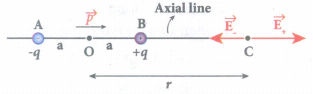
The electric field at a point C due to +q is
\({ \vec { E } }_{ + }=\frac { 1 }{ 4\pi { \varepsilon }_{ 0 } } \frac { q }{ { (r-a) }^{ 2 } } \) along BC
Since the electric dipole moment vector \(\vec { p } \) is from -q to +q and is directed along BC, the above equation is rewritten as
\({ \vec { E } }_{ + }=\frac { 1 }{ 4\pi { \varepsilon }_{ 0 } } \frac { q }{ { (r-a) }^{ 2 } } \hat { p } \) ....(1)
When \(\vec { p } \) is the electric dipole moment unit vector from -q to +q. The electric field at a point C due to -q is
\({ \vec { E } }_{ - }=-\frac { 1 }{ 4\pi { \varepsilon }_{ 0 } } \frac { q }{ { (r+a) }^{ 2 } } \hat { p } \) ....(2)
Since +q is located closer to the point C than -q, \({ \vec { E } }_{ + }\) is stronger than \({ \vec { E } }_{ - }\). Therefore, the length of the \({ \vec { E } }_{ + }\) vector is drawn larger than that of \({ \vec { E } }_{ - }\) vector.
The total electric field at point C is calculated using the superposition principle of the electric field.
\({ \vec { E } }_{ tot }={ \vec { E } }_{ + }+{ \vec { E } }_{ - }\)
\(=\frac { 1 }{ 4\pi { \varepsilon }_{ 0 } } \frac { q }{ { (r-a) }^{ 2 } } \hat { p } -\frac { 1 }{ 4\pi { \varepsilon }_{ 0 } } \frac { q }{ { (r+a) }^{ 2 } } \hat { p } \)
\({ \vec { E } }_{ tot }=\frac { q }{ 4\pi { \varepsilon }_{ 0 } } \left( \frac { 1 }{ { (r-a) }^{ 2 } } -\frac { 1 }{ { (r+a) }^{ 2 } } \right) \hat { p } \) ....(3)
\({ \vec { E } }_{ tot }=\frac { 1 }{ 4\pi { \varepsilon }_{ 0 } } q\left( \frac { 4ra }{( { r }^{ 2 }-{ a }^{ 2 })^2 } \right) \hat { p } \) ...(4)
Note that the total electric field is along \({ \vec { E } }_{ + }\), since +q is closer to C than -q.
If the point C is very far away from the dipole then (r >> a). Under this limit the term \(({ r }^{ 2 }-{ a }^{ 2 })\approx { r }^{ 2 }\).
Substituting this into equation (4), we get
\({ \vec { E } }_{ tot }=\frac { 1 }{ 4\pi { \varepsilon }_{ 0 } } \left( \frac { 4aq }{ { r }^{ 3 } } \right) \hat { p } (r>>a)\)
\(since\quad 2aq\hat { p } =\vec { p } \)
\({ \vec { E } }_{ tot }=\frac { 1 }{ 4\pi { \varepsilon }_{ 0 } } \frac { 2\vec { p } }{ { r }^{ 3 } } (r>>a)\) ...(5)
The direction \({ \vec { E } }_{ tot }\) is shown in Figure.
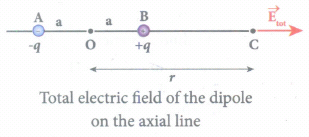
NOTE: If the point C is chosen on the left side of the dipole, the total electric field is still in the direction of \(\vec { p } \).
Case (ii) Electic field due to an electric dipole at a point on the equatorial plane:
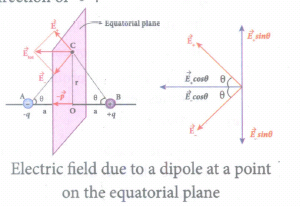
Consider a point C at a distance r from the midpoint O of the dipole on the equatorial plane. Since the point C is equidistant from +q and -q, the magnitude of the electric fields of +q and -q are the same. The direction of \({ \vec { E } }_{ + }\) is along BC and the direction of \({ \vec { E } }_{ - }\) is along CA. \({ \vec { E } }_{ + }\) and \({ \vec { E } }_{ - }\) are resolved into two components; one component parallel to the dipole axis and the other perpendicular to it. The perpendicular components \(|{ \vec { E } }_{ + }|\) sinθ and \(|{ \vec { E } }_{ -}|\) sinθ are equal in magnitude and oppositely directed and cancel each other. The magnitude of the total electric field at point C is the sum of the parallel components of \({ \vec { E } }_{ + }\) and \({ \vec { E } }_{ - }\) and its direction is along \(-\hat{p}\) as shown in the Figure.
\({ \vec { E } }_{ tot }=-|{ \vec { E } }_{ + }|cos\theta \hat { p } -|{ \vec { E } }_{ - }|cos\theta \hat { p } \) ...(6)
The magnitudes \({ \vec { E } }_{ + }\) and \({ \vec { E } }_{ - }\) are the same and given by,
\(|{ \vec { E } }_{ + }|=|{ \vec { E } }_{ - }|=\frac { 1 }{ 4\pi { \varepsilon }_{ 0 } } \frac { q }{ (r^2+a^2) } \) ...(7)
By substituting equation (7) into equation (6), we get
\({ \vec { E } }_{ tot }=\frac { 1 }{ 4\pi { \varepsilon }_{ 0 } } \frac { 2qcos\theta }{ ({ r }^{ 2 }+{ a }^{ 2 }) } \hat { p } ....(8)\)
\(=-\frac { 1 }{ 4\pi { \varepsilon }_{ 0 } } \frac { 2qa }{ ({ r }^{ 2 }+{ a }^{ 2 })^{ \frac { 3 }{ 2 } } } \hat { p } \)
Since \(cos \theta =\frac { a }{ \sqrt { { r }^{ 2 }+{ a }^{ 2 } } } \)
\({ \vec { E } }_{ tot }=\frac { 1 }{ 4\pi { \varepsilon }_{ 0 } } \frac { \vec { p } }{ ({ r }^{ 2 }+{ a }^{ 2 })^{ \frac { 3 }{ 2 } } } \)
Since \(\vec { p } \) = 2qa\(\hat { p } \) ...(9)
At very large distances (r >> a), the equation (9) becomes
\({ \vec { E } }_{ tot }=\frac { 1 }{ 4\pi { \varepsilon }_{ 0 } } \frac { \vec { p } }{ { r }^{ 3 } } (r>>a)\) ...(10)
Negative sign shows that direction of Electric field is opposite to the direction of dipole moment vector.
17.
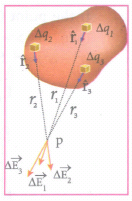
(i) Consider the following charged object of irregular shape as shown in Figure. The entire charged object is divided into a large number of charge elements \(\Delta { q }_{ 1 },\Delta { q }_{ 2 },\Delta { q }_{ 3 },.....\Delta { q }_{ n },\). and each charge element \(\Delta { q }\) is taken as a point charge.
(ii) The electric field at a point P due to a charged object is approximately given by the sum of the fields at P due to all such charge elements.
\(\vec { E } =\frac { 1 }{ 4\pi { \varepsilon }_{ 0 } } \left( \frac { { \Delta q }_{ 1 } }{ { r }_{ 1p }^{ 2 } } { \hat { r } }_{ 1p }+\frac { \Delta { q }_{ 2 } }{ { r }_{ 2p }^{ 2 } } { \hat { r } }_{ 2p }+.....+\frac { \Delta { q }_{ n } }{ { r }_{ np }^{ 2 } } { \hat { r } }_{ np } \right) \)
\(\approx \frac { 1 }{ 4\pi { \varepsilon }_{ 0 } } \sum _{ t=1 }^{ n }{ \frac { { \Delta q }_{ 1 } }{ { r }_{ 1P }^{ 2 } } { \hat { r } }_{ iP } } (1)\)
(iii) Here \(\Delta { q }_{ i }\) is the ith charge element, rip is the unit vector from the ith charge element to the point P. However the equation (1) is only an approximation. To incorporate the continuous distribution of charge, we take the limit \(\Delta q\rightarrow 0(=dq).\) In this limit, the summation in the equation (1) becomes an integration and takes the following form \(\vec { E } =\frac { 1 }{ 4\pi { \varepsilon }_{ 0 } } \int { \frac { dq }{ { r }^{ 2 } } \hat { r } } \) ...(2)
(iv) Here r is the distance of the point P from the infinitesimal charge dq and \(\hat { r } \) is the unit vector from dq to point P. Even though the electric field for a continuous charge distribution can be difficult to evaluate, the force experienced by some test charge q in this electric field is still given by \(\vec { F } =q\vec { E } \)
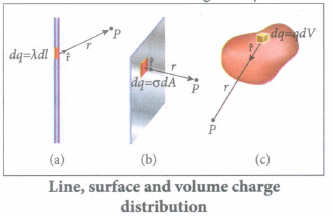
(a) If the charge Q is uniformly distributed along the line of length L, then linear charge density (charge per unit length) \(\lambda \) is \(\lambda =\frac { Q }{ L } \) unit is coulomb per meter (Cm-1). The charge present in the infinitesimal length dl is dq =\(\lambda \)dl. This is shown in Figure 1(a).
The electric field due to the line of total charge Q is given by
\(\vec { E } =\frac { 1 }{ 4\pi { \varepsilon }_{ 0 } } \int { \frac { \lambda dl }{ { r }^{ 2 } } } \hat { r } =\frac { \lambda }{ 4\pi { \varepsilon }_{ 0 } } \int { \frac { dl }{ { r }^{ 2 } } } \hat { r } \)
(b) If the charge Q is uniformly distributed on a surface of area A, then surface charge density (charge per unit area) \(\sigma \) is \(\sigma \) =\(\frac{Q}{A}\). Its unit is coulomb per square meter (C m-2). The charge present in the infinitesimal area dA is dq=\(\sigma dA\). This is shown in the figure 1(b). The electric field due to a total charge Q is given by \(\vec { E } =\frac { 1 }{ 4\pi { \varepsilon }_{ 0 } } \int { \frac { \sigma da }{ { r }^{ 2 } } \hat { r } =\frac { 1 }{ 4\pi { \varepsilon }_{ 0 } } \sigma \int { \frac { da }{ { r }^{ 2 } } } \hat { r } } \) This is shown in Figure 1(b).
(c) If the charge Q is uniformly distributed in a volume V, then volume charge density (charge per unit volume) p is given by \(\rho =\frac { Q }{ V } .\) Its unit is coulomb per cubic meter (Cm-3).
The charge present in the infinitesimal volume element dV is dq = pdV. This is shown in Figure 1(c). The electric field due to a volume of total charge Q is given by,\(\vec { E } =\frac { 1 }{ 4\pi { \varepsilon }_{ 0 } } \int { \frac { \rho dV }{ { r }^{ 2 } } =\hat { r } =\frac { 1 }{ 4\pi { \varepsilon }_{ 0 } } \rho \int { \frac { dV }{ { r }^{ 2 } } \hat { r } } } \).

12th Standard Syllabus & Materials
12th Standard
TN 12th Computer Applications களப்பெயர் முறைமை (DNS) Sample Question Papers Study Material - QB365 Set A
NEW12th Standard
TN 12th Computer Applications வலையமைப்பு எடுத்துக்காட்டுகள் மற்றும் நெறிமுறைகள் Sample Question Papers Study Material - QB365 Set A
NEW12th Standard
TN 12th Computer Applications கணினி வலையமைப்பு ஓர் அறிமுகம் Sample Question Papers Study Material - QB365 Set A
NEW12th Standard
TN 12th Computer Applications PHP-உடன் MySQL-ஐ இணைத்தல் Sample Question Papers Study Material - QB365 Set A



Tamilnadu Stateboard 12th Standard Subjects

Maths

Chemistry
Physics

Biology

Computer Science

Business Maths and Statistics

Economics

Commerce

Accountancy

History

Computer Applications
Biology
Computer Technology
Computer Applications
Computer Science
Business Maths and Statistics
Commerce
Economics
Maths
Chemistry
Physics
Computer Technology
History
Accountancy

Tamil

English

French
Tamilnadu Stateboard Standards

