
 100% FREE ACCESS
12th Standard Syllabus & Materials
12th Standard
TN 12th Computer Applications மின்னணு தரவு பரிமாற்றம் Sample Question Papers Study Material - QB365 Set A
NEW12th Standard
TN 12th Computer Applications மின் - வணிக பாதுகாப்பு அமைப்புகள் Sample Question Papers Study Material - QB365 Set A
NEW12th Standard
TN 12th Computer Applications மின்னணு செலுத்தல் முறைகள் Sample Question Papers Study Material - QB365 Set A
NEW12th Standard
TN 12th Computer Applications மின் - வணிகம் Sample Question Papers Study Material - QB365 Set A
NEW12th Standard
TN 12th Computer Applications திறந்த மூல கருத்துருக்கள் Sample Question Papers Study Material - QB365 Set A
NEW12th Standard
TN 12th Computer Applications வலையமைப்பு வடமிடல் Sample Question Papers Study Material - QB365 Set A

Published on: 22/01/2020
Electrostatics
Download Tamil Nadu 12th Standard Physics question papers, model tests, one-mark questions, important questions, and public exam papers in PDF format. Free study materials and answer keys for TN State Board students.
Questions + Answers key
Take MCQ Physics Test1.
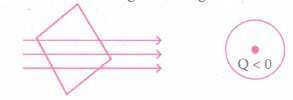
Draw equipotential surface
(i) in a uniform electric field and
(ii) for a point charge (Q < 0)
2.
Will there be any effect on the potential at the point if the medium around this point is changed?
3.
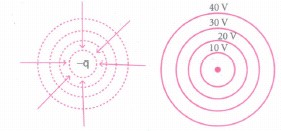
Body placed at the centre are shown. Identify the polarity of the charge & draw the electric field lines due to it
4.
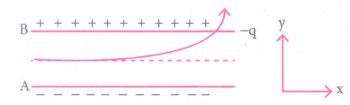
A particle of mass m and charge (-q) enters the region between the two charged plates initrally moving along X-axis with speed Vx as shown in figure. The length of plate is L and an uniform electric field E is maintained between the plates. S.T. vertical deflection of the particle at the far edge of the plate is \(\frac { q{ EL }^{ 2 } }{ 2m{ V }_{ x }^{ 2 } } \).
5.
What are the factors on which the capacity of a parallel plate capacitor with dielectric depend?
6.
A point charge Q is placed at point O potential difference VA - VB is positive. Is the charge Q negative or positive?
7.
A sphere of charge +Q is fixed. A smaller sphere of charge +q is placed near the larger sphere and released from rest. The small sphere will move away from large sphere with
a. decreasing velocity & decreasing acceleration.
b. decreasing velocity & increasing acceleration.
c. decreasing velocity & constant acceleration
d. increasing velocity & decreasing acceleration
e. increasing velocity & increasing acceleration
Which of the above statement is correct? Explain.
8.
(i) Electric field lines donot have sudden breaks why is it so?
(ii) Explain why two field lines never cross each other at any point.
9.
What is meant by dielectric breakdown?
10.
What are Polar molecules? Give examples.
11.
What is dielectric strength?
12.
What is meant by ‘electric field lines’?
13.
14.
Write down Coulomb’s law in vector form and mention what each term represents.
1.
(i) The equipotential surface is ⊥r the electric field.
(ii) The equipotential surface will be a spherical shell with the given charge at the centre
2.
Yes, If the dielectric constant of the medium is increased, there will be a decrease of potential.
3.
For a single charge the potential V \(=\frac { { q } }{ 4\pi { \varepsilon }_{ 0 }^{ }r } \)
This shows that V is constant if 'r' is constant. Greater the radius smaller will be the potential. In the given figure potential is increasing. This shows that the polarity of charge is positive. The direction of electric field will be radially inward. The field lines are directed from here to lower potential.
4.
Force on particle towards upper plate B, F-y = qE
Vertical acceleration of particle ay=\(\frac{qE}{m}\)
Initial vertical velocity Vy = 0
Time taken by particle between the plates t = \(\frac{L}{V_x}\)
From equation of motion s = ut + \(\frac{1}{2}\) at2
Vertical deflection y = 0 + \(\frac{1}{2}\) ayt2
\(=0+\frac { 1 }{ 2 } \left( \frac { qE }{ m } \right) { \left( \frac { L }{ { V }_{ x } } \right) }^{ 2 }\)
\(y=\frac { q{ EL }^{ 2 } }{ 2m{ V }_{ x }^{ 2 } } \)
5.
(i) Area of the plates
(ii) separation between the plates.
(iii) Dielectric constant of the dielectric between the plates. The capacitance of a capacitor depend upon geometrical dimension and the nature of the dielectric between the plates.
6.
The electric potential \(V=\frac { 1 }{ 4\pi { \varepsilon }_{ 0 } } .\frac { Q }{ r } \)
\(\\ V=\frac { 1 }{ r }\)
The potential due to a point charge decreases with increase of distance.
VA - VB > 0 ⇒ VA > VB
Hence the charge Q is positive.
7.
(i) At a distance r; the force on the small sphere due to large sphere
\(F=\frac { 1 }{ 4\pi { \varepsilon }_{ 0 } } .\frac { Qq }{ { mr }^{ 2 } } \)
(ii) If m is the mass of small sphere then its acceleration
\(a=\frac { F }{ m } =\frac { 1 }{ 4\pi { \varepsilon }_{ 0 } } .\frac { Qq }{ { mr }^{ 2 } } \)
(iii) As the small sphere is pushed away (i.e. r increased) 'a' decrease.
(iv) As 'a' is always +ve the speed of the small sphere goes on increasing.
(v) ∴ increasing velocity and decreasing acceleration.
(d) is correct
8.
(i) In electric field line is the path of movement of a positive test charge (q0 ⇾ 0) A moving charge experiences a continuous force is an electric field, so field line is always continuous
(ii) The field lines nevel intersect since if they cross, there will be two directions of electric field at the point of intersection, which is impossible.
9.
When the external electric field applied to a dielectric is very large, it tears the atoms apart so that the bound charges become free charges. Then the dielectric starts to conduct electricity. This is called dielectric breakdown.
10.
(i) In polar molecules, the centers of the positive and negative charges are separated even in the absence of an external electric field.
(ii) They have a permanent dipole moment.
(iii) Examples : H2O, N2O, HCI and NH3.
11.
i) When the external electric field applied to the dielectric is very large, the bound charges (electrons) become free charges. This is called dielectric breakdown.
ii) The maximum electric field the dielectric can withstand before it breaksdown is called dielectric strength.
12.
Electric field lines are a set of continuous lines which represent the electric field in some region of space visually.
13.
14.
Coulomb's law \(\overrightarrow{F_{21}}=\frac{k q_{1} q_{2}}{r^{2}} \hat{r}_{12}\)
where, q1 - charge; q2 - charge
r - distance between the charges
\(\hat{r}_{12}\)- the unit vector directed from charge q1 to charge q2
k = Proportionality constant

12th Standard Syllabus & Materials
12th Standard
TN 12th Computer Applications களப்பெயர் முறைமை (DNS) Sample Question Papers Study Material - QB365 Set A
NEW12th Standard
TN 12th Computer Applications வலையமைப்பு எடுத்துக்காட்டுகள் மற்றும் நெறிமுறைகள் Sample Question Papers Study Material - QB365 Set A
NEW12th Standard
TN 12th Computer Applications கணினி வலையமைப்பு ஓர் அறிமுகம் Sample Question Papers Study Material - QB365 Set A
NEW12th Standard
TN 12th Computer Applications PHP-உடன் MySQL-ஐ இணைத்தல் Sample Question Papers Study Material - QB365 Set A



Tamilnadu Stateboard 12th Standard Subjects

Maths

Chemistry
Physics

Biology

Computer Science

Business Maths and Statistics

Economics

Commerce

Accountancy

History

Computer Applications
Biology
Computer Technology
Computer Applications
Computer Science
Business Maths and Statistics
Commerce
Economics
Maths
Chemistry
Physics
Computer Technology
History
Accountancy

Tamil

English

French
Tamilnadu Stateboard Standards

