
 100% FREE ACCESS
12th Standard Syllabus & Materials
12th Standard
TN 12th Computer Applications மின்னணு தரவு பரிமாற்றம் Sample Question Papers Study Material - QB365 Set A
NEW12th Standard
TN 12th Computer Applications மின் - வணிக பாதுகாப்பு அமைப்புகள் Sample Question Papers Study Material - QB365 Set A
NEW12th Standard
TN 12th Computer Applications மின்னணு செலுத்தல் முறைகள் Sample Question Papers Study Material - QB365 Set A
NEW12th Standard
TN 12th Computer Applications மின் - வணிகம் Sample Question Papers Study Material - QB365 Set A
NEW12th Standard
TN 12th Computer Applications திறந்த மூல கருத்துருக்கள் Sample Question Papers Study Material - QB365 Set A
NEW12th Standard
TN 12th Computer Applications வலையமைப்பு வடமிடல் Sample Question Papers Study Material - QB365 Set A

Published on: 29/09/2020
12th Physics English Medium Important 5 Mark Creative Questions (New Syllabus2020)
Download Tamil Nadu 12th Standard Physics question papers, model tests, one-mark questions, important questions, and public exam papers in PDF format. Free study materials and answer keys for TN State Board students.
Questions + Answers key
Take MCQ Physics Test1.
Lightly falls from glass (μ = 1.5) to air. Find the angle of incidence for which the angle of deviation is 90o.
2.
A concave lens is kept in contact with a convex lens of focal length 20 cm. The combination behaves as a convex lens of focal length 50 cm. Find the power of concave lens.
3.
(i) For a glass ( \(\mu =\sqrt { 5 } \)) the angle of minimum deviation is equal to the angle of the prism. Find the angle of the prism.
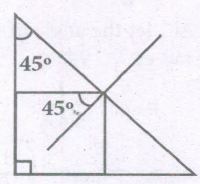
(ii) Draw ray diagram when incident ray falls normally on one of the two equal sides of a right-angled isosceles prism having refractive indeed \(\mu =\sqrt { 3 } \).
4.
Write briefly the underlying principle used in Davision - Germer experiment to verify wave nature of electrons experimentally. What is the de-Broglie wavelength of an electron with kinetic energy (KE) 120 eV?
5.
An electron microscope uses electrons accelerated by a voltage of 50 kV. Determine the de Broglie wavelength associated with the electrons. If other factors (such as numerical aperture etc.) are taken to be roughly the same, how does the resolving power of an electron, microscope compare with that of an optical microscope which uses yellow light? Given: wavelength of yellow light = 5990 Á.
6.
(i) Define the term 'intensity of radiation' in a photon picture.
(ii) Plotagraph showing the variation of photocurrent vs collector potential for three different intensities I1 > I2> I3 two of which (I1 and I2) have the same frequency v and the third has frequency v1 > v.
(iii) Explain the nature of the curves on the basis of Einstein's equation.
7.
Monochromatic light of frequency 6 x 10¹⁴ Hz is produced by a laser. The power emitted is 2.0 x 10⁻³ W. How many photons per second on an average are emitted by the source?
8.
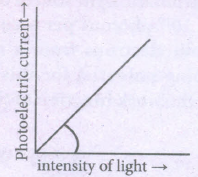
Plot a graph showing the variation of photoelectric current with the intensity of light. The work function for the following metals is given. Na: 2.75 eV and Mo: 4.175 eV. Which of these will not give photoelectron emission from a radiation of wavelength 3300 Å from a laser bean?
9.
Explain the production of x-rays.
10.
Write the applications of mobile communication.
11.
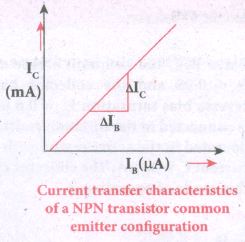
Explain current transfer characteristics.
12.
A power reactor develops energy at the rate of 30,000 kW. How many gram of 235U would be consumed daily? Assuming that on an average 200 MeV energy is released per fission.
13.
The half-life of radium is 1600 years. After how many years 25% of radium block remains undecayed?
14.
The binding energies per nucleon for deuteron \((_{ 1 }^{ 2 }{ H })\) and helium \((_{ 2 }^{ 4 }{ He) }\) are 1.1 MeV and 7 MeV respectively. Determine the energy released when two deuterons fuse to form a helium nucleus \((_{ 2 }^{ 4 }{ He) }\)
15.
What are the drawbacks of Rutherford atom model?
16.
About 5 % of the power of a 100 W light bulb is connected to visible radiation. What is the average intensity of visible radiation at the distance of 1m from the bulb?
17.
A galvanometer of resistance 15Ω gives full scale deflection for a current of 2mA. Calculate the shunt resistance needed to convert it into an ammeter of range 0 to 5A.
18.
Show how to generalize Ampere's circuital law to include the term due to displacement current?
19.
A magnetised needle of magnetic moment 3.6 x 10⁻²T-1 is placed at 30° with the direction of uniform magnetic field of magnitude 2 x 10⁻²T. Calculate the torque acting on the needle.
20.
A rectangular loop of area 20cm x 30cm is placed in a magnetic field of 0.3T with its plane
(i) normal to the field
(ii) inclined 30° to the field and
(iii) parallel to the field. Find the flux linked with the coil in each case.
21.
What difference between soft ferromagnetic materials and hard ferromagnetic materials.
22.
What is alternating current? Write an expression for its instantaneous value and write the frequency of DC.
23.
In a wheat stone bridge circuit P = 7, Q = 8 , R = 12 & s = 7. Find the additional resistance to be used in series with S, so that the bridge is balanced.
24.
A potential difference of 3 V is applied across a conductor through which the 5 A of current is flowing. Determine the resistance of the conductor.
25.
Two insulated charged copper sphere A and B have their centres separated by a distance of 50cm.
(i) What is the force of electrostatic repulsion, if the charge on each is 6.5 x 10⁻⁷C and the radii of A and B are negligible compared to the distance of separation?
(ii) What is the force of repulsion, if each sphere is charged double the above amount and the distance between them is halved?
26.
The lengths & radii of three wires of the same metal in the radio 2: 3 : 4 & 3 : 4: 5 respectively. They are joined in parallel & included in a circuit having a 5 A current. Find current in each wire.
27.
A parallel plate capacitor has plate area, 25 cm+2 and a separation of 2 mm between the plates. The capacitor is connected to a battery of 12V. Find the charge on the capacitor.
28.
What charge would be required to electrify a sphere of radius 25 cm. So as to get a surface charge density of \(\frac{3}{\pi}\) cm-1?
29.
Write mathematical relation between
(i) mobility & drift velocity of charge carriers in a conductor
(ii) mobility & relaxation time (or) mean free time.
30.
Derive an expression for the RMS value of AC.
31.
It requires 50 μJ of work to carry a 2C charge from point R to S. What is the potential difference between these points?
32.
Write the expression for the de Broglie wavelength associated with a charged particle of charge q and mass m, when it is accelerated through a potential V.
1.
\(sin{ i }_{ c }=\cfrac { 1 }{ \mu } =\cfrac { 1 }{ 1.5 } =0.667\\ \)
or ic= 41.8o
Deviation = 90o - i = 90o - 41.8o = 48.2o
This si the maximum attainable deviation in refraction. So, the given data favours total internal reflection.
In reflection, deviation = 180o - 2i
or 90o = 180o - 2i or 2i = 90o or i = 45o
or i = 45o
2.
\(\cfrac { 1 }{ F } =\cfrac { 1 }{ { f }_{ 1 } } +\cfrac { 1 }{ { f }_{ 2 } } \)
\(\cfrac { 1 }{ 50 } =\cfrac { 1 }{ 20 } +\cfrac { 1 }{ { { f }_{ 2 } } } \quad f=-\cfrac { 100 }{ 3 } cm\)
\({ P }_{ 2 }=\cfrac { 100 }{ -\frac { 100 }{ 3 } } \)
D = -3D.
3.
(i) At a minimum deviation \(\mu =\cfrac { sin\left( \frac { A+{ \delta }_{ m } }{ 2 } \right) }{ sin\left( \cfrac { A }{ 2 } \right) } \)
Given \({ \delta }_{ m }=A\)
\(\mu =\cfrac { sinA }{ sin\cfrac { A }{ 2 } } =\cfrac { 2sin\cfrac { A }{ 2 } cos\cfrac { A }{ 2 } }{ sin\cfrac { A }{ 2 } } \)
= \(2cos\cfrac { A }{ 2 } \)
\(\therefore cos\cfrac { A }{ 2 } =\cfrac { \sqrt { 3 } }{ 2 } \cfrac { A }{ 2 } =30\) A = 6o
(iii) \(\mu =\sqrt { 3 } \cfrac { 1 }{ { sini }_{ c } } \Rightarrow { sini }_{ c }=\cfrac { 1 }{ \sqrt { 3 } } \)
ஃ Angle of incidence > ic
Total internal reflection takes place.
4.
Diffraction effects are observed for beams of electrons scattered by the crystals.
λ = \(\frac { h }{ p } =\frac { h }{ \sqrt { 2mE_{ k } } } =\frac { h }{ \sqrt { 2meV } } \)
= \(\frac { 6.63\times 10^{ -34 } }{ \sqrt { 2\times 9.1\times 10^{ -31 }\times 1.6\times { 10 }^{ -19 }\times 120 } } \)
λ = 0.112 nm
5.
de Broglie wavelength, \(\lambda =\frac { h }{ \sqrt { 2mE } } \)
Given data
h = 6.62 x 10 - 34 Js, m = 9.1 x 10 - 31kg
E = 50 KeV = 50 x 1.6 x 10-19J
\(\lambda =\frac { { 6.62\times 10 }^{ -34 } }{ \sqrt { 2\times 9.1\times { 10 }^{ -31 }\times 8\times { 10 }^{ -15 } } } m\)
\(=\frac { 6.62 }{ \sqrt { 145.6 } } \times { 10 }^{ -11 }m\)
\(=\frac { 6.62 }{ 12.07 } \times { 10 }^{ -11 }m=5.48\times { 10 }^{ -12 }m\)
Wavelength of yellow light,
λ' = 5990 x 10-10 m = 5.99 x 10⁻⁷ m
Now \(\frac { \lambda }{ \lambda ' } ={ 10 }^{ -5 }\)
Since resolving power is inversely proportional to wavelength, therefore, the resolving power of an electron microscope is 105 times larger than the resolving power of the optical microscope.
6.
(i) The amount of light energy or photon energy incident per metre square per second is called intensity of radiation.
(ii) 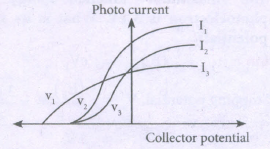
(iii) As per Einstein's equation,
(a) The stopping potential is the same for I1 and I2 as they have the same frequency.
(b) The saturation currents are as shown in the figure because of I1 > I2 > I3.
7.
Power of radiation, P =\(\frac { nhv }{ l } \) = Nhv, where N is a number of photons per sec.
or N =\(\frac { P }{ m } \)
= \(\frac { 2.0\times { 10 }^{ -3 } }{ 6.63\times 10^{ -34 }\times 6\times { 10 }^{ 14 } } \)
= 5 x 10¹⁵ photons per second.
8.
The energy of photon E = \(\frac { hc }{ \lambda } \) Joule
=\(\frac { hc }{ e\lambda } \) eV
=\(\frac { 6.63\times { 10 }^{ -34 }\times 3\times 10^{ 8 } }{ 1.6\times 10^{ -19 }\times 3.3\times 10^{ -7 } } \)eV
= 3.75 eV
Since WO of MO is greater than E,
∴ MO will not give photoemission.
9.
i) X-rays are produced in x-ray tube which is essentially a discharge tube.
ii) A tungsten filament F is heated to incandescence by a battery. As a result, electrons are emitted from it by thermionic emission.
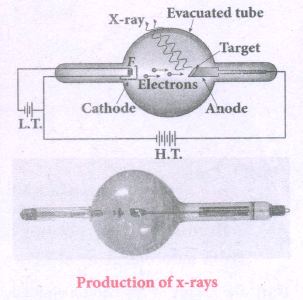
iii) The electrons are accelerated to high speeds by the voltage applied between the filament F and the anode.
iv) The target materials like tungsten, molybdenum are embedded in the face of the solid copper anode.
v) The face of the target is inclined at an angle with respect to the electron beam so that x-rays can leave the tube through its side.
vi) When high-speed electrons strike the target, they are decelerated suddenly and lose their kinetic energy.
vii) As a result, x-ray photons are produced. Since most of the kinetic energy of the bombarding electrons gets converted into heat, targets' made of high-melting-point metals and a cooling system are usually employed.
10.
(i) It is used for personal communication and cellular phones offer voice and data connectivity with high speed.
(ii) Transmission of news across the globe is done within a few seconds.
(iii) Using Internet of Things (UIT), it is made possible to control various devices from a single device. Example: home automation using a mobile phone.
(iv) It enables smart classrooms, online availability of notes, monitoring student activities etc. in the field of education.
11.
(i) This gives the variation of collector current (IC) with changes in base current (IB) at constant collector-emitter voltage (VCE).
(ii) It is seen that a small Ie flows even when IB is zero. This current is called the common emitter leakage current (ICEQ) which is due to the flow of minority charge carriers.
Forward current gain:
(i) The ratio of the change in collector current (ΔIC) to the change in base current (ΔIB) at constant collector-emitter voltage (VCE) is called forward current gain(β)
\(\beta ={ \left( \frac { \triangle { I }_{ C } }{ \triangle { I }_{ B } } \right) }_{ { V }_{ CE } }\)
(ii) It is value is very high and it generally ranges from 50 to 200. It depends on the construction of the transistors and will be provided by the manufacturer.
12.
Number of atoms undergoing fission per second
\(\frac { 3\times { 10 }^{ 7 } }{ 200\times L6\times { 10 }^{ -13 } } =0.9375\times { 10 }^{ 18 }\)
= Number of atoms undergoing fission in 24 hours = 0.9375 x 1018X 24 x 3600 = 0.81 x 10²³.
∴ Mass of uranium undergoing fission
= \(\frac { 235 }{ 6.023\times { 10 }^{ 23 } } \times 0.81\times { 10 }^{ 23 }=31.6g\)
13.
If No is the initial quantity, then the quantity left after n half-lives will be \(N={ N }_{ o }{ \left( \frac { 1 }{ 2 } \right) }^{ n }\)
But \(n=\frac { t }{ T } \) where t is the time of disintegration and T is half-life.
Then \(N={ N }_{ o }{ \left( \frac { 1 }{ 2 } \right) }^{ t/T }\)
Now, N = 25% of No = \(\frac { { N }_{ 0 } }{ 4 } \)
\(\frac { { N }_{ o } }{ 4 } ={ N }_{ o }{ \left( \frac { 1 }{ 2 } \right) }^{ t/T }\) ∴ 2t/T = 4 or 2t/T = 22
or \(\frac{t}{T}\) = 2 or t = 2T = 2 x 1600 year.
14.
The fusion reaction is as under:
\(_{ 1 }^{ 2 }{ H+ }_{ 1 }^{ 2 }{ H\rightarrow }_{ 2 }^{ 4 }{ He }+Q\) (energy)
Deuteron contains 2 nucleons. Binding energy per nucleon is 1.1 MeV. Binding energy of each deuteron nucleus is 2 x 1.1 i.e. 2 .2 MeV
Total binding energy before reaction
= 2 x 2.2 MeV = 4.4 MeV
Total binding energy after reaction
= 4 x 7 MeV = 28 MeV
Clearly the energy released is (28 - 4.4) MeV
i.e. 23.6. MeV
15.
Rutherford atom model helps in the calculation of the diameter of the nucleus and also the size of the atom but has the following limitations
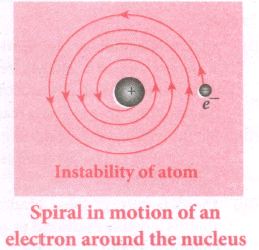
(a) This model fails to explain the distribution of electrons around the nucleus and also the stability of the atom.
According to classical electrodynamics,.any accelerated charge emits electromagnetic radiations. Due to emission of radiations, it loses its energy. Hence, it can no longer .sustain the circular motion. The radius of the orbit, therefore, becomes smaller and smaller (undergoes spiral motion) and finally the electron should fall into the nucleus and the atoms should disintegrate. But this does not happen.
(b) According to this model, emission of radiation must be continuous and must give continuous emission spectrum but experimentally we observe only line (discrete) emission spectrum for atoms.
16.
Formula:
Intensity, I = \(\frac{Power\ of\ visible\ light}{Area}\)
\(I=\frac { \frac { 5 }{ 100 } \times 100 }{ 4\pi { (1) }^{ 2 } } =0.4{ W/m }^{ 2 }\)
17.
G = 15Ω, Ig = 2mA = 2 x 10⁻³A
1 = 5A
Shunt resistance, S = \(\frac { { I }_{ g }G }{ I-{ I }_{ g } } \)
= \(\frac { 2\times 10^{ -3 }\times 15 }{ 5-2\times 10^{ -3 } } \)
= 0.006Ω
The resistance S = 0.006Ω is connected in parallel with the galvanometer in order to decrease the resistance of the galvanometer.
18.
According to Ampere's circuital law,
\(\oint _{ s }^{ }{ \overrightarrow { B } .\overrightarrow { dl } } ={ \mu }_{ 0 }I\quad ...(1)\)
As the current flows across the area bounded by loop S1, so
\(\oint _{ { s }_{ 1 },s }^{ }{ \overrightarrow { B } .\overrightarrow { dl } } ={ \mu }_{ 0 }I\quad ...(2)\)
But the area bounded by S2 lies in the region between the plates capacitor where no current flows across it.
\(\therefore \oint _{ { s }_{ 1 } }^{ }{ \overrightarrow { B } .\overrightarrow { dl } } =0\)
Consider that loops enclosing S1 & S2 are infinitesimally close to each other. Then
\(\oint _{ { s }_{ 1 } }^{ }{ \overrightarrow { B } .\overrightarrow { dl } } =\oint _{ { s }_{ 2 } }^{ }{ \overrightarrow { B } .\overrightarrow { dl } } \)
This equation is inconsistent with equations (2) & (3). To remove this maxwell said that a changing electric field (during charging) between the capacitor plates must induce a magnetic field which in turn must be associated with current Id.
\({ I }_{ d }={ \varepsilon }_{ 0 }\left( \frac { d{ \phi }_{ E } }{ dt } \right) \) [\(\frac { d{ \phi }_{ E } }{ dt } \) change in electric flux]
The total current must be
I = Iconduction + Idisplacement
\({ I }_{ c }={ \varepsilon }_{ 0 }\frac { d{ \phi }_{ E } }{ dt } \)
Hence the generalized from of Ampere's circuital law is
\(\oint _{ s }^{ }{ \overrightarrow { B } .\overrightarrow { dl } } ={ \mu }_{ 0 }\left[ { I }_{ c }+{ \varepsilon }_{ 0 }\frac { d{ \phi }_{ E } }{ dt } \right] \)
19.
ፒ = μBsinθ
Magnetic moment m = 3.6 x 10⁻²JT-1
Magnetic field B = 2 x 10⁻² T
Magnetic needle is inclined at an angle θ = 30°
Torque ፒ =?
ፒ = 3.6 x 10-2 x 2 x 10-2 sin 30°
t = 3.6 x 10⁻⁴ Nm.
20.
Given:
A = 20cm x 30cm
B = 0.3T
Let θ be the angle made by the field B with the normal to the plane of the coil
(i) Here, θ = 90° - 90° = 0°
So, flux Φ = BA cosθ
= 0.3 x 6 x 10-2 x cos0°
e = 1.8 x 10⁻² Wb
(ii) Here, θ = 90° - 30° = 60°
Φ = 0.3 x 6 x 10-2x cos60°
Φ = 0.9 X 10⁻² Wb
(iii) Here, 90° - 0° = 90°
Φ = 0.3 x 6 x 10-2x cos90°
Φ = 0°
21.
| Properties | Soft ferromagnetic materials | Hard ferromagnetic materials | |
| i | When external field is removed | Magnetization disappears | Magnetization persists |
| ii | Area of the loop | Small | Large |
| iii | Retentivity | Low | High |
| iv | Coercivity | Low | High |
| v | Susceptibility and magnetic permeability | High | Low |
| vi | Hysteresis loss | Less | More |
| vii | Uses | Solenoid core, transformer core and electromagnets | Permanent magnets |
| viii | Examples | Soft iron, Mumetal, Stalloy, etc. | Steel, Alnico, Lodestone etc. |
22.
(i) An AC is that current that changes continuously in magnitude and periodically in direction. The value of ac at any instant
I = I sin ωt = I sin 2π⋎t
Where Io is the peak value of current and angular frequency ω = 2 π⋎ = \(\frac { 2\pi }{ T } \)
(ii) The frequency of the direct current is zero.
23.
For the bridge to be balanced \(\cfrac { \\ P }{ Q } =\cfrac { R }{ S } \)
Since additionally a resistance 'x' is added in series with S, equation (1) can be written as
\(\cfrac { \\ P }{ Q } =\cfrac { R }{ (S+x) } \)
\(\left( S+x \right) =\cfrac { QR }{ P } x=\cfrac { \theta R }{ P } -S\)
\(x=\cfrac { 8\times 12 }{ 7 } -7\)
\(x=\frac{96}{7}-7=6.714 \Omega\)
24.
Potential difference V = 3 V
Current, I = 5 A
By Ohms law, \(R=\cfrac { V }{ I } =\cfrac { 3 }{ 5 } =0.6\Omega \)
25.
(i) q1 = q2 = 6.5 x 10⁻⁷C
r = 50 cm = 0.5m
Electrostatic force of repulsion,
\(F=\frac { 1 }{ 4\pi { \varepsilon }_{ 0 } } \frac { { q }_{ 1 }{ q }_{ 2 } }{ { r }^{ 2 } } \)
\(\\ =\frac { 9\times { 10 }^{ 9 }\times { (6.5\times { 10 }^{ -7 }) }^{ 2 } }{ { (0.5) }^{ 2 } } \)
F = 1.521 x 10⁻²N
(ii) Now if q1,q2 are doubled and r' is halved then F becomes 16 times.
i.e., New force of repulsion, \(F'=16\times \frac { 1 }{ 4\pi { \varepsilon }_{ 0 } } \frac { { q }_{ 1 }{ q }_{ 2 } }{ { r }^{ 2 } } \)
F' = 16F
= 16 x 1.521510-2
F' = 0.24 N.
26.
Let R1, R2, R3be the resistance of the wires
Then \({ R }_{ 1 }:{ R }_{ 2 };R_{ 3 }=l\cfrac { 1_{ 1 } }{ { r }_{ 1 }^{ 2 } } :\cfrac { { l }_{ 2 } }{ { r }_{ 2 }^{ 2 } } :\cfrac { { l }_{ 3 } }{ { r }_{ 3 }^{ 2 } } =\cfrac { 2 }{ 9 } :\cfrac { 3 }{ 16 } ;\cfrac { 4 }{ 25 } \)
The ratio of the circuits in the three wires must be inverse of the above ratio \(\left[ \because I=\cfrac { V }{ R } i.eI\alpha \cfrac { I }{ R } \right] \)
\(\therefore { I }_{ 1 }:{ I }_{ 2 }:{ I }_{ 3 }=\cfrac { 9 }{ 2 } :\cfrac { 16 }{ 3 } :\cfrac { 25 }{ 4 } =54:64:75\)
As total current = 5A [54 + 64+ 75 = 193]
\(\therefore { I }_{ 1 }=\cfrac { 5\times 54 }{ 193 } =1.40;{ I }_{ 2 }=\cfrac { 5\times 64 }{ 193 } =1.66A\)
\({ I }_{ 3 }=\cfrac { 5\times 75 }{ 193 } =1.94A\)
27.
Area of the plate, A = 25 cm2
= 25 x 10-4m2
Distance between the plates, d = 2 mm
d = 2 x 10⁻³m
Potential difference, V = 12V
Charge, q = CV \(\left[ C=\frac { { \varepsilon }_{ 0 }A }{ d } \right] \)
\(q=\left( \frac { { \varepsilon }_{ 0 }A }{ d } \right) V\)
\(=\frac { 8.85\times { 10 }^{ -12 }\times 25\times { 10 }^{ -4 }\times 12 }{ 2\times { 10s }^{ -3 } } \)
q = 1.33 x 10⁻¹⁰C
28.
r = 25cm = 25 x 10-2m
\(\sigma =\frac { 3 }{ \pi } { cm }^{ -2 }\)
\(AS,\quad \sigma =\frac { q }{ A } =\frac { q }{ 4\pi { r }^{ 2 } } \) [A - surface Area of the sphere]
\(q=(4\pi { r }^{ 2 })\sigma \)
\(=4\pi (0.25{ ) }^{ 2 }\times \frac { 3 }{ \pi } \)
= 0.75C.
29.
(i) \(mobility=\cfrac { Drift\ velocity }{ electric\ field } \) (or) \(\mu =\cfrac { { V }_{ d } }{ E } \)
(ii) \({ \mu }_{ d }=\cfrac { eE }{ mL } .\tau \) (or) \(\cfrac { { v }_{ d } }{ E } =\left( \cfrac { e }{ mL } \right) .\tau \)
\(\mu =\cfrac { e }{ mL } .\tau \)
30.
(i) The term RMS refers to time-varying sinusoidal currents and voltages and is not used in DC systems.
(ii) The root mean square value of an alternating current is defined as the square root of the mean of the squares of all currents over one cycle. It is denoted by IRMS. For alternating voltages, the RMS value is given by IVRM.
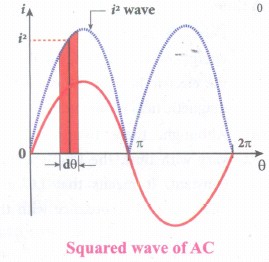
(iii) The alternating current i = Im sin ωt or i = Im sin θ, is represented graphically in Figure. The corresponding squared current wave is also shown by the dotted lines.
(iv) The sum of the squares of all currents over one cycle is given by the area of one cycle of the squared wave. Therefore,
IRMS = \(\sqrt{\frac{Area \ of \ one \ cycle \ of \ squared \ wave}{Base\ length \ of \ one\ cycle}}\) ....(1)
(v) An elementary area of thickness dθ is considered in the first half-cycle of the squared current wave as shown in Figure. Let i2 be the mid-ordinate of the element. Area of the element = i2dθ
Area of one cycle of squared.
wave = \(\int _{ 0 }^{ 2\pi }{ { i }^{ 2 }d\theta } \)
= \(\int _{ 0 }^{ 2\pi }{ { { I }^{ 2 } }_{ m } } { sin }^{ 2 }\theta d\theta ={ { I }^{ 2 } }_{ m }\int _{ 0 }^{ 2\pi }{ { sin }^{ 2 }\theta d\theta } \)
= \({ { I }^{ 2 } }_{ m }\int _{ 0 }^{ 2\pi }{ \left[ \frac { 1-cos2\theta }{ 2 } \right] d\theta } \)
since \({ sin }^{ 2 }\theta =\frac { 1-cos2\theta }{ 2 } \)
= \(\frac { { { I }^{ 2 } }_{ m } }{ 2 } \left[ \int _{ 0 }^{ \pi }{ id\theta } =\int _{ 0 }^{ \pi }{ { I }_{ m }cos2\theta d\theta } \right] \)
= \(\frac { { { I }^{ 2 } }_{ m } }{ 2 } { \left[ \theta -\frac { sin2\theta }{ 2 } \right] }_{ 0 }^{ 2\pi }\)
= \(\frac { { { I }^{ 2 } }_{ m } }{ 2 } \left[ \left( 2\pi -\frac { sin2\times 2\pi }{ 2 } \right) -\left( 0-\frac { sin0 }{ 2 } \right) \right] \)
= \(\frac { { { I }^{ 2 } }_{ m } }{ 2 } \times \pi ={ { I }^{ 2 } }_{ m }\pi \) [∵ sin 0 = sin 4π = 0]
Substituting this in equation (1), we get
\(\sqrt { \frac { { { I }^{ 2 } }_{ m }\pi }{ 2\pi } } =\frac { { { I }^{ 2 } }_{ m } }{ \sqrt { 2 } } \) [Base length of cone cycle is 2π]
IRMS = 0.707 Im
31.
\({ V }_{ S }-{ V }_{ R }=\frac { W }{ q } \)
Work W = 50μJ = 50 x 10-6 J
Charge q = 2μC = 2 x 10⁻⁶ C
V = VS - VR \(=\frac { W }{ q } =\frac { 50\times { 10 }^{ -6 } }{ 2\times { 10 }^{ -6 } } =25V\)
V = 25V
32.
The kinetic energy acquired by the electron is given by
\(=\frac{1}{2}mv^2=e V\)
Therefore, the speed v of the electron is \(v=\sqrt{\frac{2 eV}{m}}\)
Hence, the de Broglie wavelength of the electron is, \(\lambda=\frac{h}{mv}=\frac{h}{\sqrt{2meV}}\)

12th Standard Syllabus & Materials
12th Standard
TN 12th Computer Applications களப்பெயர் முறைமை (DNS) Sample Question Papers Study Material - QB365 Set A
NEW12th Standard
TN 12th Computer Applications வலையமைப்பு எடுத்துக்காட்டுகள் மற்றும் நெறிமுறைகள் Sample Question Papers Study Material - QB365 Set A
NEW12th Standard
TN 12th Computer Applications கணினி வலையமைப்பு ஓர் அறிமுகம் Sample Question Papers Study Material - QB365 Set A
NEW12th Standard
TN 12th Computer Applications PHP-உடன் MySQL-ஐ இணைத்தல் Sample Question Papers Study Material - QB365 Set A



Tamilnadu Stateboard 12th Standard Subjects

Maths

Chemistry
Physics

Biology

Computer Science

Business Maths and Statistics

Economics

Commerce

Accountancy

History

Computer Applications
Biology
Computer Technology
Computer Applications
Computer Science
Business Maths and Statistics
Commerce
Economics
Maths
Chemistry
Physics
Computer Technology
History
Accountancy

Tamil

English

French
Tamilnadu Stateboard Standards

