
 100% FREE ACCESS
12th Standard Syllabus & Materials
12th Standard
TN 12th Computer Applications மின்னணு தரவு பரிமாற்றம் Sample Question Papers Study Material - QB365 Set A
NEW12th Standard
TN 12th Computer Applications மின் - வணிக பாதுகாப்பு அமைப்புகள் Sample Question Papers Study Material - QB365 Set A
NEW12th Standard
TN 12th Computer Applications மின்னணு செலுத்தல் முறைகள் Sample Question Papers Study Material - QB365 Set A
NEW12th Standard
TN 12th Computer Applications மின் - வணிகம் Sample Question Papers Study Material - QB365 Set A
NEW12th Standard
TN 12th Computer Applications திறந்த மூல கருத்துருக்கள் Sample Question Papers Study Material - QB365 Set A
NEW12th Standard
TN 12th Computer Applications வலையமைப்பு வடமிடல் Sample Question Papers Study Material - QB365 Set A

Published on: 29/09/2020
12th Physics English Medium Sample 5 Mark Book Back Questions (New Syllabus 2020)
Download Tamil Nadu 12th Standard Physics question papers, model tests, one-mark questions, important questions, and public exam papers in PDF format. Free study materials and answer keys for TN State Board students.
Questions + Answers key
Take MCQ Physics Test1.
At the given point of time, the earth receives energy from sun at 4 cal cm–2min–1. Determine the number of photons received on the surface of the Earth per cm2 per minute. (Given: Mean wavelength of sun light = 5500 Å )
2.
Calculate the power of the lens of the spectacles needed to rectify the defect of nearsightedness for a person who could see clearly up to a distance of 1.8 m.
3.
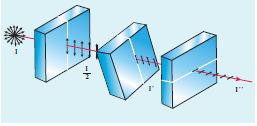
Two polaroids are kept crossed (transmission axes at 90o ) to each other.
(a) What will be the intensity of the light coming out from the second polaroid when an unpolarised light of intensity I falls on the first polaroid?
(b) What will be the intensity of light coming out from the second polaroid if a third polaroid is kept in between at 45o inclination to both of them.
4.
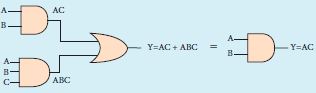
Prove the Boolean identity AC + ABC = AC and give its circuit description.
5.
Characol pieces of tree is found from an archeological site. The carbon-14 content of this characol is only 17.5% that of equivalent sample of carbon from a living tree. What is the age of tree?
6.
Consider two hydrogen atoms HA and HB in ground state. Assume that hydrogen atom HA is at rest and hydrogen atom HB is moving with a speed and make head-on collision with the stationary hydrogen atom HA. After the collision, both of them move together. What is minimum value of the kinetic energy of the moving hydrogen atom HB, such that any one of the hydrogen atoms reaches first excitation state.
7.
Calculate the instantaneous value at 60o, average value and RMS value of an alternating current whose peak value is 20 A.
8.
Determine the self-inductance of 4000 turn air-core solenoid of length 2m and diameter 0.04 m.
9.
Consider a parallel plate capacitor whose plates are closely spaced. Let R be the radius of the plates and the current in the wire connected to the plates is 5 A, calculate the displacement current through the surface passing between the plates by directly calculating the rate of change of flux of electric field through the surface.
10.
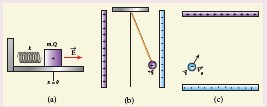
Draw the free body diagram for the following charges as shown in the figure (a), (b) and (c).
11.
Two cells each of 5V are connected in series with a 8 Ω resistor and three parallel resistors of 4 Ω, 6 Ω, and 12 Ω. Draw a circuit diagram for the above arrangement. Calculate
(i) the current drawn from the cells
(ii) current through each resistor
12.
The resistance of a nichrome wire at 20oC is 10 Ω. If its temperature coefficient of resistanc is 0.004oC, find its resistance of the wire at boiling point of water. Comment on the result.
13.
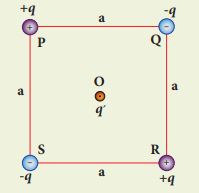
Four charges are arranged at the corners of the square PQRS of side an as shown in the figure.
(a) Find the work required to assemble these charges in the given configuration.
(b) Suppose a charge q is brought to the center of the square, by keeping the four charges fixed at the corners, how much extra work is required for this?
14.
Find the minimum thickness of a film of refractive index 1.25, which will strongly reflect the light of wavelength 589 nm. Also find the minimum thickness of the film to be anti-reflecting.
15.
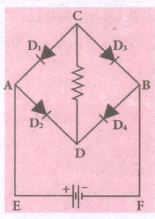
Four silicon diodes and a 10 Ω resistor are connected as shown in figure below. Each diode has a resistance of 1Ω. Find the current flows through the 10Ω resistor.
16.
In Young's double-slit experiment, the slits are 2 mm apart and are illuminated with a mixture of two-wavelength λ0 = 750 nm and λ = 900mm. What is the minimum distance from the common central bright fringe on a screen 2 m from the slits where a bright fringe from one interference pattern coincides with a . bright fringe from the other?
17.
A bar magnet is placed in a uniform magnetic field whose strength is 0.8 T. If the bar magnet is oriented at an angle 30o with the external field experiences a torque of 0.2 Nm. Calculate
(i) the magnetic moment of the magnet
(ii) the work done by the applied force in moving it from most stable configuration to the most unstable configuration and also compute the work done by the applied magnetic field in this case.
18.
A proton moves in a uniform magnetic field of strength 0.500 T magnetic field is directed along the x - axis. At initial time, t = 0s, the proton has velocity
\(\hat { v } =(1.95\times { 10 }^{ -5 }\hat { i } +2.00\times { 10 }^{ 5 }\hat { k } )m{ s }^{ -1 }\). Find
(a) At initial time, what is the acceleration of the proton.
(b) Is the path circular or helical? If helical, calculate the radius of helical trajectory and also calculate the pitch of the helix (Note: Pitch of the helix is the distance travelled along the helix axis per revolution).
19.
A capacitor of capacitance \(\frac { { 10 }^{ -4 } }{ \pi } F\), an inductor of inductance \(\frac { 2 }{ \pi } H\) and a resistor of resistance 100 Ω are connected to form a series RLC circuit. When an AC supply of 220 V, 50 Hz is applied to the circuit, determine
(i) the impedance of the circuit
(ii) the peak value of current flowing in the circuit
(iii) the power factor of the circuit and
(iv) the power factor of the circuit at resonance.
20.
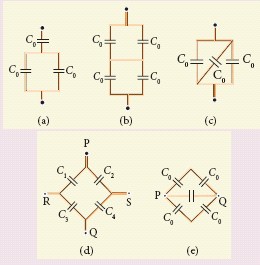
Calculate the resultant capacitances for each of the following combinations of capacitors.
21.
22.
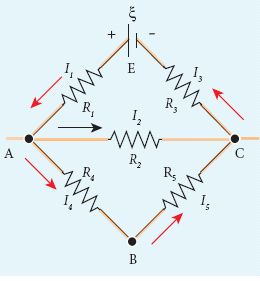
The following figure shows a complex network of conductors which can be divided into two closed loops like EACE and ABCA. Apply Kirchoff’s voltage rule(KVR)
23.
Two electric bulbs marked 20 W – 220 V and 100 W – 220 V are connected in series to 440 V supply. Which bulb will get fused?
1.
\(P=4 \ \mathrm{cal} \mathrm{} \mathrm{cm}^{-2} \mathrm{~min}^{-1}=4 \times 4.2=16.8 \mathrm{~J} \mathrm{~cm}^{-2} \mathrm{~min}^{-1} \)
\(E=\frac{h c}{\lambda}=\frac{6.626 \times 10^{-34} \times 3 \times 10^{8}}{5500 \times 10^{-10}}=3.6 \times 10^{-19} \mathrm{~J} \)
\(n=\frac{E}{hv}=\frac{16.8}{3.6 \times 10^{-19}}=4.67 \times 10^{19} \)
\(n=4.67 \times 10^{19} \) per cm2 per minute.
2.
The maximum distance the person could see is, x = 1.8 m.
The lens should have a focal length of,
f = –x m = –1.8 m.
It is a concave (or) diverging lens.
The power of the lens is,
\(\\ \\ \\ \\ P=-\cfrac { 1 }{ 1.8m } =-0.56D\)
3.
(a) As the intensity of the unpolarised light falling on the first polaroid is I, the intensity of polarized light emerging from it will be \({ I }_{ o }=\left( \cfrac { 1 }{ 2 } \right) \). Let I' be the intensity of light emerging from the second polaroid.
Malus’ law, I' = Io cos2θ
Here θ is 90o as the transmission axes are perpendicular to each other.
Substituting,
\(I'=\left( \cfrac { 1 }{ 2 } \right) { cos }^{ 2 }\left( { 90 }^{ o } \right) =0\left[ \therefore cos\left( { 90 }^{ o } \right) =0 \right] \)
No light comes out from the second polaroid
(b) Let the first polaroid be P1 and the second polaroid be P2. They are oriented at 90o. The third polaroid P3 is introduced between them at 45o. Let ′I be the intensity of light emerging from P3.
Angle between P1 and P3 is 45o. The intensity of light coming out from P3 is, I' = Io cos2θ
Substituting,
\(I'=\left( \cfrac { 1 }{ 2 } \right) { cos }^{ 2 }\left( { 45 }^{ o } \right) =\left( \cfrac { 1 }{ 2 } \right) \left( \cfrac { 1 }{ \sqrt { 2 } } \right) ^{ 2 }=\cfrac { 1 }{ 4' } ;I'\cfrac { I }{ 4 } \)
Finally, the light has to pass through P2. Angle between P3 and P2 is 45o. Let I″ is the intensity of light coming out from P2 I''= I'os2 θ
Here, I' is the intensity of polarized light existing between P3 and P2. I'= \(\cfrac { 1 }{ 4 } \)
Substituting,
\({ I }^{ n }=\left( \cfrac { 1 }{ 4 } \right) { cos }^{ 2 }\left( { 45 }^{ o } \right) =\left( \cfrac { 1 }{ 4 } \right) \left( \cfrac { 1 }{ \sqrt { 2 } } \right)^2 =\cfrac { 1 }{ 8 } \)
\(I^{ n }=\cfrac { 1 }{ 8 } \)
4.
Step 1: AC (1 + B) = AC.1 [OR law-2]
Step 2: AC . 1 = AC [AND law – 2]
Therefore, AC + ABC = AC
Thus the Boolean identity is proved.
Circuit Description
5.
\(\frac{\mathrm{N}}{\mathrm{N}_{0}}=\frac{17.5}{100} \),\(\mathrm{~T}_{1 / 2}=5730 \text { Years } \)
Age of the sample (t) = ?
Age of sample, \(t=\frac{2.303 \times \log \left(\frac{\mathrm{N}_{0}}{\mathrm{~N}}\right) \times \mathrm{T}_{1 / 2}}{0.6931}\)
\(t=\frac{2.303 \times \log \left(\frac{100}{17.5}\right) \times 5730}{0.6931} \)
\(t=\frac{2.303 \times \log (5.714) \times 5730}{0.6931} \)
\(t=\frac{2.303 \times 0.7570 \times 5730}{0.6931} \)
t = 14410 years
t = 1.44 x 10⁴ years
6.
Kinetic energies,
KEAi = 0
KEAf = KEBt
It should obey law of conservation of energy
Total Initial KE = Total final KE
\(\mathrm{KE}_{\mathrm{A}_{i}}+\mathrm{KE}_{\mathrm{B}_{i}}=\mathrm{KE}_{\mathrm{A}_{\mathrm{t}}}+\mathrm{KE}_{\mathrm{B}_{\mathrm{t}}} \)
\(0+\mathrm{KE}_{\mathrm{B}_{i}}=\mathrm{KE}_{\mathrm{A}_{\mathrm{f}}}+\mathrm{KE}_{\mathrm{A}_{t}} \)
\(\mathrm{KE}_{\mathrm{B}_{\mathrm{i}}}=2 \mathrm{KE}_{\mathrm{A}_{\mathrm{f}}} \)
Minimum energy required for excite the hydrogen atom is 10.2eV
Hence minimum Kinetic energy of HB is
\(\mathrm{KE}_{\mathrm{B}_{1}}=2 \times 10.2 \mathrm{eV}=20.4 \mathrm{eV}\)
7.
Angle, \( \theta=60^{\circ}\)
Peak value of current, \(I_{P_m}=20 \mathrm{~A}\)
(i) Instantaneous value of current at 60o,
\(i =I_m \sin \theta \)
\(=20 \times \sin 60^{\circ}=\frac{20 \times \sqrt{3}}{2} \)
\(=10 \times 1.732 \)
\(i =17.32 \mathrm{~A}\)
(ii) Average value of current,
\(I_{\mathrm{av}}=0.637 I_m \)
\(I_{\mathrm{av}}=0.637 \times 20 \)
\(I_{\mathrm{av}}=12.74 \mathrm{~A}\)
(iii) RMS value of current,
\(I_{\mathrm{rms}}=0.707 I_m=0.707 \times 20 \)
\(I_{\mathrm{rms}}=14.14 \mathrm{~A}\)
8.
Relative permeability of air-core solenoid is μr = 1
Length of the solenoid, I = 2 m, Number of turns, N = 4000
Diameter of the solenoid, d = 4 x 10⁻²m
Area of solenoid, A = \(\frac{\pi d^2}{4}\)
\(A =\frac{3.14 \times\left(4 \times 10^{-2}\right)^2}{4} \)
\(=12.56 \times 10^{-4} \mathrm{~m}^2\)
Self inductance of a solenoid is, \(L=\frac{\mu_0 \mu_r N^2 A}{l}\)
\(\therefore L =\frac{4 \pi \times 10^{-7} \times 1 \times(4000)^2 \times 12.56 \times 10^{-4}}{2} \)
\(=2 \times 3.14 \times 10^{-7} \times 16 \times 10^6 \times 12.56 \times 10^{-4} \)
\(=1262 \times 10^{-5} \mathrm{H}=12.62 \times 10^{-3} \mathrm{H} \)
\(\therefore L =12.62 \mathrm{mH}\)
∴ Self inductance of a solenoid L =12.62 mH
9.
Area of the capacitor = A
Radius = R
Current in the wire connected to the plates I = 5 A
The electric field, between the plates of a parallel plate capacitor,
\(E=\frac{\sigma}{\varepsilon_0} \)
\(E=\frac{Q}{A \varepsilon_0}\)
Q is the charge accumulated at the positive plate.
The flux of this field, \(\phi_E=\frac{Q}{A \varepsilon_0} \times A=\frac{Q}{\varepsilon_0}\)
Displacement current \(i_d=\varepsilon_0 \frac{d \phi_E}{d t}\)
\(=\varepsilon_0 \frac{d}{d t}\left(\frac{Q}{\varepsilon_0}\right)=i_c\)
\(\therefore \mathrm{i}_{\mathrm{d}}=5 \mathrm{~A} \quad\left(\because\right.\) The current through the capacitor ic = 5 A)
Displacement current = 5 A
10.
(a) In the figure
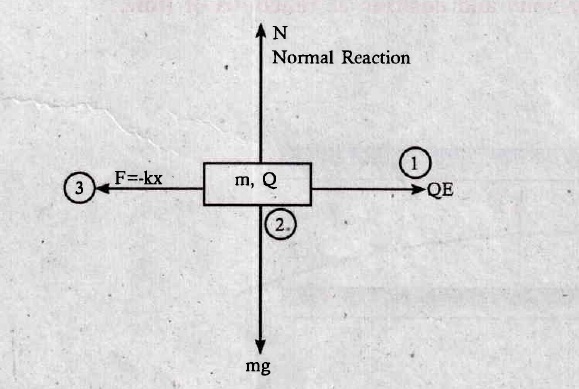
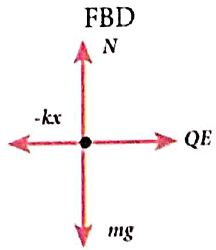
1 - Electrostatic force Fe = QE
2 - Weight W = mg
3 - Elastic force F = -kx
4 - Upward force = Normal reaction = N
b) In this figure
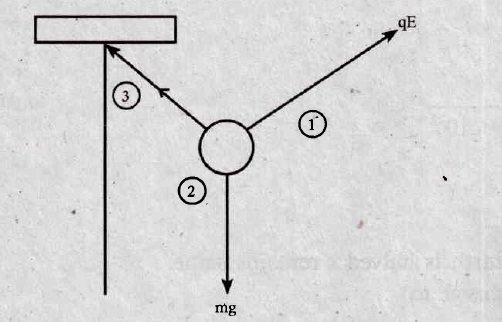
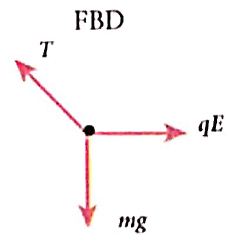
1- Electrostatic force F = qE
2 - Weight W = mg
3 - Tension acting along the string is T
(c) The charge is attracted towards the positively charged plate because it is a negative charge.
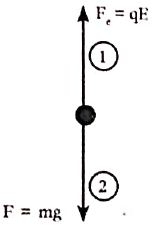
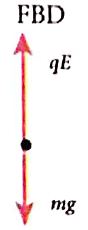
1 - Force = qE
2 - Downward force F = mg
11.
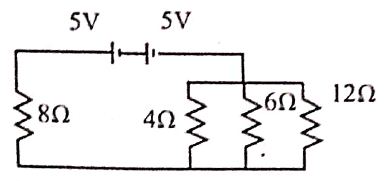
Circuit Diagram:
Here, 2 cells are in series,
\(\therefore \varepsilon_{\mathrm{tot}} =\varepsilon+\varepsilon=2 \varepsilon \)
\(\varepsilon_{\mathrm{tot}} =10 \mathrm{~V}\)
Here 4, 6 and 12 are in parallel
\(\therefore \frac{1}{\mathrm{R}_{\mathrm{p}}} =\frac{1}{\mathrm{R}_1}+\frac{1}{\mathrm{R}_1}+\frac{1}{\mathrm{R}_1}=\frac{1}{4}+\frac{1}{6}+\frac{1}{12} \)
\(\mathrm{R}_{\mathrm{p}} =2 \Omega\)
Now, the circuit becomes,
(i) current drawn from the cell (through the circuit) is,
\(\mathrm{I}=\frac{\mathrm{V}}{\mathrm{R}_{\mathrm{s}}}=\frac{10}{8+2}=1 \mathrm{~A}\)
Potential drop across the parallel combination of 3 resistors is \(\mathrm{V}^{\prime}=1 R_P=1 \times 2=2 \mathrm{~V}\)
(ii) Current through 8 resistor is I =1 A
\((\because 8 \Omega, 2 \Omega \text { in series) }\)
Current through \(\mathrm{R}=4 \Omega \ is, \mathrm{I}=\frac{\mathrm{V}^{\prime}}{\mathrm{R}}=\frac{2}{4}=0.5 \mathrm{~A}\)
Current through \(\mathrm{R}=6 \Omega \ is, \mathrm{I}=\frac{\mathrm{V}^1}{\mathrm{R}}=\frac{2}{6}=0.33 \mathrm{~A}\)
Current through \(\mathrm{R}=12 \Omega \ is, \mathrm{I}=\frac{\mathrm{V}^1}{\mathrm{R}}=\frac{2}{12}=0.17 \mathrm{~A}\)
12.
At To = 20oC, resistance R0 = 10 \(\Omega \)
\(\alpha\) = 0.004/oC, At To = 100oC R100 = ? (at boiling point of water)
RT = R0[1 + \(\left.(\alpha( T-T_{0}\right))\)]
R100 = 10 [1 + (0.004 x (100 - 20))]
= 10 [1 + 0.32] = 10 x 1.32 = 13.2 \(\Omega \)
∴ Resistance at boiling point of water R100 = 13.2 \(\Omega \)
(i.e) Rr = 13.2 \(\Omega \)
Comment : As the temperature increases, the resistance of the wire also increases.
13.
(a) The work done to arrange the charges in the corners of the square is independent of the way they are arranged. We can follow any order.
(i) First, the charge +q is brought to the corner P. This requires no work since no charge is already present, WP = 0
(ii) Work required to bring the charge –q to the corner Q = (-q) x potential at a point Q due to +q located at a point P
WQ = -q x \(\frac { 1 }{ 4\pi { \varepsilon }_{ 0 } } \frac { q }{ a } =-\frac { 1 }{ 4\pi { \varepsilon }_{ 0 } } \frac { q^{ 2 } }{ a } \)
(iii) Work required to bring the charge +q to the corner R = q x potential at the point R due to charges at the point P and Q.
WR = q x \(\frac { 1 }{ 4\pi { \varepsilon }_{ 0 } } \left( -\frac { q }{ a } +\frac { q }{ \sqrt { 2 } a } \right) \)
= \(\frac { 1 }{ 4\pi { \varepsilon }_{ 0 } } \frac { { q }^{ 2 } }{ a } \left( -1+\frac { 1 }{ \sqrt { 2 } } \right) \)
(iv) Work required to bring the fourth charge –q at the position S = q × potential at the point S due the all the three charges at the point P, Q and R.
Ws = - q x \(\frac { 1 }{ 4\pi { \varepsilon }_{ 0 } } \left( \frac { q }{ a } +\frac { q }{ a } -\frac { q }{ \sqrt { 2 } a } \right) \)
Ws = \(-\frac { 1 }{ 4\pi { \varepsilon }_{ 0 } } \frac { q^2 }{ a } \left( 2-\frac { 1 }{ \sqrt { 2 } } \right) \)
(b) Work required to bring the charge q′ to the center of the square = q′ x potential at the center point O due to all the four charges in the four corners.
The potential created by the two +q charges are canceled by the potential created by the -q charges which are located in the opposite corners. Therefore the net electric potential at the center O due to all the charges in the corners is zero.
Hence no work is required to bring any charge to the point O. Physically this implies that if any charge q′ when brought close to O, then it moves to the point O without any external force.
14.
λ = 589 nm = 589 x 10−9 m
For the film to have strong reflection, the reflected waves should interfere constructively. The least optical path difference introduced by the film should be λ/2. The optical path difference between the waves reflected from the two surfaces of the film is 2μd. Thus, for strong reflection, 2μd = λ/2 [As given in equation 6.145. with n = 1]
Rewriting, \(d=\frac{\lambda}{4 \mu}\)
Substituting, \(d=\frac{589 \times 10^{9}}{4 \times 1.25}=117.8 \times 10^{-9}\)
d = 117.8 x 10-9 = 117.8 nm
For the film to be anti-reflecting, the reflected rays should interfere destructively. The least optical path difference introduced by the film should be λ. The optical path difference between the waves reflected from the two surfaces of the film is 2μd. For strong reflection, 2μd = λ [As given in equation 6.146. with n = 1]
Rewriting, \(d=\cfrac { \lambda }{ 2\mu } \)
Substituting, \(d=\cfrac { 589\times { 10 }^{ 9 } }{ 2\times 1.25 } =235.6\times { 10 }^{ -9 }\)
d = 235.6 x 10-9 = 235.6 nm
15.
Diode D1 and D4 is reverse biased [open]
Diode D1 and D3 are forward biased.
The resistances are in series
R = 1 + 10 + 1 - 12 Ω
Barier Potential, V = 0.7 + 0.7 = 1.4 V (Silicon diode)
Applying Kirchhoff's voltage Law,
0.7 + I(1) + I(10) + 0.7 + I(1) = 3V
12 I = 3 - 1.4
12 I = 1.6
\(I=\frac{1.6}{12}=\mathbf{0 . 1 3 3 A}\)
16.
Given data:
λ = 900 nm = 900 x 10-9 m
λ 2 = 750 nm = 750 x 10-9 m
D = 2 m d = 2 nm = 2 x 10⁻³ m
Let nth order bright fringe of λ1,
Coincides with (n + 1)th order bright fringe of λ 2
\(y_{n}=\frac{n \lambda_{1} D}{d}, Y_{n+1}=\frac{(n+1) \lambda_{2} D}{d} \)
\(\frac{n \lambda_{1} D}{d}=\frac{(n+1) \lambda_{2} D}{d} \)
\(n \lambda_{1}=(n+1) \lambda_{2} \)
\(\frac{n+1}{n}=\frac{\lambda_{1}}{\lambda_{2}}=\frac{900 \times 10^{-9}}{750 \times 10^{-9}}=\frac{18}{15}=\frac{6}{5} \)
\(1+\frac{1}{n} =\frac{6}{5} \)
\(\frac{1}{n} =\frac{6}{5}-1=\frac{6-5}{5} \)
\(\frac{1}{n} =\frac{1}{5} \)
n = 5
n + 1 = 6
5th bright fringe of λ 1 coincides with 6th bright fringe of λ 2 in the least distance of y
\(y =\frac{n \lambda_{1} D}{d}=\frac{5 \times 900 \times 10^{-9} \times 2}{2 \times 10^{-3}} \)
\(=4500 \times 10^{-6}=4.5 \times 10^{-3} \)
y = 4.5 mm
17.
Uniform magnetic field B = 0.8 T
Angle of orientation θ = 30°
Torque, ፒ = 0.2 Nm.
(i) We know that torque ፒ = PmB sinθ
\(0.2=p_\mathrm{m} \times 0.8 \times \sin 30^{\circ} \)
\(0.2=p_\mathrm{m} \times 0.8 \times \frac{1}{2} \)
0.2 = 0.4 pm
\(p_m=\frac{0.2}{0.4}=0.5 \mathrm{Am}^{2}\)
(ii) Work done by the applied force to move the magnet from stable to unstable position.
\(\mathrm{W} =-p_\mathrm{m}B\left[\cos \theta_{2}-\cos \theta_{1}\right] \)
\(\mathrm{W} =-p_\mathrm{m}B\left(\cos 180^{\circ}-\cos 0^{\circ}\right) \)
\(\mathrm{W} =-p_\mathrm{m}B(-1-1)=2 \mathrm{p_mB} \)
\(\mathrm{W} =2 \times 0.5 \times 0.8=\mathbf{0 . 8} \mathbf{J} \)
Work done by the applied magnetic field are in opposite direction
\(\mathbf{W}_{\text {mag }}=-0.8 \mathrm{J}\)
18.
Magnetic field \(\overset { \rightarrow }{ B } ={ 0.500\hat { i } T } \)
Velocity of the particle
\(\hat { v } \) = (1.95 x 10⁵\(\hat { i } \) + 2.00 x 10⁵\(\hat { k } \)) ms-1
Charge of the proton q = 1.67 x 10⁻¹⁹ C
Mass of the proton m = 1.67 x 10⁻²⁷kg
(a) The force experienced by the proton is \(\overset { \rightarrow }{ F } \) = q(\(\overset { \rightarrow }{ v } \) x \(\overset { \rightarrow }{ B } \) )
= 160 x 10-19 x ((1.95 x 10⁵\(\hat { i } \) + 2.00 x 10⁵\(\hat { k } \)) x (0.500 \(\hat { i } \)))
\(\overset { \rightarrow }{ F } \)= 1.60 x 10⁻¹⁴ \(\hat { j } \) N
Therefore, from Newton’s second law,
\(\overset { \rightarrow }{ a } =\frac { 1 }{ m } \overset { \rightarrow }{ F } =\frac { 1 }{ 1.67\times { 10 }^{ -27 } } (1.60\times { 10 }^{ -14 })\hat j\)
\(=9.58\times { 10 }^{ 12 }\hat jm{ s }^{ -2 }\)
(b) Trajectory is helical Radius of helical path is
\(R=\frac { { mv }_{ z } }{ \left| q \right| B } =\frac { 1.67\times { 10 }^{ -27 }\times 2.00\times { 10 }^{ 5 } }{ 1.60\times { 10 }^{ -19 }\times 0.500 } \)
= 4.175 x 10⁻³m = 4.18mm
Pitch of the helix is the distance travelled along x-axis in a time T, which is P = vx T
But time, \(T=\frac { 2\pi }{ \omega } =\frac { 2\pi m }{ \left| q \right| B } =\frac { 2\times 3.14\times 1.67\times { 10 }^{ -27 } }{ 1.60\times 1{ 0 }^{ -19 }\times 0.500 } =13.1\times { 10 }^{ -8 }s\)
Hence, pitch of the helix is
\(p={ v }_{ x }T=(1.95\times { 10 }^{ 5 })(13.1\times { 10 }^{ -8 })=25.5\times { 10 }^{ -3 }m=25.5mm\)
The proton experiences appreciable acceleration in the magnetic field, hence the pitch of the helix is almost six times greater than the radius of the helix.
19.
L = \(\frac { 2 }{ \pi } \)H; C = \(\frac { { 10 }^{ -4 } }{ \pi } F\); R = 100Ω
VRMS = 220 V; f = 50Hz
XL= 2πfl = 2π x 50 x \(\frac { 2 }{ \pi } \) = 200Ω
Xc = \(\frac { 1 }{ 2\pi fC } =\frac { 1 }{ 2\pi \times 50\times \frac { 10^{ -4 } }{ \pi } } 100 \Omega\)
(i) Impedance, Z = \(\sqrt { { R }^{ 2 }+({ X }_{ L }-{ X }_{ C })^2 } \)
=\(\sqrt { 100^{ 2 }+(200-100)^{ 2 } } \) = 141.4Ω
(ii) Peak value of current,
Im = \(\frac { { v }_{ m } }{ Z } =\frac { \sqrt { 2 } V_{ RMS } }{ Z } \)
= \(\frac { \sqrt { 2 } \times 220 }{ 141.4 } \) = 2.2 A
(iii) Power factor of the circuit
\(cos\phi =\frac { R }{ Z } =\frac { 100 }{ 141.4 } \)= 0.707
(iv) Power factor at resonance
\(cos\phi =\frac { R }{ Z } =\frac { R }{ R } \) = 1
20.
Figure (a)
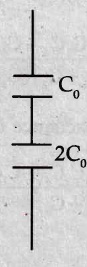
Parallel : \(C_{P}=C_{0}+C_{0}=2 C_{0}\)
Series : \(\frac{1}{C_{S}} =\frac{1}{C_{0}}+\frac{1}{2 C_{0}} \)
\(=\frac{2+1}{2 C_{0}} \)
\(\frac{1}{C_{S}} =\frac{3}{2} C_{0} \)
\(\therefore C_{s} =\frac{2}{3} C_{0} \)
Figure (b)
.jpg)
\(C_{p 1} =2 C_{0},C_{p 2} =2 C_{0}\)
\(\frac{1}{C_{S}} =\frac{1}{C_{p_{1}}}+\frac{1}{C_{P 2}}=\frac{1}{2 C_{0}}+\frac{1}{2 C_{0}} \)
\(\frac{1+1}{2 C_{0}} =\frac{2}{2 C_{0}}=\frac{1}{C_{0}} \)
\(\therefore C_{s} =C_{0} \)
Figure (c)
.jpg)
\(C_{p} =C_{0}+C_{0}=2 C_{0} \)
\(C_{p} =2 C_{0}+C_{0} \)
\(C_p=3 C_{0} \)
Figure (d)
.jpg)
\(\frac{1}{C_{s 1}}=\frac{1}{C_{1}}+\frac{1}{C_{2}}=\frac{C_{1}+C_{2}}{C_{1} C_{2}} \)
\(\therefore C_{S 1}=\frac{C_{1} C_{2}}{C_{1}+C_{2}} \) ....(1)
\(\frac{1}{C_{s 2}}=\frac{1}{C_{3}}+\frac{1}{C_{4}}=\frac{C_{4}+C_{3}}{C_{3} C_{4}} \)
\(\therefore C_{s 2}=\frac{C_{3} C_{4}}{C_{3}+C_{4}} \) ...(2)
\(C_{p} =C_{s 1}+C_{s 2} \)
\(C_p= \frac{C_{1} C_{2}}{C_{1}+C_{2}}+\frac{C_{3} C_{4}}{C_{3}+C_{4}} \)
\(=\frac{C_{1} C_{2}\left(C_{3}+C_{4}\right)+C_{3} C_{4}\left(C_{1}+C_{2}\right)}{\left(C_{1}+C_{2}\right)\left(C_{3}+C_{4}\right)} \)
\(C_{p} =\frac{\mathbf{C}_{1} C_{2} C_{3}+C_{1} C_{2} C_{4}+C_{3} \mathbf{C}_{4} C_{1}+C_{3} C_{4} C_{2}}{\left(C_{1}+C_{2}\right)\left(C_{3}+C_{4}\right)} \)
The Effective capacitance across PQ and RS is same.
\(C_{PQ}=C_{RS}=C=\frac{C_{1} C_{2} C_{3}+C_{2} C_{3} C_{4}+C_{1} C_{2} C_{4}+C_{1} C_{3} C_{4}}{\left(C_{1}+C_{2}\right)\left(C_{3}+C_{4}\right)}\)
Figure (e): Across PQ
.jpg)
\(\frac{1}{C_{S 1}}=\frac{1}{C_{0}}+\frac{1}{C_{0}}=\frac{2}{C_{0}} \)
\(\therefore C_{S 1}=\frac{C_{0}}{2} \)
\(\frac{1}{C_{S 2}}=\frac{1}{C_{0}}+\frac{1}{C_{0}}=\frac{2}{C_{0}} \)
\(C_{S 2}=\frac{C_{0}}{2} \)
\(C_{P}=C_{S 1}+C_{S 2}=\frac{C_{0}}{2}+\frac{C_{0}}{2} \)
\(C_p=C_{0} \)
Resultant Capacitance
.jpg)
CR = Co + Co
CR = 2Co
21.
22.
Thus applying Kirchoff’s second law to the closed loop EACE
I1R1 + I2R2 + I3R3 = ξ
and for the closed loop ABCA
I4R4 + I5R5 - I2R2 = 0
23.
To check which bulb will be fused, the voltage drop across each bulb has to be calculated.
The resistance of a bulb,
\(R=\frac { V^{ 2 } }{ P } =\frac { { (Ratedvoltage) }^{ 2 } }{ Ratedpower } \)
For 20W - 220V bulb,
\({ R }_{ 1 }=\frac { { \left( 220 \right) }^{ 2 } }{ 20 } \Omega =2420\Omega \)
For 100W - 220V bulb,
\({ R }_{ 2 }=\frac { { \left( 220 \right) }^{ 2 } }{ 20 } \Omega =484\Omega \)
Both the bulbs are connected in series. So same current will pass through both the bulbs. The current that passes through the circuit, \(I=\frac { V }{ { R }_{ tot } } \)
Rtot (R1 + R2)
Rtot = (484 + 2420) \(\Omega\) = 2904 \(\Omega\)
\(I=\frac { 440V }{ 2904\Omega } \approx 0.151A\)
The voltage drop across the 20W bulb is
\(V_1=IR_1=\frac { 440V }{ 2904 }\times2420 \approx 366.6V\)
The voltage drop across the 100W bulb is
\({ V }_{ 2 }=I{ R }_{ 2 }=\frac { 440 }{ 2904 } 484\approx 73.3A\)
The 20 W bulb will get fused because the voltage across it is more than the voltage rating.

12th Standard Syllabus & Materials
12th Standard
TN 12th Computer Applications களப்பெயர் முறைமை (DNS) Sample Question Papers Study Material - QB365 Set A
NEW12th Standard
TN 12th Computer Applications வலையமைப்பு எடுத்துக்காட்டுகள் மற்றும் நெறிமுறைகள் Sample Question Papers Study Material - QB365 Set A
NEW12th Standard
TN 12th Computer Applications கணினி வலையமைப்பு ஓர் அறிமுகம் Sample Question Papers Study Material - QB365 Set A
NEW12th Standard
TN 12th Computer Applications PHP-உடன் MySQL-ஐ இணைத்தல் Sample Question Papers Study Material - QB365 Set A



Tamilnadu Stateboard 12th Standard Subjects

Maths

Chemistry
Physics

Biology

Computer Science

Business Maths and Statistics

Economics

Commerce

Accountancy

History

Computer Applications
Biology
Computer Technology
Computer Applications
Computer Science
Business Maths and Statistics
Commerce
Economics
Maths
Chemistry
Physics
Computer Technology
History
Accountancy

Tamil

English

French
Tamilnadu Stateboard Standards

