
 100% FREE ACCESS
12th Standard Syllabus & Materials
12th Standard
TN 12th Computer Applications மின்னணு தரவு பரிமாற்றம் Sample Question Papers Study Material - QB365 Set A
NEW12th Standard
TN 12th Computer Applications மின் - வணிக பாதுகாப்பு அமைப்புகள் Sample Question Papers Study Material - QB365 Set A
NEW12th Standard
TN 12th Computer Applications மின்னணு செலுத்தல் முறைகள் Sample Question Papers Study Material - QB365 Set A
NEW12th Standard
TN 12th Computer Applications மின் - வணிகம் Sample Question Papers Study Material - QB365 Set A
NEW12th Standard
TN 12th Computer Applications திறந்த மூல கருத்துருக்கள் Sample Question Papers Study Material - QB365 Set A
NEW12th Standard
TN 12th Computer Applications வலையமைப்பு வடமிடல் Sample Question Papers Study Material - QB365 Set A

Published on: 20/01/2020
Download Tamil Nadu 12th Standard Physics question papers, model tests, one-mark questions, important questions, and public exam papers in PDF format. Free study materials and answer keys for TN State Board students.
Questions + Answers key
Take MCQ Physics Test1.
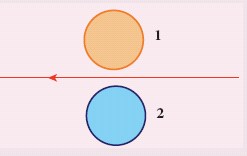
Using Lenz’s law, predict the direction of induced current in conducting rings 1 and 2 when current in the wire is steadily decreasing.
2.
Suppose a cyclotron is operated to accelerate protons with a magnetic field of strength 1 T. Calculate the frequency in which the electric field between two Dees could be reversed.
3.
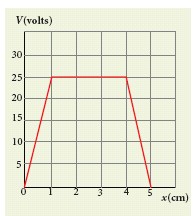
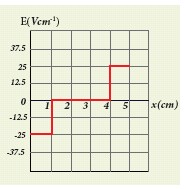
The following figure represents the electric potential as a function of x – coordinate. Plot the corresponding electric field as a function of x.
4.
A small telescope has an objective lens of focal length 125 cm and an eyepiece of focal length 2 cm.
(a) What is the magnification of the telescope?
(b) What is the separation between the objective and the eyepiece?
(c) What is the angular separation between two stars when viewed through this telescope if they subtend 1' for bare eye?
5.
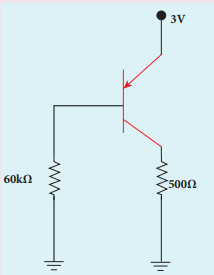
In the circuit shown in the figure, the BJT has a current gain (β) of 50. For an emitter-base voltage VEB = 600 mV, calculate the emitter-collector voltage VEC (in volts).
6.
A pulse of light of duration 10−6 s is absorbed completely by a small object initially at rest. If the power of the pulse is 60\(\times\) 10−3 W. Calculate the final momentum of the object.
7.
The current in an inductive circuit is given by 0.3 sin (200t – 40°) A. Write the equation for the voltage across it if the inductance is 40 mH.
8.
A parallel plate capacitor filled with mica having εr = 5 is connected to a 10 V battery. The area of the parallel plate is 6 cm2 and separation distance is 6 mm.
(a) Find the capacitance and stored charge.
(b) After the capacitor is fully charged, the battery is disconnected and the dielectric is removed carefully.
Calculate the new values of capacitance, stored energy and charge.
9.
In a Wheatstone’s bridge P = 100 Ω, Q = 1000 Ω and R = 40 Ω. If the galvanometer shows zero deflection, determine the value of S.
10.
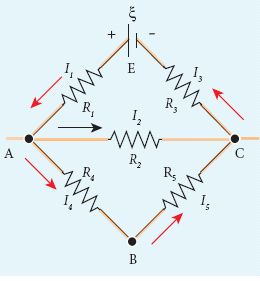
The following figure shows a complex network of conductors which can be divided into two closed loops like EACE and ABCA. Apply Kirchoff’s voltage rule(KVR)
11.
A consider the situation in the figure. The bottom of the pot is a reflecting plane mirror. F is a fish and B is a bird. (a) At what distance(s) from itself will the fish see the image (b) At what distance(s) from itself will the bird see the image(s) of the fish? Take \(\\ { m }_{ wa }=\cfrac { 4 }{ 3 }\).
12.
X -rays of wavelength 'A' fallon a photosensitive surface emitting electrons. Assuming that the work function of the surface can be neglected, prove that the de Broglie wavelength of electrons emitted will be \(\sqrt { \frac { h\lambda }{ 2mc } } \)
13.
Write the advantages and disadvantages of robotic.
14.
Consider the case of bombardment of 235U nucleus with a thermal neutron. The fission products are 95Mo and 139La and two neutrons. Calculate the energy released. (Rest masses of the nuclides: 235U = 235.0439 u, \(_{ 0 }^{ 1 }{ n }\) = 1.0087 u, 95Mo = 94.9058 u, 139La = 138.9061 u, Take 1 u = 931 MeV.)
15.
A parallel plate capacitor is charged by an external ac source straight the displacement current inside the capacitor is the same as the current charging the capacitor.
16.
The magnetic flux through a coil perpendicular to the plane is given by Φ = 5t3 +4t2 +2t calculate the induced emf through the coil at t = 2S
17.
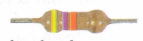
A carbon resistor has coloured strips. What is its resistors?
18.
Let I1 and I2 be the steady currents passing through a long horizontal wire XY and PQ respectively. The wire PQ is fixed in horizontal plane and the wire XY be is allowed to move freely in a vertical plane. Let the wire XY is in equilibrium at a height d over the parallel wire PQ as shown in figure.
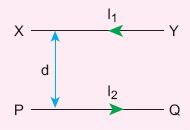
Show that if the wire XY is slightly displaced and released, it executes Simple Harmonic Motion (SHM). Also, compute the time period of oscillations.
19.
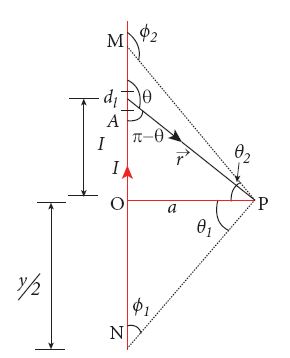
Show that for a straight conductor, the magnetic field
\(\overset { \rightarrow }{ B } =\frac { { \mu }_{ ° }I }{ 4\pi a } (cos\varphi _{ 1 }-cos\varphi _{ 2 })\hat { n } \)
\(=\frac { { \mu }_{ ° }I }{ 4\pi a } (sin{ \theta }_{ 1 }+sin{ \theta }_{ 2 })\hat { n } \)
20.
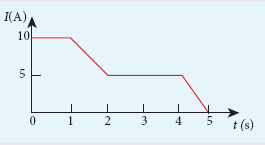
The current through an element is shown in the figure. Determine the total charge that pass through the element at a) t = 0 s, b) t = 2 s, c) t = 5s
1.
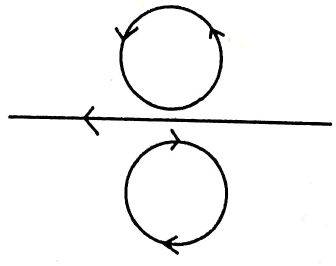
(i) Current is induced in the anticlockwise direction in the upper coil. Then only as per Lenz's law, the induced current will oppose the motion of the magnet.
(ii) In the lower coil, current is induced in the clockwise direction. As per Lenz's law the direction of induced emf will in opposite direction of motion of the magnet.
2.
Magnetic field B = 1 T
Mass of the proton, mp = 1.67 x 10⁻²⁷kg
Charge of the proton, q = 1.60 x 10⁻¹⁹C
\(f=\frac { qB }{ { { 2\pi m }_{ p } } } =\frac { \left( 1.60\times { 10 }^{ -19 } \right) \left( 1 \right) }{ 2\left( 3.14 \right) \left( 1.67\times { 10 }^{ -27 } \right) } \)
= 15.3 x 10⁶ Hz = 15.3 MHz
3.
In the given problem, since the potential depends only on x, we can use \(\vec { E } =\frac { dV }{ dx } \hat { i } \) (the other two terms \(\frac { \eth V }{ \eth y } \) and \(\frac { \eth V }{ \eth z } \) are zero)
From 0 to 1 cm, the slope is constant and so \(\frac { dV }{ dx } \) = 25V cm-1, So \(\vec { E } \)= -25V cm-1\(\hat { i } \)
From 1 to 4 cm, the potential is constant
V = 25 V. It implies that \(\frac { dV }{ dx } \) = 0, So \(\vec { E } \) = 0
From 4 to 5 cm, the slope \(\frac { dV }{ dx } \) = -25 V cm-1
So \(\vec { E } \) = + 25Vcm-1\(\hat { i } \)
The plot of electric field for the various points along the x-axis is given below
4.
fo = 125 cm; fe = 2 cm; m = ? L = ?; θi = ?
(a) Equation for magnification of telescope,
\(m=\cfrac { { f }_{ o } }{ { f }_{ e } } \)
Substituting, \(m=\cfrac { 125 }{ 2 } =62.5\)
(b) Equation for approximate length of telescope, L = fo+ fe
Substituting, L = 125 + 2 = 127 cm = 1.27 m
(c) Equation for angular magnification,\(m=\cfrac { { \theta }_{ 1 } }{ { \theta }_{ 0 } } \)
Rewriting, \({ \theta }_{ 1 }=m\times { \theta }_{ 0 }\)
Substituting,
\({ \theta }_{ i }=62.5\times 1'=62.5'=\cfrac { 62.5 }{ 60 } =1.04^{ o }\) = 1o2'30''
5.
\(\beta =50 \)
\(V_{\beta E} =600 \mathrm{mV} \)
\(=0.6 \mathrm{~V} \)
\(\mathrm{V}_{\mathrm{B}} =\mathrm{V}_{\mathrm{E}}-\mathrm{V}_{\mathrm{EB}} \)
\(\mathrm{V}_{\mathrm{B}} =3-0.6 \)
\(=2.4 \mathrm{~V} \)
\(\mathrm{I}_{\mathrm{B}} =\frac{\mathrm{V}_{\mathrm{B}}}{R_B}=\frac{2.4}{60 \times 10^3}=40 \mu \mathrm{A} \)
\(\mathrm{I}_{\mathrm{C}} =\beta \mathrm{I}_{\mathrm{B}}=50 \times 40 \mu \mathrm{A} =2 \mathrm{~mA} \)
\(V_C=R_FI_C=500 \times 2 \times10^{-3}=1 V\)
\(V_{EC}=V_E-V_C\)
\(V_{EC}=V_E-V_C\)
\(V_{EC}=3-1=2V\)
6.
Power of the pulse P = 60 x 10-3 W
Time internal t = 10-6 S
Energy U = Power x time
U = p x t
= 60 x 10-3 x 10-6
U = 60 x 10-9 J
Lineral momentum, \(\mathrm{P}=\frac{\text { Energy }}{\text { speed }}=\frac{U}{C} \ \)
\(\mathrm{P}=\frac{60 \times 10^{-9}}{3 \times 10^{8}} \)
P = 20 x 10-17 kg ms-1
7.
L = 40 x 10-3 H; i = 0.3 sin (200t – 40o)
XL = ωL = 200 x 40 x 10-3 = 8 Ω
Vm = Im XL = 0.3 x 8 = 2.4 V
In an inductive circuit, the voltage leads the current by 90o Therefore,
v = Vmsin (ωt + 90o)
v = 2.4sin (200t - 40o + 90o)
v = 2.4sin (200t + 50o)volt
8.
(a) The capacitance of the capacitor in the presence of dielectric is
C = \(\frac { { \varepsilon }_{ r }{ \varepsilon }_{ 0 }A }{ d } =\frac { 5\times 8.85\times 10^{ -12 }\times 6 \times 10^{-4}}{ 6\times 10^{ -3 } } \)
= 44.25 x 10⁻¹³F = 4.425 pF
The stored charge is
Q = CV = 44.25 x 10-13 x 10
= 442.5 x 10⁻¹³C = 44.25pC
The stored energy is
\(U=\frac { 1 }{ 2 } \) CV2 = \(\frac { 1 }{ 2 } \) x 44.25 x 10-13 x 100
= 2.21 x 10⁻¹⁰ J
(b) After the removal of the dielectric, since the battery is already disconnected the total charge will not change. But the potential difference between the plates increases. As a result, the capacitance is decreased.
New capacitance is
C0=\(\frac { C }{ { \varepsilon }_{ r } } =\frac { 44.25\times 10^{ -12 } }{ 5 } \)
= 0.885 x 10⁻¹² F = 0.885 pF
The stored charge remains same and 44.25 pC. Hence newly stored energy is
U0 =\(\frac { { Q }^{ 2 } }{ 2{ C }_{ 0 } } =\frac { { Q }^{ 2 }{ \varepsilon }_{ r } }{ 2C } =\varepsilon _{ r }U\)
= 5 x 2.21 x 10-10J = 11.05 x 10⁻¹⁰J
The increased energy is ΔU = (11.05 - 2.21) x 10-10 J = 8.84 x 10⁻¹⁰ J
When the dielectric is removed, it experiences an inward pulling force due to the plates. To remove the dielectric, an external agency has to do work on the dielectric which is stored as additional energy. This is the source for the extra energy 8.84 x 10⁻¹⁰ J.
9.
\(\frac { P }{ Q } =\frac { R }{ S } \)
\(S=\frac { Q }{ P } \times R\)
\(S=\frac { 1000 }{ 100 } \times 40S=400\Omega \)
10.
Thus applying Kirchoff’s second law to the closed loop EACE
I1R1 + I2R2 + I3R3 = ξ
and for the closed loop ABCA
I4R4 + I5R5 - I2R2 = 0
11.
For the fish, the distance of the bird from the free surface is \(\cfrac { 4h }{ 3 } \) or 1.33 h, Distance of fish from the free surface = 0.5 h. So, the required distance is 1.83 h.
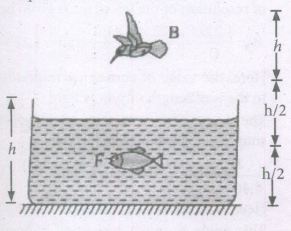
Again, effective distance of bird from the mirror is NH + h or 2.33 h. So, the distance of the bird's image from the mirror is 2.33 h. Distance from fish is 2.33 h + 0.5 h i.e. 2.83 h.
(b) For the bird, the distance of fish from the free surface is
\(\cfrac { h }{ 2n } \) or \(\cfrac { h }{ 2\times \cfrac { 4 }{ 3 } } \) or \(\cfrac { 3h }{ 8 } \) or 0.375 h
Distance of fish from bird is 0.375 h + h i.e. 1.375 h.
Again, distance of image of fish from mirror is \(\cfrac { h }{ 2 } \)
Effective distance (for the bird) of the image of fish is the mirror is
\(\cfrac { 1 }{ n } \left[ \cfrac { 3h }{ 2 } \right] +h.i.e,\cfrac { 3 }{ 4 } \times \cfrac { 3h }{ 2 } +h\) or \(\cfrac { 9h }{ 8 } +h\) or \(\cfrac { 17h }{ 8 } \) or 2.125 h.
12.
\(\frac { 1 }{ 2 } { mv }^{ 2 }=hv\quad or\quad { E }_{ k }=\frac { hc }{ \lambda } \)
\(or\quad \frac { { p }^{ 2 } }{ 2m } =\frac { hc }{ \lambda } or\quad p=\sqrt { \frac { 2mhc }{ \lambda } } \)
de Broglie wavelength\(=\frac { h }{ p } =\frac { h }{ \sqrt { \frac { 2mhc }{ \lambda } } } \)
\(\\ =\sqrt { \frac { h\lambda }{ 2mc } } \)
13.
Advantages of robotics:
(i) The robots are much cheaper than humans.
(ii) Robots never get tired like humans. It can work for 24 x 7. Hence absenteeism in work place can be reduced.
(iii) Robots are more precise and error free in performing the task.
(iv) Stronger and faster than humans.
(v) Robots can work in extreme environmental conditions: extreme hot or cold, space or underwater. In dangerous situations like bomb detection and bomb deactivation.
(vi) In warfare, robots can save human lives.
(vii) Robots are significantly used in handling materials in chemical industries especially in nuclear plants which can lead to health hazards in humans.
Disadvantages of Robotics:
(i) Robots have no sense of emotions or conscience.
(ii) They lack empathy and hence create an emotionless workplace.
(iii) If ultimately robots would do all the work, and the humans will just sit and monitor them, health hazards will increase rapidly.
(iv) Unemployment problem will increase.
(v) Robots can perform defined tasks and cannot handle unexpected situations.
(vi) The robots are well programmed to do a job and if a small thing goes wrong it ends up in a big loss to the company.
(vii) If a robot malfunctions, it takes time to identify the problem, rectify it, and even reprogram if necessary. This process requires signi cant time.
(viii) Humans cannot be replaced by robots in decision making.
(ix) Till the robot reaches the level of human intelligence, the humans in work place will exit.
14.
Total rest mass (initial) = 236.0526 u
Total rest mass (final) = 235.8293 u
Decrease in rest mass due to fission = 0.2233 u
Energy released
= 0.2233 u x 931 \(\frac{MeV}{u}\) = 207.9 MeV.
15.
Electric field between the capacitor plates
\(E=\frac { \sigma }{ \varepsilon _{ 0 } } =\frac { q }{ \varepsilon _{ 0 }A } \)
Where q is the charge accumulated on the positive plate.
The electric flux through this plate
\({ \phi }_{ E }=EA=\frac { q }{ \varepsilon _{ 0 }A } .A=\frac { q }{ \varepsilon _{ 0 } } \)
∴ Displacement current
\(\\ { I }_{ d }=\varepsilon _{ 0 }.\frac { d\phi }{ dt } =\varepsilon _{ 0 }\frac { d }{ dt } \left[ \frac { q }{ \varepsilon _{ 0 } } \right] =\frac { dq }{ dt } \)
\(\frac { dq }{ dt } \) is the rate at which charge flows to a positive plate through the conducting wire.
Id = Ic
i.e. displacement current between the capacitor plates = conduction current through the wire.
16.
Given:
We know that e = -\(\frac { d\Phi }{ dt } \)
e = \(\frac{d}{dt}\) (5t3 + 4t2 + 2t)
e = 15t2 + 8t + 2
for t = 2s, e = 15 x (2)2 + 8 (2) + 2
e = 78V
17.
The first two colour bands
for yellow = 4
for Violet = 7
for Brown = 101
The value of carbon resistor = 47 x 10 = 470\(\Omega \)
The gold ring showing tolerance of ± 5%
R = (470 ± 5%)\(\Omega \)
18.
Let the currents flowing through wires XY and PQ be I1 and I2
Magnetic field along PQ is \(\mathrm{B}_{1}=\frac{\mu_{o} I_{2}}{2 \pi r}\)
Force per unit length on PQ is \(\frac{F_{2}}{l}=\frac{\mu_{0} I_{1} I_{2}}{2 \pi r}\)
If the wire XY is slightly displaced and released, it executes simple harmonic motion with the condition that acceleration is directly proportional to the displacement y
\(\therefore a=-\omega^{2} y\) .....(1)
The distance between two wires = d
Time period
\(T=\frac{2 \pi}{\omega} \)
\(a=\frac{g}{d} y \) .....(2)
By comparing the equations (1) and (2) we get
\(\omega^{2} =-\frac{g}{d} \ \therefore \omega=\sqrt{\frac{g}{d}} \)
\(\text { Time period } =\frac{2 \pi}{\omega}=2 \pi \sqrt{\frac{d}{g}} \)
\(\therefore T =2 \pi \sqrt{\frac{d}{g}} \)
19.
In a right angle triangle OPN let the angle \(\angle\)OPN = \(\theta \)1 which implies, \({ \varphi }_{ 1 }=\frac { \pi }{ 2 } -{ \theta }_{ 1 }\) and also in a right angle triangle OPM,
\(\angle\)OPN = \(\theta \)2 which implies, \({ \varphi }_{ 2 }=\frac { \pi }{ 2 } +{ \theta }_{ 2 }\)
Hence,
\(\overset { \rightarrow }{ B } =\frac { { \mu }_{ ° }I }{ 4\pi a } \left( cos\left( \frac { \pi }{ 2 } -{ \theta }_{ 1 } \right) -cos\left( \frac { \pi }{ 2 } +{ \theta }_{ 2 } \right) \right) \hat { n } \)
\(=\frac { { \mu }_{ ° }I }{ 4\pi a } (si{ n }_{ 1 }+{ sin }_{ 2 })\hat { n } \)
20.
Charge Q = Current x Time interval
= I x t
At t = 0 s,
dq = dI x t
= 5 x 0
dq = 0 C
At t = 2 s,
dg = dI x t
=5 x 2
dq = 10 C
At t = 5 s,
dg = dl x t
=0 x 5
dq = 0 C
At t= 0 s, dg = 0 C; At t = 2 s, dg = 10 C; At t= 5 s, dg = 0 C.

12th Standard Syllabus & Materials
12th Standard
TN 12th Computer Applications களப்பெயர் முறைமை (DNS) Sample Question Papers Study Material - QB365 Set A
NEW12th Standard
TN 12th Computer Applications வலையமைப்பு எடுத்துக்காட்டுகள் மற்றும் நெறிமுறைகள் Sample Question Papers Study Material - QB365 Set A
NEW12th Standard
TN 12th Computer Applications கணினி வலையமைப்பு ஓர் அறிமுகம் Sample Question Papers Study Material - QB365 Set A
NEW12th Standard
TN 12th Computer Applications PHP-உடன் MySQL-ஐ இணைத்தல் Sample Question Papers Study Material - QB365 Set A



Tamilnadu Stateboard 12th Standard Subjects

Maths

Chemistry
Physics

Biology

Computer Science

Business Maths and Statistics

Economics

Commerce

Accountancy

History

Computer Applications
Biology
Computer Technology
Computer Applications
Computer Science
Business Maths and Statistics
Commerce
Economics
Maths
Chemistry
Physics
Computer Technology
History
Accountancy

Tamil

English

French
Tamilnadu Stateboard Standards

