
 100% FREE ACCESS
12th Standard Syllabus & Materials
12th Standard
TN 12th Computer Applications மின்னணு தரவு பரிமாற்றம் Sample Question Papers Study Material - QB365 Set A
NEW12th Standard
TN 12th Computer Applications மின் - வணிக பாதுகாப்பு அமைப்புகள் Sample Question Papers Study Material - QB365 Set A
NEW12th Standard
TN 12th Computer Applications மின்னணு செலுத்தல் முறைகள் Sample Question Papers Study Material - QB365 Set A
NEW12th Standard
TN 12th Computer Applications மின் - வணிகம் Sample Question Papers Study Material - QB365 Set A
NEW12th Standard
TN 12th Computer Applications திறந்த மூல கருத்துருக்கள் Sample Question Papers Study Material - QB365 Set A
NEW12th Standard
TN 12th Computer Applications வலையமைப்பு வடமிடல் Sample Question Papers Study Material - QB365 Set A

Published on: 20/01/2020
Download Tamil Nadu 12th Standard Physics question papers, model tests, one-mark questions, important questions, and public exam papers in PDF format. Free study materials and answer keys for TN State Board students.
Questions + Answers key
Take MCQ Physics Test1.
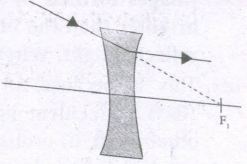
A ray of light incident on a concave lens becomes parallel to the principal axis after refraction. Show this situation with the help of a ray diagram.
2.
Define centre of curvature.
3.
A proton and a deuteron have the same velocity, what is the ratio of their de Broglie wavelengths?
4.
The stopping potential in an experiment on photoelectric effect is 2V. What is the maximum kinetic energy of the photoelectrons emitted?
5.
Define nano solid?
6.
Which modulation is more advantageous? AM or FM? Why?
7.
Write the advantages of PM?
8.
What is called output resistance?
9.
Define energy band
10.
Why neutrons in the nucleus are stable?
11.
What are the uses of spectrometer?
12.
What are the sign conventions followed for lenses?
13.
What is angle of deviation due to refraction?
14.
(i) In which situation is there a displacement current but no conduction current?
(ii) Find the displacement current across the plate of the capacitor whose charging current is 0.25 A.
15.
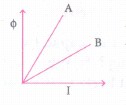
A graph of magnetic flux (Ф) versus current CI is shown for two inductors A & B, which has a larger value of self-inductance?
16.
Explain the use of transformers in long distance transmission of electric power.
17.
Define draft velocity and write its relationship with the current flowing through it.
18.
State Coulomb’s inverse law.
19.
What are step-up and step-down transformers?
20.
Define ‘capacitance’. Give its unit.
21.
What is an equipotential surface?
22.
What do you mean by internal resistance of a cell?
23.
Define temperature coefficient of resistance.
24.
State microscopic form of Ohm’s law.
25.
Write the Similarities between Coulomb's law and Biot-Savort's law.
1.
In the ray diagram, the incident ray is directed towards the first principal focus of the concave lens. After refraction, this ray becomes parallel to the principal axis.
2.
The centre of the sphere of which the mirror is a part is called the center of curvature (C) of the mirror.
3.
de Broglie wavelength \(\lambda =\frac { P }{ m } \propto \frac { 1 }{ m } \) for the same velocity v.
\(\frac { { \lambda }_{ p } }{ { \lambda }_{ d } } =\frac { { m }_{ d } }{ { m }_{ p } } =\frac { 2{ m }_{ p } }{ { m }_{ p } } =\frac { 2 }{ 1 } \) = 2.1
4.
Maximum kinetic energy, (Ek)max = eVs = e(2V) = 2eV
5.
The particle of solid is of size less than 100 nm, it is said to be a nano solid. Ex. ZnO.
6.
Frequency modulation. (FM) Because it is quite immune to noise as compared to AM.
7.
(i) FM signal produced from PM signal is very stable.
(ii) The centre frequency called resting equency is extremely stable
8.
The ratio of the change in the collector-emitter voltage (ΔVCE) to the corresponding change in the collector current (ΔIC) at constant base current (IB) is called output resistance (Ro).
9.
Band of very large number of closely spaced energy levels in a very small energy range is known as energy band.
10.
Neutrons are stable inside the nucleus. But outside the nucleus they are unstable. If the neutron comes out of the nucleus (free neutron), it decays with the emission of proton, electron, and antineutrino with a half-life of 13 minutes.
11.
(i) To study the spectra of different sources of light.
(ii) To measure the refractive indices of materials due to determinant of angle of prism (A) and angle of minimum deviation (D).
(iii) To find the refractive indices of liquids.
(iv) To find the wavelength of light using grating.
12.
Sign conventions for lens
(i) The sign of focal length is not decided on the direction of measurement of the focal length from the pole of the lens as they have two focal lengths, one to the left and another to the right.
(ii) The focal length of the thin lens is taken as positive for a converging lens and negative for a diverging lens.
(iii) The other sign conventions for object. distance, image distance, radius of curvature, object height and image height remain the same for thin lenses as that of spherical mirrors.
13.
The angle between the incident and deviated light is called Angle of deviation due to refraction. When light travels from
(i) rarer to denser medium, d = i - r
(ii) denser to rarer medium, d = r - i
14.
(i) During charging or discharging there is a displacement current, but no conduction current between the plates of the capacitor.
(ii) The displacement current is equal to conduction current Id = Ic, so Id = 0.25 A.
15.
Ф = LI
For same current ФA > ФB
So LA > LB
i.e conductor a has a larger value of self-induction
For a series LCR circuit power factor is
\(\frac { R }{ z } =\frac { R }{ \sqrt { { R }^{ 2 }+\left( \omega L-\frac { 1 }{ \omega c } \right) } } \)
The maximum value of power factor = 1
The minimum value of power factor = 0
16.
At the transmitting point, the voltage is increased and the corresponding current is decreased by using a step-up transformer. Then it is transmitted through transmission lines. This reduced current at high voltage reaches the destination without any appreciable loss. At the receiving point, the voltage is decreased and the current is increased to appropriate values by using a step-down transformer, and then it is given to consumers.
17.
The drift velocity is defined as the average velocity with which free electrons in a conductor get drifted under the influence of an external electricity applied across the conductor. The relation between drift velocity of free electrons the circuit flowing through the conductor is \(I=\eta Ae{ v }_{ d }e-\) charge of the electron n - no of free electrons in the conductor; A - area of cross-section.
18.
Coulomb's inverse square law states that the force of attraction or repulsion between two magnetic poles is directly proportional to the product of their pole strengths and inversely proportional to the square of the distance between them.
\(\vec { F } =k \frac { { q }_{ m_{A} }{ q }_{ m_{B} } }{ { r }^{ 2 } } \hat { r } \)
19.
(i) If Ns>Np(K>1),thenVs>Vp and Is
20.
The capacitance C of a capacitor is defined as the ratio of the magnitude of charge on either of the conductor plates to the potential difference existing between the conductors. \(C=\frac{Q}{V}\)
Its unit is Coulomb per volt or farad (F).
21.
An equipotential surface is a surface on which all the points are at the same electric potential.
22.
The internal resistance of a cell is the resistance offered to the flow of current (by the electrolyte) inside the cell.
23.
Temperature coefficient of resistance is defined as the ratio of increase in resistivity per degree rise in temperature to its resistivity at To.
\(\alpha=\frac{\rho_{T}-\rho_{0}}{\rho_{0}\left(T-T_{0}\right)}\)
24.
Microscopic form of ohm's law is
\(\vec{J}=\sigma\vec {E}\)
\(J=\frac{ne^2\tau}{m}\vec{E}\)
\(\frac{e \tau}{m} \rightarrow Drift \ velocity \ v_d\)
where \(\vec{J} \) - current density
\(\sigma \) - conductivity
\(\vec{E} \) - Electric field
25.
(i) Obey inverse square law, so they are long-range fields.
(ii) obey the principle of superposition and are linear with respect to source in magnitude,
E ∝ q
B ∝ Idl

12th Standard Syllabus & Materials
12th Standard
TN 12th Computer Applications களப்பெயர் முறைமை (DNS) Sample Question Papers Study Material - QB365 Set A
NEW12th Standard
TN 12th Computer Applications வலையமைப்பு எடுத்துக்காட்டுகள் மற்றும் நெறிமுறைகள் Sample Question Papers Study Material - QB365 Set A
NEW12th Standard
TN 12th Computer Applications கணினி வலையமைப்பு ஓர் அறிமுகம் Sample Question Papers Study Material - QB365 Set A
NEW12th Standard
TN 12th Computer Applications PHP-உடன் MySQL-ஐ இணைத்தல் Sample Question Papers Study Material - QB365 Set A



Tamilnadu Stateboard 12th Standard Subjects

Maths

Chemistry
Physics

Biology

Computer Science

Business Maths and Statistics

Economics

Commerce

Accountancy

History

Computer Applications
Biology
Computer Technology
Computer Applications
Computer Science
Business Maths and Statistics
Commerce
Economics
Maths
Chemistry
Physics
Computer Technology
History
Accountancy

Tamil

English

French
Tamilnadu Stateboard Standards

