
 100% FREE ACCESS
12th Standard Syllabus & Materials
12th Standard
TN 12th Computer Applications மின்னணு தரவு பரிமாற்றம் Sample Question Papers Study Material - QB365 Set A
NEW12th Standard
TN 12th Computer Applications மின் - வணிக பாதுகாப்பு அமைப்புகள் Sample Question Papers Study Material - QB365 Set A
NEW12th Standard
TN 12th Computer Applications மின்னணு செலுத்தல் முறைகள் Sample Question Papers Study Material - QB365 Set A
NEW12th Standard
TN 12th Computer Applications மின் - வணிகம் Sample Question Papers Study Material - QB365 Set A
NEW12th Standard
TN 12th Computer Applications திறந்த மூல கருத்துருக்கள் Sample Question Papers Study Material - QB365 Set A
NEW12th Standard
TN 12th Computer Applications வலையமைப்பு வடமிடல் Sample Question Papers Study Material - QB365 Set A

Published on: 12/11/2019
Download Tamil Nadu 12th Standard Physics question papers, model tests, one-mark questions, important questions, and public exam papers in PDF format. Free study materials and answer keys for TN State Board students.
Questions + Answers key
Take MCQ Physics Test1.
Calculate the de Broglie wavelength of a proton whose kinetic energy is equal to 81.9 x 10⁻¹⁵ J. (Given: mass of proton is 1836 times that of electron).
2.
Write the properties of neutrino?
3.
A variable frequency ac source is connected to capacitor. How will the displacement current change with decrease in frequency.
4.
In a certain region of space, electric field \(\vec { E } \) and magnetic field \(\vec { B } \) are perpendicular to each other. An electron enters the region perpendicular to the direction of both \(\vec { B } \) & \(\vec { E } \) and moves undeflected. Find the velocity of the electron.
5.
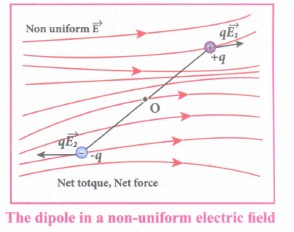
What happens when and electric dipole is held in a non-uniform electric field?
6.
A magnetron in a microwave oven emits electromagnetic waves (em waves) with frequency f = 2450 MHz. What magnetic field strength is required for electrons to move in circular paths with this frequency?
7.
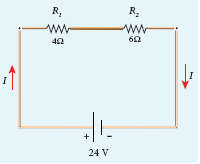
Calculate the equivalent resistance for the circuit which is connected to 24 V battery and also find the potential difference across each resistors in the circuit.
8.
What are thermal neutrons? Why are neutrons considered as ideal particles for nuclear fission?
9.
10.
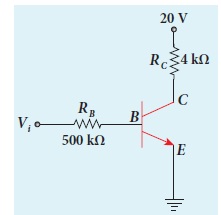
In the circuit shown in the figure, the input voltage Vi is 20 V, VBE = 0 V, and VCE = 0 V. What are the values of IB, IC, β?
11.
What does RADAR stand for?
12.
What are the important points of wave theory of light?
13.
A bar magnet is moved in the direction indicted by the arrow between two coils PQ and CD predict the directions of induced current in each coil.
14.
What is the electric flux through a cube of side 1 cm which encloses on electric dipole?
15.
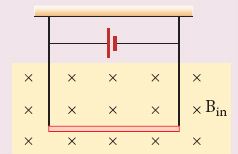
A conductor of linear mass density 0.2 g m–1 suspended by two flexible wire as shown in figure. Suppose the tension in the supporting wires is zero when it is kept inside the magnetic field of 1 T whose direction is into the page. Compute the current inside the conductor and also the direction of the current. Assume g = 10 m s–2
16.
Define magnetic flux.
17.
What are electromagnetic waves?
18.
For the given capacitor configuration
(a) Find the charges on each capacitor
(b) potential difference across them
(c) energy stored in each capacitor
19.
Write down Coulomb’s law in vector form and mention what each term represents.
20.
If the resistance of coil is 3 Ω at 20oC and α = 0.004/oC then determine its resistance at 100oC.
21.
Which one of the following is the natural nanomaterial.
Peacock feather
Peacock beak
Grain of sand
Skin of the Whale
22.
If a small amount of antimony (Sb) is added to germanium crystal,______.
it becomes a p-type semiconductor
the antimony becomes an acceptor atom
there will be more free electrons than hole in the semiconductor
its resistance is increased
23.
The ratio between the radius of first three orbits of hydrogen atom is _____.
1:2:3
2:4:6
1:4:9
1:3:5
24.
The work functions for metals A, B and C are 1.92 eV, 2.0 eV and 5.0 eV respectively. The metal/metals which will emit photoelectrons for a radiation of wavelength 4100 Å is/are _____.
A only
both A and B
all these metals
none
25.
Two point white dots are 1 mm apart on a black paper. They are viewed by eye of pupil diameter 3 mm approximately. The maximum distance at which these dots can be resolved by the eye is_____. [take wavelength of light, λ = 500 nm]
1 m
5 m
3 m
6 m
26.
The wavelength range of microwave is _______m
10-8 to 0.35
10-3 to 0.3
10-8 to 10-6
10-3 to 10-1
27.
In LCR circuit when KL = Xc (at resonance) the current _________________
is zero
is in phase with the voltage
leads the voltage
lags behind the voltage
28.
In electric power transmission, the wastage of power is ___________.
more at high voltages
independent of voltage
more at low voltage
low at low voltages
29.
The reciprocal of the resistance is__________
conductance
conductivity
resistivity
specific resistance
30.
A resistance of a metal wire of length AB is 2\(\Omega \). Another wire of length PQ of the same metal with twice the diameter of the wire AB is found to have the same resistance of 2\(\Omega \). What is the length of PQ?
4 AB
2 AB
1AB
6 AB
31.
Three wires of equal lengths are bent in the form of loops. One of the loops is circle, another is a semi-circle and the third one is a square. They are placed in a uniform magnetic field and same electric current is passed through them. Which of the following loop configuration will experience greater torque?
Circle
Semi-circle
Square
All of them
32.
A circular coil of radius 5 cm and 50 turns carries a current of 3 ampere. The magnetic dipole moment of the coil is nearly ____.
1.0 A m2
1.2 A m2
0.5 A m2
0.8 A m2
33.
A radiation of energy E falls normally on a perfectly reflecting surface. Th e momentum transferred to the surface __________________.
\(\frac{E}{c}\)
2\(\frac{E}{c}\)
Ec
\(\frac { E }{ { c }^{ 2 } } \)
34.
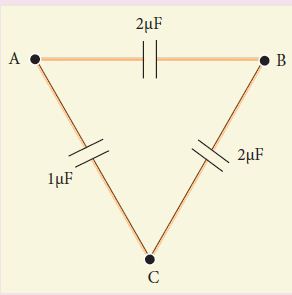
Three capacitors are connected in triangle as shown in the figure. The equivalent capacitance between the points A and C is
1μF
2μF
3μF
\(\frac{1}{4}\)μF
35.
Two points A and B are maintained at a potential of 7 V and -4 V respectively. The work done in moving 50 electrons from A to B is _______.
8.80 x 10⁻¹⁷ J
-8.80 x 10⁻¹⁷ J
4.40 x 10⁻¹⁷ J
5.80 x 10⁻¹⁷ J
36.
The half-life of \(_{ 38 }^{ 90 }{ Sr }\) is 28 years. What is the disintegration rate of 15 mg of this isotope?
37.
Explain experimentally observed facts of photoelectric effect with the help of Einstein’s explanation.
38.
Give circuit symbol, logical operation, truth table, and Boolean expression of
i) AND gate
ii) OR gate
iii) NOT gate
iv) NAND gate
v) NOR gate and
vi) EX-OR gate.
39.
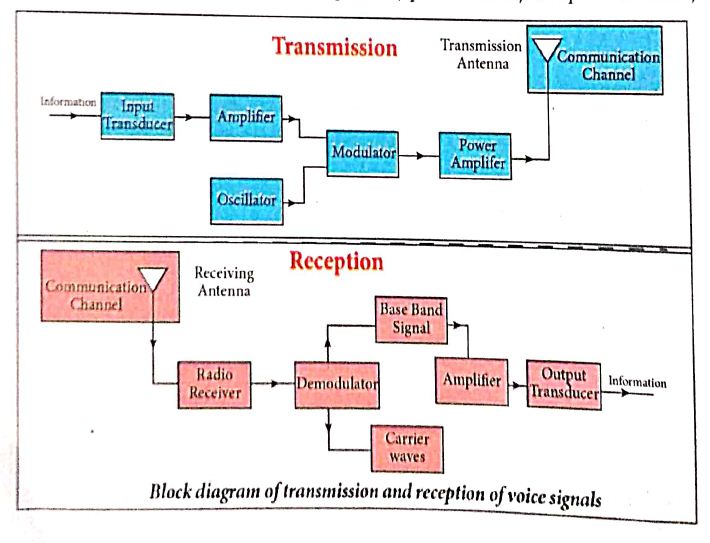
Explain the basic elements of communication system with the necessary block diagram.
40.
The magnetic field amplitude of an Electromagnetic wave is 1.6 x 10⁻⁷ T. If the frequency is 30 MHz. determine electric field, any velocity K and λ.
41.
The instantaneous voltage from an ac source is given by V = 300 sin 314t. What is the rms voltage of the sauce? Find its peak voltage and frequency of the sauce?
42.
Estimate the average different speed of conduction electrons in a copper wire of crosssectional area 1.0 x 10⁻⁷ m2 carrying a current of 1.5 A. Assume the density of conduction electrons to be 9 x 1028 m-3.
43.
Calculate the magnetic field at a point on the axial line of a bar magnet.
1.
\(\text { K.E }=81.9 \times 10^{-15} \mathrm{~J} \)
\(\lambda =\frac{\mathrm{h}}{\sqrt{2 \mathrm{mk}}}=\frac{6.626 \times 10^{-34}}{\sqrt{2 \times 9.1 \times 10^{-3} \times 1836 \times 81.9 \times 10^{-15}}} \)
\(\lambda =\mathbf{4 . 0 0} \times 10^{-14} \mathrm{~m} \)
2.
The neutrino has the following properties
(i) It has zero charge
(ii) It has an antiparticle called anti-neutrino.
(iii) Recent experiments showed that the neutrino has very tiny mass
(iv) It interacts very weakly with the matter. Therefore, it is very difficult to detect In fact, in every second, trillions of neutrinos coming from the sun are passing through our body without any interaction.
3.
On decreasing the frequency, reactance \({ X }_{ c }=\frac { 1 }{ \omega C } \) will increase which will lead to decrease in condition current. In this case Id = Ic hence displacement current will decrease.
4.
Net force an electron moving in the combined electric field \(\vec { E } \) and a magnetic field \(\vec { B } \) is
\(\vec { F } =-e[\vec { E } +\vec { v } \times \vec { B } ]\)
Since electron moves undeflected then \(\vec { F } \) = 0
\(\vec { E } +(\vec { v } \times \vec { B } )\) = 0
\(|\vec { E } |=(|\vec { v } |\times |\vec { B } |)\Rightarrow |\vec { v } |=\frac { |\vec { E } | }{ |\vec { B } | } \).
5.
If the electric field is not uniform, then the force experienced by +q is different from that experienced by -q. In addition to the torque, there will be net force acting on the dipole.
6.
Frequency of the electromagnetic waves given, f = 2450 MHz
The corresponding angular frequency is
ω = 2πf = 2 x 3.14 x 2450 x 106
= 15,386 x 106 Hz
= 1.54 x 10¹⁰ s-1
The required magnetic field, B = \(\frac { { m }_{ e }\omega }{ |q| } \)
Mass of the electron, me = 9.11 x 10⁻³¹ kg
Charge of the electron,
q = -1.60 x 10⁻¹⁹C
⇒ |q| = 1.60 x 10⁻¹⁹ C
B = \(\frac { (9.11\times { 10 }^{ -31 })(1.54\times 10^{ 10 }) }{ (1.60\times 10^{ -19 }) } \) = 8.7683 x 10⁻²T
B = 0.08768 T
This magnetic field can be easily produced with a permanent magnet. So, electromagnetic waves of frequency 2450 MHz can be used for heating and cooking food because they are strongly absorbed by water molecules.
7.
Since the resistors are connected in series, the effective resistance in the circuit
= 4 Ω + 6 Ω = 10 Ω
The Current I in the circuit =\(\frac { V }{ { R }_{ eq } } =\frac { 24 }{ 10 } =2.4A\)
Voltage across 4Ω resistor
V1= IR1 = 2.4A x 4Ω = 9.6V
Voltage across 6 Ω resistor
V2 = IR2 = 2.4A x 6Ω = 14.4V
8.
Thermal neutrons are low-energy neutrons having an approximate energy of 0.025 eV. Neutrons are consider as ideal particles for nuclear fission because they are uncharged.
9.
10.
\({ I }_{ B }=\frac { { V }_{ i } }{ { R }_{ B } } =\frac { 20V }{ 500k\Omega } =40\mu A\) [∵ VBE = 0V]
\({ I }_{ C }=\frac { { V }_{ CC } }{ { R }_{ C } } =\frac { 20V }{ 4k\Omega } =5mA\) [∵ VCE = 0V]
\(\beta =\frac { { I }_{ C } }{ { I }_{ B } } =\frac { 5mA }{ 40\mu A } =125\)
11.
RADAR stands for RAdio Detection And Ranging.
12.
Wave theory of light:
(i) According to Huygen's wave theory, light is propagated in the form of longitudinal waves through an invisible elastic medium called ether, which pervades all space.
(ii) Later Fresnel and Young suggested that light waves are transverse. Wave theory could satisfactorily explain reflection, refraction, interference diffraction and polarisation.
(iii) According to this theory, the velocity of light in a denser medium is lesser than that in a rarer medium.
13.
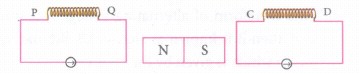
The current in the coil will flow clockwise the direction of current will be from P to Q in coil PQ and from C to D in coil CD.
14.
Net electric flux is zero because
(i) It is independent to the shape and size
(ii) Net charge of the electric dipole is zero.
15.
Linear mass density of the conductor is = 0.2 g/m
Mass per unit length \(\frac{M}{l}=0.2 \times 10^{-3} \mathrm{~kg} / \mathrm{m}\)
Magnetic field B = 1T.
Acceleration due to gravity, g = 10 ms-2
Force \(=\frac{m}{l} \times g\)
= 0.2 x 10-3 x 10 = 0.2 x 10⁻²
F = 2 x 10⁻³ N ....(1)
If the coil is placed in the magnetic field then the force acting on the coil is
F= BIl ....(2)
From the equation (1) and (2) we get
BIl = 2 x 10⁻³
∴ 1 x L x I = 2 x 10⁻³
∴ I = 2 x 10⁻³ A [∴ l = 1m]
∴ I = 2mA
16.
Magnetic flux is defined as the number of magnetic field lines crossing per unit area kept normal to the direction of lines of force.
17.
An electromagnetic waves are the waves that are radiated by an accelerated charge which propagates through space as coupled electric and magnetic fields, oscillating perpendicular to each other and to the direction of propagation of the wave.
18.
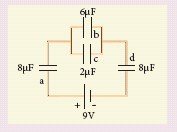
Cp = Cb + Cc
\(C_{P}=6+2=8 \mu \mathrm{F} \)
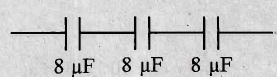
\(\frac{1}{C_{s}}=\frac{1}{C_a}+\frac{1}{C_p}=\frac{1}{C_d} \)
\(C_{s}=\frac{1}{8}+\frac{1}{8}+\frac{1}{8}=\frac{3}{8} \)
\(\therefore C_{s}=\frac{8}{3} \mu \mathrm{F} \)
Total capacitance \(C_{s}=\frac{8}{3} \times 10^{-6} \mathrm{~F} \)
Total Charge, \(Q=C_{s} V=\frac{8}{3} \times 10^{-6} \times 9 \)
\(Q_{a}=24 \mu C\)
(a) Charge on capacity \(Q_{a}=24 \mu C\) .....(1)
Charge on capacitor \(Q_{b}=24 \times \frac{6}{8}=18 \mu \mathrm{C} \) ..............(2)
Charge on capacitor \(Q_{c}=24 \times \frac{2}{8}=6 \mu \mathrm{C} \) ..............(3)
Charge on capacitor \(Q_{d}=24 \times \frac{8}{8}=24 \mu \mathrm{C} \) ..............(4)
(b) Potential difference across \(C_{a} \ is\ V_{a}=\frac{Q_{a}}{C_{a}} \)
\(=\frac{24}{8}=3 \mathrm{~V} \) ...(5)
Potential difference across \(C_{b}\ is \ V_{b}=\frac{Q_{b}}{C_{b}} \)
\(=\frac{18}{6}=3 \mathbf{V}\) ........(6)
Potential difference across \(C_{c}\ is \ V_{c}=\frac{Q_{c}}{C_{c}}=\frac{6}{2}=3 \mathrm{~V} \) ......(7)
Potential difference across \(C_{d}\ is \ V_{d}=\frac{Q_{d}}{C_{d}} \)
\(=\frac{24}{8}=3 \mathbf{V} \) ....(8)
(c) Energy stored in each capacitor \(U=\frac{1}{2} C V^{2}\)
Energy stored in \(\mathrm{C}_{\mathrm{a}} \text { is } U_{a}=\frac{1}{2} C_{a} V_{a}^{2}\)
\(U_{\mathrm{a}}=\frac{1}{2} \times 8 \times 10^{-6} \times 3 \times 3=36 \mu \mathrm{J}\) ....(9)
Energy stored in \(C_{b}\ is \ U_{b}=\frac{1}{2} C_{b} V_{b}^{2} \)
\(U=\frac{1}{2} \times 6 \times 10^{-6} \times 3 \times 3 \)
\(=27 \mu \mathrm{J} \) ........(10)
Energy stored in Ce is \(U_{c} =\frac{1}{2} C_{c} V_{c}^{2} \)
\(=\frac{1}{2} \times 2 \times 10^{-6} \times 3 \times 3=9 \mu \mathrm{J} \) ......(11)
Energy stored in Cd is \(U_{d} =\frac{1}{2} C_{d} V_{d}^{2} \)
\(U_d=\frac{1}{2} \times 8 \times 10^{-6} \times 3 \times 3 \)
\(=36 \times 10^{-6} \mathrm{~J}=36 \mu \mathrm{J} \) .........(12)
19.
Coulomb's law \(\overrightarrow{F_{21}}=\frac{k q_{1} q_{2}}{r^{2}} \hat{r}_{12}\)
where, q1 - charge; q2 - charge
r - distance between the charges
\(\hat{r}_{12}\)- the unit vector directed from charge q1 to charge q2
k = Proportionality constant
20.
R0 = 3 Ω, T = 100oC, T0 = 20oC
α = 0.004/oC, RT = ?
RT = R0(1 + α(T - T0))
R100 = 3(1 + 0.004 x 80)
R100 = 3.96 Ω
21.
Wings of a morpho butterfly, peacock feathers, lotus leaf surface and sources of parrot fish's bite are some of the natural nano particles.
22.
(c)
there will be more free electrons than hole in the semiconductor
23.
rn ∞ n2
r1: r2: r3 = 1: 4: 9
24.
\(E=\frac{12400 \stackrel{o}A}{4100 \stackrel{o}A}=3.02 eV\)
25.
λ = 500 nm = 500 x 10-9 m
x = 3 mm = 3 x 10⁻³ m
a = 1 mm = 1 x 10⁻³ m
\(d=\frac{xa}{1.22 \lambda}\)
\(d=\frac{3 \times1\times10^{-6}}{1.22 \times500\times10^{-9}}\)
\(=\frac{3 \times1\times10^{-6}}{6.10 \times 10^{-7}}\)
\(d=\frac{30}{6.1}=5 m\)
26.
(b)
10-3 to 0.3
27.
(b)
is in phase with the voltage
28.
(c)
more at low voltage
29.
(a)
conductance
30.
(a)
4 AB
31.
(a)
Circle
32.
Dipole moment, \(\vec{p}_m=n\times I\times\vec{A}\)
\(\vec{p}_m\) = 50 x 3 x 3.14 x 25 x 10-4 ≈ 1.2 A m2
33.
(b)
2\(\frac{E}{c}\)
34.
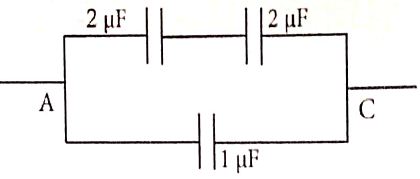
\(\frac{1}{C_s}=\frac{1}{2}+\frac{1}{2}=1 \ μF\)
Cp = 1 + 1 = 2 μF
35.
W = qV
V = 7 - (-4) = 11 V
q = ne = 50 x 1.6 x 10-19 = 8 x 10-18C
W = 8 x 10-18 x 11 = 88 x 10-18 = 8.8 x 10⁻¹⁷]
36.
\(N=\frac { 6.023\times { 10 }^{ 23 } }{ 90 } \times 15\times { 10 }^{ -3 }\)
\(\frac { dN }{ dt } =\lambda N=\frac { 0.693 }{ { T }_{ 1/2 } } N\)
= \(\frac { 0.693 }{ 28\times 365\times 24\times 60\times 60 } \times \frac { 6.023{ 10 }^{ 23 } }{ 90 } \times 15\times { 10 }^{ -3 }Bq\)
= 7.878 x 10¹⁰ Bq.
37.
Explanation for the photoelectric effect:
The experimentally observed facts of photoelectric effect can be explained with the help of Einstein's photoelectric equation.
(i) As each incident photon liberates one electron, then the increase of intensity of the light (the number of photons per unit area per unit time) increases the number of electrons emitted thereby increasing the photocurrent. The same has been experimentally observed.
(ii) From Kmax = hv - Φ0, it is evident that Kmax is proportional to the frequency of the light and is independent of intensity of the light.
(iii) As given in equation \({ hv }_{ o }+\cfrac { 1 }{ 2 } { mv }^{ 2 }\) , there must be minimum energy (equal to the work function of the metal) for incident photons to liberate electrons from the metal surface. Below which, emission of electrons is not possible. Correspondingly, there exists minimum frequency called threshold frequency below which there is no photoelectric emission.
(iv) According to quantum concept, the transfer of photon energy to the electrons is instantaneous so that there is no time lag between incidence of photons and ejection of electrons.
Thus, the photoelectric effect is explained on the basis of quantum concept of light.
38.
i) AND gate
a) Circuit Symbol:
The circuit symbol of a two input AND gate is shown in Figure (a). A and B are inputs and Y is the output. It is a logic gate and hence A, B, and Y can have the value of either 1 or 0
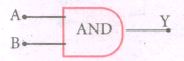
Two input AND gate
| Inputs | outputs | |
| A | B | Y = A + B |
| 0 | 0 | 0 |
| 0 | 1 | 0 |
| 1 | 0 | 0 |
| 1 | 1 | 1 |
Truth table
b) Boolean equation:
Y = A.B
It performs logical multiplication and is different from arithmetic multiplication.
c) Logic operation:
The output of AND gate is high only when all the inputs are high. In the rest of the cases, the output is low. It is represented in the truth table (Figure (b).
ii) OR gate
a) Circuit Symbol:
The circuit symbol of a two input OR gate is shown in Figure (a). A and B are inputs and Y is the output.
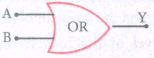
The input OR gate
| Inputs | outputs | |
| A | B | Y = A + B |
| 0 | 0 | 0 |
| 0 | 1 | 1 |
| 1 | 0 | 1 |
| 1 | 1 | 1 |
Truth table
a) Boolean equation:
A + B = Y
It performs logical addition and is different from arithmetic addition.
b) Logic operation:
The output of OR gate is high (logic 1 state) when either of the inputs or both are high. The truth table of OR gate is shown in Figure (a).
iii) NOT gate
a) Circuit Symbol:
The circuit symbol of NOT gate is shown in Figure (a). A and B are inputs and Y is the output.
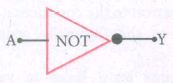
NOT gate
| Inputs | Output |
| A | Y = Ā |
| 0 | 1 |
| 1 | 0 |
Truth table
a) Boolean equation:
Y = Ā
b) Logic operation:
The output is the complement of the input. It is represented with an overbar. It is also called as inverter. The truth table infers that the output Y is I when input A is 0 and vice versa. The truth table of NOT is shown in Figure (b).
iv) NAND gate
a) Circuit Symbol:
The circuit symbol of NAND gate is shown in Figure (a). A and B are inputs and Y is the output.

Two input NAND gate
| Inputs | Output (AND) |
outputs (NAND) |
|
| A | B | Z = A.B | Y = \(\overline { A.B } \) |
| 0 | 0 | 0 | 1 |
| 0 | 1 | 0 | 1 |
| 1 | 0 | 0 | 1 |
| 1 | 1 | 1 | 0 |
Truth table
b) Boolean equation:
Y = \(\overline { A.B } \)
Logic operation:
The output Y equals, the complement of AND operation. The circuit is an AND gate followed by a NOT gate. Therefore, it is summarized as NAND. The output is at logic zero only when all the inputs are high. The rest of the cases, the output is high (Logic I state). The truth table of NAND gate is shown in Figure (b).
v) NOR gate
a) Circuit Symbol:
The circuit symbol of NOR gate is shown in Figure (a). A and B are inputs and Y is the output.

Two input NANS gate
| Inputs | Output (OR) |
outputs (NOR) |
|
| A | B | Z = A + B | Y = \(\overline { A+B } \) |
| 0 | 0 | 0 | 1 |
| 0 | 1 | 1 | 0 |
| 1 | 0 | 1 | 0 |
| 1 | 1 | 1 | 0 |
Truth table
Boolean equation:
Y = \(\overline { A+B } \)
Logic operation:
The output Y equals the complement of OR operation (A OR B). The circuit is an OR gate followed by a NOT gate and is summarized as NOR. The output is high when all the inputs are low. The output is low for all other combinations of inputs. The truth table of NOR gate is shown in Figure (b).
vi) Ex-OR gate
a) Circuit Symbol:
The circuit symbol of Ex-OR gate is shown in Figure (a). A and B are inputs and Y is the output. The Ex-OR operation is denoted as ⊕
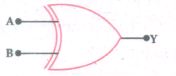
Ex-OR gate
| Inputs | outputs (Ex-OR) |
|
| A | B | Y = A ⊕ B |
| 0 | 0 | 0 |
| 0 | 1 | 1 |
| 1 | 0 | 1 |
| 1 | 1 | 0 |
Truth table
b) Boolean equation
Y = \(A.\overline { B } \) + \(\overline { A }.B \)
Y = A ⊕ B
Logic operation:
The output is high only when either of the two inputs is high. In the case of an Ex-OR gate with more than two inputs, the output will be high when odd number of inputs are high. The truth table of Ex-OR gate is shown in Figure (b).
39.
a) Information (Baseband or input signal):
i) Information can be in the form of a sound signal like speech, music, pictures, or computer data which is given as input to the input transducer.
b) Input transducer:
i) It converts the information which is in the form of sound, music, pictures or computer data into corresponding electrical signals.
ii) The electrical equivalent of the original information is called the baseband signal.
iii) The best example is the microphone that converts sound energy into electrical energy.
c) Transmitter
i) It feeds the electrical signal from the transducer to the communication channel
ii) It consists of circuits such as amplifier, oscillator, modulator, and power amplifier.
iii) Amplifier: The transducer output is very weak and is amplified by the amplifier.
iv) Oscillator: It generates high-frequency carrier wave (a sinusoidal wave) for long distance transmission into space. As the energy of a wave is proportional to its frequency, the carrier wave has very high energy.
v) Modulator: It superimposes the baseband signal onto the carrier signal and generates the modulated signal.
vi) Power amplifier: It increases the power level of the electrical signal in order to cover a large distance.
d) Transmitting antenna:
i) It radiates the radio signal into space in all directions.
ii) It travels in the form of electromagnetic waves with the speed of light.
e) Communication channel:
Communication channel is used to carry the electrical signal from transmitter to receiver with less noise or distortion.
Example: Wires, cables, optical fibres in wireline communication and free space in wireless communication.
f) Receiver:
i) The signals that are transmitted through the communication medium are received with the help of a receiving antenna and are fed into the receiver.
ii) The receiver consists of electronic circuits like demodulator, amplifier, detector etc. The demodulator extracts the baseband signal from the carrier signal.
iii) Then the baseband signal is detected and amplified using amplifiers.
iv) Finally, it is fed to the output transducer.
g) Repeaters:
i) Repeaters are used to increase the range or distance through which the signals are sent.
ii) It is a combination of transmitter and receiver.
iii) The signals are received, amplified, and retransmitted with a carrier signal of different frequency to the destination.
iv) The best example is the communication satellite in space
h) Output transducer:
i) It converts the electrical signal back to its original form such as sound, music, pictures or data.
ii) Examples of output transducers are loudspeakers, picture tubes, computer monitor, etc
40.
Given: The amplitude of magnetic field of an Electromagnetic wave B = 1.6 x 10⁻⁷ T
To find:
The amplitude of electric field of an Electromagnetic wave E = ?
frequency ૪ = 30 Mhz = 30 x 106 Hz.
To find: Angle velocity ω =?
Wavelength of Electromagnetic wave λ = ?
(i) Ampere of electric field E = ?
\(\frac { E }{ B } =C\Rightarrow E=C.B\Rightarrow 3\times { 10 }^{ 8 }\times 1.6\times { 10 }^{ -7 }\)
E = 48Vm-1.
(ii) Angle velocity, ω = 2π૪
ω = 2 x 3.14 x 30 x 106
ω = 1.885 x 10⁸ rad /s.
(iii) Wavelength of Electromagnetic wave, λ = \(\frac{C}{\gamma}\)
\(\gamma=\frac{3\times 10^8}{30\times 10^6}\) = 10m
λ = 10m
41.
Given: The maximum value of voltage Vm = 300V
Angle frequency of ac voltage w = 21t ⋎ = 314
RMS value of the source Vrms = ?
V = 300 sin 314t.
To find:
Peak voltage Vm= 300V, frequency ⋎ =?
Solution:
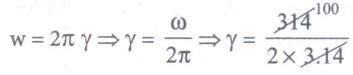
⋎ = 50 Hz.
RMS voltage, Vrm = \(\frac { { V }_{ m } }{ \sqrt { 2 } } \)
= 0.707 X 300 = 212.1 V
Vrms = 212.1 V.
42.
Cross sectional Area, A = 1.0 x 1028 m-3
Current, I = 1.5 A
Electron density, n = 9 x 1028 m-3
To find:
Driff velocity, vd = ?
We know that 1 = n Aevd
\({ v }_{ d }=\cfrac { 1 }{ nAe } \)
\({ v }_{ d }=\cfrac { 1 }{ nAe } \)
Vd = 1.042 x 10⁻³ m/s.
43.
(i) Consider a bar magnet NS whose pole strength is qm and length is 2l.
(ii) Let C be the point along axis of maget.
(iii) The magnetic field at a point C (lies along the axis of the magnet) at a distance r from the geometrical center O of the bar magnet can be computed by keeping unit north pole (qmc = 1 A m) at C.
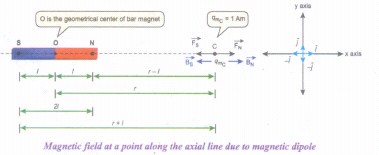
The magnetie field at C due to the north pole is,
\(\vec { { B }_{ N } } =\frac { { \mu }_{ 0 } }{ 4\pi } \frac { { q }_{ m } }{ (r-l)^{ 2 } } \hat { i } \)
where (r - I) is the distance between north pole of the bar magnet and unit north pole at C. The magnetic field at C due to the south pole is,
\(\vec { { B }_{ S } } =-\frac { { \mu }_{ 0 } }{ 4\pi } \frac { { q }_{ m } }{ (r+l)^{ 2 } } \hat { i } \)
where (r + I) is the distance between south pole of the bar magnet and unit north pole at C. The net magnetic field due to magnetic dipole at a point C
\(\vec { B } =\vec { { B }_{ N } } +\vec { B_{ S } } \)
\(\vec { B } =\frac { { \mu }_{ 0 } }{ 4\pi } \frac { { q }_{ m } }{ (r-l)^{ 2 } } \hat { i } +\left(- \frac { { \mu }_{ 0 } }{ 4\pi } \frac { { q }_{ m } }{ (r+l)^{ 2 } } \hat { i } \right) \)
\(\vec { B } =\frac { { \mu }_{ 0 }{ q }_{ m } }{ 4\pi } \left( \frac { 1 }{ (r-l)^{ 2 } } -\frac { 1 }{ (r+l)^{ 2 } } \right) \hat { i } \)
\(\vec { B } =\frac { { \mu }_{ 0 }2r }{ 4\pi } \left( \frac { { q }_{ m }.(2l) }{ ({ r }^{ 2 }-{ l }^{ 2 })^{ 2 } } \right) \hat { i } \)
Since, magnitude of magnetic dipole moment is \(|\vec { { p }_{ m } } |\) = pm = qm. 2l the magnetic field at a point C can be written as,
\(\vec { { B }_{ axial } } =\frac { { \mu }_{ 0 } }{ 4\pi } \left( \frac { 2rp_{ m } }{ { (r^2-l^2)}^{ 2 } } \right) \hat { i } \)
If r >> I then, (r2 - l2)2 ≈ r4
\( { { \vec B }_{ axial } } =\frac { { \mu }_{ 0 } 2r}{ 4\pi } \left( \frac { p_{ m } }{ { r }^{ 4 } } \right) \hat { i } =\frac { { \mu }_{ 0 } }{ 4\pi }[ \frac { 2 \vec p_{ m } }{ { r }^{ 3 }}] \)
∵ \(\vec { { p }_{ m } } =p_{ m }\hat { i } \).

12th Standard Syllabus & Materials
12th Standard
TN 12th Computer Applications களப்பெயர் முறைமை (DNS) Sample Question Papers Study Material - QB365 Set A
NEW12th Standard
TN 12th Computer Applications வலையமைப்பு எடுத்துக்காட்டுகள் மற்றும் நெறிமுறைகள் Sample Question Papers Study Material - QB365 Set A
NEW12th Standard
TN 12th Computer Applications கணினி வலையமைப்பு ஓர் அறிமுகம் Sample Question Papers Study Material - QB365 Set A
NEW12th Standard
TN 12th Computer Applications PHP-உடன் MySQL-ஐ இணைத்தல் Sample Question Papers Study Material - QB365 Set A



Tamilnadu Stateboard 12th Standard Subjects

Maths

Chemistry
Physics

Biology

Computer Science

Business Maths and Statistics

Economics

Commerce

Accountancy

History

Computer Applications
Biology
Computer Technology
Computer Applications
Computer Science
Business Maths and Statistics
Commerce
Economics
Maths
Chemistry
Physics
Computer Technology
History
Accountancy

Tamil

English

French
Tamilnadu Stateboard Standards

