
 100% FREE ACCESS
12th Standard Syllabus & Materials
12th Standard
TN 12th Computer Applications மின்னணு தரவு பரிமாற்றம் Sample Question Papers Study Material - QB365 Set A
NEW12th Standard
TN 12th Computer Applications மின் - வணிக பாதுகாப்பு அமைப்புகள் Sample Question Papers Study Material - QB365 Set A
NEW12th Standard
TN 12th Computer Applications மின்னணு செலுத்தல் முறைகள் Sample Question Papers Study Material - QB365 Set A
NEW12th Standard
TN 12th Computer Applications மின் - வணிகம் Sample Question Papers Study Material - QB365 Set A
NEW12th Standard
TN 12th Computer Applications திறந்த மூல கருத்துருக்கள் Sample Question Papers Study Material - QB365 Set A
NEW12th Standard
TN 12th Computer Applications வலையமைப்பு வடமிடல் Sample Question Papers Study Material - QB365 Set A

Published on: 27/11/2019
Magnetism and Magnetic Effects of Electric
Download Tamil Nadu 12th Standard Physics question papers, model tests, one-mark questions, important questions, and public exam papers in PDF format. Free study materials and answer keys for TN State Board students.
Questions + Answers key
Take MCQ Physics Test1.
What is magnetic field?
2.
What is meant by the horizontal component of Earth's magnetic field?
3.
Compare dia, para and ferro-magnetism.
4.
What is magnetic susceptibility?
5.
Define magnetic flux.
6.
A particle of charge q moves with velocity\(\vec { v } \) along positive y-direction in a magnetic field \(\vec { B } \) .Compute the Lorentz force experienced by the particle
(a) when magnetic field is along positive y - direction
(b) when magnetic field points in positive z - direction
(c) when magnetic field is in zy - plane and making an angle θ with velocity of the particle. Mark the direction of magnetic force in each case
7.
What is the magnetic field at the centre of the loop shown in figure?
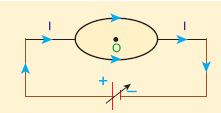
8.
Using the relation \(\overset { \rightarrow }{ B } =\mu _{ ° }(\overset { \rightarrow }{ H+ } \overset { \rightarrow }{ M } )\) show that \({ x }_{ m }={ \mu }_{ r }-{ 1 }\)
9.
Calculate the magnetic flux coming out from closed surface containing magnetic dipole (say, a bar magnet) as shown in figure.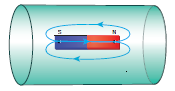
10.
If a current I is flowing in a straight wire parallel to the x-axis and magnetic field is in the y-axis then the wire experiences in _________________.
in Z-direction
in Y- direction
no force
in X- diection
11.
The direction of the magnetic force on a positive charge moving in a magnetic field is given by ________________.
thumb rule
left hand rule
right hand rule
cork screw rule
12.
A wire of length l carrying a current I along the Y direction is kept in a magnetic field is given by \(\vec { B } =\frac { \beta }{ \sqrt { 3 } } =(\hat { i } +\hat { j } +\hat { k } )T.\) The magnitude of Lorentz force acting on the wire is _____.
\(\sqrt { \frac { 2 }{ { 3 } } } \beta Il\)
\(\sqrt { \frac { 1 }{ { 3 } } } \beta Il\)
\(\sqrt { 2 } \beta Il\)
\(\sqrt { \frac { 1 }{ 2 } } \beta Il\)
13.
A thin insulated wire forms a plane spiral of N = 100 tight turns carrying a current I = 8 m A (milli ampere). The radii of inside and outside turns are a = 50 mm and b = 100 mm respectively. The magnetic induction at the centre of the spiral is ______.
\(5\mu T\)
\(7\mu T\)
\(8\mu T\)
\(10\mu T\)
14.
A particle having mass m and charge q accelerated through a potential difference V. Find the force experienced when it is kept under perpendicular magnetic field \(\vec { B } \).
\(\sqrt { \frac { 2{ q }^{ 3 }BV }{ m } } \)
\(\sqrt { \frac { { q }^{ 3 }{ B }^{ 2 }V }{ 2m } } \)
\(\sqrt { \frac { 2{ q }^{ 3 }{ B }^{ 2 }V }{ m } } \)
\(\sqrt { \frac { { 2q }^{ 3 }BV }{ { m }^{ 3 } } } \)
15.
A rectangular current carrying loop placed 2 cm away from a long, street, current - carrying conductors. What is the direction and magnitude of the net force acting on the loop.
16.
A given galvanometer is to be converted into
(i) an ammeter
(ii) a voltmeter.
In which case will the required resistance be
(i) least
(ii) highest and why?
17.
In a certain region of space, electric field \(\vec { E } \) and magnetic field \(\vec { B } \) are perpendicular to each other. An electron enters the region perpendicular to the direction of both \(\vec { B } \) & \(\vec { E } \) and moves undeflected. Find the velocity of the electron.
18.
Two long and parallel street wires carrying current of 2A and 5A in the opposite direction are separated by a distance of 1 cm, Find the nature and magnitude of the magnetic force between them.
19.
Deduce the expression for the torque \(\vec { \tau } \) when \(\hat { n } \) unit vector n is at an angle 8 with the field.
1.
Magnetic field is the region or space around every magnet within which its influence will be felt by keeping another magnet in that region.
\(\vec { B } =\frac{1}{q_m}\vec{E}\)
Its unit is N A-1m-1
2.
The component of Earth's magnetic field along the horizontal direction in the magnetic meridian is called horizontal component of Earth's magnetic field, denoted by BH.
3.
| sno | Dia magnetic materials | Para magnetic materials | Ferromagnetic materials |
| (i) | In diamagnetic materials each electron orbit has finite orbital magnetic dipole moment. | In paramagnetic materials each atom (or) molecule has net magnetic dipole moment. |
The ferromagnetic materials have net dipole moment as in a paramagnetic material. |
| (ii) | Since the orbital planes are oriented in random manner, the vector sum of magnetic moments is zero. | Due to the random orientation of these magnetic moments, the net magnetic moment of the material is zero. | Within each domain, the magnetic moments are spontaneously aligned in a direction. |
| (iii) | The resultant magnetic moment for each atom is zero. | There is net magnetic dipole moment induced in the direction of the applied field. | Since the direction of magnetisation varies from domain to domain, net magnetisation of the specimen is zero. |
4.
Magnetic susceptibility is defined as the ratio of the intensity of magnetisation (\(\vec { M } \)) induced in the material due to the magnetising field |\(\vec H\)|.
\( \chi _{ m }=\frac { |\vec { M } | }{ |\vec { H } | } \).
5.
Magnetic flux is defined as the number of magnetic field lines crossing per unit area kept normal to the direction of lines of force.
6.
Velocity of the particle is \(\vec { v } =v\hat { j } \)
(a) Magnetic field is along positive y-direction, this implies \(\vec B=B\hat { j } \)
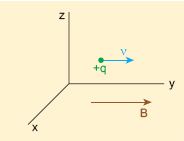
From Lorentz force, \( {\vec F } _{ m }=q(v\hat { j } \times B\hat { j } )=\vec 0\)
So, no force acts on the particle when it moves along the direction of magnetic field.
(b) Since the magnetic field points in positive z - direction, this implies, \(\vec { B } =B\hat { k } \)
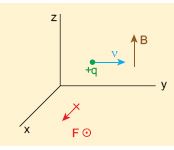
From Lorentz force, \( {\vec F } _{ m }=q(v\hat { j } \times B\hat { k } )=qvB\vec i \)
Therefore, the magnitude of the Lorentz force is qvB and direction is along positive x - direction.
(c) Magnetic field is in zy - plane and making an angle θ with the velocity of the particle, which implies \( {\vec B } =Bcos\theta \hat { j } +Bsin\theta \hat { k } \)
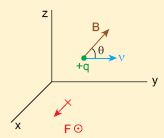
From Lorentz force,
\({ \vec F }_{ m }=q(v\hat { j } )\times (Bcos\theta \hat { j } +Bsin\theta \hat k)\)
\(=qvBsin\theta \hat { i } \)
7.
The magnetic field due to current in the upper semicircle and lower semicircle of the circular coil are equal in magnitude but opposite in direction. Hence, the net magnetic field at the center of the loop (at point O) is zero \(\overset { \rightarrow }{ B } =\overset { \rightarrow }{ 0 } \).
8.
\(\overset { \rightarrow }{ B } =\mu _{ ° }(\overset { \rightarrow }{ H+ } \overset { \rightarrow }{ M } )\)
But from equation (3.33), in vector form,
\(\overset { \rightarrow }{ M } ={ x }_{ m }\overset { \rightarrow }{ H } \)
Hence, \(\overset { \rightarrow }{ B } =\mu _{ ° }({ x }_{ m }+1)\overset { \rightarrow }{ H } \Rightarrow \overset { \rightarrow }{ B } =\mu \overset { \rightarrow }{ H } \)
where, \(\mu =\mu _{ ° }({ x }_{ m }+1)\Rightarrow { x }_{ m }+1=\frac { \mu }{ \mu _{ ° } } =\mu _{ r }\)
\(\Rightarrow { x }_{ m }=\mu _{ r }-1\)
9.
The total flux emanating from the closed surface S enclosing the dipole is zero. So,
\({ \Phi }_{ B }=\oint { \overset { \rightarrow }{ B } .d\overset { \rightarrow }{ A } } =0\)
Here the integral is taken over closed surface. Since no isolated magnetic pole (called magnetic monopole) exists, this integral is always zero,
\(\oint { \overset { \rightarrow }{ B } .d\overset { \rightarrow }{ A } } =0\)
This is similar to Gauss’s law in electrostatics.
10.
(a)
in Z-direction
11.
(c)
right hand rule
12.
\(\vec { B } =\frac { \beta }{ \sqrt { 3 } } =(\hat { i } +\hat { j } +\hat { k } )T\)
Using an equation,
Lorentz force, \(\vec{F}=Il\hat{j}\times\vec B\)
We can get,
Lorentz force \(F=\sqrt { \frac { 2 }{ { 3 } } } \beta Il\)
13.
(b)
\(7\mu T\)
14.
Lorentz force F = Bqv
Energy w = qV
Energy is equal to kinetic energy,
\(qV=\frac{1}{2}mv^2\)
\(v=\sqrt { \frac {2qV }{ m } } \)
\(\therefore Lorentz \ force \ F= Bq\times \sqrt \frac{2qV}{m}=\sqrt { \frac { 2{ B }^{ 2 }{ q }^{ 3 }V }{ m } } \)
15.
The like currents i.e current in both the wire are in the same direction attracts each other. The force is repulsive when the current flows in opposite direction through the wires.
F = \(\frac { { \mu }_{ 0 }{ I }_{ 1 }{ I }_{ 2 }dl }{ 2\pi r } \)
i.e \(F\alpha \frac { 1 }{ r } \)
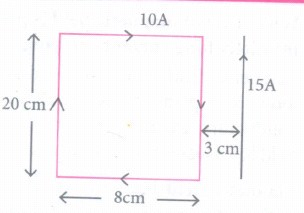
As the wire of the loop carrying the opposite current is near so the net force acting on the loop is repulsive.
16.
The required resistance has the least value for ammeter and maximum value in the case of a voltmeter.
(i) The shunt resistance required to convert a galvanometer to an ammeter has the value
S = \(\frac { { I }_{ g } }{ I-{ I }_{ g } } \) x G
The shunt required for the milliammeter be a higher value.
(ii) Similarly, The voltmeter should have high resistance, the value of the required resistance should be highest in the case of the voltmeter. This is connected in series with the coil of the galvanometer.
17.
Net force an electron moving in the combined electric field \(\vec { E } \) and a magnetic field \(\vec { B } \) is
\(\vec { F } =-e[\vec { E } +\vec { v } \times \vec { B } ]\)
Since electron moves undeflected then \(\vec { F } \) = 0
\(\vec { E } +(\vec { v } \times \vec { B } )\) = 0
\(|\vec { E } |=(|\vec { v } |\times |\vec { B } |)\Rightarrow |\vec { v } |=\frac { |\vec { E } | }{ |\vec { B } | } \).
18.
Current I1 = 2A ; I2 = 5A
Two wires are separated by a distance a = 1 cm
= 1 x 10⁻²m
The force between two parallel wires per unit length
F =?
F = \(\frac { { \mu }_{ 0 } }{ 2\pi } .\frac { { I }_{ 1 }{ I }_{ 2 } }{ a } \)
= 2 x 10⁻⁷ x \(\frac { 2\times 5 }{ 1\times { 10 }^{ -2 } } \)
F = 20 x 10-5 N
This force is repulsive F = 20 x 10-5 N.
19.
In the general case, the unit normal vector \(\hat { n } \) and magnetic field \(\vec { B } \) is with an angle 8 as shown in Figure.
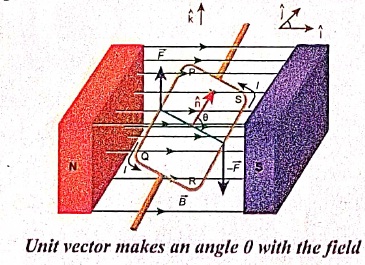
(a) The force on section PQ
\(\vec { i } =a\hat { j } \) and \(\vec { B } =B\hat { i } \)
\(\vec { { F }_{ PQ } } =\vec { Il } \times \vec { B } =IaB(\hat { j } \times \hat { j } )=-IaB\hat { k } \)
Since the unit vector normal to the plane \(\hat { n } \) is along the direction of .\(\vec { k } \)
(b) The force on section QR
\(\vec { l } =bcos\left( \frac { \pi }{ 2 } -\theta \right) \hat { i } -sin\left( \frac { \pi }{ 2 } -\theta \right) \hat { k } \)
\(\vec { { F }_{ QR } } =\vec { Il } \times \vec { B } =-IbB\left( \frac { \pi }{ 2 } -\theta \right) \hat { j } \)
\(\vec { { F }_{ QR } } =-IbBcos\theta \hat { j } \)
(c) The force on section RS
\(\vec { l } =a\hat { j } \) and \(\vec { B } =B\hat { i } \)
\(\vec { { F }_{ RS } } =\vec { Il\times \vec { B } } =IaB(\hat { j } \times \hat { j } )=-IaB\hat { k } \)
Since the unit vector normal to the plane is along the direction of \(\hat { k } \).
(d) The force on section SP
\(\vec { l } =bcos\left( \frac { \pi }{ 2 } -\theta \right) \hat { i } +sin\left( \frac { \pi }{ 2 } +\theta \right) \hat { k } \quad \vec { B } =B\hat { i } \)
\(\vec { { F }_{ SP } } =\vec { Il } \times \vec { B } =IbBsin\left( \frac { \pi }{ 2 } -\theta \right) \hat { j } \)
\(\vec { { F }_{ SP } } =-IbBcos\theta \hat { j } \)
The net force on the rectangular loop is
\(\vec { { F }_{ net } } =\vec { { F }_{ PQ } } +\vec { { F }_{ QR } } +\vec { { F }_{ RS } } +\vec { { F }_{ SP } } \)
\({ F }_{ net }=IaB\hat { k } -IbBcos\theta \hat { j } -IaB\hat { k } +IbBcos\theta \hat { j } \)
\(\vec { { F }_{ net } } =\vec { 0 } \)
Hence, the net force on the rectangular loop in this configuration is also zero. Notice that the force on section QR and SP is not zero here. But, they have equal and opposite effects, but we assume that the loop to be rigid, so no deformation. So, no torque was produced by these two sections.
Even though the forces PQ and RS also are equal and opposite, they are not collinear. So these two forces constitute a couple as shown in Figure (a). Hence the net torque produced by these two forces about the axis of the rectangular loop is given by
\(\vec { { \tau }_{ net } } =baBIsin\theta \hat { k } =ABIsin\theta \hat { k } \)
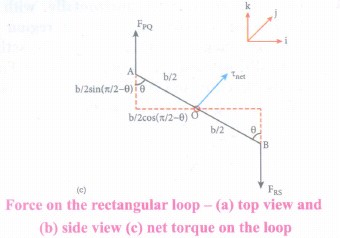
\(\vec { OA } =\frac { b }{ 2 } cos\left( \frac { \pi }{ 2 } -\theta \right) (-\hat { i } )+\frac { b }{ 2 } cos\left( \frac { \pi }{ 2 } -\theta \right) (-\hat { k } )\)
=\(\frac { b }{ 2 } (-sin\theta \hat { i } +cos\theta \hat { k } )\)
\(\vec { OB } =\frac { b }{ 2 } cos\left( \frac { \pi }{ 2 } -\theta \right) (\hat { i } )+\frac { b }{ 2 } cos\left( \frac { \pi }{ 2 } -\theta \right) (\hat { k } )\)
=\(\frac { b }{ 2 } (-sin\theta \hat { i } +cos\theta \hat { k } )\)
\(\vec { OA } \times \vec { { F }_{ PQ } } =\left\{ \frac { b }{ 2 } (-sin\theta \hat { i } +cos\theta \hat { k } \right\} \times \left\{ IaB\hat { k } \right\} \)
= \(\frac { 1 }{ 2 } IabBsin\theta \hat { j } \)
\(\vec { OA } \times \vec { { F }_{ RS } } =\left\{ \frac { b }{ 2 } (sin\theta \hat { i } +cos\theta \hat { k } \right\} \times \left\{ -IaB\hat { k } \right\} \)
= \(\frac { 1 }{ 2 } IabBsin\theta \hat { j } \)
The net torque \(\vec { \tau _{ net } } =IaBsin\theta \hat { j } \) ..........(1)
Note that the net torque is in the positive y-direction which tends to rotate the loop in a clockwise direction about the y axis. If the current is passed in the other way (P⟶S⟶R⟶Q⟶P), then total torque will point in the negative y-direction which tends to rotate the loop in an anticlockwise direction about the y-axis.
Another important point is to note that the torque is less in this case compared to the earlier case (where the \(\hat { n } \) is perpendicular to the magnetic field \(\vec { B } \)). It is because the perpendicular distance is reduced between the forces \(\vec { { F }_{ PQ } } \) and \(\vec { { F }_{ RS } } \) in this case.
The equation (1) can also be rewritten in terms of magnetic dipole moment \(\vec { { p }_{ m } } =I\vec { A } =Iab\hat { n } \)
\(\vec { \tau _{ net } } =\vec { p } \times \vec { B } \).

12th Standard Syllabus & Materials
12th Standard
TN 12th Computer Applications களப்பெயர் முறைமை (DNS) Sample Question Papers Study Material - QB365 Set A
NEW12th Standard
TN 12th Computer Applications வலையமைப்பு எடுத்துக்காட்டுகள் மற்றும் நெறிமுறைகள் Sample Question Papers Study Material - QB365 Set A
NEW12th Standard
TN 12th Computer Applications கணினி வலையமைப்பு ஓர் அறிமுகம் Sample Question Papers Study Material - QB365 Set A
NEW12th Standard
TN 12th Computer Applications PHP-உடன் MySQL-ஐ இணைத்தல் Sample Question Papers Study Material - QB365 Set A



Tamilnadu Stateboard 12th Standard Subjects

Maths

Chemistry
Physics

Biology

Computer Science

Business Maths and Statistics

Economics

Commerce

Accountancy

History

Computer Applications
Biology
Computer Technology
Computer Applications
Computer Science
Business Maths and Statistics
Commerce
Economics
Maths
Chemistry
Physics
Computer Technology
History
Accountancy

Tamil

English

French
Tamilnadu Stateboard Standards

