
 100% FREE ACCESS
12th Standard Syllabus & Materials
12th Standard
TN 12th Computer Applications மின்னணு தரவு பரிமாற்றம் Sample Question Papers Study Material - QB365 Set A
NEW12th Standard
TN 12th Computer Applications மின் - வணிக பாதுகாப்பு அமைப்புகள் Sample Question Papers Study Material - QB365 Set A
NEW12th Standard
TN 12th Computer Applications மின்னணு செலுத்தல் முறைகள் Sample Question Papers Study Material - QB365 Set A
NEW12th Standard
TN 12th Computer Applications மின் - வணிகம் Sample Question Papers Study Material - QB365 Set A
NEW12th Standard
TN 12th Computer Applications திறந்த மூல கருத்துருக்கள் Sample Question Papers Study Material - QB365 Set A
NEW12th Standard
TN 12th Computer Applications வலையமைப்பு வடமிடல் Sample Question Papers Study Material - QB365 Set A

Published on: 02/01/2020
Magnetism and Magnetic Effects of Electric Current
Download Tamil Nadu 12th Standard Physics question papers, model tests, one-mark questions, important questions, and public exam papers in PDF format. Free study materials and answer keys for TN State Board students.
Questions + Answers key
Take MCQ Physics Test1.
State Coulomb’s inverse law.
2.
Define magnetic flux.
3.
What is meant by magnetic induction?
4.
Calculate the magnetic flux coming out from closed surface containing magnetic dipole (say, a bar magnet) as shown in figure.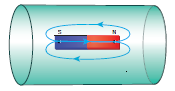
5.
Magnetic field lines can be entirely confined within the core of toroid, but not within a straight solenoid. Why?
6.
Write the value of
(i) Horizontal component &
(ii) vertical component of Earth's magnetic field.
7.
Compute the intensity of magnetisation of the bar magnet whose mass, magnetic moment and density are 200 g, 2 A m2 and 8 g cm–3, respectively.
8.
A coil of a tangent galvanometer of diameter 0.24 m has 100 turns. If the horizontal component of Earth’s magnetic field is 25 x 10–6 T then, calculate the current which gives a deflection of 60o .
9.
Consider a magnetic dipole which on switching ON external magnetic field orient only in two possible ways i.e., one along the direction of the magnetic field (parallel to the field) and another anti-parallel to magnetic field. Compute the energy for the possible orientation.
10.
Let I1 and I2 be the steady currents passing through a long horizontal wire XY and PQ respectively. The wire PQ is fixed in horizontal plane and the wire XY be is allowed to move freely in a vertical plane. Let the wire XY is in equilibrium at a height d over the parallel wire PQ as shown in figure.
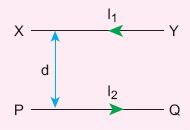
Show that if the wire XY is slightly displaced and released, it executes Simple Harmonic Motion (SHM). Also, compute the time period of oscillations.
11.
Discuss Earth’s magnetic field in detail.
12.
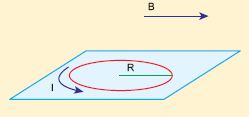
Consider a circular wire loop of radius R, mass m kept at rest on a rough surface. Let I be the current flowing through the loop and be the magnetic field acting along horizontal as shown in Figure. Estimate the current I that should be applied so that one edge of the loop is lifted off the surface?
13.
A thin insulated wire forms a plane spiral of N = 100 tight turns carrying a current I = 8 m A (milli ampere). The radii of inside and outside turns are a = 50 mm and b = 100 mm respectively. The magnetic induction at the centre of the spiral is ______.
\(5\mu T\)
\(7\mu T\)
\(8\mu T\)
\(10\mu T\)
14.
A particle having mass m and charge q accelerated through a potential difference V. Find the force experienced when it is kept under perpendicular magnetic field \(\vec { B } \).
\(\sqrt { \frac { 2{ q }^{ 3 }BV }{ m } } \)
\(\sqrt { \frac { { q }^{ 3 }{ B }^{ 2 }V }{ 2m } } \)
\(\sqrt { \frac { 2{ q }^{ 3 }{ B }^{ 2 }V }{ m } } \)
\(\sqrt { \frac { { 2q }^{ 3 }BV }{ { m }^{ 3 } } } \)
15.
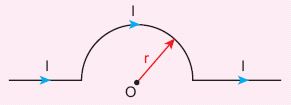
The magnetic field at the centre O of the following current loop is
\(\frac { { \mu }_{ ° }I }{ 4r } \bigotimes \)
\(\frac { { \mu }_{ ° }I }{ 4r } \bigodot \)
\(\frac { { \mu }_{ ° }I }{ 2r } \bigotimes \)
\(\frac { { \mu }_{ ° }I }{ 2r } \bigodot \)
1.
Coulomb's inverse square law states that the force of attraction or repulsion between two magnetic poles is directly proportional to the product of their pole strengths and inversely proportional to the square of the distance between them.
\(\vec { F } =k \frac { { q }_{ m_{A} }{ q }_{ m_{B} } }{ { r }^{ 2 } } \hat { r } \)
2.
Magnetic flux is defined as the number of magnetic field lines crossing per unit area kept normal to the direction of lines of force.
3.
(i) When a substance is placed in a uniform magnetising field, the substance gets magnetised.
(ii) The total magnetic field inside the specimen is equal to the sum of the magnetic field produced in vacuum due to the magnetising field and the magnetic field due to the induced magnetism of the substance.
4.
The total flux emanating from the closed surface S enclosing the dipole is zero. So,
\({ \Phi }_{ B }=\oint { \overset { \rightarrow }{ B } .d\overset { \rightarrow }{ A } } =0\)
Here the integral is taken over closed surface. Since no isolated magnetic pole (called magnetic monopole) exists, this integral is always zero,
\(\oint { \overset { \rightarrow }{ B } .d\overset { \rightarrow }{ A } } =0\)
This is similar to Gauss’s law in electrostatics.
5.
Magnetic field lines can be entirely confined within the core of a toroid since the toroid has no ends. θ solenoid is open ended and the field lines inside it which are parallel to the length of the solenoid cannot form closed curves inside the solenoid.
6.
(i) Horizontal component:
The Earth's magnetic field is parallel to the surface of the Earth (i.e., horizontal) which implies that the needle of the magnetic compass rests horizontally at an angle of dip, I = 00 as shown in the figure.
BH = BE
Bv = 0
This implies that the horizontal component is maximum at the equator and the vertical component is zero at the equator.
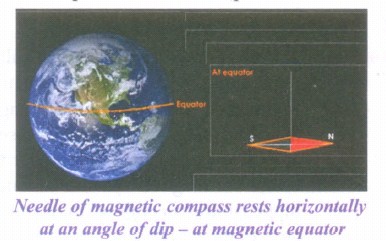
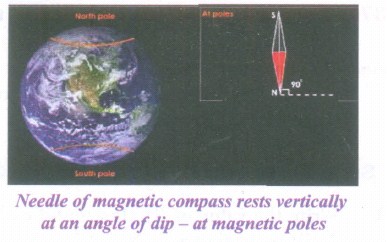
(ii) Vertical component: The Earth's magnetic field is perpendicular to the surface of the Earth (i.e., vertical) which implies that the needle of magnetic compass rests vertically at an angle of dip, I = 90° as shown in Figure
Hence,
BH = 0
Bv = BE
This implies that the vertical component is maximum at poles and the horizontal component is zero at poles.
7.
Density of the magnet is
Density = \(\frac { Mass }{ volume } \Rightarrow Volume=\frac { Mass }{ Density } \)
\(Volume=\frac { 200\times 1{ 0 }^{ -3 }kg }{ \left( 8\times 1{ 0 }^{ -3 }kg \right) \times 1{ 0 }^{ 6 }{ m }^{ -3 } } =25\times { 10 }^{ -6 }{ m }^{ 3 }\)
Magnitude of magnetic moment pm = 2A m2
Intensity of magnetization,
\(I=\frac { magnetic\ moment }{ Volume } =\frac { 2 }{ 25\times { 10 }^{ -6 } } \)
M = 0.8 x 10⁵ Am-1
8.
The diameter of the coil is 0.24 m. Therefore, radius of the coil is 0.12 m.
Number of turns is 100 turns. Earth’s magnetic field is 25 x 10-6 T
Deflection is
\(\theta =60°\Rightarrow tan60°=\sqrt { 3 } =1.732\)
\(I=\frac { 2R{ B }_{ H } }{ { \mu }_{ ° }N } tan\theta \)
\(=\frac { 2\times 0.12\times 25\times 1{ 0 }^{ -6 } }{ 4\times 1{ 0 }^{ -7 }\times 3.14\times 100 } \times 1.732=0.82\times 1{ 0 }^{ -1 }A\)
I = 0.082 A
9.
Let \(\vec{p}_m\)be the dipole and before switching ON the external magnetic field, there is no orientation. Therefore, the energy U = 0.
As soon as external magnetic field is switched ON, the magnetic dipole orient parallel (θ = 0o) to the magnetic field with energy,
Uparallel = Uminimum = -pmBcos 0
Uparallel = -pmB
since cos 0o = 1
Otherwise, the magnetic dipole orients anti-parallel (θ = 180o) to the magnetic field with energy,
U anti-parallel = U maximum = -pmBcos 180
\(\Rightarrow \) Uanti-parallel = PmB
since cos 180o = -1
10.
Let the currents flowing through wires XY and PQ be I1 and I2
Magnetic field along PQ is \(\mathrm{B}_{1}=\frac{\mu_{o} I_{2}}{2 \pi r}\)
Force per unit length on PQ is \(\frac{F_{2}}{l}=\frac{\mu_{0} I_{1} I_{2}}{2 \pi r}\)
If the wire XY is slightly displaced and released, it executes simple harmonic motion with the condition that acceleration is directly proportional to the displacement y
\(\therefore a=-\omega^{2} y\) .....(1)
The distance between two wires = d
Time period
\(T=\frac{2 \pi}{\omega} \)
\(a=\frac{g}{d} y \) .....(2)
By comparing the equations (1) and (2) we get
\(\omega^{2} =-\frac{g}{d} \ \therefore \omega=\sqrt{\frac{g}{d}} \)
\(\text { Time period } =\frac{2 \pi}{\omega}=2 \pi \sqrt{\frac{d}{g}} \)
\(\therefore T =2 \pi \sqrt{\frac{d}{g}} \)
11.
There are three quantities required to specify the magnetic field of the Earth on its surface, which are often called as the elements of the Earth's magnetic field. They are:
(a) magnetic declination (D)
(b) magnetic dip or inclination (I)
(c) the horizontal component of the Earth's magnetic field (BH)
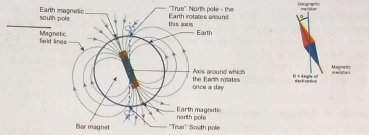
Let BE be the net Earth's magnetic field at any point P on the surface of the Earth. BE can be resolved into two perpendicular components.
Horizontal component, BH = BE cos I .... (1)
Vertical component, BV = BE sin I .....(2)
Dividing equation (1) and (2), we get,
\(=\frac{B_{V}}{B_{H}} ...(3)\)
(i) At magnetic equator:
The Earth's magnetic field is parallel to the surface of the Earth (i.e., horizontal) which implies that the needle of magnetic compass rests horizontally at an angle of dip, I = 0o Hence, BH = BE
BV = 0
This implies that the horizontal component is maximum and vertical component is zero at equator.
(ii) At magnetic poles:
The Earth's magnetic field is perpendicular to the surface of the Earth (i.e, vertical) which implies that the needle of magnetic compass rests vertically at an angle of dip, I = 90o
Hence, BH = 0
BV = BE
This implies that the vertical component is maximum at poles and horizontal component is zero at poles.
12.
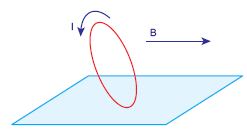
When the current is passed through the loop, the torque is produced. If the torque acting on the loop is increased then the loop will start to rotate. The loop will start to lift if and only if the magnitude of magnetic torque due to current applied equals to the gravitational torque as shown in Figure
Tmagnetic = Tgravitational
IAB = mgR
\(But\quad { p }_{ m }=IA=I(\pi { R }^{ 2 })\)
\(IR^{ 2 }B=mgR\)
\(\Rightarrow \frac { mg }{ \pi { R }B } \)
The current estimate using this equation should be applied so that one edge of loop is lifted off the surface.
13.
(b)
\(7\mu T\)
14.
Lorentz force F = Bqv
Energy w = qV
Energy is equal to kinetic energy,
\(qV=\frac{1}{2}mv^2\)
\(v=\sqrt { \frac {2qV }{ m } } \)
\(\therefore Lorentz \ force \ F= Bq\times \sqrt \frac{2qV}{m}=\sqrt { \frac { 2{ B }^{ 2 }{ q }^{ 3 }V }{ m } } \)
15.
Magnetic filed at the centre of a circular
loop, B = \(\frac{μ_oI}{2\pi R}\)
From the figure, R =\(\frac{2r}{\pi}\)
\(\therefore B'=\frac{μ_oI}{2\pi \times\frac{2r}{\pi}}=\frac{μ_oI}{4r}\)
\(B'=\frac { { \mu }_{ ° }I }{ 4r } \bigotimes \)

12th Standard Syllabus & Materials
12th Standard
TN 12th Computer Applications களப்பெயர் முறைமை (DNS) Sample Question Papers Study Material - QB365 Set A
NEW12th Standard
TN 12th Computer Applications வலையமைப்பு எடுத்துக்காட்டுகள் மற்றும் நெறிமுறைகள் Sample Question Papers Study Material - QB365 Set A
NEW12th Standard
TN 12th Computer Applications கணினி வலையமைப்பு ஓர் அறிமுகம் Sample Question Papers Study Material - QB365 Set A
NEW12th Standard
TN 12th Computer Applications PHP-உடன் MySQL-ஐ இணைத்தல் Sample Question Papers Study Material - QB365 Set A



Tamilnadu Stateboard 12th Standard Subjects

Maths

Chemistry
Physics

Biology

Computer Science

Business Maths and Statistics

Economics

Commerce

Accountancy

History

Computer Applications
Biology
Computer Technology
Computer Applications
Computer Science
Business Maths and Statistics
Commerce
Economics
Maths
Chemistry
Physics
Computer Technology
History
Accountancy

Tamil

English

French
Tamilnadu Stateboard Standards

