
 100% FREE ACCESS
12th Standard Syllabus & Materials
12th Standard
TN 12th Maths Applications of Matrices and Determinants Sample Question Papers Study Material - QB365 Set A
NEW12th Standard
TN 12th Computer Applications மின்னணு தரவு பரிமாற்றம் Sample Question Papers Study Material - QB365 Set A
NEW12th Standard
TN 12th Computer Applications மின் - வணிக பாதுகாப்பு அமைப்புகள் Sample Question Papers Study Material - QB365 Set A
NEW12th Standard
TN 12th Computer Applications மின்னணு செலுத்தல் முறைகள் Sample Question Papers Study Material - QB365 Set A
NEW12th Standard
TN 12th Computer Applications மின் - வணிகம் Sample Question Papers Study Material - QB365 Set A
NEW12th Standard
TN 12th Computer Applications திறந்த மூல கருத்துருக்கள் Sample Question Papers Study Material - QB365 Set A

Published on: 16/09/2019
Magnetism and Magnetic Effects of Electric Current
Download Tamil Nadu 12th Standard Physics question papers, model tests, one-mark questions, important questions, and public exam papers in PDF format. Free study materials and answer keys for TN State Board students.
Questions + Answers key
Take MCQ Physics Test1.
The magnetic field lines prefer to pass through iron than why?
2.
Why the Phosphor - bronze wire is used as the suspension wire in moving coil galvanometer?
3.
When is a galvanometer said to be sensitive?
4.
Define ampere.
5.
What is magnetic Lorentz force?
6.
Tabulate End rule polarity with direction of current in circular loop using module.
7.
What are the uses of studying hysteresis loops of various material?
8.
What is Declination?
9.
What is magnetic axis, magnetic meridian & magnetic equator?
10.
What is meant by hysteresis?
11.
State Biot-Savart’s law.
12.
What is magnetic susceptibility?
13.
Define magnetic flux.
14.
What is meant by magnetic induction?
15.
Define Voltage sensitivity?
1.
The magnetic field lines prefer to pass through iron than because the permeability of iron is much larger than air.
2.
Phosphor - bronze wire is used as the suspension wire because the couple per unit twist is very small.
3.
The galvanometer is said to be sensitive if it shows large scale deflection even though a small current is passed through it or a small voltage is applied across it.
4.
One ampere is defined as that constant current when it is passed through each of the two infinitely long parallel straight conductors kept side by side parallely at a distance of one meter apart in vacuum causes each conductor to experience a force of 2 x 10⁻⁷ newton per meter length of conductor.
5.
When an electric charge q is kept at rest in a magnetic field, no force acts on it. At the same time, if the charge moves in the magnetic field, it experiences a force. This force is different from Coulomb's force. This force is known as magnetic Lorentz force
\(\vec { F } =q(\vec { v } \times \vec { B } )\)
In general, if the charge is moving in both the electric and magnetic fields, the total force experienced by the charge is given by \(\vec { F } =q(\vec { v } \times \vec { B } )q\vec { E } \) . It is known as Lorentz force.
6.
| Current in a circular loop | Polarity | Picture |
| Anti-clockwise current | North Pole | 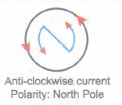 |
| Clockwise current | South Pole |  |
7.
The significance of hysteresis loop is that it provides information such as retentivity, coercivity, permeability, susceptibility and energy loss during one cycle of magnetisation for each ferromagnetic material. Therefore, the study of hysteresis loop will help us in selecting proper and suitable material for a given purpose.
8.
The angle between magnetic meridian at a point and geographical meridian is called the declination or magnetic declination (D).
9.
The straight line which connects magnetic poles of Earth is known as magnetic axis. A vertical plane passing through magnetic axis is called magnetic meridian and a great circle perpendicular to Earth's magnetic axis is called magnetic equator.
10.
Hysteresis is the phenomenon of lagging of magnetic induction behind the magnetising field.
11.
Biot-Savart's law states that, the magnitude of magnetic field \(d\vec { B } \) at a point P at a distance of r from the small elemental length taken on a conductor carrying current varies
(i) directly as the strength of the current I
(ii) directly as the magnitude of the length of element \(\vec { dl } \)
(iii) directly as the sine of the angle θ between \(\vec { dl } \) and \(\hat { r } \).
(iv) inversely as the square of the distance r between the point P and length of element \(\vec { dl } \).
\(d\vec { B } =\frac { { \mu }_{ 0 } }{ 4\pi } \frac { I\vec { dl } \times \hat { r } }{ { r }^{ 2 } } \)
12.
Magnetic susceptibility is defined as the ratio of the intensity of magnetisation (\(\vec { M } \)) induced in the material due to the magnetising field |\(\vec H\)|.
\( \chi _{ m }=\frac { |\vec { M } | }{ |\vec { H } | } \).
13.
Magnetic flux is defined as the number of magnetic field lines crossing per unit area kept normal to the direction of lines of force.
14.
(i) When a substance is placed in a uniform magnetising field, the substance gets magnetised.
(ii) The total magnetic field inside the specimen is equal to the sum of the magnetic field produced in vacuum due to the magnetising field and the magnetic field due to the induced magnetism of the substance.
15.
It is defined as the deflection produced per unit voltage applied across the galvanometer.
Vs =\(\frac { \theta }{ V } \)
Vs = \(\frac { \theta }{ IR_{ g } } =\frac { NAB }{ KR_{ g } } =V_{ s }=\frac { 1 }{ GR_{ g } } =\frac { { I }_{ s } }{ { R }_{ g } } \)

12th Standard Syllabus & Materials
12th Standard
TN 12th Computer Applications வலையமைப்பு வடமிடல் Sample Question Papers Study Material - QB365 Set A
NEW12th Standard
TN 12th Computer Applications களப்பெயர் முறைமை (DNS) Sample Question Papers Study Material - QB365 Set A
NEW12th Standard
TN 12th Computer Applications வலையமைப்பு எடுத்துக்காட்டுகள் மற்றும் நெறிமுறைகள் Sample Question Papers Study Material - QB365 Set A
NEW12th Standard
TN 12th Computer Applications கணினி வலையமைப்பு ஓர் அறிமுகம் Sample Question Papers Study Material - QB365 Set A



Tamilnadu Stateboard 12th Standard Subjects

Maths

Chemistry
Physics

Biology

Computer Science

Business Maths and Statistics

Economics

Commerce

Accountancy

History

Computer Applications
Biology
Computer Technology
Computer Applications
Computer Science
Business Maths and Statistics
Commerce
Economics
Maths
Chemistry
Physics
Computer Technology
History
Accountancy

Tamil

English

French
Tamilnadu Stateboard Standards

