
 100% FREE ACCESS
12th Standard Syllabus & Materials
12th Standard
TN 12th Computer Applications மின்னணு தரவு பரிமாற்றம் Sample Question Papers Study Material - QB365 Set A
NEW12th Standard
TN 12th Computer Applications மின் - வணிக பாதுகாப்பு அமைப்புகள் Sample Question Papers Study Material - QB365 Set A
NEW12th Standard
TN 12th Computer Applications மின்னணு செலுத்தல் முறைகள் Sample Question Papers Study Material - QB365 Set A
NEW12th Standard
TN 12th Computer Applications மின் - வணிகம் Sample Question Papers Study Material - QB365 Set A
NEW12th Standard
TN 12th Computer Applications திறந்த மூல கருத்துருக்கள் Sample Question Papers Study Material - QB365 Set A
NEW12th Standard
TN 12th Computer Applications வலையமைப்பு வடமிடல் Sample Question Papers Study Material - QB365 Set A

Published on: 06/01/2020
Optics
Download Tamil Nadu 12th Standard Physics question papers, model tests, one-mark questions, important questions, and public exam papers in PDF format. Free study materials and answer keys for TN State Board students.
Questions + Answers key
Take MCQ Physics Test1.
A ray of light is incident normally on a lane mirror. The angle of reflection will be _____________.
0°
90°
will not be reflected
None of these
2.
Two plane mirrors are at 45° to each other. If an object is placed between them then the number of images will be ________________.
5
9
7
8
3.
4.
The radius of curvature of curved surface at a thin planoconvex lens is 10 cm and the refractive index is 1.5. If the plane surface is silvered, then the focal length will be, ______.
5 cm
10 cm
15 cm
20 cm
5.
When a biconvex lens of glass having refractive index 1.47 is dipped in a liquid, it acts as plane sheet of glass. This implies that the liquid must have refractive index, ______.
less than one
less than that of glass
greater than that of glass
equal to that of glass
6.
Write the uses of nicol prism.
7.
What is meant by angular dispersion?
8.
A beam of light of wavelength 600 nm from a distant source falls on a single slit 1 mm wide and the resulting diffraction pattern is observed on a screen 2 m away. What is the distance between the first dark fringes on either side of the central bright fringe?
9.
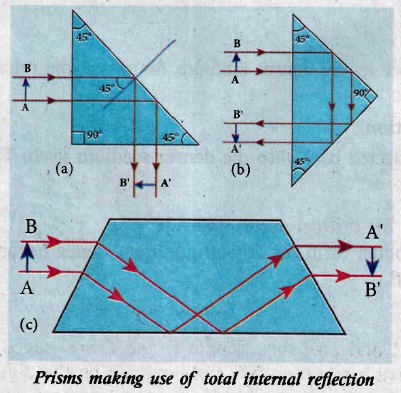
Write a short note on the prisms making use of total internal reflections.
10.
What are mirage and looming?
11.
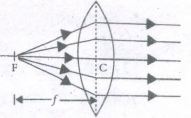
The image of a candle is formed by a convex lens on a screen. The lower half of the lens is painted black to make it completely opaque. Draw the ray diagram to show the image formation. How will this image be different from the one obtained when the lens is not painted black?
12.
An object is placed at the principal focus of a convex lens. Determine the position of the image making use of the lens equation.
13.
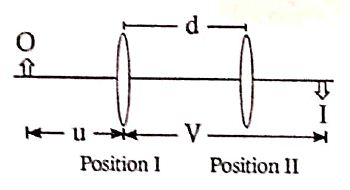
If the distance D between an object and screen is greater than 4 times the focal length f of a convex lens, then there are two positions for which the lens forms an enlarged image and a diminished image respectively. This method is called conjugate foci method. If d is the distance between the two positions of the lens, obtain the equation for focal length of the convex lens.
14.
State the laws of reflection
15.
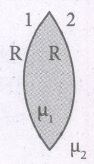
A biconvex lens with its two faces of the equal radius of curvature R is made of a transparent medium of refractive index ~2 as shown in the figure.
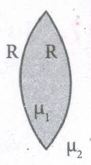
(i) Find the equivalent focal length of the combination.
(ii) Obtain the condition when this combination acts as a diverging lens.
(iii) Draw the ray diagram for the case (\({ \mu }_{ 1 }>({ \mu }_{ 2 }+1)\) + 1) / 2 when the object is kept far away from the lens. Point out the nature of the image formed by the system.
16.
The critical angle for a given piece of glass is 45°. Calculate the polarising angle for it. Also calculate the angle of refraction when light is incident on this glass at an angle of incident equal to ip.
17.
Prove law of reflection using Huygens’ principle.
18.
What is dispersion? Obtain the equation for dispersive power of a medium.
19.
Obtain the equation for radius of illumination (or) Snell’s window.
1.
(a)
0°
2.
(c)
7
3.
(b)
4.
\(\frac{1}{f} =(n-1)\left(\frac{1}{R_1}-\frac{1}{R_2}\right) \)
\(=(1.5-1)\left(\frac{1}{\infty}-\frac{1}{(-10)}\right)\)
(Since plano convex lens)
\(=0.5\left[\frac{1}{10}\right]=\frac{1}{20} \)
\(\mathrm{f}_t =20 \mathrm{~cm}\)
Formula for silvered lenses
\(\frac{1}{\mathrm{~F}} =\frac{2}{\mathrm{f}_1}+\frac{1}{\mathrm{f}_m} \)
\(\frac{1}{\mathrm{~F}} =\frac{2}{20}+\frac{1}{\infty} \)
\(\therefore \mathrm{F} =\frac{20}{2}=10 \mathrm{~cm}\)
5.
\(\frac{I}{f}=\left(\frac{\mu_{\mathrm{L}}}{\mu_L}-1\right)\left(\frac{1}{R_1}-\frac{1}{R_2}\right)\)
When the biconvex lens of glass dipped in liquid, it acts as a plane sheet of glass.
\(\therefore \mathrm{f}=\infty, \frac{1}{\mathrm{f}}=0 \quad \frac{\mu_g}{\mu_{\mathrm{L}}}-1=0 ; \frac{\mu_{\mathrm{s}}}{\mu_{\mathrm{L}}}=1, \mu_{\mathrm{s}}=\mu_{\mathrm{L}}\)
6.
(i) It produces plane polarised light and functions as a polariser.
(ii) It can also be used to analyse the plane polarised light i.e used at an analyser.
7.
The angular separation between the two extreme colours (violet and red) in the spectrum is called the angular dispersion.
8.
⋋2 = 600 x 10-9 m, ⇒ d = 1 x 10⁻³ m, D =2m
n⋋ = dsinθ
For first dark fringe
n = 1 For minimum
d sinθ = ⋋, here
CO = Nc (approximately)
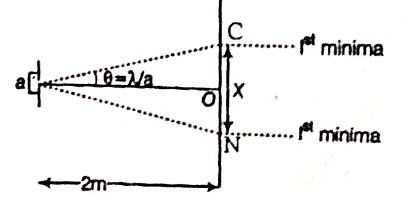
From Fig, sinθ \(=\frac{x/2}{D} =x/2D\)
\(sin \theta =\frac{ \lambda}{d} \)
\(\lambda/d=x/2D\)
\(\therefore x =\frac{2D\lambda}{d}=\frac{2 \times 2 \times 600\times 10^{-9}}{ 10^{-3}} \)
\(x=2.4 \times10^{-3}m =2.4\mathrm{~mm} \)
9.
Prisms can be designed to reflect light by 90o or by 180o by making use of total internal reflection from the Figures (a) and (b). In the first two cases, the critical angle ic for the material of the prism must be less than 45o. Prisms are also used to invert images without changing their size as shown in Figure(c).
10.
Mirage:
Mirage is an optical illusion caused by atmospheric conditions especially the appearance of sheet of water in a desert caused by total internal reflection (or) refraction of light from the sky by heated air.
Looming:
Looming is an optical illusion caused by bending of light which appear an object floating high above its actual position specially in polar region.
11.
The full size of the image will be obtained. But the intensity of image will be reduced. This is because the number of rays of light refracted through different parts of the lens will be reduced.
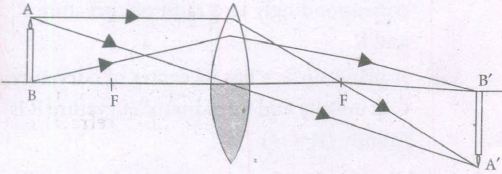 .
.
12.
From the lens equation
\(\cfrac { 1 }{ v } -\cfrac { 1 }{ -f } =\cfrac { 1 }{ f } \)
or \(\cfrac { 1 }{ v } =0\)
∴v = ∞
So, the image is formed at infinity.
13.
From figure,
D = u + v
d = r - u
D + d = u + v + v - u
D + d = 2v
\(v=\frac{D+d}{2}\)
D - d = u + v - v + u = 2u
\(v=\frac{D-d}{2}\)
\(\frac{1}{f}=\frac{1}{v}-\frac{1}{u} \)
\(\frac{1}{f} =\frac{1}{\frac{D+d}{2}}-\frac{1}{\frac{D-d}{2}} \)
\(=\frac{2}{D+d}-\frac{2}{D-d} \)
\(=\frac{2[D-d+D+d]}{D^{2}-d^{2}} \)
\(=\frac{2 \times 2 D}{D^{2}-d^{2}} \)
\(\frac{1}{f} =\frac{4 D}{D^{2}-d^{2}} \quad \therefore f=\frac{D^{2}-d^{2}}{4 D} \)
14.
According to law of reflection,
(i) The incident ray, reflected ray and normal to the reflecting surface all are coplanar (ie. lie in the same plane).
(ii) The angle of incidence i is equal to the angle of reflection r.
i = r
15.
(i) If refraction occurs at the first surface
\(\cfrac { { \mu }_{ 1 } }{ { v }_{ 1 } } -\cfrac { 1 }{ u } =\left( \cfrac { { \mu }_{ 1 }-1 }{ R } \right) \)
If refraction occurs at the second surface, and the image of the first surface acts as an object.
\(\cfrac { { \mu }_{ 2 } }{ v } -\cfrac { { u }_{ 1 } }{ { v }_{ 1 } } =\cfrac { { \mu }_{ 2 }-{ \mu }_{ 1 } }{ -R } \)
On adding equations (1) and (2), we get
\(\cfrac { { \mu }_{ 2 } }{ v } -\cfrac { 1 }{ u } =\cfrac { 2{ \mu }_{ 1 }-{ \mu }_{ 2 }-1 }{ R } \)
If rays are coming from infinity, i.e., u = -∞ then v = f
\(\cfrac { { \mu }_{ 2 } }{ f } +\cfrac { 1 }{ \infty } =\cfrac { { 2\mu }_{ 1 }-{ \mu }_{ 2 } }{ R } \)
\(f=\cfrac { { \mu }_{ 2 }R }{ { 2{ \mu }_{ 1 }-{ \mu }_{ 2 }-1 } } \)
(ii) If the combination behaves as a diverging system then f <: O. This is possible only when
\(\Rightarrow 2{ \mu }_{ 1 }-{ \mu }_{ 2 }-1<0\)
\(2{ \mu }_{ 1 }-{ \mu }_{ 2 }+1\)
\(\Rightarrow { \mu }_{ 1 }<\cfrac { \left( { { \mu }_{ 2 }+1 } \right) }{ 2 } \)
(iii) If the combination behaves as a converging lens then> 0. It is possible only when
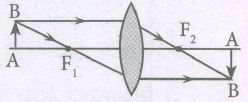
\(\Rightarrow { 2\mu }_{ 1 }-{ \mu }_{ 2 }-1>0\)
\(\Rightarrow 2{ \mu }_{ 1 }->{ \mu }_{ 2 }+1\)
\({ \mu }_{ 1 }>\cfrac { \left( { \mu }_{ 2 }+1 \right) }{ 2 } \)
The nature of the image formed is real.
16.
Formula
We know \({ i }_{ c }=\cfrac { 1 }{ \mu } \)
\(\mu =\cfrac { 1 }{ { sini }_{ c } } =\cfrac { 1 }{ { sin45 }^{ o } } =\sqrt { 2 } \)
According to Brewster's law
\({ i }_{ p }=\mu =\sqrt { 2 } \)
\(\Rightarrow { i }_{ p }={ tan }^{ -1 }\sqrt { 2 } \)
= tan-1(1.414) ≅ 510 40o
When light is incident at an angle ip the corresponding angle of refraction 'r' is given by
ip + r = 90o
ஃ r = 90o- (51o40') = (38o 20')
17.
(i) Let us consider a parallel beam of light, incident on a reflecting plane surface such as a plane mirror XY.
(ii) The incident wavefront is AB and the reflected waterfront is A'B'.
(iii) These wavefronts are perpendicular to the incident rays L, M and reflected rays L', M', respectively.
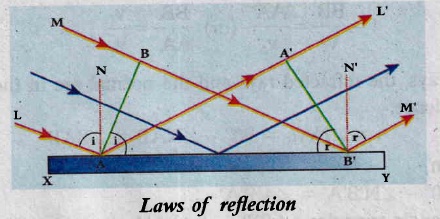
(i) The incident rays, the reflected rays and the normal are in the same plane.
(ii) Angle of incidence, ∠i = ∠NAL = 90°- ∠NAB = ∠BAB'
Angle of reflection ∠r = ∠N'B'M = 90°- ∠N'B'A'= ∠A'B'A
(a) For the two right angle triangles, ∆ABB' and ∆B'A'A, the two right angles, ∠B and ∠A' are equal, (∠B and ∠A' = 90°); the two sides., AA' and BB' are equal, (AA' = BB'); the side AB' is common
(b) Thus the two triangles are congruent. As per the property of congruency, the two angles, ∠BAB' and ∠A'B'A must also be equal.
i = r
Hence, the laws of reflection are proved.
18.
Dispersion: It is splitting of white light into its constituent colours.
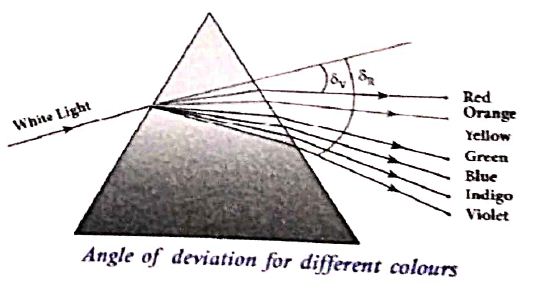
(i) Consider a beam of white light passes through a prism; it gets dispersed into its constituent colours as shown in Figure.
(ii) Let \(\delta_{v}, \delta_{R} \) are the angles of deviation for violet and red light. Let nV and nR are the refractive indices for the violet and red light respectively
(iii) The refractive index of the material of a prism is given by the equation
\(\mathrm{n}=\frac{\sin \left(\frac{\mathrm{A}+\mathrm{D}}{2}\right)}{\sin (\mathrm{A} / 2)}\)
(iv) Here A is the angle of the prism and D is the angle of minimum deviation. If the angle of prism is small of the order of 10o, the prism is said to be a small angle prism.
(v) When rays of light pass through such prisms, the angle of deviation also becomes small. If A be the angle of a smitt angle prism and the angle of deviation then the prism formula becomes.
\(n=\frac{\sin \left(\frac{A+\delta}{2}\right)}{\sin (A / 2)}\)
For small angles of \(A\ and \ \delta \)
\(\sin \frac{A+\delta}{A} \approx \frac{A+\delta}{A} \)
\(\sin \frac{A}{2} \approx \frac{A}{2} \)
\(n=\frac{(A+\delta / 2)}{(A / 2)}=\frac{A+\delta}{A}=1+\frac{\delta}{A} \)
Further simplifying,
\(\frac{\delta}{A} =n-1 \)
\(\delta =(n-1) A \) .....(1)
(vi) When white light enters the prism, the deviation is different for different colours. Thus, the refractive index is also different for different colours
For Violet colour, \( \delta_{\mathrm{v}}=\left(\mathrm{n}_{\mathrm{v}}-1\right) \mathrm{A} \) ...(2)
For Red colour, \(\delta_{\mathrm{R}}=\left(\mathrm{n}_{\mathrm{R}}-1\right) \mathrm{A} \) ....(3)
(vii) As, angle of deviation for violet colour \(\delta_{v}\) is greater the angle of deviation for red colour \(\delta_{\mathrm{R}}\) the refractive index for violet colour nv is greater than the refractive index for red colour nR Subtracting \(\delta_{v}\) from \(\delta_{\mathrm{R}}\) we get
\(\delta_{\mathrm{v}}-\delta_{\mathrm{R}}=\left(\mathrm{n}_{\mathrm{v}}-\mathrm{n}_{\mathrm{R}}\right) \mathrm{A}\) ....(4)
(viii) The term \(\left(\delta_{v}-\delta_{R}\right)\) is the angular separation between the two extreme colours (violet and red) in the spectrum is called the angular dispersion. If we take \(\delta\) is the angle of deviation for any middly ray (green or yellow) and the corresponding refractive index. Then,
\(\delta=(n-1) A\) .....(5)
Dispersive power (ω):
It is the ability of the material of the prism to cause dispersion. It is defined as the ratio of the angular dispersion for the extreme colours to the deviation for any mean colour.
Dispersive power
\(\omega=\frac{\text { Angular dispersion }}{\text { Mean deviation }}=\frac{\delta_{v}-\delta_{R}}{\delta}\) ....(6)
Substituting \(\left(\delta_{\mathrm{v}}-\delta_{\mathrm{R}}\right) \text { and }(\delta) \)
\(\omega=\frac{\mathrm{n}_{\mathrm{v}}-\mathrm{n}_{\mathrm{R}}}{(\mathrm{n}-1)} \) .......(7)
(ix) Dispersive power is a dimensionless quality It has no unit. Dispersive power is always positive. The dispersive power of a prism depends only on the nature of material of the prism and it is independent of the angle of the prism.
19.
(i) The angle of view for water animals is restricted to twice the critical angle 2ic. The critical angle for water is 48.6°. Thus the angle of view is 97.2°.
(ii) The radius R of the circular area depends on the depth d from which it is seen and also the refractive indices of the media.
(iii) The radius R of Snell's window can be deduced with the illustration as shown in Figure.
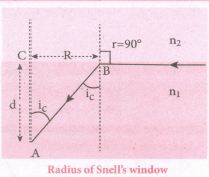
(iv) Light is seen from a point A at a depth 'd'.
(v) From the Snell's law in product form, n1 sini = n2 sinr
(vi) The equation for the refraction happening at the point B on the boundary between the two media is,
n1 sin ic = n2 sin90o ..(1)
n1sinic = n2 (∵ sin90o = 1)
\(sin{ i }_{ c }=\cfrac { { n }_{ 2 } }{ { n }_{ 1 } } \) ...(2)
From the right angle triangle ΔABC,
\({ sini }_{ c }=\cfrac { CB }{ AB } =\cfrac { R }{ \sqrt { { d }^{ 2 }+{ R }^{ 2 } } } \) ....(3)
Equating the above two equation
\(\cfrac { R }{ \sqrt { { d }^{ 2 }+{ R }_{ 2 } } } =\cfrac { { n }_{ 2 } }{ { n }_{ 1 } } \)
Squaring on both sides
\(\cfrac { { R }^{ 2 } }{ { R }^{ 2 }+d^{ 2 } } \left( \cfrac { { n }_{ 2 } }{ { n }_{ 1 } } \right) ^{ 2 }\)
Taking reciprocal,
\(\cfrac { { R }^{ 2 }+{ d }^{ 2 } }{ { R }^{ 2 } } =\left( \cfrac { { n }_{ 1 } }{ { n }_{ 2 } } \right) ^{ 2 }\)
On further simplifying
\(1+\cfrac { { d }^{ 2 } }{ { R }^{ 2 } } =\left( \cfrac { { n }_{ 1 } }{ { n }_{ 2 } } \right) ^{ 2 };\cfrac { { d }^{ 2 } }{ { R }^{ 2 } } =\left( \cfrac { { n }_{ 1 } }{ { n }_{ 2 } } \right) ^{ 2 }-1;\)
\(\cfrac { { d }^{ 2 } }{ { R }^{ 2 } } =\cfrac { { n }_{ 1 }^{ 2 } }{ { n }_{ 1 }^{ 2 } } -1=\cfrac { { n }_{ 1 }^{ 2 }-{ n }_{ 2 }^{ 2 } }{ { n }_{ 2 }^{ 2 } } \)
Again taking reciprocal and rearranging
\(\cfrac { { R }^{ 2 } }{ { d }^{ 2 } } =\cfrac { { { n }_{ 2 }^{ 2 } } }{ { n }_{ 1 }^{ 2 }-{ n }_{ 2 }^{ 2 } } { R }^{ 2 }={ d }^{ 2 }\left( \cfrac { { n }_{ 2 }^{ 2 } }{ { n }_{ 1 }^{ 2 }-{ n }_{ 2 }^{ 2 } } \right) \)
∴ The radius of illumination is,
\(R=d\sqrt { \cfrac { { n }_{ 2 }^{ 2 } }{ \left( n_{ 1 }^{ 2 }-{ n }_{ 2 }^{ 2 } \right) } } \) ...(4)
If the rarer medium outside is air, then, n2 = 1, and we can take n1 = n
\(R=d\left( \cfrac { 1 }{ \sqrt { { n }^{ 2 }-1 } } \right) \) or \(R=\cfrac { d }{ \sqrt { { n }^{ 2 }-1 } } \) ....(5)

12th Standard Syllabus & Materials
12th Standard
TN 12th Computer Applications களப்பெயர் முறைமை (DNS) Sample Question Papers Study Material - QB365 Set A
NEW12th Standard
TN 12th Computer Applications வலையமைப்பு எடுத்துக்காட்டுகள் மற்றும் நெறிமுறைகள் Sample Question Papers Study Material - QB365 Set A
NEW12th Standard
TN 12th Computer Applications கணினி வலையமைப்பு ஓர் அறிமுகம் Sample Question Papers Study Material - QB365 Set A
NEW12th Standard
TN 12th Computer Applications PHP-உடன் MySQL-ஐ இணைத்தல் Sample Question Papers Study Material - QB365 Set A



Tamilnadu Stateboard 12th Standard Subjects

Maths

Chemistry
Physics

Biology

Computer Science

Business Maths and Statistics

Economics

Commerce

Accountancy

History

Computer Applications
Biology
Computer Technology
Computer Applications
Computer Science
Business Maths and Statistics
Commerce
Economics
Maths
Chemistry
Physics
Computer Technology
History
Accountancy

Tamil

English

French
Tamilnadu Stateboard Standards

