
 100% FREE ACCESS
12th Standard Syllabus & Materials
12th Standard
TN 12th Computer Applications மின்னணு தரவு பரிமாற்றம் Sample Question Papers Study Material - QB365 Set A
NEW12th Standard
TN 12th Computer Applications மின் - வணிக பாதுகாப்பு அமைப்புகள் Sample Question Papers Study Material - QB365 Set A
NEW12th Standard
TN 12th Computer Applications மின்னணு செலுத்தல் முறைகள் Sample Question Papers Study Material - QB365 Set A
NEW12th Standard
TN 12th Computer Applications மின் - வணிகம் Sample Question Papers Study Material - QB365 Set A
NEW12th Standard
TN 12th Computer Applications திறந்த மூல கருத்துருக்கள் Sample Question Papers Study Material - QB365 Set A
NEW12th Standard
TN 12th Computer Applications வலையமைப்பு வடமிடல் Sample Question Papers Study Material - QB365 Set A

Published on: 03/12/2019
Optics
Download Tamil Nadu 12th Standard Physics question papers, model tests, one-mark questions, important questions, and public exam papers in PDF format. Free study materials and answer keys for TN State Board students.
Questions + Answers key
Take MCQ Physics Test1.
A man runs towards a mirror at a speed 15m/s. The speed of the image relative to the man is _______________.
15 ms-1
30 ms-1
35 ms-1
20 ms-1
2.
A man of length h requires a mirror of length at least equal to, to see his own complete image is _______________.
\(\cfrac { h }{ 4 } \)
\(\cfrac { h }{ 2 } \)
\(\cfrac { h }{ 2 } \)
h
3.
A ray of light travelling in a transparent medium of refractive index n falls, on a surface separating the medium from air at an angle of incidents of 45o . The ray can undergo total internal reflection for the following n, ______.
n = 1.25
n = 1.33
n = 1.4
n = 1.5
4.
Stars twinkle due to, ______.
reflection
total internal reflection
refraction
polarisation
5.
If the velocity and wavelength of light in air is Va and λa and that in water is Vw and λw, then the refractive index of water is______.
\(\frac{V_W}{V_a}\)
\(\frac{V_a}{V_W}\)
\(\frac{\lambda_W}{\lambda_a}\)
\(\frac{{V_a}\lambda_a}{{V_W}\lambda_W}\)
6.
What is thin lens?
7.
Write the drawbacks of Nicol prism.
8.
If the distance D between an object and screen is greater than 4 times the focal length f of a convex lens, then there are two positions for which the lens forms an enlarged image and a diminished image respectively. This method is called conjugate foci method. If d is the distance between the two positions of the lens, obtain the equation for focal length of the convex lens.
9.
Obtain the equation for apparent depth.
10.
Write the two conditions for total internal reflection.
11.
Define focal length.
12.
A beam of light of wavelength 600 nm from a distant source falls on a single slit 1 mm wide and the resulting diffraction pattern is observed on a screen 2 m away. What is the distance between the first dark fringes on either side of the central bright fringe?
13.
What are the sign conventions followed for lenses?
14.
Why do stars twinkle?
15.
Discuss the experiment to determine the wavelength of monochromatic light using diffraction grating.
16.
What is dispersion? Obtain the equation for dispersive power of a medium.
17.
Derive the equation for angle of deviation produced by a prism and thus obtain the equation for refractive index of material of the prism.
1.
(b)
30 ms-1
2.
(a)
\(\cfrac { h }{ 4 } \)
3.
For total internal reflection,
sin i > sin c
\(n=\frac{1}{sin \ c}\)
\(sin \ c=\frac{1}{n}\)
\(sin \ i>\frac{1}{n}\)
\(n>\frac{1}{sin \ i}\)
n >\(\sqrt{2}\)
n >1.414 = 1.5
4.
(c)
refraction
5.
Refractive index of water \(=\frac{Velocity \ of \ light \ in \ air(V_s)}{Velocity \ of \ light \ in \ water(V_w)}\)
6.
(i) A lens is formed by a transparent material bounded between two spherical surfaces or one plane and another spherical surface.
(ii) In a thin lens, the distance between the surfaces is very small. If there are two spherical surfaces, then there will be two centers of curvature C1 and C2 and correspondingly two radii of curvature R1 and R2.
(iii) A plane surface has its center of curvature C at infinity and its radius of curvature R is infinity (R = ∞).
7.
(i) Its cost is very high due to scarity of large and flawless calcite crystals
(ii) Due to extraordinary ray passing obliquely through it the emergent ray is always displaced a little to one side.
(iii) The effective field of view is quite limited
(iv) Light emerging out of it is not uniformly plane polarised.
8.
From figure,
D = u + v
d = r - u
D + d = u + v + v - u
D + d = 2v
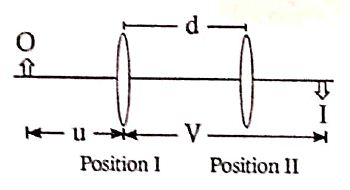
\(v=\frac{D+d}{2}\)
D - d = u + v - v + u = 2u
\(v=\frac{D-d}{2}\)
\(\frac{1}{f}=\frac{1}{v}-\frac{1}{u} \)
\(\frac{1}{f} =\frac{1}{\frac{D+d}{2}}-\frac{1}{\frac{D-d}{2}} \)
\(=\frac{2}{D+d}-\frac{2}{D-d} \)
\(=\frac{2[D-d+D+d]}{D^{2}-d^{2}} \)
\(=\frac{2 \times 2 D}{D^{2}-d^{2}} \)
\(\frac{1}{f} =\frac{4 D}{D^{2}-d^{2}} \quad \therefore f=\frac{D^{2}-d^{2}}{4 D} \)
9.
(i) Light from the object O at the bottom of the tank passes from denser medium (water) to rarer medium (air) to reach our eyes for viewing the object.
(ii) It deviates away from the normal in the rarer medium at the point of incidence B as shown in Figure.
(iii) The refractive index of the denser medium is n1 and that of rarer medium is n2. Here, n1 > n2.
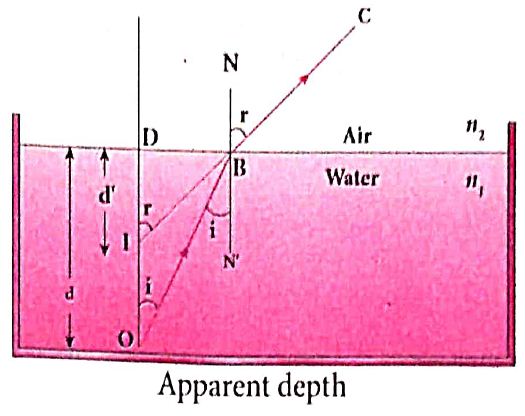
The angle of incidence in the denser medium is i and the angle of refraction in the rarer medium is r. The lines NN'and OD are parallel. Thus, the angle ∠DIB is also r. The angles i and r are very small as the diverging light from O entering the eye is very narrow. The Snell's law in product form for this refraction from equation is,
n1 sin i = n2 sin r
As the angles i and r are small, we can approximate, sin i = tan i and sin r tan r.
n1 tan i = n2 tan r
In triangles ∆DOB and ∆DIB,
\(tan \ i=\frac{DB}{DO}and \ tan \ r=\frac{DB}{DI}\)
\(n_1\frac{DB}{DO}=n_2\frac{DB}{DI}\)
DB is cancelled both sides. Now, DO is the actual depth d and DI is the apparent depth d'.
\(n_1\frac{1}{d}=n_2\frac{1}{d'}\)
After rearranging, \(\frac{d'}{d}=\frac{n_2}{n_1}\)
Rewriting the above equation for the apparent depth d', d' = \(=\frac{n_2}{n_1}d\)
As the rarer medium is air, its refractive index n, can be taken as 1, (n2 = 1) and the refractive index n1 of denser medium could then be taken as n itself, (n1 = n). Now, the equation for apparent depth becomes,
\(d'=\frac{d}{n}\)
The bottom appears to be elevated by d-d',
\(d-d'=d-\frac{d}{n}(or)d-d'=d(1-\frac{1}{n})\)
10.
(i) Light must travel from denser to rarer medium,
(ii) Angle of incidence in the denser medium must be greater than critical angle (i > ic).
11.
The distance between the pole and the focus is called the focal length (f) of the mirror.
12.
⋋2 = 600 x 10-9 m, ⇒ d = 1 x 10⁻³ m, D =2m
n⋋ = dsinθ
For first dark fringe
n = 1 For minimum
d sinθ = ⋋, here
CO = Nc (approximately)
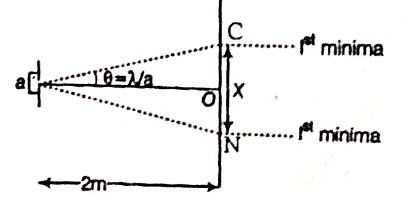
From Fig, sinθ \(=\frac{x/2}{D} =x/2D\)
\(sin \theta =\frac{ \lambda}{d} \)
\(\lambda/d=x/2D\)
\(\therefore x =\frac{2D\lambda}{d}=\frac{2 \times 2 \times 600\times 10^{-9}}{ 10^{-3}} \)
\(x=2.4 \times10^{-3}m =2.4\mathrm{~mm} \)
13.
Sign conventions for lens
(i) The sign of focal length is not decided on the direction of measurement of the focal length from the pole of the lens as they have two focal lengths, one to the left and another to the right.
(ii) The focal length of the thin lens is taken as positive for a converging lens and negative for a diverging lens.
(iii) The other sign conventions for object. distance, image distance, radius of curvature, object height and image height remain the same for thin lenses as that of spherical mirrors.
14.
Stars appear twinkling because of the movement of the atmospheric layer with varying refractive indices due to refraction.
15.
(i) The wavelength of a spectral line can be very accurately determined with the help of a diffraction grating. For that we need to use an instrument called spectrometer.
(ii) The slit of collimator is illuminated by a monochromatic light, whose wavelength is to be determined.
(iii) The telescope is brought in line with collimator to view the image of the slit.
(iv) The given plane transmission grating is then mounted on the prism table with its plane perpendicular to the incident beam of light coming from the collimator.
(v)The telescope is turned to one side until the first order diffraction image of the slit coincides with the vertical cross wire of the eye piece.
(vi) The reading of the position of the telescope is noted.
(vii) Similarly the first order diffraction image on the other side is made to coincide with the vertical cross wire and corresponding reading is noted.
(viii) The difference between two positions gives 2θ. Half of its value gives θ, the diffraction angle for first order maximum as shown in Figure.
The wavelength of light is calculated from the equation.
\(\\ \lambda =\cfrac { sin\theta }{ Nm } \)
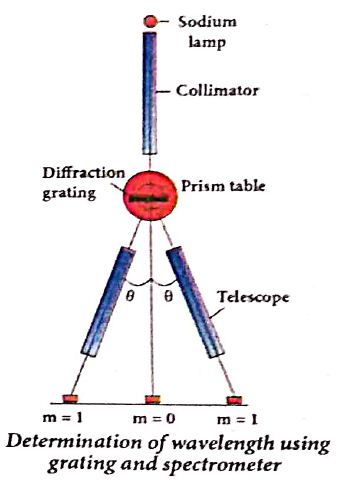
(ix) Here, N is the number of rulings per metre in the grating and m is the order of the diffraction image.
16.
Dispersion: It is splitting of white light into its constituent colours.
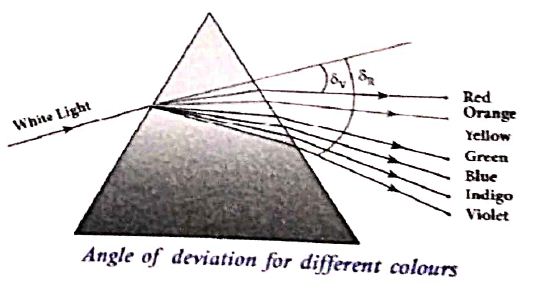
(i) Consider a beam of white light passes through a prism; it gets dispersed into its constituent colours as shown in Figure.
(ii) Let \(\delta_{v}, \delta_{R} \) are the angles of deviation for violet and red light. Let nV and nR are the refractive indices for the violet and red light respectively
(iii) The refractive index of the material of a prism is given by the equation
\(\mathrm{n}=\frac{\sin \left(\frac{\mathrm{A}+\mathrm{D}}{2}\right)}{\sin (\mathrm{A} / 2)}\)
(iv) Here A is the angle of the prism and D is the angle of minimum deviation. If the angle of prism is small of the order of 10o, the prism is said to be a small angle prism.
(v) When rays of light pass through such prisms, the angle of deviation also becomes small. If A be the angle of a smitt angle prism and the angle of deviation then the prism formula becomes.
\(n=\frac{\sin \left(\frac{A+\delta}{2}\right)}{\sin (A / 2)}\)
For small angles of \(A\ and \ \delta \)
\(\sin \frac{A+\delta}{A} \approx \frac{A+\delta}{A} \)
\(\sin \frac{A}{2} \approx \frac{A}{2} \)
\(n=\frac{(A+\delta / 2)}{(A / 2)}=\frac{A+\delta}{A}=1+\frac{\delta}{A} \)
Further simplifying,
\(\frac{\delta}{A} =n-1 \)
\(\delta =(n-1) A \) .....(1)
(vi) When white light enters the prism, the deviation is different for different colours. Thus, the refractive index is also different for different colours
For Violet colour, \( \delta_{\mathrm{v}}=\left(\mathrm{n}_{\mathrm{v}}-1\right) \mathrm{A} \) ...(2)
For Red colour, \(\delta_{\mathrm{R}}=\left(\mathrm{n}_{\mathrm{R}}-1\right) \mathrm{A} \) ....(3)
(vii) As, angle of deviation for violet colour \(\delta_{v}\) is greater the angle of deviation for red colour \(\delta_{\mathrm{R}}\) the refractive index for violet colour nv is greater than the refractive index for red colour nR Subtracting \(\delta_{v}\) from \(\delta_{\mathrm{R}}\) we get
\(\delta_{\mathrm{v}}-\delta_{\mathrm{R}}=\left(\mathrm{n}_{\mathrm{v}}-\mathrm{n}_{\mathrm{R}}\right) \mathrm{A}\) ....(4)
(viii) The term \(\left(\delta_{v}-\delta_{R}\right)\) is the angular separation between the two extreme colours (violet and red) in the spectrum is called the angular dispersion. If we take \(\delta\) is the angle of deviation for any middly ray (green or yellow) and the corresponding refractive index. Then,
\(\delta=(n-1) A\) .....(5)
Dispersive power (ω):
It is the ability of the material of the prism to cause dispersion. It is defined as the ratio of the angular dispersion for the extreme colours to the deviation for any mean colour.
Dispersive power
\(\omega=\frac{\text { Angular dispersion }}{\text { Mean deviation }}=\frac{\delta_{v}-\delta_{R}}{\delta}\) ....(6)
Substituting \(\left(\delta_{\mathrm{v}}-\delta_{\mathrm{R}}\right) \text { and }(\delta) \)
\(\omega=\frac{\mathrm{n}_{\mathrm{v}}-\mathrm{n}_{\mathrm{R}}}{(\mathrm{n}-1)} \) .......(7)
(ix) Dispersive power is a dimensionless quality It has no unit. Dispersive power is always positive. The dispersive power of a prism depends only on the nature of material of the prism and it is independent of the angle of the prism.
17.
Angle of deviation Produced by Prism:
(i) Let light ray PQ is incident on one of the refracting faces of the prism.
(ii) The angles of incidence and refraction at the first face AB are i1 and rl. The path of the light inside the prism is QR.
(iii) The angle of incidence and refraction at the second face AC is r2 and i2 respectively.
(iv) RS is the ray emerging from the second face. Angle i2 is also caned angle of emergence.
(v) The angle between the direction of the incident ray PQ and the emergent ray RS is called the angle of deviation d.
(vi) The two normals drawn at the point of incidence Q and emergence R meet at point N. They meet at point N.
(vii) The extended incident ray and the emergent ray meet at a point M.
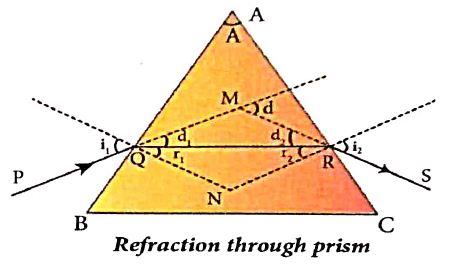
The angle of deviation d1 at the surface AB is,
ㄥRQM = d = i1 - r1 ...(1)
The angle of deviation d2 at the surface AC is
ㄥQRM = d2 = i2 - r2 .......(2)
Total angle of deviation d produced is,
d = d1 + d2 .....(3)
Substituting for d1 and d2 in equation (3)
d = (i1 - r1) + (i2 - r2)
After rearranging,
d = (i1 - r1) + (i2 - r2) ........(4)
In the quadrilateral AQNR, two of the angles (at the vertices Q and R) are right angles. Therefore, the sum of the other angles of the quadrilateral is 180°.
\(\angle A+\angle QNR={ 180 }^{ 0 }\) .........(5)
From the triangle ΔQNR
\({ r }_{ 1 }+{ r }_{ 2 }+\angle QNR={ 180 }^{ o }\) ......(6)
Comparing these two equations (5) and (6) we get,
r1 + r2 = A .......(7)
Substituting this in equation (4) for angle of deviation,
d = i1+ i2 - A .............(8)
(viii) Thus, the angle of deviation depends on the angle of incidence i1, angle of emergence i2 and the angle for the prism A.
(ix) For a given angle of incidence the angle of emergence is decided by the refractive index of the material of the prism. Hence the angle of deviation depends on these following factors.
(i) the angle of incidence
(ii) the angle of the prism.
(iii) the refractive index of the material of the prism (which decides the angle of emergence).
Refractive index of the material of the prism:
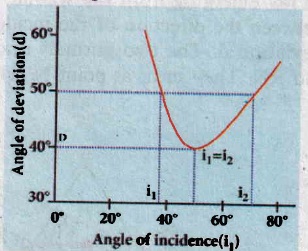
At minimum deviation, i1 = i2 = i and r1 = r2 = r
Now, the equation (8) becomes,
D - i1 + i2 - A = 2i - A (or) \(i=\cfrac { \left( A+D \right) }{ 2 } \)
The equation (7) becomes
r1 + r2 = A ⇒ 2r = A (or) \(r=\cfrac { A }{ 2 } \)
Substituting i and r in Snell's law
\(n=\cfrac { sini }{ sinr } \)
\(n=\cfrac{\cfrac{sin(A+D)}{2}}{sin(A/2)}\)

12th Standard Syllabus & Materials
12th Standard
TN 12th Computer Applications களப்பெயர் முறைமை (DNS) Sample Question Papers Study Material - QB365 Set A
NEW12th Standard
TN 12th Computer Applications வலையமைப்பு எடுத்துக்காட்டுகள் மற்றும் நெறிமுறைகள் Sample Question Papers Study Material - QB365 Set A
NEW12th Standard
TN 12th Computer Applications கணினி வலையமைப்பு ஓர் அறிமுகம் Sample Question Papers Study Material - QB365 Set A
NEW12th Standard
TN 12th Computer Applications PHP-உடன் MySQL-ஐ இணைத்தல் Sample Question Papers Study Material - QB365 Set A



Tamilnadu Stateboard 12th Standard Subjects

Maths

Chemistry
Physics

Biology

Computer Science

Business Maths and Statistics

Economics

Commerce

Accountancy

History

Computer Applications
Biology
Computer Technology
Computer Applications
Computer Science
Business Maths and Statistics
Commerce
Economics
Maths
Chemistry
Physics
Computer Technology
History
Accountancy

Tamil

English

French
Tamilnadu Stateboard Standards

