
 100% FREE ACCESS
12th Standard Syllabus & Materials
12th Standard
TN 12th Computer Applications மின்னணு தரவு பரிமாற்றம் Sample Question Papers Study Material - QB365 Set A
NEW12th Standard
TN 12th Computer Applications மின் - வணிக பாதுகாப்பு அமைப்புகள் Sample Question Papers Study Material - QB365 Set A
NEW12th Standard
TN 12th Computer Applications மின்னணு செலுத்தல் முறைகள் Sample Question Papers Study Material - QB365 Set A
NEW12th Standard
TN 12th Computer Applications மின் - வணிகம் Sample Question Papers Study Material - QB365 Set A
NEW12th Standard
TN 12th Computer Applications திறந்த மூல கருத்துருக்கள் Sample Question Papers Study Material - QB365 Set A
NEW12th Standard
TN 12th Computer Applications வலையமைப்பு வடமிடல் Sample Question Papers Study Material - QB365 Set A

Published on: 30/10/2019
Optics
Download Tamil Nadu 12th Standard Physics question papers, model tests, one-mark questions, important questions, and public exam papers in PDF format. Free study materials and answer keys for TN State Board students.
Questions + Answers key
Take MCQ Physics Test1.
2.
Light transmitted by Nicol prism is, _____.
partially polarised
unpolarised
plane polarised
elliptically polarised
3.
A ray of light strikes a glass plate at an angle 60o. If the reflected and refracted rays are perpendicular to each other, the refractive index of the glass is, _____.
\(\sqrt3\)
\(\frac{3}{2}\)
\(\sqrt{\frac{3}{2}}\)
2
4.
When light is incident on a soap film of thickness 5 x 10⁻⁵ cm, the wavelength of light reflected maximum in the visible region is 5320 Å. Refractive index of the film will be, _____.
1.22
1.33
1.51
1.83
5.
Two coherent monochromatic light beams of intensities I and 4I are superposed. The maximum and minimum possible intensities in the resulting beam are _____.
5I and I
5I and 3I
9I and I
9I and 3I
6.
A plane glass is placed over a various coloured letters (violet, green, yellow, red) The letter which appears to be raised more is _____.
red
yellow
green
violet
7.
The radius of curvature of curved surface at a thin planoconvex lens is 10 cm and the refractive index is 1.5. If the plane surface is silvered, then the focal length will be, ______.
5 cm
10 cm
15 cm
20 cm
8.
When a biconvex lens of glass having refractive index 1.47 is dipped in a liquid, it acts as plane sheet of glass. This implies that the liquid must have refractive index, ______.
less than one
less than that of glass
greater than that of glass
equal to that of glass
9.
If the velocity and wavelength of light in air is Va and λa and that in water is Vw and λw, then the refractive index of water is______.
\(\frac{V_W}{V_a}\)
\(\frac{V_a}{V_W}\)
\(\frac{\lambda_W}{\lambda_a}\)
\(\frac{{V_a}\lambda_a}{{V_W}\lambda_W}\)
10.
11.
What are the sign conventions followed for lenses?
12.
What is Snell’s window?
13.
Explain the reason for the glittering of diamond.
14.
Why do stars twinkle?
15.
What is principle of reversibility?
16.
What is dispersion? Obtain the equation for dispersive power of a medium.
17.
Derive the equation for angle of deviation produced by a prism and thus obtain the equation for refractive index of material of the prism.
18.
Obtain lens maker’s formula and mention its significance.
19.
Derive the equation for refraction at single spherical surface.
20.
Obtain the equation for lateral displacement of light passing through a glass slab.
1.
(d)
2.
(c)
plane polarised
3.
n = tan ip = tan 60o = \(\sqrt{3}\)
4.
2n t cos r = (2m + 1) \(\frac{\lambda}{2}\)
For maximum
m = 2 (For visible region), n - refractive index.
cos r = cos 0 = 1
t = 5 x 10-5 x 10-2 = 5 x 10⁻⁷ m
\(n=\frac{(2m+1)\frac{\lambda}{2}}{2t}=\frac{5\lambda}{2 \times 2 \times t}\)
\(=\frac{5 \times5320\times10^{-10}}{4 \times 5 \times 10^{-7}}\)
\(=\frac{5 \times5320\times10^{-10}}{20}=1330 \times 10^3\)
n = 1.330
5.
I = l1 + l2 + 2\(\sqrt{I_1I_2}\)cos θ
If cos θ = cos 0 = l, I is max
= I+ 4I + 2\(\sqrt{41^2}\) cos 0
= 5I + 4I = 91
If cos π = -1, I is min
Imin = I + 4I + 2\(\sqrt{41^2}\) cos π
= 5I + 4I(-1)
= 5I + 4I = I
(Imax, Imin)= (9I, I)
6.
Refractive index for violet is more and wavelength for violet is very low comparing other colours. So, the letter which appears to be raised more is violet.
7.
\(\frac{1}{f} =(n-1)\left(\frac{1}{R_1}-\frac{1}{R_2}\right) \)
\(=(1.5-1)\left(\frac{1}{\infty}-\frac{1}{(-10)}\right)\)
(Since plano convex lens)
\(=0.5\left[\frac{1}{10}\right]=\frac{1}{20} \)
\(\mathrm{f}_t =20 \mathrm{~cm}\)
Formula for silvered lenses
\(\frac{1}{\mathrm{~F}} =\frac{2}{\mathrm{f}_1}+\frac{1}{\mathrm{f}_m} \)
\(\frac{1}{\mathrm{~F}} =\frac{2}{20}+\frac{1}{\infty} \)
\(\therefore \mathrm{F} =\frac{20}{2}=10 \mathrm{~cm}\)
8.
\(\frac{I}{f}=\left(\frac{\mu_{\mathrm{L}}}{\mu_L}-1\right)\left(\frac{1}{R_1}-\frac{1}{R_2}\right)\)
When the biconvex lens of glass dipped in liquid, it acts as a plane sheet of glass.
\(\therefore \mathrm{f}=\infty, \frac{1}{\mathrm{f}}=0 \quad \frac{\mu_g}{\mu_{\mathrm{L}}}-1=0 ; \frac{\mu_{\mathrm{s}}}{\mu_{\mathrm{L}}}=1, \mu_{\mathrm{s}}=\mu_{\mathrm{L}}\)
9.
Refractive index of water \(=\frac{Velocity \ of \ light \ in \ air(V_s)}{Velocity \ of \ light \ in \ water(V_w)}\)
10.
(a)
11.
Sign conventions for lens
(i) The sign of focal length is not decided on the direction of measurement of the focal length from the pole of the lens as they have two focal lengths, one to the left and another to the right.
(ii) The focal length of the thin lens is taken as positive for a converging lens and negative for a diverging lens.
(iii) The other sign conventions for object. distance, image distance, radius of curvature, object height and image height remain the same for thin lenses as that of spherical mirrors.
12.
When light entering the water from outside is seen from inside the water, the view is restricted to a particular angle equal to the critical angle ic. The restricted illuminated circular area is called Snell's window
13.
Diamond appears glittering because the total internal reflection of light.
Inside the diamond the refractive index of diamond is about 2.417 which is greater than the refractive index of glass. (μg =1.5). The critical angle of diamond is 24.4d which is much less than that of glass (gcrown = 40.5°, gflint 31.9°).
So, when the light enters the diamond, the total internal reflection of light happens inside the diamond before getting out. This gives a sparkling effect for diamond.
14.
Stars appear twinkling because of the movement of the atmospheric layer with varying refractive indices due to refraction.
15.
The principle of reversibility states that light will follow exactly the same path if its direction of travel is reversed.
16.
Dispersion: It is splitting of white light into its constituent colours.
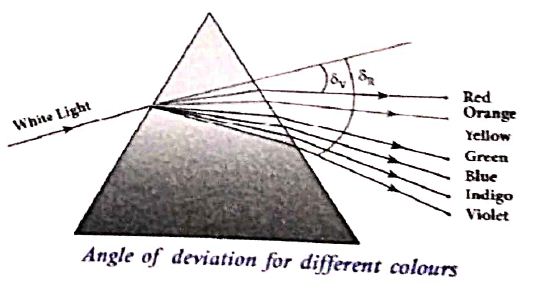
(i) Consider a beam of white light passes through a prism; it gets dispersed into its constituent colours as shown in Figure.
(ii) Let \(\delta_{v}, \delta_{R} \) are the angles of deviation for violet and red light. Let nV and nR are the refractive indices for the violet and red light respectively
(iii) The refractive index of the material of a prism is given by the equation
\(\mathrm{n}=\frac{\sin \left(\frac{\mathrm{A}+\mathrm{D}}{2}\right)}{\sin (\mathrm{A} / 2)}\)
(iv) Here A is the angle of the prism and D is the angle of minimum deviation. If the angle of prism is small of the order of 10o, the prism is said to be a small angle prism.
(v) When rays of light pass through such prisms, the angle of deviation also becomes small. If A be the angle of a smitt angle prism and the angle of deviation then the prism formula becomes.
\(n=\frac{\sin \left(\frac{A+\delta}{2}\right)}{\sin (A / 2)}\)
For small angles of \(A\ and \ \delta \)
\(\sin \frac{A+\delta}{A} \approx \frac{A+\delta}{A} \)
\(\sin \frac{A}{2} \approx \frac{A}{2} \)
\(n=\frac{(A+\delta / 2)}{(A / 2)}=\frac{A+\delta}{A}=1+\frac{\delta}{A} \)
Further simplifying,
\(\frac{\delta}{A} =n-1 \)
\(\delta =(n-1) A \) .....(1)
(vi) When white light enters the prism, the deviation is different for different colours. Thus, the refractive index is also different for different colours
For Violet colour, \( \delta_{\mathrm{v}}=\left(\mathrm{n}_{\mathrm{v}}-1\right) \mathrm{A} \) ...(2)
For Red colour, \(\delta_{\mathrm{R}}=\left(\mathrm{n}_{\mathrm{R}}-1\right) \mathrm{A} \) ....(3)
(vii) As, angle of deviation for violet colour \(\delta_{v}\) is greater the angle of deviation for red colour \(\delta_{\mathrm{R}}\) the refractive index for violet colour nv is greater than the refractive index for red colour nR Subtracting \(\delta_{v}\) from \(\delta_{\mathrm{R}}\) we get
\(\delta_{\mathrm{v}}-\delta_{\mathrm{R}}=\left(\mathrm{n}_{\mathrm{v}}-\mathrm{n}_{\mathrm{R}}\right) \mathrm{A}\) ....(4)
(viii) The term \(\left(\delta_{v}-\delta_{R}\right)\) is the angular separation between the two extreme colours (violet and red) in the spectrum is called the angular dispersion. If we take \(\delta\) is the angle of deviation for any middly ray (green or yellow) and the corresponding refractive index. Then,
\(\delta=(n-1) A\) .....(5)
Dispersive power (ω):
It is the ability of the material of the prism to cause dispersion. It is defined as the ratio of the angular dispersion for the extreme colours to the deviation for any mean colour.
Dispersive power
\(\omega=\frac{\text { Angular dispersion }}{\text { Mean deviation }}=\frac{\delta_{v}-\delta_{R}}{\delta}\) ....(6)
Substituting \(\left(\delta_{\mathrm{v}}-\delta_{\mathrm{R}}\right) \text { and }(\delta) \)
\(\omega=\frac{\mathrm{n}_{\mathrm{v}}-\mathrm{n}_{\mathrm{R}}}{(\mathrm{n}-1)} \) .......(7)
(ix) Dispersive power is a dimensionless quality It has no unit. Dispersive power is always positive. The dispersive power of a prism depends only on the nature of material of the prism and it is independent of the angle of the prism.
17.
Angle of deviation Produced by Prism:
(i) Let light ray PQ is incident on one of the refracting faces of the prism.
(ii) The angles of incidence and refraction at the first face AB are i1 and rl. The path of the light inside the prism is QR.
(iii) The angle of incidence and refraction at the second face AC is r2 and i2 respectively.
(iv) RS is the ray emerging from the second face. Angle i2 is also caned angle of emergence.
(v) The angle between the direction of the incident ray PQ and the emergent ray RS is called the angle of deviation d.
(vi) The two normals drawn at the point of incidence Q and emergence R meet at point N. They meet at point N.
(vii) The extended incident ray and the emergent ray meet at a point M.
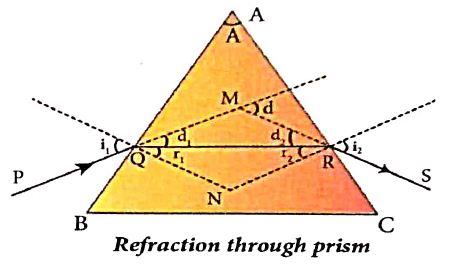
The angle of deviation d1 at the surface AB is,
ㄥRQM = d = i1 - r1 ...(1)
The angle of deviation d2 at the surface AC is
ㄥQRM = d2 = i2 - r2 .......(2)
Total angle of deviation d produced is,
d = d1 + d2 .....(3)
Substituting for d1 and d2 in equation (3)
d = (i1 - r1) + (i2 - r2)
After rearranging,
d = (i1 - r1) + (i2 - r2) ........(4)
In the quadrilateral AQNR, two of the angles (at the vertices Q and R) are right angles. Therefore, the sum of the other angles of the quadrilateral is 180°.
\(\angle A+\angle QNR={ 180 }^{ 0 }\) .........(5)
From the triangle ΔQNR
\({ r }_{ 1 }+{ r }_{ 2 }+\angle QNR={ 180 }^{ o }\) ......(6)
Comparing these two equations (5) and (6) we get,
r1 + r2 = A .......(7)
Substituting this in equation (4) for angle of deviation,
d = i1+ i2 - A .............(8)
(viii) Thus, the angle of deviation depends on the angle of incidence i1, angle of emergence i2 and the angle for the prism A.
(ix) For a given angle of incidence the angle of emergence is decided by the refractive index of the material of the prism. Hence the angle of deviation depends on these following factors.
(i) the angle of incidence
(ii) the angle of the prism.
(iii) the refractive index of the material of the prism (which decides the angle of emergence).
Refractive index of the material of the prism:
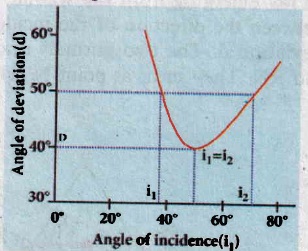
At minimum deviation, i1 = i2 = i and r1 = r2 = r
Now, the equation (8) becomes,
D - i1 + i2 - A = 2i - A (or) \(i=\cfrac { \left( A+D \right) }{ 2 } \)
The equation (7) becomes
r1 + r2 = A ⇒ 2r = A (or) \(r=\cfrac { A }{ 2 } \)
Substituting i and r in Snell's law
\(n=\cfrac { sini }{ sinr } \)
\(n=\cfrac{\cfrac{sin(A+D)}{2}}{sin(A/2)}\)
18.
(i) Let us consider a thin lens made up of a medium of refractive index n2 is placed in a medium of refractive index n1. Let R1 and R2 be the radii of curvature of two spherical surfaces (1) and (2) respectively and P be the pole.
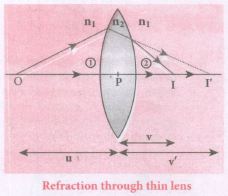
(ii) Consider a point object 'O' on the principal axis. A paraxial ray from 'O' which falls very close to P, after refraction at the surface (1) forms image at 1'.
(iii) Before it does so, it is again refracted by the surface (2). Therefore the final image is formed at I.
(iv) The general equation for the refraction at a single spherical surface is given from Equation,
\(\cfrac { { n }_{ 2 } }{ v } -\cfrac { { n }_{ 1 } }{ v} =\cfrac { \left( { n }_{ 2 }-{ n }_{ 1 } \right) }{ { R } } \)
For the refracting surface (1), the light goes from n1 to n2
\(\cfrac { { n }_{ 2 } }{ v' } -\cfrac { { n }_{ 1 } }{ u } =\cfrac { \left( { n }_{ 2 }-{ n }_{ 1 } \right) }{ { R }_{ 1 } } \) .....(1)
For the refracting surface (2), the light goes from n2 to n1
\(\frac{n_{1}}{v}+\frac{n_{2}}{v^{\prime}}=\frac{\left(n_{1}-n_{2}\right)}{R_{2}}\) ......(2)
For surface (2) I' acts as virtual object.
Adding the above two equations (1) and (2)
\(\cfrac { { n }_{ 1 } }{ v } -\cfrac { { n }_{ 1 } }{ u } =\left( { n }_{ 2 }-{ n }_{ 1 } \right) \left( \cfrac { 1 }{ { R }_{ 1 } } -\cfrac { 1 }{ { R }_{ 2 } } \right) \)
on further simplifying and rearranging,
\(\cfrac { 1 }{ v } -\cfrac { 1 }{ u } =\left( \cfrac { { n }_{ 2 }-{ n }_{ 1 } }{ { n }_{ 1 } } \right) \left( \cfrac { 1 }{ { R }_{ 1 } } -\cfrac { 1 }{ { R }_{ 2 } } \right) \)
\(\cfrac { 1 }{ v } -\cfrac { 1 }{ u } =\left( \cfrac { { n }_{ 2 } }{ n_{ 1 } } -1 \right) \left( \cfrac { 1 }{ { R }_{ 1 } } -\cfrac { 1 }{ { R }_{ 2 } } \right) \) ....(3)
If the object is at infinity, the image is formed at the focus of the lens. Thus, for u = \(\infty\), v = f. Then the equation becomes.
\(\cfrac { 1 }{ f } -\cfrac { 1 }{ \infty } =\left( \cfrac { { n }_{ 2 } }{ { { n }_{ 1 } } } -1 \right) \left( \cfrac { 1 }{ { R }_{ 1 } } -\cfrac { 1 }{ { R }_{ 2 } } \right) \)
\(\cfrac { 1 }{ f } =\left( \cfrac { { n }_{ 2 } }{ { n }_{ 1 } } -1 \right) \left( \cfrac { 1 }{ { R }_{ 1 } } -\cfrac { 1 }{ { R }_{ 2 } } \right) \) ......(4)
If the lens is kept in air, then we can take n2 = n and n1 = 1. So the equation (4) becomes,
\(\\ \cfrac { 1 }{ f } =\left( n-1 \right) \left( \cfrac { 1 }{ { R }_{ 1 } } -\cfrac { 1 }{ { R }_{ 2 } } \right) \) ..(5)
The above equation is called the lens maker's formula.
Significance:
It tells the lens manufacturers what curvature is needed to make a lens of desired focal length with a material of particular refractive index to make a lens of desired focal length. This formula holds good also for a concave lens.
19.
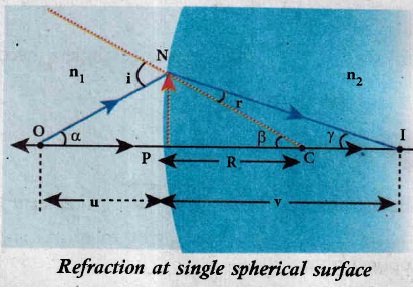
(i) Let us consider two transparent media with refractive indices n, and n, which are separated by a spherical surface. Let C be the centre of curvature of the spherical surface. Let a point object O be in the medium n.
(ii) The line OC cuts the spherical surface at the pole P of the surface. As the rays considered are paraxial rays, the perpendicular dropped for the point of incidence to the principal axis is very close to the pole (or) passes through the pole itself.
(iii) Light from O falls on the refracting surface at N. The normal drawn at the point of incidence passes through the centre of curvature C.
(iv) As n2 > n1 light in the denser medium deviates towards the normal and meets the principal axis at I where the image is formed.
(v) Snell's law in product form for the refraction at the point N can be written from the cquation,
n1 sin i = n2 sin r ...(1)
(vi) As the angles are small, sine of the angle could be approximated to the angle itself,
n1 i = n2r .........(2)
Let the angles be,
\(\angle NOP=\alpha ,\angle NCP=\beta ,\angle NIP=\gamma \)
From the right angle triangles, ∆NOP, ∆NCP and ∆NIP
\(tan\alpha =\cfrac { PN }{ PO } ;tan\beta =\cfrac { PN }{ PC } ;tan\gamma =\cfrac { PN }{ PI } \)
As these angles are small, tan of the angle could be approximated to the angle itself.
\(\alpha =\cfrac { PN }{ PO } ;\beta =\cfrac { PN }{ PC } ;\gamma =\cfrac { PN }{ PI } \) ................(3)
For the triangle, ΔONC,
\(i=\alpha +\beta \) ......(4)
For the triangle, ΔINC,
\(\beta =r+\gamma (or)r=\beta -\gamma \) ...............(5)
Substituting for i and r from equations (4) and (5) in equation (2),
\({ n }_{ 1 }(\alpha +\beta )={ n }_{ 2 }\left( { \beta -\gamma } \right) \)
After rearranging,
\({ n }_{ 1 }a+{ n }_{ 2 }\gamma =\left( { n }_{ 2 }-{ n }_{ 1 } \right) \beta \)
Substituting for α, β and y from equation
\({ n }_{ 1 }\left( \cfrac { PN }{ PO } \right) +{ n }_{ 2 }\left( \cfrac { PN }{ PI } \right) ={ (n }_{ 2 }-{ n }_{ 1 })\left( \cfrac { PN }{ PC } \right) \)
Further simplifying by cancelling PN,
\(\cfrac { { n }_{ 1 } }{ PO } +\cfrac { { n }_{ 2 } }{ PI } =\cfrac { { n }_{ 2 }-{ n }_{ 1 } }{ PC } \) .............(6)
Following sign conventions, PO = -u, PI = +v and PC = +R in equation (6)
\(\cfrac { { n }_{ 1 } }{ -u } +\cfrac { { n }_{ 2 } }{ v } =\cfrac { \left( { n }_{ 2 }-{ { n }_{ 1 } } \right) }{ R } \)
After rearranging, finally we get,
\(\cfrac { { n }_{ 1 } }{ -u } +\cfrac { { n }_{ 2 } }{ v } =\cfrac { \left( { n }_{ 2 }-{ { n }_{ 1 } } \right) }{ R } \) ..................(7)
(vii) If the first medium is air then, n1 = 1 and the second medium is taken just as n2 = n, then the equation (7) is reduced to,
\(\cfrac { n }{ v } -\cfrac { 1 }{ u } =\cfrac { \left( n-1 \right) }{ R } \) ....(8)
20.
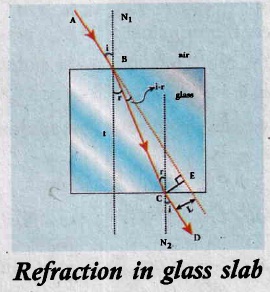
(i) Consider a glass slab of thickness t and refractive index n is kept in air medium.
(ii) If path of the light is ABCD and the refractions occur at two points B and C in the glass slab.
(iii) The angles of incidence i and refraction r are measured with respect to the normal N1 and N2 at the two points Band C respectively. The lateral displacement 'L' is the perpendicular distance CE drawn between the path of light and the undeviated light at point C. In the right angle triangle ΔBCE,
\(sin(i-r)=\frac{1}{BC};BC=\cfrac { L }{ sin(i-r) } \) ..(1)
In the right angle triangle ΔBCF,
\(cos(r)=\cfrac { t }{ BC } ;BC=\cfrac { t }{ cos(r) } \)
Equating equation (1) and (2),
\(\cfrac { L }{ sin(i-r) } =\cfrac { t }{ cos(r) } \)
After rearranging,
\(L=t\left( \cfrac { sin(i-r) }{ cos(r) } \right) \)
(iv) Lateral displacement depends upon
(a) the thickness of the slab
(b) the angle of incidence
(c) the refractive index of the slab.
(v) Thicker the slab, larger will be the lateral displacement. Greater the angle of incidence, larger will be the lateral displacement.
(vi) Higher the refractive index, larger will be the lateral displacement.

12th Standard Syllabus & Materials
12th Standard
TN 12th Computer Applications களப்பெயர் முறைமை (DNS) Sample Question Papers Study Material - QB365 Set A
NEW12th Standard
TN 12th Computer Applications வலையமைப்பு எடுத்துக்காட்டுகள் மற்றும் நெறிமுறைகள் Sample Question Papers Study Material - QB365 Set A
NEW12th Standard
TN 12th Computer Applications கணினி வலையமைப்பு ஓர் அறிமுகம் Sample Question Papers Study Material - QB365 Set A
NEW12th Standard
TN 12th Computer Applications PHP-உடன் MySQL-ஐ இணைத்தல் Sample Question Papers Study Material - QB365 Set A



Tamilnadu Stateboard 12th Standard Subjects

Maths

Chemistry
Physics

Biology

Computer Science

Business Maths and Statistics

Economics

Commerce

Accountancy

History

Computer Applications
Biology
Computer Technology
Computer Applications
Computer Science
Business Maths and Statistics
Commerce
Economics
Maths
Chemistry
Physics
Computer Technology
History
Accountancy

Tamil

English

French
Tamilnadu Stateboard Standards

