
 100% FREE ACCESS
12th Standard Syllabus & Materials
12th Standard
TN 12th Computer Applications மின்னணு தரவு பரிமாற்றம் Sample Question Papers Study Material - QB365 Set A
NEW12th Standard
TN 12th Computer Applications மின் - வணிக பாதுகாப்பு அமைப்புகள் Sample Question Papers Study Material - QB365 Set A
NEW12th Standard
TN 12th Computer Applications மின்னணு செலுத்தல் முறைகள் Sample Question Papers Study Material - QB365 Set A
NEW12th Standard
TN 12th Computer Applications மின் - வணிகம் Sample Question Papers Study Material - QB365 Set A
NEW12th Standard
TN 12th Computer Applications திறந்த மூல கருத்துருக்கள் Sample Question Papers Study Material - QB365 Set A
NEW12th Standard
TN 12th Computer Applications வலையமைப்பு வடமிடல் Sample Question Papers Study Material - QB365 Set A

Published on: 02/01/2020
Optics
Download Tamil Nadu 12th Standard Physics question papers, model tests, one-mark questions, important questions, and public exam papers in PDF format. Free study materials and answer keys for TN State Board students.
Questions + Answers key
Take MCQ Physics Test1.
A man of length h requires a mirror of length at least equal to, to see his own complete image is _______________.
\(\cfrac { h }{ 4 } \)
\(\cfrac { h }{ 2 } \)
\(\cfrac { h }{ 2 } \)
h
2.
To get three images of a single object, one should have two plane mirror at an angle of ______________.
30°
60o
90°
120°
3.
The radius of curvature of curved surface at a thin planoconvex lens is 10 cm and the refractive index is 1.5. If the plane surface is silvered, then the focal length will be, ______.
5 cm
10 cm
15 cm
20 cm
4.
When a biconvex lens of glass having refractive index 1.47 is dipped in a liquid, it acts as plane sheet of glass. This implies that the liquid must have refractive index, ______.
less than one
less than that of glass
greater than that of glass
equal to that of glass
5.
A rod of length 10 cm lies along the principal axis of a concave mirror of focal length 10 cm in such a way that its end closer to the pole is 20 cm away from the mirror. The length of the image is, ______.
2.5 cm
5cm
10 cm
15cm
6.
The speed of light in an isotropic medium depends on, ______.
its intensity
its wavelength
the nature of propagation
the motion of the source w.r.t medium
7.
Write the difference of real and virtual images by a plane mirror.
8.
What is reflection?
9.
An object is placed at a certain distance from a convex lens of focal length 20 cm. Find the object distance if the image obtained is magnified 4 times.
10.
What is principle of reversibility?
11.
What is angle of deviation due to refraction?
12.
13.
Write the conditions for nature of objects and images.
14.
State the laws of reflection.
15.
Prove the laws of reflection using Huygen's principle.
16.
The focal length of an equiconvex lens is equal to the radius of curvature of either face. What is the value of refractive index of the material of the lens?
17.
18.
Derive the mirror equation and the equation for lateral magnification.
19.
| (a) | Refractive index of diamond | - | 2.417 |
| (b) | Refractive index of ordinary glass | - | 1.5 |
| (c) | Monochromatic | - | Single colour |
| (d) | Convergent lens | - | Virtual image |
20.
Assertion: Nicol prism is used to produce and analyze plane polarised light.
Reason: Nicol prism reduces the intensity of light to zero.
Codes:
(a) Assertion and Reason are correct and Reason is the correct explanation of Assertion.
(b) Assertion and Reason are true but Reason is the false explanation of the Assertion.
(c) Assertion is true but Reason is false.
(d) Assertion is false but Reason is true.
21.
(I) The fringe width is inversely proportional to the distance between the two slits.
(II) In Young's experiment, the fringe width for dark fringes is different from that for white fringes.
(III) In Young's experiment, the width of each slit is about 0.05 mm.
(IV) In Young's experiment, the double slit S1 and S2 are separated by a distance of about 0.3 mm.
(a) I and II only
(b) I and IV only
(c) I, II and III only
(d) I, II, III and IV
22.
(a) Angular dispersion produced by a prism depends upon angle of the prism.
(b) Dispersive power is the ability of the material of the prism to cause dispersion.
(c) Dispersive power is a dimensionless quality.
(d) Dispersive power is always negative
1.
(a)
\(\cfrac { h }{ 4 } \)
2.
(c)
90°
3.
\(\frac{1}{f} =(n-1)\left(\frac{1}{R_1}-\frac{1}{R_2}\right) \)
\(=(1.5-1)\left(\frac{1}{\infty}-\frac{1}{(-10)}\right)\)
(Since plano convex lens)
\(=0.5\left[\frac{1}{10}\right]=\frac{1}{20} \)
\(\mathrm{f}_t =20 \mathrm{~cm}\)
Formula for silvered lenses
\(\frac{1}{\mathrm{~F}} =\frac{2}{\mathrm{f}_1}+\frac{1}{\mathrm{f}_m} \)
\(\frac{1}{\mathrm{~F}} =\frac{2}{20}+\frac{1}{\infty} \)
\(\therefore \mathrm{F} =\frac{20}{2}=10 \mathrm{~cm}\)
4.
\(\frac{I}{f}=\left(\frac{\mu_{\mathrm{L}}}{\mu_L}-1\right)\left(\frac{1}{R_1}-\frac{1}{R_2}\right)\)
When the biconvex lens of glass dipped in liquid, it acts as a plane sheet of glass.
\(\therefore \mathrm{f}=\infty, \frac{1}{\mathrm{f}}=0 \quad \frac{\mu_g}{\mu_{\mathrm{L}}}-1=0 ; \frac{\mu_{\mathrm{s}}}{\mu_{\mathrm{L}}}=1, \mu_{\mathrm{s}}=\mu_{\mathrm{L}}\)
5.
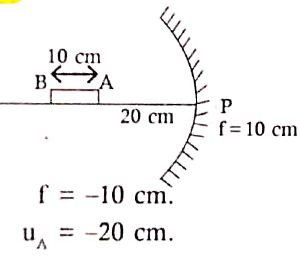
At end A,
\(\frac{1}{f} =\frac{1}{u_A}+\frac{1}{v_A} \)
\(\therefore \frac{1}{v_A} =\frac{1}{-10}-\frac{1}{-20} \)
\(\frac{1}{v_A} =-\frac{1}{10}+\frac{1}{20}=\frac{-2+1}{20}=-\frac{1}{20} \)
\(v_A =-20 \mathrm{~cm} \)
\(\left|v_{\wedge}\right|=20 \mathrm{~cm}\)
At end B,
\(\frac{1}{f} =\frac{1}{u_B}+\frac{1}{v_B} \)
\(\frac{1}{v_B} =\frac{1}{f}-\frac{1}{u_B}, \)
\(u_B =-30 \mathrm{~cm} \)
\(\frac{1}{v_B} =-\frac{1}{10}+\frac{1}{30} \)
\(=\frac{-3+1}{30}=\frac{-2}{30}=\frac{-1}{15} \)
\(v_B =-15 \mathrm{~cm} \)
\(\left|v_B\right| =15 \mathrm{~cm} \)
\(\therefore \quad\left|\mathrm{v}_{\mathrm{A}}\right|-\left|\mathrm{v}_{\mathrm{B}}\right| \) is the length of the image
= 20 - 15 = 5 cm
6.
v = nג
In an isotropic medium, there is no change in the frequency of the light. So, the speed of light depends on wavelength of light.
7.
Real image :
This type of image which can be formed on a screen and can also be seen with the eyes is called real image.
Virtual image :
Image which cannot be formed on the screen but can only be seen with the eyes.
8.
The bouncing back of light into the same medium when it encounters a reflecting surface is called reflection of light.
9.
\(\frac{1}{f}=\frac{1}{v}-\frac{1}{u} \)
\(m=\frac{-v}{u}=-4, f=20 \mathrm{~cm} \text { (Given) } \)
V = 4u
\(\frac{1}{f} =\frac{1}{4 u}-\frac{1}{u} \)
\(=\frac{1-4}{4 u}=\frac{-3}{4 u} \)
\(\frac{1}{f} =\frac{-3}{4 u} \)
4u = -3 x f
\(u=\frac{-3}{4} \times 20=-15 \mathrm{~cm}\)
10.
The principle of reversibility states that light will follow exactly the same path if its direction of travel is reversed.
11.
The angle between the incident and deviated light is called Angle of deviation due to refraction. When light travels from
(i) rarer to denser medium, d = i - r
(ii) denser to rarer medium, d = r - i
12.
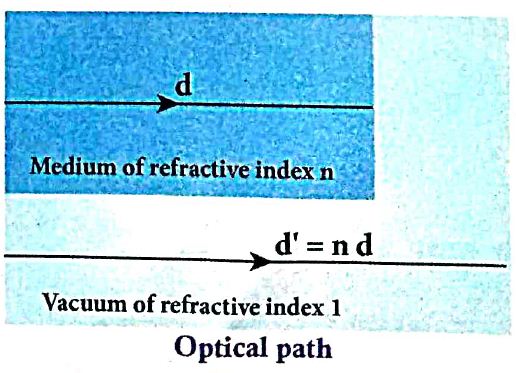
13.
| Nature of object image | Condition | |
| (i) | Real Image | Rays actually converge at the image. |
| (ii) | Virtual Image | Rays appear to diverge from the image |
| (iii) | Real Object | Rays actually diverge from the object |
| (iv) | Virtual Object | Rays appear to converge at the object. |
14.
The law of reflection states that the incident ray, the reflected ray, and the normal to the surface of the mirror all lie in the same plane. The angle of reflection is equal to the angle of incidence.
15.
(i) Consider a parallel beam of light, incident on a reflecting plane surface such as a plane mirror XY as shown in Figure.
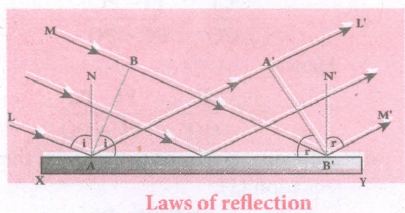
(ii) The incident wavefront is AB and the reflected wavefront is A'B' in the same medium. These wavefronts are perpendicular to the incident rays L, M and reflected rays L', M' respectively.
(iii) By the time point A of the incident wavefront touches the reflecting surface, point B is yet to travel a distance BB' to touch the reflecting surface a B'.
(iv) When point B falls on the reflecting surface at H', point A would have reached A.
(v) This is applicable to all the points on the wavefront. Thus, the reflected wavefront A'B' emanates as a plane wavefront. The two normals Nand N' are considered at the points where the rays Land Mfallon the reflecting surface.
(vi) As reflection happens in the same medium, the speed of light is the same before and after the reflection.
(vii) Hence, the time is taken for the ray to travel from B to B' is the same as the time taken for the ray to travel from A to A'.
(viii) Thus, the distance BB' is equal to the distance AA'; (A~A' = BB').
(a) The incident rays, the reflected rays, and the normal are in the same plane.
(b) Angle of incidence,\(\angle i=\angle NAL={ 90 }^{ o }-\angle NAB=\angle BAB'\)
Angle of reflection,
∠r= ∠N' B' M' = 900 - ∠N' B' A' = A' B' A'
(ix) For the two right-angle triangles, ΔABB' and ΔB' A' A', the right angles, ∠B and ∠A' are equal, (∠B and∠A = 900); the two sides, ∠A' and ∠B' are equal, (AA'= BB'); the side AB' is common.
(x) Thus, the two triangles are congruent. As per the property of congruency, the two angles, ∠BAB' and A' B' A' must also be equal.
i = r
Hence, the laws of reflection are proved.
16.
\(\cfrac { 1 }{ f } =\left( \mu -1 \right) \left( \cfrac { 1 }{ { R }_{ 1 } } -\cfrac { 1 }{ { R }_{ 2 } } \right) \)
\(\cfrac { 1 }{ f } =\left( \mu -1 \right) \left( \cfrac { 2 }{ f } \right) \)
\(\cfrac { 1 }{ 2 } =\left( \mu -1 \right) \)
\(\mu =1.5\)
17.
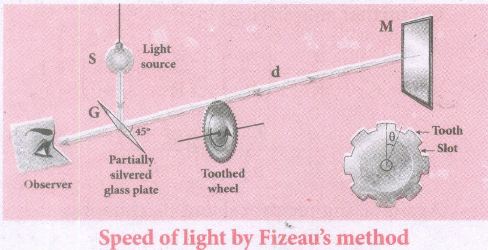
18.
Mirror Equation :
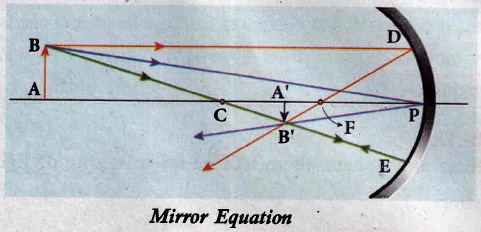
(i) AB is an object which is placed on the principal axis of a concave mirror beyond the center of curvature C. A' B' is an image which is formed between the point pole P, and the centre of curvature.
(ii) From the figure As per law of reflection, the angle of incidence ∠BPA is equal to the angle of reflection ∠B'PA'.
(iii) The triangles ∠BPA and ∠B'PA' are similar. Thus, from the rule of similar triangles,
\(\cfrac { { A }^{ ' }{ B }^{ ' } }{ AB } =\cfrac { { PA }^{ ' } }{ PA } \) ................(1)
(iv) The other set of similar triangles are, ΔDPF and ΔB'A'F. (PD is almost a straight vertical line)
\(\cfrac { { A }^{ ' }B' }{ PD } =\cfrac { A'F }{ PF } \)
(v) As, PD = AB the above equation becomes,
\(\cfrac { A'B' }{ AB } =\cfrac { A'F }{ PF } \) ......(2)
(vi) From equations (1) and (2) we can write,
\(\cfrac { PA' }{ PA } =\cfrac { A'F }{ PF } \)
(vii) As, A'F = PA' - PF, the above equation becomes,
\(\cfrac { PA' }{ PA } =\cfrac { PA'-PF }{ PF } \) .....(3)
(viii) We can apply the sign conventions for the various distances in the above equation
PA = - u, PA' = -v, PF = - f
(ix) All the three distances are negative as per sign convention, because they are measured to the left of the pole. Now, the equation (3) becomes,
\(\cfrac { -v }{ -u } =\cfrac { -v-\left( -f \right) }{ -f } \)
On further simplification,
\(\cfrac { v }{ u } =\cfrac { v-f }{ f } ;\cfrac { v }{ u } =\cfrac { v }{ f } -1 \)
Dividing either side with v,
\(\cfrac { 1 }{ u } =\cfrac { 1 }{ f } -\cfrac { 1 }{ v } \)
After rearranging,
\(\cfrac { 1 }{ v } +\cfrac { 1 }{ u } =\cfrac { 1 }{ f } \)
The above equation is called mirror equation.
Lateral magnification:
The lateral or transverse magnification is defined as the ratio of the height of the image to the height of the object. The height of the object and image are measured perpendicular to the principal axis.
Magnification (m) \(=\frac{\text { height of the image }\left(h^{\prime}\right)}{\text { height of the image }(h)} \)
\(m=\frac{h^{\prime}}{h} \) ....(1)
Applying proper sign conventions for equation,
\(\frac{A^{\prime} B^{\prime}}{A B}=\frac{P A^{\prime}}{P A} \)
\(A^{\prime} B^{\prime}=-h^{\prime}, A B=h, P A^{\prime}=-v, P A=-u \)
\(-\frac{h}{h}=\frac{-v}{-u} \)
On simplifying we get,
\(\mathrm{m}=\frac{\mathrm{h}^{\prime}}{\mathrm{h}}=-\frac{\mathrm{v}}{\mathrm{u}}\) ...(2)
Using mirror equation, we can further write the magnification as,
\(m=\frac{h^{\prime}}{h}=\frac{f-v}{f}=\frac{f}{f-u}\) ..(3)
19.
Convergent lens - Virtual image
20.
(c) Assertion is true but Reason is false
21.
I and IV only
22.
Dispersive power is always negative

12th Standard Syllabus & Materials
12th Standard
TN 12th Computer Applications களப்பெயர் முறைமை (DNS) Sample Question Papers Study Material - QB365 Set A
NEW12th Standard
TN 12th Computer Applications வலையமைப்பு எடுத்துக்காட்டுகள் மற்றும் நெறிமுறைகள் Sample Question Papers Study Material - QB365 Set A
NEW12th Standard
TN 12th Computer Applications கணினி வலையமைப்பு ஓர் அறிமுகம் Sample Question Papers Study Material - QB365 Set A
NEW12th Standard
TN 12th Computer Applications PHP-உடன் MySQL-ஐ இணைத்தல் Sample Question Papers Study Material - QB365 Set A



Tamilnadu Stateboard 12th Standard Subjects

Maths

Chemistry
Physics

Biology

Computer Science

Business Maths and Statistics

Economics

Commerce

Accountancy

History

Computer Applications
Biology
Computer Technology
Computer Applications
Computer Science
Business Maths and Statistics
Commerce
Economics
Maths
Chemistry
Physics
Computer Technology
History
Accountancy

Tamil

English

French
Tamilnadu Stateboard Standards

