
 100% FREE ACCESS
12th Standard Syllabus & Materials
12th Standard
TN 12th Computer Applications மின்னணு தரவு பரிமாற்றம் Sample Question Papers Study Material - QB365 Set A
NEW12th Standard
TN 12th Computer Applications மின் - வணிக பாதுகாப்பு அமைப்புகள் Sample Question Papers Study Material - QB365 Set A
NEW12th Standard
TN 12th Computer Applications மின்னணு செலுத்தல் முறைகள் Sample Question Papers Study Material - QB365 Set A
NEW12th Standard
TN 12th Computer Applications மின் - வணிகம் Sample Question Papers Study Material - QB365 Set A
NEW12th Standard
TN 12th Computer Applications திறந்த மூல கருத்துருக்கள் Sample Question Papers Study Material - QB365 Set A
NEW12th Standard
TN 12th Computer Applications வலையமைப்பு வடமிடல் Sample Question Papers Study Material - QB365 Set A

Published on: 02/11/2019
Optics
Download Tamil Nadu 12th Standard Physics question papers, model tests, one-mark questions, important questions, and public exam papers in PDF format. Free study materials and answer keys for TN State Board students.
Questions + Answers key
Take MCQ Physics Test1.
What is astigmatism? What is its remedy?
2.
What is presbyopia?
3.
What is myopia? What is its remedy?
4.
What are the uses of spectrometer?
5.
Why is oil immersed objective preferred in a microscope?
6.
What is double refraction?
7.
What is Rayleigh’s scattering?
8.
What is call 'grating element'?
9.
What is Rayleigh's scattering?
10.
What are the sign conventions followed for lenses?
11.
What are primary focus and secondary focus of a lens?
12.
Write a note on optical fibre.
13.
What is Snell’s window?
14.
What are the advantages and disadvantages of a reflecting telescope?
15.
What are resolution and resolving power?
1.
Astigmatism:
Astigmatism is the defect arising due to different curvatures along different planes in the eye lens.
Remedy:
Use of Cylindrical, Bi-focal and progressive lenses.
2.
Farsightedness arising due to aging is called presbyopia as the aged people cannot strain their eye more to reduce the focal length of the eye lens.
3.
Myopia:
A person suffering from nearsightedness or myopia cannot see distant objects clearly. This may due to short focal length of the eye lens or larger diameter of the eyeball than usual.
Remedy:
These people have difficulty in relaxing their eye more than what is needed to overcome this difficulty. They need correcting lens, which should be concave lens.
4.
(i) To study the spectra of different sources of light.
(ii) To measure the refractive indices of materials due to determinant of angle of prism (A) and angle of minimum deviation (D).
(iii) To find the refractive indices of liquids.
(iv) To find the wavelength of light using grating.
5.
Resolving Power of microscope
\(d_{min}=\frac{1.22 \lambda}{2 n \sin \beta}\)
To further reduce the value of dmin, the optical path of the light should be increased. So, in order to increase the optical path, the objective of the microscope immerses into a bath containing oil of refractive index 'n'.
6.
When a ray of unpolarised light is incident on a calcite crystal, two refracted rays are produced, Hence, two images of a single object are formed. This phenomenon is called double refraction.
7.
If the scattering of light is by atoms and molecules which have size a yery less than that of the wavelength \({\lambda}\) of light a << \({\lambda}\) the scattering is called Rayleigh's scattering.
The intensity of Rayleigh's scattering is inversely proportional to fourth power of wavelength
\(\mathrm{I} ∝ \frac{1}{\lambda^{4}}\)
8.
(i) In Grating, the combined width of a ruling and a slit is called 'grating element' (1.e.) e = a + b.
9.
(i) If the scattering of light is by atoms and molecules which have size a very less than that of the wavelength λ of light a <.
(ii) The intensity of Rayleigh's scattering is inversely proportional to the fourth power of wavelength.
\(1\propto \cfrac { 1 }{ { \lambda }^{ 4 } } \)
10.
Sign conventions for lens
(i) The sign of focal length is not decided on the direction of measurement of the focal length from the pole of the lens as they have two focal lengths, one to the left and another to the right.
(ii) The focal length of the thin lens is taken as positive for a converging lens and negative for a diverging lens.
(iii) The other sign conventions for object. distance, image distance, radius of curvature, object height and image height remain the same for thin lenses as that of spherical mirrors.
11.
Primary focus:
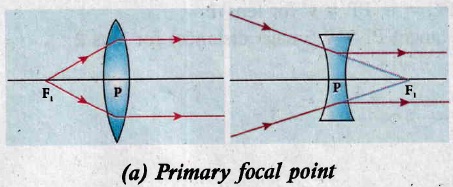
(i) The primary focus FI is defined as a point where an object should be placed to give parallel emergent rays to the principal axis after passing through lens.
Secondary focus:
.jpg)
(ii) The secondary focus F2 is defined as a point where all the parallel rays travelling close to the principal axis converge to form an image on the principal axis after passing through lens.
12.
(i) Optical fibers consist of the inner part called core and the outer part called cladding (or) sleeving. The refractive index of core is higher than that of cladding.
(ii) Signal in the form of light is made to incident inside the core-cladding boundary at an angle greater than the critical angle. So, that total internal reflection happens without undergoing any refraction. The light travels without appreciable loss of intensity.
13.
When light entering the water from outside is seen from inside the water, the view is restricted to a particular angle equal to the critical angle ic. The restricted illuminated circular area is called Snell's window
14.
Advantages:
Only one surface it to be polished and maintained. Support can be given from the entire back of the miror rather than only at the rim for lens. Mirrors weigh much less compared to lens.
Disadvantages:
The objective mirror would focus the light inside the telescope tube.
15.
(i) Resolution: Resolution is the quality of image which is decided by diffraction effect and Rayleigh criterion.
(ii) Resolving power: The ability of an optical instrument to separate or distinguish small or closely adjacent objects through the image formation is said to be resolving power of the instrument.

12th Standard Syllabus & Materials
12th Standard
TN 12th Computer Applications களப்பெயர் முறைமை (DNS) Sample Question Papers Study Material - QB365 Set A
NEW12th Standard
TN 12th Computer Applications வலையமைப்பு எடுத்துக்காட்டுகள் மற்றும் நெறிமுறைகள் Sample Question Papers Study Material - QB365 Set A
NEW12th Standard
TN 12th Computer Applications கணினி வலையமைப்பு ஓர் அறிமுகம் Sample Question Papers Study Material - QB365 Set A
NEW12th Standard
TN 12th Computer Applications PHP-உடன் MySQL-ஐ இணைத்தல் Sample Question Papers Study Material - QB365 Set A



Tamilnadu Stateboard 12th Standard Subjects

Maths

Chemistry
Physics

Biology

Computer Science

Business Maths and Statistics

Economics

Commerce

Accountancy

History

Computer Applications
Biology
Computer Technology
Computer Applications
Computer Science
Business Maths and Statistics
Commerce
Economics
Maths
Chemistry
Physics
Computer Technology
History
Accountancy

Tamil

English

French
Tamilnadu Stateboard Standards

