
 100% FREE ACCESS
12th Standard Syllabus & Materials
12th Standard
TN 12th Computer Applications மின்னணு தரவு பரிமாற்றம் Sample Question Papers Study Material - QB365 Set A
NEW12th Standard
TN 12th Computer Applications மின் - வணிக பாதுகாப்பு அமைப்புகள் Sample Question Papers Study Material - QB365 Set A
NEW12th Standard
TN 12th Computer Applications மின்னணு செலுத்தல் முறைகள் Sample Question Papers Study Material - QB365 Set A
NEW12th Standard
TN 12th Computer Applications மின் - வணிகம் Sample Question Papers Study Material - QB365 Set A
NEW12th Standard
TN 12th Computer Applications திறந்த மூல கருத்துருக்கள் Sample Question Papers Study Material - QB365 Set A
NEW12th Standard
TN 12th Computer Applications வலையமைப்பு வடமிடல் Sample Question Papers Study Material - QB365 Set A

Published on: 22/01/2020
Optics
Download Tamil Nadu 12th Standard Physics question papers, model tests, one-mark questions, important questions, and public exam papers in PDF format. Free study materials and answer keys for TN State Board students.
Questions + Answers key
Take MCQ Physics Test1.
How does focal length of a lens change when red light is replaced by blue light?
2.
A convex lens is held in water. What would be the change in the focal length?
3.
(i) Explain briefly how the focal length of a convex lens changes with increase in wavelength of incident light.
(ii) What happens to the focal length of convex lens when it is immersed in water ? Refractive index of the material of lens is greater than that of water.
4.
Why is the interference pattern not detected when two coherent sources are far apart?
5.
Define bandwidth.
6.
What are the assumptions made while considering refraction at spherical surfaces?
7.
What are the uses of spectrometer?
8.
9.
Mention the differences between interference and diffraction.
10.
How does wavefront division provide coherent sources?
11.
Define wavefront.
12.
Write a short note on quantum theory of light.
13.
Arrive at lens equation from lens maker’s formula.
14.
How does an endoscope work?
15.
It is possible for two lenses to produce zero power?
1.
\(\cfrac { 1 }{ f } =\left( { \mu }_{ 21 }-1 \right) \left( \cfrac { 1 }{ { R }_{ 1 } } -\cfrac { 1 }{ { R }_{ 2 } } \right) \)
2.
There will be an increases in the focal length of the convex lens. This is because the refractive index of glass with respect to water is less than the refractive index of glass with respect to air.
3.
(i) Focal length increases with increase of wavelength.\(\cfrac { 1 }{ f } \left( \cfrac { { \mu }_{ 2 } }{ { \mu }_{ 1 } } -1 \right) \) as wavelength increases \(\cfrac { { \mu }_{ 2 } }{ { \mu }_{ 1 } } \) decreases hence focal length increases.
(ii) As μl increase focal length increases.\(\cfrac { 1 }{ f } \left( \cfrac { { \mu }_{ 2 } }{ { \mu }_{ 1 } } -2 \right) \cfrac { 2 }{ R } \)
4.
(i) Fringe width of interference fringes, is given by \(\beta =\cfrac { D\lambda }{ d } \propto \cfrac { 1 }{ d } \) . If the sources are far apart, d is large; so fringe width (β) will be so small that the fringes are not resolved and they do not appear separate.
(ii) That is why the interference pattern is not detected for large separation of coherent sources.
5.
The bandwidth (β) is defined as the distance between any two consecutive bright or dark fringes.
6.
(i) The incident light is assumed to be monochromatic (single colour).
(ii) The incident ray of light is very dose to the principal axis (paraxial rays).
7.
(i) To study the spectra of different sources of light.
(ii) To measure the refractive indices of materials due to determinant of angle of prism (A) and angle of minimum deviation (D).
(iii) To find the refractive indices of liquids.
(iv) To find the wavelength of light using grating.
8.
9.
| S.No |
Interference |
Diffraction |
|---|---|---|
| (i) | Superposition of two waves | Bending of waves around edges |
| (ii) | Superposition of waves from two coherent sources | Superposition wavefronts emitted from various points of the same wavefront. |
| (iii) | Equally spaced bright and dark fringes. | Central bright is double other the size of fringes. |
| (iv) | Equal intensity for all the bright fringes. | Intensity falls rapidly for higher order fringes. |
| (v) | Large number of fringes are obtained. | Less number of fringes are obtained. |
10.
This is the most commonly used method for producing two coherent sources. If two points are chosen on the wavefront by using a double slit, the two points will act as coherent sources.
11.
A wavefront is the locus of points which are in the same state or phase of vibration.
12.
Quantum theory of light:
Quantum theory states that light waves consist of small packets of energy called photons. The energy associated with each photon is E = hv, Where 'h' is Planck's constant (h = 6.625 x 10⁻³⁴ J s) and v is frequency of electromagnetic radiation.
13.
(i) Let us consider a thin lens made up of a medium of refractive index n2 is placed in a medium of refractive index n1. Let R1 and R2 be the radii of curvature of two spherical surfaces (i) and (ii) respectively and P be the pole.
(ii) Consider a point object 'O' on the principal axis. A paraxial ray from 'O' which falls very close to P, after refraction at the surface (i) forms image at I'.
(iii) Before it does so, it is again refracted by the surface (ii). Therefore the final image is formed at I.
(iv) The general equation for the refraction at a single spherical surface is given by the equation is,
\(\cfrac { { n }_{ 2 } }{ v } =\cfrac { { n }_{ 1 } }{ u } =\cfrac { \left( { \quad n }_{ 2 }-{ { n }_{ 1 } } \right) }{ R } \) ....(i)
(v) For the refracting surface (1), the light goes from n1 to n2
\(\cfrac { { { n }_{ 2 } } }{ v' } -\cfrac { { n }_{ 1 } }{ u } =\cfrac { \left( n_{ 2 }-{ n }_{ 1 } \right) }{ { R }_{ 1} } \) ......(ii)
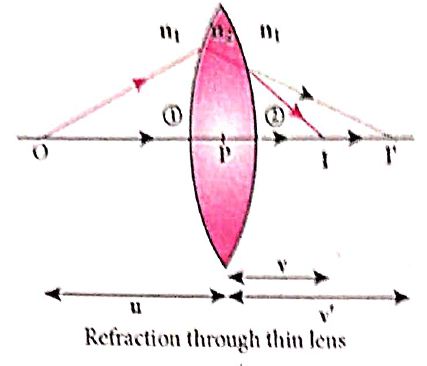
(vi) For the refracting surface (ii), the light goes from medium n2 to n1
\(\cfrac { { { n }_{ 1 } } }{ v' } -\cfrac { { n }_{ 2 } }{ v' } =\cfrac { \left( n_{ 1 }-{ n }_{ 2 } \right) }{ { R }_{ 2 } } \) ....(iii)
(vii) Adding the above two equations (ii) and (iii)
\(\cfrac { { { n }_{ 1 } } }{ v } =\cfrac { { n }_{ 1 } }{ u } =\left( { n }_{ 2 }-{ n }_{ 1 } \right) \left( \cfrac { 1 }{ { R }_{ 1 } } -\cfrac { 1 }{ { R }_{ 2 } } \right) \)
On further simplifying and rearranging
\(\cfrac { 1 }{ v } -\cfrac { 1 }{ u } =\left( \cfrac { { n }_{ 2 }-{ n }_{ 1 } }{ { n }_{ 1 } } \right) \left( \cfrac { 1 }{ { R }_{ 1 } } -\cfrac { 1 }{ { R }_{ 2 } } \right) \)
\(\cfrac { 1 }{ v } -\cfrac { 1 }{ u } =\left( \cfrac { { n }_{ 2 } }{ { n }_{ 1 } } -1 \right) \left( \cfrac { 1 }{ { R }_{ 1 } } -\cfrac { 1 }{ { R }_{ 2 } } \right) \) ....(iv)
If the refractive of the lens is n2 and is placed in air, then n2= n and n1= 1. So the equation (iv) becomes,
\(\cfrac { 1 }{ v } -\cfrac { 1 }{u } =(n-1) \left( \cfrac { 1 }{ { R }_{ 1 } } -\cfrac { 1 }{ { R }_{ 2 } } \right) \) ...(v)
According to lens makers formula
\(\cfrac { 1 }{ f } =(n-1) \left( \cfrac { 1 }{ { R }_{ 1 } } -\cfrac { 1 }{ { R }_{ 2 } } \right) \) ...(vi)
Comparing the two equations (v) and (vi), we find
\(\cfrac { 1 }{ v } -\cfrac { 1 }{ u }=\cfrac { 1 }{ f }\) .....(vii)
This is called lens equation
14.
An endoscope is an instrument used by doctors which has a bundle of optical fibres that are used to see inside a patient's body. Endoscopes work on the phenomenon of total internal reflection. The optical fibres are inserted in to the body through mouth, nose or a special hole made in the body.
15.
Yes, It is possible for two lens to produce zero power.
Explanation:
when the two lens (one is concave & another one is convex lens) are combined together, the focal length of the combination of the two lenses is F.
Then
\(\frac{1}{F}=\frac{1}{f_{1}}+\frac{1}{f_{2}} \)
\(\text { if } f_{1}=f_{2}=f \)
\(f_{1}=f(\text { convex }) \)
\(f_{2}=-f(\text { concave) } \)
\(P=\frac{1}{F}=\frac{1}{f}-\frac{1}{f}=0 . \ P \rightarrow \text { power } \)

12th Standard Syllabus & Materials
12th Standard
TN 12th Computer Applications களப்பெயர் முறைமை (DNS) Sample Question Papers Study Material - QB365 Set A
NEW12th Standard
TN 12th Computer Applications வலையமைப்பு எடுத்துக்காட்டுகள் மற்றும் நெறிமுறைகள் Sample Question Papers Study Material - QB365 Set A
NEW12th Standard
TN 12th Computer Applications கணினி வலையமைப்பு ஓர் அறிமுகம் Sample Question Papers Study Material - QB365 Set A
NEW12th Standard
TN 12th Computer Applications PHP-உடன் MySQL-ஐ இணைத்தல் Sample Question Papers Study Material - QB365 Set A



Tamilnadu Stateboard 12th Standard Subjects

Maths

Chemistry
Physics

Biology

Computer Science

Business Maths and Statistics

Economics

Commerce

Accountancy

History

Computer Applications
Biology
Computer Technology
Computer Applications
Computer Science
Business Maths and Statistics
Commerce
Economics
Maths
Chemistry
Physics
Computer Technology
History
Accountancy

Tamil

English

French
Tamilnadu Stateboard Standards

