
 100% FREE ACCESS
12th Standard Syllabus & Materials
12th Standard
TN 12th Computer Applications மின்னணு தரவு பரிமாற்றம் Sample Question Papers Study Material - QB365 Set A
NEW12th Standard
TN 12th Computer Applications மின் - வணிக பாதுகாப்பு அமைப்புகள் Sample Question Papers Study Material - QB365 Set A
NEW12th Standard
TN 12th Computer Applications மின்னணு செலுத்தல் முறைகள் Sample Question Papers Study Material - QB365 Set A
NEW12th Standard
TN 12th Computer Applications மின் - வணிகம் Sample Question Papers Study Material - QB365 Set A
NEW12th Standard
TN 12th Computer Applications திறந்த மூல கருத்துருக்கள் Sample Question Papers Study Material - QB365 Set A
NEW12th Standard
TN 12th Computer Applications வலையமைப்பு வடமிடல் Sample Question Papers Study Material - QB365 Set A

Published on: 17/01/2020
Download Tamil Nadu 12th Standard Physics question papers, model tests, one-mark questions, important questions, and public exam papers in PDF format. Free study materials and answer keys for TN State Board students.
Questions + Answers key
Take MCQ Physics Test1.
Two plane mirrors are at right angles to each other. A man stands between them and combs hair with his right hand. In how many of the images will he be seen using his right-hand __________.
None
1
2
3
2.
Wavelength of X-rays is ______ the wavelength of visible light
smaller than
greater than
negligible when compared to
equal to
3.
The device which is a combination of a receiver and a transmitter is ___________________.
Amplifier
Repeater
Transducer
Modulator
4.
A common - emitter amplifier has a voltage gain of 100, an input impendence of 100Ω and an output impedence of 200 Ω. The product of voltage gain and current gain is _________
1000
3000
5000
500
5.
The gravitational waves were theoretically proposed by _____.
Conrad Rontgen
Marie Curie
Albert Einstein
Edward Purcell
6.
The frequency range of 3 MHz to 30 MHz is used for ______.
Ground wave propagation
Space wave propagation
Sky wave propagation
Satellite communication
7.
8.
Two radiations with photon energies 0.9 eV and 3.3 eV respectively are falling on a metallic surface successively. If the work function of the metal is 0.6 eV, then the ratio of maximum speeds of emitted electrons in the two cases will be _____.
1:4
1:3
1:1
1:9
9.
When light is incident on a soap film of thickness 5 x 10⁻⁵ cm, the wavelength of light reflected maximum in the visible region is 5320 Å. Refractive index of the film will be, _____.
1.22
1.33
1.51
1.83
10.
Above the neutral temperature the thermo emf ____________________.
changes sign
is constant
increases with the rise in temperature
decrease with the rise in temperature
11.
In a transformer, eddy current loss is minimized by using ____________.
laminated core made of muemetal
laminated core made of stelloy
shell type core
thick copper wire
12.
The force between like charges is _________.
attraction
repulsion
no force
none
13.
Three wires of equal lengths are bent in the form of loops. One of the loops is circle, another is a semi-circle and the third one is a square. They are placed in a uniform magnetic field and same electric current is passed through them. Which of the following loop configuration will experience greater torque?
Circle
Semi-circle
Square
All of them
14.
The electric and magnetic fields of an electromagnetic wave are _____.
in phase and perpendicular to each other
out of phase and not perpendicular to each other
in phase and not perpendicular to each other
out of phase and perpendicular to each other
15.
In a large building, there are 15 bulbs of 40 W, 5 bulbs of 100 W, 5 fans of 80 W and 1 heater of 1 kW are connected. The voltage of electric mains is 220 V. The maximum capacity of the main fuse of the building will be ______.
14 A
8 A
10 A
12 A
16.
What is meant by satellite communication? Give its applications.
17.
Write the advantages and disadvantages of robotic.
18.
For a radioactive material, half-life period is 600s. If initially there are 600 number of molecules, find the time taken for disintegration of 450 molecules and the rate of disintegration.
19.
A plane Electromagnetic wave travels in vacuum along z - direction. What can you say about the directions of electric and magnetic field vectors? If the frequency of the wave is 30 MHz. What is its wavelength?
20.
Calculate the force per unit length on a long straight wire carrying current of 4A due to a parallel wire carrying 6A current if the distance between the wires is 3cm.
21.
A wheel with 10 metallic spokes each 0.5m long is rotated with a speed of 120 rev/min in a plane normal to the horizontal component of the earth's magnetic field HE at a place if HE = 0.4 G at the place what is the induced emf between the a x k and the rim of the wheel? Take 1 gauss (G) = 10-4T.
22.
Discuss the conversion of galvanometer into an ammeter and also a voltmeter.
23.
Show that Lenz’s law is in accordance with the law of conservation of energy.
24.
Explain the determination of unknown resistance using meter bridge.
25.
Write the expression for angular resolution.
26.
How does the manipulation of colours obtain in nanoscale structure?
27.
What do you mean by noise in communication?
28.
Calculate the cut-off wavelength and cutoff frequency of x-rays from an x-ray tube of accelerating potential 20,000 V.
29.
What is the reason for using lighter nuclei as moderators?
30.
An electron and an alpha particle have same kinetic energy. How are the de Broglie wavelengths associated with them related?
31.
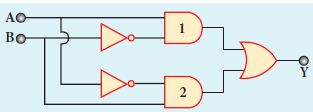
In the combination of the following gates, write the Boolean equation for output Y in terms of inputs A and B.
32.
Explain the need for a feedback circuit in a transistor oscillator.
33.
Which part of Electromagnetic is absorbed from sunlight by ozone layer?
(i) Write its source and
(ii) mention its uses.
34.
(i) Electric field lines donot have sudden breaks why is it so?
(ii) Explain why two field lines never cross each other at any point.
35.
Give any one definition of power factor.
36.
In a potentiometer arrangement, a cell of emf 1.25 V gives a balance point at 35 cm length of the wire. If the cell is replaced by another cell and the balance point shifts to 63 cm, what is the emf of the second cell?
37.
The graph shows the variation of stopping potential with frequency of incident radiation for two photosensitive metals A and B. Which one of the two has higher value of workfunction? Justify your answer.
38.
What are radioactive elements? What are the factors that affect radio activity?
39.
What is the focal length of the combination if the lenses of focal lengths –70 cm and 150 cm are in contact? What is the power of the combination?
40.
A compound microscope has a magnifying power of 100 when the image is formed at infinity. The objective has a focal length of 0.5 cm and the tube length is 6.5 cm. What is the focal length of the eyepiece.
41.
The charge on a parallel plate capacitor varies as q = qo cos 2\(\pi \gamma \)t. The plates are very large and close together. (area - A. separation - d) find the displacement current through the capacitor?
42.
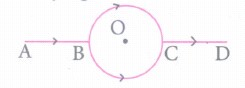
What is the magnetic field at point O due to current carrying wires shown in the figure?
43.
Explain the Lightning arrester or lightning conductor.
1.
(a)
None
2.
(a)
smaller than
3.
(b)
Repeater
4.
(c)
5000
5.
Albert Einstein theoretically proposed the existence of gravitational waves in the year 1915.
6.
Ground wave propagation: frequency less than 2 MHz
Sky wave propagation: 3 to 30 MHz
Space wave propagation: Above 30 MHz to 400 GHz
Satellite communication: uplink communication 6 GHz band downlink communication 4 GHz band
7.
(b)
8.
K.E= hv - Φ
K.E1 = 0.9 - 0.6 = 0.3 eV
K.E2 = 3.3 - 0.6 = 2.7 ev
K.E ∝ v2
\(\frac{0.3}{2.7}=\frac{v^2_1}{v^2_2} \)
\(\frac{v^1}{v^2} =\frac{1}{3}\)
9.
2n t cos r = (2m + 1) \(\frac{\lambda}{2}\)
For maximum
m = 2 (For visible region), n - refractive index.
cos r = cos 0 = 1
t = 5 x 10-5 x 10-2 = 5 x 10⁻⁷ m
\(n=\frac{(2m+1)\frac{\lambda}{2}}{2t}=\frac{5\lambda}{2 \times 2 \times t}\)
\(=\frac{5 \times5320\times10^{-10}}{4 \times 5 \times 10^{-7}}\)
\(=\frac{5 \times5320\times10^{-10}}{20}=1330 \times 10^3\)
n = 1.330
10.
(a)
changes sign
11.
(b)
laminated core made of stelloy
12.
(b)
repulsion
13.
(a)
Circle
14.
(a)
in phase and perpendicular to each other
15.
Total power = 15 x 40 + 5 x 100 + 5 x 80 + 1000
= 600 + 500 + 400 + 1000
= 2500 W
P = VI, V = 220 V
\(I=\frac{P}{V}=\frac{2500}{220}=11.363 \ A\)
≃ 12 A
16.
(i) The satellite communication is a mode of transmission of signal between transmitter and receiver via satellite.
(ii) The message signal from the Earth station is transmitted to the satellite on board via an uplink (frequency band 6 GHz), amplified by a transponder and then retransmitted to another earth station via a downlink (frequency band 4 GHz).
Applications:
Satellites are classified into different types based on their applications.
(i) Weather Satellites:
They are used to monitor the weather and climate of Earth. By measuring cloud mass, these satellites enable us to predict rain and dangerous storms like hurricanes, cyclones etc.
(ii) Communication satellites:
They are used to transmit television, radio, internet signals etc. Multiple satellites are used for long distance communication
(iii) Navigation satellites:
These are employed to determine the geographic location of ships, aircraft or any other object.
17.
Advantages of robotics:
(i) The robots are much cheaper than humans.
(ii) Robots never get tired like humans. It can work for 24 x 7. Hence absenteeism in work place can be reduced.
(iii) Robots are more precise and error free in performing the task.
(iv) Stronger and faster than humans.
(v) Robots can work in extreme environmental conditions: extreme hot or cold, space or underwater. In dangerous situations like bomb detection and bomb deactivation.
(vi) In warfare, robots can save human lives.
(vii) Robots are significantly used in handling materials in chemical industries especially in nuclear plants which can lead to health hazards in humans.
Disadvantages of Robotics:
(i) Robots have no sense of emotions or conscience.
(ii) They lack empathy and hence create an emotionless workplace.
(iii) If ultimately robots would do all the work, and the humans will just sit and monitor them, health hazards will increase rapidly.
(iv) Unemployment problem will increase.
(v) Robots can perform defined tasks and cannot handle unexpected situations.
(vi) The robots are well programmed to do a job and if a small thing goes wrong it ends up in a big loss to the company.
(vii) If a robot malfunctions, it takes time to identify the problem, rectify it, and even reprogram if necessary. This process requires signi cant time.
(viii) Humans cannot be replaced by robots in decision making.
(ix) Till the robot reaches the level of human intelligence, the humans in work place will exit.
18.
The initial number of molecules, No = 150
The final number of molecules, N = 150
\(\frac { N }{ { N }_{ 0 } } ={ \left( \frac { 1 }{ 2 } \right) }^{ n } \ or \ \frac { 150 }{ 600 } ={ \left( \frac { 1 }{ 2 } \right) }^{ n }\)
\({ \left( \frac { 1 }{ 2 } \right) }^{ 2 }={ \left( \frac { 1 }{ 2 } \right) }^{ n } \ or \ n=2=\frac { t }{ { T }_{ 1/2 } } \)
t = 2 x 600 s = 1200 s
Best of disintegration,
\(R=\frac { dN }{ dt } =-\lambda N\)
\(=\frac { 0.693 }{ { T }_{ 1/2 } } \times 150\)
\(=\frac { 0.693 }{ { 600} } \times 150\) = 0.173
disintegration/second at the instant when 150 molecules were remaining.
19.
E and B vectors must be in x and y directions.
Formula: We know \(\lambda =\frac { v }{ \gamma } =\frac { 3\times { 10 }^{ 8 } }{ 30\times { 10 }^{ 6 } } \)
λ = 10m.
20.
I1 = 4A, I2= 6A, r = 3cm = 0.03A
\(\frac { F }{ l } =\frac { { \mu }_{ 0 } }{ 4\pi } \frac { 2{ I }_{ 1 }{ I }_{ 2 } }{ 0.03 } \)
\(\frac { F }{ 1 } =\frac { 10^{ -7 }\times 2\times 4\times 6 }{ 0.03 } \)
F = 1.6 x 10⁻⁴ N/m.
21.
Given:
Induced emf, e = Blv (or) e = \(\frac12\) Bl2ω [where, v = rω, 1 = 2R]
Also, ω=2ㅠf = 2π x \(\frac{120}{60}\)
ω = 4ㅠ
Solution:
emf, e = \(\frac12\) x 4ㅠ x 0.4 x 10-4 (0.5)2
= 6.28 x 10⁻⁵V
The number of spokes is immaterial because the emf's across the spokes are in parallel
22.
(i) Galvanometer to an Ammeter:
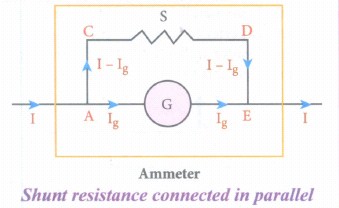
(i) Ammeter is an instrument used to measure current flowing in the electrical circuit.
(ii) The Ammeter must offer low resistance such that it will not change the current passing through it. So, ammeter is connected in series to measure the circuit current.
(iii) A galvanometer is converted into an ammeter by connecting a low resistance in parallel with the galvanometer.
(iv) Let I be the current passing through the circuit. When current I reaches the junction A, it divides into two components.
a) Ig → Current passing through the galvanometer
b) I - Ig → Current passing through the shunt resistance.
(v) The potential difference across the galvanometer is same as the potential difference across the shunt resistance.
\(\mathrm{V}_{\text {galvanometer }} =\mathrm{V}_{\text {shunt }} \)
\(\Rightarrow \mathrm{I}_{\mathrm{g}} \mathrm{R}_{\mathrm{g}} =\left(\mathrm{I}-\mathrm{I}_{g}\right) \mathrm{S} \)
\(\mathrm{S} =\frac{I_{g}}{\left(I-I_{g}\right)} R_{g} \) (or)
\(\mathrm{I}_{\mathrm{g}}=\frac{S}{S+R_{g}} I \Rightarrow I_{g} \propto I\)
Since, the deflection in the galvanometer is proportional to the current passing through it.
\(\theta=\frac{1}{G} I_{g} \Rightarrow \theta \propto I_{g} \Rightarrow \theta \propto I\)
Where, Rg → Galvanometer resistance, S → Shunt resistance.
Since shunt resistance is connected in parallel to galvanometer,
Effective resistance,\(\frac{1}{R_{e f f}}=\frac{1}{R_{g}}+\frac{1}{S} \Rightarrow R_{e f f}=\frac{R_{g} S}{R_{g}+S}=R_{a}\)
Ra ⇒ low resistance. An ideal ammeter has zero resistance.
The percentage error in measuring a current through an ammeter is,
\(\frac{\Delta I}{I} \times 100 \%=\frac{I_{i d e a l}-I_{a c t u a l}}{I_{a c t u a l}} \times 100 \%\)
(ii) Galvanometer to a voltmeter:
i) A voltmeter is an instrument used to measure potential difference across any two points in the electrical circuits.
ii) Voltmeter must have high resistance and when it is connected in parallel, it will rot draw appreciable current so that it will indicate the true potential difference.
iii) A galvanometer is converted into a voltmeter by connecting high resistance Rh in series with galvanometer.
iv) Let Rg be the resistance of galvanometer and Ig be the current with which the galvanometer produces full scale deflection.
v) Since the galvanometer is connected in series with high resistance, the current in the electrical circuit is same as the current passing through the galvanometer.
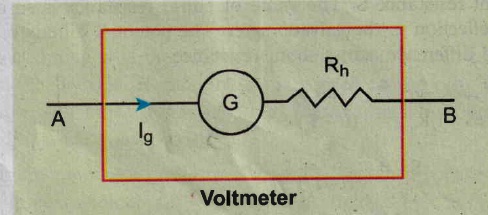
\(\mathrm{I}=\mathrm{I}_{\mathrm{g}} \)
\(\mathrm{I}=I_{g} \Rightarrow I_{g}=\frac{\text { potential difference }}{\text { total resistance }} \)
Since the galvanometer and high resistance are connected in series, the voltmeter resistance is,
\(R_{v} =R_{g}+R_{h} \)
Therefore,
\(I_{g} =\frac{V}{R_{g}+R_{h}} \)
\(\Rightarrow R_{h} =\frac{V}{I_{g}}-R_{g} \)
Note that \(I_{g} \propto V\)
Rh is very large. An ideal voltmeter has infinite resistance
23.
Conservation of energy:
(i) The truth of Lenz's law can be established on the basis of the law of conservation of energy. The explanation is as follows:
(ii) According to Lenz's law, when a magnet is moved either towards or away from a coil, the induced current produced opposes its motion
(iii) As a result, there will always be a resisting force on the moving magnet.
(iv) Work has to be done by some external agency to move the magnet against this resisting force
(v) Here the mechanical energy of the moving magnet is converted into the electrical energy which in turn, gets converted into Joule heat in the coil i.e., energy is converted from one form to another.
(vi) On the contrary to Lenz's law, let us assume that the induced current helps the cause responsible for its production.
(vii) Now When we push the magnet litle bit towards the coil, the induced current helps the movement of the magnet towards the coil.
(viii) Then the magnet starts moving towards the coil without any expense of energy. This, becomes a perpetual motion machine.
(ix) In practice, no such machine is possible. Therefore, the assumption that the induced current helps the cause is wrong.
24.
(i) The meter bridge is another form of Wheatstone's bridge. It consists of a uniform manganin wire AB of one meter length.
(ii) This wire is stretched along a meter scale on a wooden board between two copper strips C and D. Between these two copper strips another copper strip E is mounted to enclose two gaps G1 and G2.
(iii) An unknown resistance P is connected in G1 and a standard resistance Q is connected in G2. A jockey (conducting wire) is connected to the terminal E on the central copper strip through a galvanometer (G) and a high resistance (HR).
(iv) The exact position of jockey on the wire can be read on the scale. A Lechlanche cell and a key (K) are connected across the ends of the bridge wire.

(v) The position of the jockey on the wire is adjusted so that the galvanometer shows zero deflection. Let the position of jockey at the wire be at J.
(vi) The resistances corresponding to AJ and JB of the bridge wire now form the resistance R and S of the Wheatstone's bridge. Then for the bridge balance.
\(\cfrac { P }{ Q } =\cfrac { R }{ S } =\cfrac { { r }.AJ }{ { r }.JB } \)
where r' is the resistance per unit length of wire
\(\cfrac { P }{ Q } =\cfrac { AJ }{ JB } =\cfrac { { l }_{ 1 } }{ { l }_{ 2 } } \)
\(P=Q\cfrac { { l }_{ 1 } }{ { l }_{ 2 } } \)
(vii) By interchanging P and Q, another set of readings are taken and the average value of P is value of unknown resistance.
25.
The angular resolution has a unit in radian (rad) and it is given by the equation,
\(\theta =\cfrac { 1.22\lambda }{ \alpha } \)
26.
Manipulation of colours by adjusting the size of nano particles with which the materials are made.
27.
The undesired electrical signals are termed as noise. When a signal is transmitted, the undesired signals get mixed with it, leading to distortion of the signal.
28.
The cut-off wavelength of the characteristic x - rays is
\({ \lambda }_{ ° }\frac { 12400 }{ V } \mathring { A } =\frac { 12400 }{ 20000 } \mathring { A }\)
= 0.62 \(\mathring { A } \)
The corresponding frequency is
\({ \upsilon }_{ o }=\frac { c }{ { \lambda }_{ o } } =\frac { 3\times 10^{ 8 } }{ 0.62\times 10^{ -10 } }\) = 4.84 x 10¹⁸ Hz
29.
The moderator is a material used to convert fast neutrons into slow neutrons
(i) A billiard ball striking a stationary billiard ball of equal mass would itself be stopped but the same billiard ball bounces off almost with same speed when it strikes a heavier mass.
(ii) This is the reason for using lighter nuclei as moderators.
30.
The de Broglie wavelength associated with the kinetic energy k is given as \(\lambda=\frac{h}{\sqrt{2 m k}}\) , where m is the mass of the particle.
Therefore \(\lambda_{\mathrm{e}}=\frac{\mathrm{h}}{\sqrt{2 \mathrm{~m}_{\mathrm{e}} \mathrm{k}_{\mathrm{e}}}} \text { and } \lambda_{\alpha}=\frac{\mathrm{h}}{\sqrt{2 \mathrm{~m}_{\alpha} \mathrm{k}_{\alpha}}} \text {. But } \mathrm{k}_{\mathrm{e}}=\mathrm{k}_{\alpha} . \)
Therefore \(\frac{\lambda_{\mathrm{e}}}{\lambda_{\alpha}}=\sqrt{\frac{\mathrm{m}_{\alpha}}{\mathrm{m}_{\mathrm{e}}}} \mathrm{m}_{\alpha}>\mathrm{m}_{\mathrm{e}^{*}} \text {. Therefore, } \lambda_{\mathrm{e}}>\lambda_{\alpha^{\circ}}\)
31.
The output at the 1st AND gate : A\(\overline { B } \)
The output at the 2nd AND gate : ĀB
The output at the OR gate: Y = A. \(\overline { B } \) + Ā .B
32.
(i) If the portion of the output fed to the input is in phase with the input, then the magnitude of the input signal increases
(ii) It is necessary for sustained oscillations.
33.
UV light is absorbed by the ozone layer
(i) Source: Sun, arc and ionized gases.
(ii) Uses: To destroy bacteria, sterilizing the surgical instruments, burglar alarm etc
34.
(i) In electric field line is the path of movement of a positive test charge (q0 ⇾ 0) A moving charge experiences a continuous force is an electric field, so field line is always continuous
(ii) The field lines nevel intersect since if they cross, there will be two directions of electric field at the point of intersection, which is impossible.
35.
Power factor is defined as the ratio of resistance to the impedance of an AC circuit
Power factor \(\cos \phi=\frac{R}{2}\)
\(=\frac{Resistance}{Impedance}\)
36.
Balancing lengths are
11 = 35 cm, l2 = 63 cm
E1 = 1.25v E2 = ?
At the following point \(E \propto 1\)
\(\frac{E_{1}}{E_{2}}=\frac{l_{1}}{l_{2}} \)
\(\therefore \frac{1.25}{E_{2}}=\frac{35}{63} \quad \therefore E_{2}=\frac{1.25 \times 63}{35}=2.25 \mathrm{v} \)
∴ EMF of the second cell = 2.25 V
Vd = 0.03 x 10⁻³ m s-1
37.
Metal A
Since work function W = hvo
and vo > Vo so work function of metal A is more.
Aliter :
On stopping potential axis \(-\frac { { W }_{ o }^{ ' } }{ e } >-\frac { { W }_{ o } }{ e } \)
Hence work function W'o of metal A is more.
38.
(i) The phenomenon of spontaneous emission of highly penetrating radiations such as α, β, γ rays by heavy elements having atomic number greater than 82 is called radioactivity and the substances which emit these radiations are called radioactive elements.
(ii) The radioactive phenomenon spontaneous and is unaffected by any external agent like temperature, pressure, and magnetic fields.
39.
Given, focal length of first lens, f1 = –70 cm,
focal length of second lens, f2 = 150 cm.
Equation for focal length of lenses in contact, \(\cfrac { 1 }{ f } =\cfrac { 1 }{ { f }_{ 1 } } +\cfrac { 1 }{ { f }_{ 2 } } \)
Substituting the values,
\(\cfrac { 1 }{ f } =\cfrac { 1 }{ -70 } +\cfrac { 1 }{ 150 } =\cfrac { 1 }{ 70 } +\cfrac { 1 }{ 150 } \)
\(\cfrac { 1 }{ f } =\cfrac { -150+70 }{ 70\times 150 } =\cfrac { -80 }{ 70\times 150 } =\cfrac { 80 }{ 10500 } \)
\(f=\cfrac { -1050 }{ 8 } =131.25cm\)
As the focal length is negative, the combination of two lenses is a diverging system of lenses
The power of the combination is,
\(P=\cfrac { 1 }{ f } =\cfrac { 1 }{ -1.3125m } =0.76D\)
40.
\(\mathrm{m}_{\alpha}=100 ; \mathrm{f}_{o}=0.5 \mathrm{~cm} ; \mathrm{f}_{\mathrm{e}}=? \)
\(\mathrm{~L}_{\alpha}=6.5 \mathrm{~cm}, \mathrm{D}=25 \mathrm{~cm} \)
When the image is formed at infinity,
\(\mathrm{m}_{\alpha}=\frac{\left(\mathrm{L}_{\alpha}-\mathrm{f}_{0}-\mathrm{f}_{\mathrm{c}}\right) \mathrm{D}}{\mathrm{f}_{0} \mathrm{f}_{\mathrm{e}}} \)
\(100 =\left(\frac{6.5-0.5-f_{e}}{0.5 \times f_{e}}\right) \times 25 \)
\(=\left(\frac{6-f_{e}}{0.5 f_{e}}\right) \times 25 \)
\(100 \times 0.5 f_{e} =150-25 f_{e} \)
\(50 f_{e} =150-25 f_{e} \)
\(75 f_{e} =150 \)
\(f_{e} =150 / 75=2 \mathrm{~cm} \)
41.
Conduction current Ie = Displacement current ID
\({ I }_{ C }={ I }_{ s }=\frac { dq }{ dt } =\frac { d }{ dt } ({ q }_{ 0 }cos2\pi \gamma t)\)
\(=-2\pi { q }_{ 0 }\gamma sin2\pi \gamma t\)
42.
The magnetic field due to street wires AB & CD is zero since either θ = 0° or 180° and that due to a semi -circular arc are equal & opposite. Hence net field at O is zero.
43.
(i) This device consists of a long thick copper rod passing from top of the building to the ground. The upper end of the rod has a sharp spike or a sharp needle as shown in Figure 1.64 (a) and (b).
(ii) The lower end of the rod is connected to the copper plate which is buried deep into the ground. When a negatively charged cloud is passing above the building, it induces a positive charge on the spike.
(iii) Since the induced charge density on thin sharp spike is large, it results in a corona discharge.
(iv) This positive charge ionizes the surrounding air which in turn neutralizes the negative charge in the cloud.
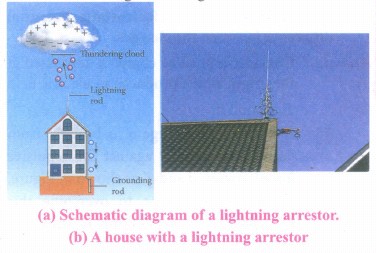
(v) The negative charge pushed to the spikes passes through the copper rod and is safely diverted to the earth.
(vi) The lightning arrester does not stop the lightning; rather it diverts the lightning to the ground safely.

12th Standard Syllabus & Materials
12th Standard
TN 12th Computer Applications களப்பெயர் முறைமை (DNS) Sample Question Papers Study Material - QB365 Set A
NEW12th Standard
TN 12th Computer Applications வலையமைப்பு எடுத்துக்காட்டுகள் மற்றும் நெறிமுறைகள் Sample Question Papers Study Material - QB365 Set A
NEW12th Standard
TN 12th Computer Applications கணினி வலையமைப்பு ஓர் அறிமுகம் Sample Question Papers Study Material - QB365 Set A
NEW12th Standard
TN 12th Computer Applications PHP-உடன் MySQL-ஐ இணைத்தல் Sample Question Papers Study Material - QB365 Set A



Tamilnadu Stateboard 12th Standard Subjects

Maths

Chemistry
Physics

Biology

Computer Science

Business Maths and Statistics

Economics

Commerce

Accountancy

History

Computer Applications
Biology
Computer Technology
Computer Applications
Computer Science
Business Maths and Statistics
Commerce
Economics
Maths
Chemistry
Physics
Computer Technology
History
Accountancy

Tamil

English

French
Tamilnadu Stateboard Standards

