
 100% FREE ACCESS
12th Standard Syllabus & Materials
12th Standard
TN 12th Computer Applications மின்னணு தரவு பரிமாற்றம் Sample Question Papers Study Material - QB365 Set A
NEW12th Standard
TN 12th Computer Applications மின் - வணிக பாதுகாப்பு அமைப்புகள் Sample Question Papers Study Material - QB365 Set A
NEW12th Standard
TN 12th Computer Applications மின்னணு செலுத்தல் முறைகள் Sample Question Papers Study Material - QB365 Set A
NEW12th Standard
TN 12th Computer Applications மின் - வணிகம் Sample Question Papers Study Material - QB365 Set A
NEW12th Standard
TN 12th Computer Applications திறந்த மூல கருத்துருக்கள் Sample Question Papers Study Material - QB365 Set A
NEW12th Standard
TN 12th Computer Applications வலையமைப்பு வடமிடல் Sample Question Papers Study Material - QB365 Set A

Published on: 06/01/2020
Recent Developments in Physics
Download Tamil Nadu 12th Standard Physics question papers, model tests, one-mark questions, important questions, and public exam papers in PDF format. Free study materials and answer keys for TN State Board students.
Questions + Answers key
Take MCQ Physics Test1.
Zno is an example of __________
Bulk solid
Nano solid
Bulk solid and Nano solid
None of the above
2.
Best example for applications of nanotechnology is ______________.
Chemical industry
Engineering
medicine
all of these
3.
__________ Scanning Electron Micrograph (SEM) showing the nano structures on the surface of a leaf from a lotus plant
Parrot fish
Morpho butterfly
Lotus leaf surface
Peacock feathers
4.
The particle which gives mass to protons and neutrons are _____.
Higgs particle
Einstein particle
Nanoparticle
Bulk particle
5.
The alloys used for muscle wires in Robots are _____.
Shape memory alloys
Gold copper alloys
Gold silver alloys
Two dimensional alloys
6.
What is use of robotics?
7.
What is the two ways of preparing nano particle?
8.
Define nano solid?
9.
What is the use of household robots?
10.
What are God particles?
11.
What is the role of nanostructure in the morpho butterfly wings?
12.
What are sub atomic particles?
13.
Mention any two advantages and disadvantages of Robotics.
14.
Write the advantages and disadvantages of robotic.
15.
What are the possible harmful effects of usage of Nanoparticles? Why?
16.
Write a note on Gravitational waves.
17.
What is robotics?
18.
Write the aim of artificial intelligence in robots.
19.
Write the two ways of preparing the nano materials.
20.
What is particle physics?
21.
Write the application of nano robots in medical field?
22.
Discuss the functions of key components in Robots?
1.
(c)
Bulk solid and Nano solid
2.
(d)
all of these
3.
(c)
Lotus leaf surface
4.
Proton and neutron are made up of quarks. Later, it was found that Higg's particles or God particles give mass to the particles like protons, neutrons etc.
5.
They are thin strands of wire made of shape memory alloys. They can contract by 5% when electric current is passed through them.
6.
(i) Defusing Bomb.
(ii) Finding survivors in unstable rains, and exploring mines and shipwrecks.
7.
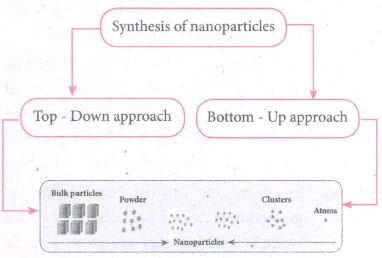
(i) Top - down approach.
(ii) Bottom - up approach.
8.
The particle of solid is of size less than 100 nm, it is said to be a nano solid. Ex. ZnO.
9.
Household robots are used as vacuum cleaners, floor cleaners, gutter cleaners, lawn mowing, pool cleaning, and to open and close doors.
10.
(i) Higgs particles' also known as "God" particles were discovered and for this, Peter Higgs and Englert received noble prize in physics.
(ii) It is the 'Higgs particle' which gives mass to many particles like protons, neutrons etc.
11.
The scales on the wings of a morpho butterfly contain nanostructures that change the way light waves interact with each other, giving the wings brilliant metallic blue and green hues.
12.
The constituent particles of atom are called sub atomic particles. Therefore electron, proton and neutron are sub atomic particles. Later it was understood that protons and neutrons are made up of quarks. These quarks are also sub atomic particles. Recently it is discovered that the Higgs particles or God particles give mass to many particles like protons, neutrons etc.
13.
Advantages of Robotics:
(i) Robots are more precise and error free in performing the task.
(ii) Robots never get tired like humans. It can work for 24 x 7. Hence absenteeism in work place can be reduced.
Disadvantages of Robotics:
(i) Unemployment problem will increase.
(ii) Robots can perform defined tasks and cannot handle unexpected situations.
14.
Advantages of robotics:
(i) The robots are much cheaper than humans.
(ii) Robots never get tired like humans. It can work for 24 x 7. Hence absenteeism in work place can be reduced.
(iii) Robots are more precise and error free in performing the task.
(iv) Stronger and faster than humans.
(v) Robots can work in extreme environmental conditions: extreme hot or cold, space or underwater. In dangerous situations like bomb detection and bomb deactivation.
(vi) In warfare, robots can save human lives.
(vii) Robots are significantly used in handling materials in chemical industries especially in nuclear plants which can lead to health hazards in humans.
Disadvantages of Robotics:
(i) Robots have no sense of emotions or conscience.
(ii) They lack empathy and hence create an emotionless workplace.
(iii) If ultimately robots would do all the work, and the humans will just sit and monitor them, health hazards will increase rapidly.
(iv) Unemployment problem will increase.
(v) Robots can perform defined tasks and cannot handle unexpected situations.
(vi) The robots are well programmed to do a job and if a small thing goes wrong it ends up in a big loss to the company.
(vii) If a robot malfunctions, it takes time to identify the problem, rectify it, and even reprogram if necessary. This process requires signi cant time.
(viii) Humans cannot be replaced by robots in decision making.
(ix) Till the robot reaches the level of human intelligence, the humans in work place will exit.
15.
Possible harmful effects of nanoparticles:
(i) They may easily get absorbed onto the surface of living organisms as dimensions of the nano particles are the same as that of biological molecules such as proteins.
(ii) They readily enter the tissues and fluids of the body and distort their functions
(iii) Nano particles can also cross cell membranes so that, interaction with living systems is affected
(iv) It is also possible for the inhaled nanoparticles to reach the blood, to reach other sites such as the liver, heart or blood cells.
16.
(i) Gravitational waves are the disturbances in the curvature of space-time and it travels with speed of light.
(ii) Any accelerated charge emits electromagnetic wave.
(iii) Similarly any accelerated mass emits gravitational waves but these waves are very weak even for masses like earth.
(iv) The strongest source of gravitational waves are black holes. The discovery of gravitational waves made it possible to study the structure of black holes since it is the strongest source of gravitational waves.
(v) In fact, the recent discoveries of gravitational waves are emitted by two black holes when they merge to a single black hole.
(vi) In fact, Albert Einstein. theoretically proposed the existence of 'gravitational waves' in the year 1915. After 100 years, it is experimentally proved that his predictions are correct.
17.
(i) Robotics is an integrated study of mechanical engineering, electronic engineering, computer engineering, and science.
(ii) Robot is a mechanical device designed with electronic circuitry and programmed to perform a specific task.
(iii) These automated machines are highly Significant in this robotic era where they can take up the role of humans in certain dangerous environments that are hazardous to people like defusing bombs, finding survivors in unstable ruins, and exploring mines and shipwrecks.
18.
(i) Face recognition.
(ii) Providing response to player's actions in computer games.
(iii) Taking decisions based on previous actions.
(iv) To regulate the traffic by analyzing the density of traffic on roads.
(v) Translate words from one language to another.
19.
There are two ways of preparing the nanomateials, top down and bottom up approaches
20.
(i) Particle physics deals with the theory of fundamental particles of nature and it is one of the active research areas in physics.
(ii) Initially it was thought that atom is the fundamental entity of matter.
(iii) In 1930s and it was established that atoms are made up of electrons, protons and neutrons.
21.
(i) Nano-robots in blood stream to perform small surgical procedures, to fight against bacteria, repairing individual cell in the body.
(ii) It can travel into the body and once after the job is performed it can find its way out. Chinese scientists have created the world's first autonomous DNA robots to combat cancer tumours.
22.
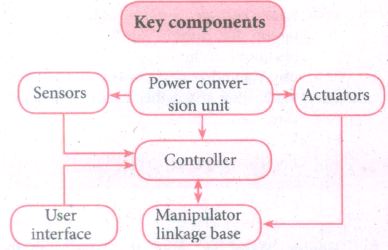
The key components in Robots are power conversion unit, actuators, controller, sensors, manipulators and necessary software.
The following diagram clearly explains the functions of the key components.
Most Robots are composed of 3 Main parts:
i) The controller:
It is known as the 'brain' which is run by computer program. It gives commands for the moving parts to perform the job.
ii) Sensors:
It tells the robot about its surroundings. It helps to determine the sizes and shapes of the objects around, distance between the objects and directions as well.
iii) Mechanical parts:
It makes the robot to move, grab, turn and lift. It consists of motors, pistons, grippers, wheels and gears.

12th Standard Syllabus & Materials
12th Standard
TN 12th Computer Applications களப்பெயர் முறைமை (DNS) Sample Question Papers Study Material - QB365 Set A
NEW12th Standard
TN 12th Computer Applications வலையமைப்பு எடுத்துக்காட்டுகள் மற்றும் நெறிமுறைகள் Sample Question Papers Study Material - QB365 Set A
NEW12th Standard
TN 12th Computer Applications கணினி வலையமைப்பு ஓர் அறிமுகம் Sample Question Papers Study Material - QB365 Set A
NEW12th Standard
TN 12th Computer Applications PHP-உடன் MySQL-ஐ இணைத்தல் Sample Question Papers Study Material - QB365 Set A



Tamilnadu Stateboard 12th Standard Subjects

Maths

Chemistry
Physics

Biology

Computer Science

Business Maths and Statistics

Economics

Commerce

Accountancy

History

Computer Applications
Biology
Computer Technology
Computer Applications
Computer Science
Business Maths and Statistics
Commerce
Economics
Maths
Chemistry
Physics
Computer Technology
History
Accountancy

Tamil

English

French
Tamilnadu Stateboard Standards

