
 100% FREE ACCESS
12th Standard Syllabus & Materials
12th Standard
TN 12th Computer Applications மின்னணு தரவு பரிமாற்றம் Sample Question Papers Study Material - QB365 Set A
NEW12th Standard
TN 12th Computer Applications மின் - வணிக பாதுகாப்பு அமைப்புகள் Sample Question Papers Study Material - QB365 Set A
NEW12th Standard
TN 12th Computer Applications மின்னணு செலுத்தல் முறைகள் Sample Question Papers Study Material - QB365 Set A
NEW12th Standard
TN 12th Computer Applications மின் - வணிகம் Sample Question Papers Study Material - QB365 Set A
NEW12th Standard
TN 12th Computer Applications திறந்த மூல கருத்துருக்கள் Sample Question Papers Study Material - QB365 Set A
NEW12th Standard
TN 12th Computer Applications வலையமைப்பு வடமிடல் Sample Question Papers Study Material - QB365 Set A

Published on: 06/01/2020
Semiconductor Electronics
Download Tamil Nadu 12th Standard Physics question papers, model tests, one-mark questions, important questions, and public exam papers in PDF format. Free study materials and answer keys for TN State Board students.
Questions + Answers key
Take MCQ Physics Test1.
The intrinsic semi-conductor has ______________.
A finite resistance which does not change with temperature
Infinite resistance which decreases with temperature
Finite resistance which decreases with temperature
Finite resistance which does not change with temperature
2.
Which statement is incorrect regarding for p-n junction?
Donor atoms are depleted of their holes in junction
No net charge exists far from junction
Barrier potential VB is generated
Energy VB is to be surrounted before any charge can flow across junction
3.
The electrical series circuit in digital form is
AND
OR
NOR
NAND
4.
The principle based on which a solar cell operates is______.
Diffusion
Recombination
Photovoltaic action
Carrier flow
5.
The zener diode is primarily used as ______.
Rectifier
Amplifier
Oscillator
Voltage regulator
6.
What is Breakdown voltage?
7.
What is rectification?
8.
What is forward V-I characteristics?
9.
In a transistor connected in the common base configuration, \(\alpha\) = 0 95, IE = 1 mA. Calculate the values of IC and IB.
10.
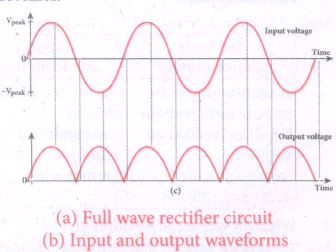
Draw the input and output waveform of a full wave rectifier.
11.
12.
For a BJT circuit shown, assume that the 'β' of the transistor is very large and VBE= 0.7 V. The mode of operation.
13.
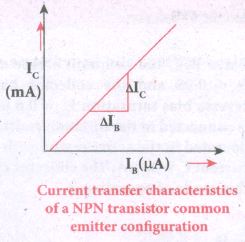
Explain current transfer characteristics.
14.
State Boolean laws. Elucidate how they are used to simplify Boolean expressions with suitable example.
15.
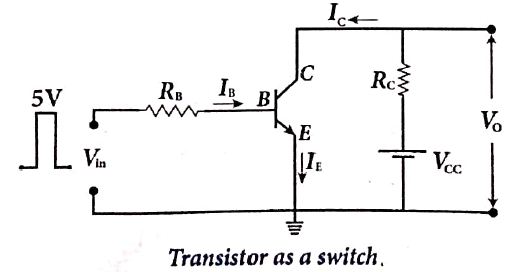
Transistor functions as a switch. Explain.
16.
What is electronics?
17.
Give the Schematic representation of valence band, conduction band, and forbidden energy gap and draw energy band structure of
(a) Insulators
(b) Semiconductors
(c) Metals?
18.
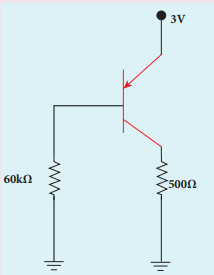
In the circuit shown in the figure, the BJT has a current gain (β) of 50. For an emitter-base voltage VEB = 600 mV, calculate the emitter-collector voltage VEC (in volts).
1.
(c)
Finite resistance which decreases with temperature
2.
(d)
Energy VB is to be surrounted before any charge can flow across junction
3.
(a)
AND
4.
(c)
Photovoltaic action
5.
(d)
Voltage regulator
6.
The voltage at which the diode breaks down is called the breakdown voltage
7.
The process in which alternating voltage or alternating current is converted direct voltage or direct current is called rectification.
8.
A graph is plotted by taking the forward bias voltage (V) along the x- axis and the current (I) through the diode along y-axis. This graph is called the forward V-I characteristics.
9.
α = \(\frac{I_C}{I_E}\)
IC = α IE = 0.95 x 1 = 0.95 mA
IE = IB + IC
∴ IB = IE - IC = 1 - 0.95 = 0.05 mA
10.
11.
12.
VBE =0.7V
Input junction is a forward biased.
Since,
VBE = 0.7V
VCE = VBE+ VCB
VCB = VCE-VBE
To determine VCB we find IC
\({ I }_{ C }\cong { I }_{ C }\frac { 2-{ V }_{ BE } }{ { R }_{ 2 } } =\frac { 2-0.7 }{ 1k\Omega } \)
IC = 1.3mA
VCE = VCC - IC (R1 + R2)
= 10 - 1.3mA (10K + 1K)
VCE = - 4.3 V
VCE =-4.3V-0.7
VCB = - 5V
13.
(i) This gives the variation of collector current (IC) with changes in base current (IB) at constant collector-emitter voltage (VCE).
(ii) It is seen that a small Ie flows even when IB is zero. This current is called the common emitter leakage current (ICEQ) which is due to the flow of minority charge carriers.
Forward current gain:
(i) The ratio of the change in collector current (ΔIC) to the change in base current (ΔIB) at constant collector-emitter voltage (VCE) is called forward current gain(β)
\(\beta ={ \left( \frac { \triangle { I }_{ C } }{ \triangle { I }_{ B } } \right) }_{ { V }_{ CE } }\)
(ii) It is value is very high and it generally ranges from 50 to 200. It depends on the construction of the transistors and will be provided by the manufacturer.
14.
Laws of Boolean algebra:
Complement law:
| A | Y=Ā |
| 0 | Y = \(\bar { 0 } \) = 1 |
| 0 | Y=\(\bar { 1 } \)=0 |
The complement law can be realised as Ā = A
OR laws:
| A | B | Y=A+B |
| 0 | 0 | Y = 0 + 0 = 0 |
| 0 | 1 | Y = 0 + 1 = 1 |
| 1 | 0 | Y = 1 + 0 = 1 |
| 1 | 1 | Y = 1 + 1 = 1 |
The OR laws can be realised as:
| 1st law | A+0=A |
| 2st law | A+1=1 |
| 3st law | A+A=A |
| 4st law | A+Ā=1 |
AND law:
| A | B | Y=A.B |
| 0 | 0 | Y=0.0=0 |
| 0 | 1 | Y=0.1=0 |
| 1 | 0 | Y=1.0=0 |
| 1 | 1 | Y=1.1=1 |
The AND laws can be realised as:
| 1st law | A.0=0 |
| 2st law | A.1=A |
| 3st law | A.A=A |
| 4st law | A.Ā=0 |
The Boolean operations obey the folloWing laws:
Communtative laws:
A+B =B+A
A.B =B.A
A sociate laws:
A + (B + C) = (A + B) + C
A. (B.C) = (A.B).C
D stributive laws:
A (B + C) = AB + BC
A + BC = (A + B) (A + C)
The above laws are used to simplify complicated expressions and to simplify the logic circuitry.
15.
(i) The transistor in saturation region acts as a closed switch while in cut-off region, it acts as an open switch.
(ii) It functions like an electronic switch that helps to turn ON or OFF a given circuit by a small control signal which keeps the transistor either in saturation region or in cut-off region.
When the input is low:
(i) When the input is low (say 0 V), the base current is zero and transistor is not properly forward biased.
(ii) It is in cut off region, As a result, the collector current is zero and correspondingly the voltage drop across RC, also becomes nearly zero, The output voltage is high and Is equal to VCC.
(iii) It means that the no current flows through the transistor and it is said to be switched off. The transistor acts as an open switch.
When the input is high:
(i) When input voltage is increased to a certain high value (say +5 V), the base current (IB) increases and in turn decreases the collector current to its maximum.
(ii) The transistor will move into the saturation region. The increase in collector current (IC). increases the voltage drop across RC, thereby thereby lowering the output voltage, close to zero (since Vo = VCC -ICRC). It means that maximum current flows through the transistor and it is said to be switched on.
(iii)The transistor acts as a closed switch.
16.
(i) It is the branch of physics incorporated with technology towards the design of circuits using transistors and microchips.
(ii) It depicts the behavior and movement of electrons in a semiconductor, vacuum, or gas.
(iii) Electronics deals with electrical circuits that involve active components such as transistors, diodes, integrated circuits, and sensors, associated with the passive components like resistors, inductors, capacitors, and transformers.
17.
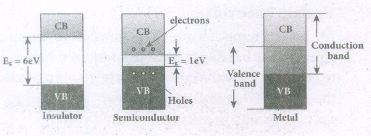
18.
\(\beta =50 \)
\(V_{\beta E} =600 \mathrm{mV} \)
\(=0.6 \mathrm{~V} \)
\(\mathrm{V}_{\mathrm{B}} =\mathrm{V}_{\mathrm{E}}-\mathrm{V}_{\mathrm{EB}} \)
\(\mathrm{V}_{\mathrm{B}} =3-0.6 \)
\(=2.4 \mathrm{~V} \)
\(\mathrm{I}_{\mathrm{B}} =\frac{\mathrm{V}_{\mathrm{B}}}{R_B}=\frac{2.4}{60 \times 10^3}=40 \mu \mathrm{A} \)
\(\mathrm{I}_{\mathrm{C}} =\beta \mathrm{I}_{\mathrm{B}}=50 \times 40 \mu \mathrm{A} =2 \mathrm{~mA} \)
\(V_C=R_FI_C=500 \times 2 \times10^{-3}=1 V\)
\(V_{EC}=V_E-V_C\)
\(V_{EC}=V_E-V_C\)
\(V_{EC}=3-1=2V\)

12th Standard Syllabus & Materials
12th Standard
TN 12th Computer Applications களப்பெயர் முறைமை (DNS) Sample Question Papers Study Material - QB365 Set A
NEW12th Standard
TN 12th Computer Applications வலையமைப்பு எடுத்துக்காட்டுகள் மற்றும் நெறிமுறைகள் Sample Question Papers Study Material - QB365 Set A
NEW12th Standard
TN 12th Computer Applications கணினி வலையமைப்பு ஓர் அறிமுகம் Sample Question Papers Study Material - QB365 Set A
NEW12th Standard
TN 12th Computer Applications PHP-உடன் MySQL-ஐ இணைத்தல் Sample Question Papers Study Material - QB365 Set A



Tamilnadu Stateboard 12th Standard Subjects

Maths

Chemistry
Physics

Biology

Computer Science

Business Maths and Statistics

Economics

Commerce

Accountancy

History

Computer Applications
Biology
Computer Technology
Computer Applications
Computer Science
Business Maths and Statistics
Commerce
Economics
Maths
Chemistry
Physics
Computer Technology
History
Accountancy

Tamil

English

French
Tamilnadu Stateboard Standards

