
 100% FREE ACCESS
12th Standard Syllabus & Materials
12th Standard
TN 12th Computer Applications மின்னணு தரவு பரிமாற்றம் Sample Question Papers Study Material - QB365 Set A
NEW12th Standard
TN 12th Computer Applications மின் - வணிக பாதுகாப்பு அமைப்புகள் Sample Question Papers Study Material - QB365 Set A
NEW12th Standard
TN 12th Computer Applications மின்னணு செலுத்தல் முறைகள் Sample Question Papers Study Material - QB365 Set A
NEW12th Standard
TN 12th Computer Applications மின் - வணிகம் Sample Question Papers Study Material - QB365 Set A
NEW12th Standard
TN 12th Computer Applications திறந்த மூல கருத்துருக்கள் Sample Question Papers Study Material - QB365 Set A
NEW12th Standard
TN 12th Computer Applications வலையமைப்பு வடமிடல் Sample Question Papers Study Material - QB365 Set A

Published on: 21/09/2019
Download Tamil Nadu 12th Standard Physics question papers, model tests, one-mark questions, important questions, and public exam papers in PDF format. Free study materials and answer keys for TN State Board students.
Questions + Answers key
Take MCQ Physics Test1.
Define magnetic flux.
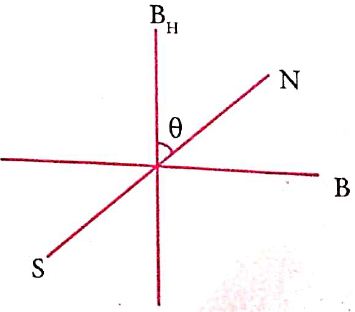
2.
3.
What is meant by Fraunhofer lines?
4.
Define ‘electric dipole’. Give the expression for the magnitiude of its electric dipole moment and the direction.
5.
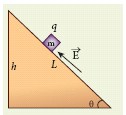
A block of mass m carrying a positive charge q is placed on an insulated frictionless inclined plane as shown in the figure. A uniform electric field E is applied parallel to the inclined surface such that the block is at rest. Calculate the magnitude of the electric field E.
6.
A potential difference across 24 Ω resistor is 12 V. What is the current through the resistor?
7.
State microscopic form of Ohm’s law.
8.
Obtain Gauss law from Coulomb’s law.
9.
10.
State and explain Kirchhoff ’s rules
11.
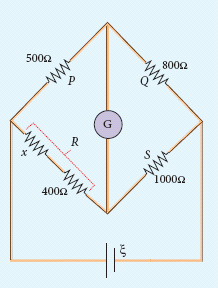
What is the value of x when the Wheatstone’s network is balanced?
P = 500 Ω, Q = 800 Ω, R = x + 400, S = 1000 Ω
12.
Two electric bulbs marked 20 W – 220 V and 100 W – 220 V are connected in series to 440 V supply. Which bulb will get fused?
13.
A non-conducting charged ring carrying a charge of q, mass m and radius r is rotated about its axis with constant angular speed ω. Find the ratio of its magnetic moment with angular momentum is _____.
\(\\ \frac { q }{ m } \)
\(\\ \frac { 2q }{ m } \)
\(\\ \frac { q }{ 2m } \)
\(\\ \frac { q }{ 4m } \)
14.
When the current changes from +2A to −2A in 0.05 s, an emf of 8 V is induced in a coil. The co-efficient of self-induction of the coil is
0.2H
0.4H
0.8H
0.1H
15.
Which of the following is false for electromagnetic waves
transverse
non-mechanical waves
longitudinal
produced by accelerating charges
16.
A parallel plate capacitor stores a charge Q at a voltage V. Suppose the area of the parallel plate capacitor and the distance between the plates are each doubled then which is the quantity that will change?
Capacitance
Charge
Voltage
Energy density
17.
18.
A carbon resistor of (47 ± 4.7 ) k Ω to be marked with rings of different colours for its identification. The colour code sequence will be ______.
Yellow – Green – Violet – Gold
Yellow – Violet – Orange – Silver
Violet – Yellow – Orange – Silver
Green – Orange – Violet - Gold
19.
What is tangent law? Discuss in detail.
20.
How will you define the unit of inductance?
21.
Fraunhofer Lines
22.
Radio waves
23.
RLC circuit
24.
Electric Fuses
25.
Air
26.
Assertion: If two ends of a solenoid are bent and together to form a closed ring shape, it is called as toroid
Reason: Magnetic field due to a long current-carrying solenoid is m
B=\(\frac { \mu NI }{ L } \) =μnI (where, n=\(\frac { N }{ L } \))
Codes:
(a) Assertion and Reason are correct and Reason is the correct explanation of Assertion.
(b) Assertion and Reason are true but Reason is the false explanation of the Assertion.
(c) Assertion is true but Reason is false.
(d) Assertion is false but Reason is true
27.
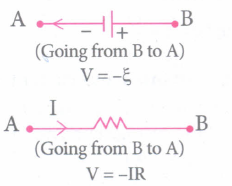
Assertion: Kirchoff's voltage rule can be expressed as \({ \varepsilon }_{ 1 }+{ \varepsilon }_{ 2 }+{ \varepsilon }_{ 3 }+...{ \varepsilon }_{ n }={ I }_{ 1 }{ R }_{ 1 }+{ I }_{ 2 }{ R }_{ 2 }+...{ I }_{ n }{ R }_{ n }\)
Reason: For the given diagrams
Codes:
(a) Assertion and Reason are correct and Reason is the correct explanation of Assertion.
(b) Assertion and Reason are true but Reason is the false explanation of the Assertion.
(c) Assertion is true but Reason is False.
(d) Assertion is false but Reason is True
28.
Assertion: Two surfaces of spheres A and B of radii r1 and r2 when connected by a wire, form an equipotential surface. i.e VA= VB
Reason: Surface charge density (σ) is inversely proportional to the radius of the sphere i.e sx\(\frac{1}{r}\). [as radius is smaller, σ will be larger]
Codes:
(a) Assertion and Reason are correct and Reason is the correct explanation of Assertion.
(b) Assertion and Reason are true but Reason is the false explanation of the Assertion.
(c) Assertion is true but Reason is false.
(d) Assertion is false but Reason is true.
1.
Magnetic flux is defined as the number of magnetic field lines crossing per unit area kept normal to the direction of lines of force.
2.
3.
When the spectrum obtained from the Sun is examined, it consists of large number of dark lines (line absorption spectrum). These dark lines in the solar spectrum are known as Fraunhofer lines.
4.
(i) Two equal and opposite charges separated by a small distance constitute an electric dipole.
(ii) The magnitude of the electric dipole moment is equal to the product of the magnitude of one of the charges and the distance between them, \(|\vec{p}|=2 q a\).
(iii) The electric dipole moment vector lies along the line joining two charges and is directed from -q to +q.
5.
Note: A similar problem is solved in XIth Physics volume I, unit 3 section 3.3.2. There are three forces that acts on the mass m:
(i) The downward gravitational force exerted by the Earth (mg)
(ii) The normal force exerted by the inclined surface (N)
(iii) The Coulomb force given by uniform electric field (qE) The free body diagram for the mass m is drawn below.
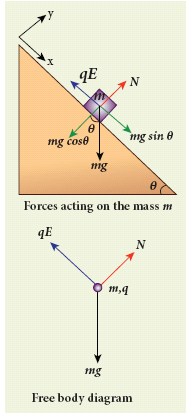
A convenient inertial coordinate system is located in the inclined surface as shown in the figure. The mass m has zero net acceleration both in x and y-direction.
Along x-direction, applying Newton’s second law, we have
mg sinθ\(\hat { i } \) - qE\(\hat { i } \) = 0
mg sinθ - q E = 0
or, E = \(\\ \frac { mgsin\theta }{ q } \)
Note that the magnitude of the electric field is directly proportional to the mass m and inversely proportional to the charge q. It implies that, if the mass is increased by keeping the charge constant, then a strong electric field is required to stop the object from sliding. If the charge is increased by keeping the mass constant, then a weak electric field is sufficient to stop the mass from sliding down the plane.
The electric field also can be expressed in terms of height and the length of the inclined surface of the plane.
E = \(\frac { mgh }{ qL } \).
6.
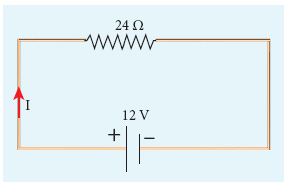
V = 12 V and R = 24 Ω
Current, I = ?
From Ohm’s law, \(I=\frac{V}{R}=\frac{12}{24}=0.5A\)
7.
Microscopic form of ohm's law is
\(\vec{J}=\sigma\vec {E}\)
\(J=\frac{ne^2\tau}{m}\vec{E}\)
\(\frac{e \tau}{m} \rightarrow Drift \ velocity \ v_d\)
where \(\vec{J} \) - current density
\(\sigma \) - conductivity
\(\vec{E} \) - Electric field
8.
Gauss law:
(i) A positive point charge Q is surrounded by an imaginary sphere of radius r as shown in Figure. then the total electric flux through the closed surface of the sphere is
\(\Phi_E =\oint { \vec { E } .d\vec { A } =\oint { Ed } Acos\theta } \) .....(1)
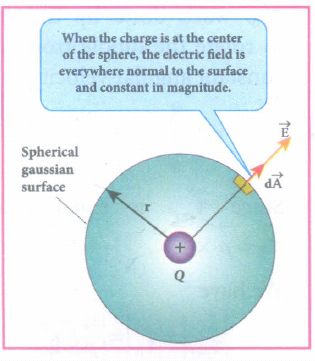
(ii) The electric field of the point charge is directed radially outward at all points on the surface of the sphere. Therefore, the direction of the area element \(d\vec { A } \) is along the electric field \(\vec { E } \) and θ = 0o.
\(\\ \Phi_E =\oint { EdA } \) Since cos0o = 1 ......(2)
iii) E is uniform on the surface of the sphere,
\(\\ \Phi_E=E\oint { dA } \) .......(3)
Substituting for \(\oint { dA=4{ \pi r }^{ 2 } } \) and \(E=\frac { 1 }{ 4\pi { \varepsilon }_{ 0 } } \frac { Q }{ { r }^{ 2 } } \) in eqn (3), we get
\(\therefore \phi E=4{ \pi r }^{ 2 }E\)
\({ \phi }_{ E }=\frac { 1 }{ 4\pi { \varepsilon }_{ 0 } } \frac { Q }{ { r }^{ 2 } } \times { 4\pi r }^{ 2 }=4\pi \frac { 1 }{ 4\pi { \varepsilon }_{ 0 } } Q\)
\({ \phi }_{ E }=\frac { Q }{ { \varepsilon }_{ 0 } } \) .....(4)
The equation (4) is called as Gauss's law.
9.
10.
Kirchhoff's First rule: (current rule)
(i) It states that the algebraic sum of the currents at any junction of a circuit is zero. It is a statement of law of conservation of electric charge.
(ii) All charges that enter a given junction in a circuit must leave that junction since charge cannot build up or disappear at a junction. By convention current entering the junction is taken as positive and current leaving the junction is taken as negative.
Applying law to the junction A in Figure.
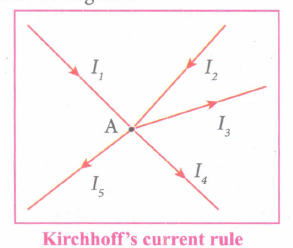
\({ I }_{ 1 }+{ I }_{ 2 }-{ I }_{ 3 }-{ I }_{ 4 }-{ I }_{ 5 }=0\)
(or)
\({ I }_{ 1 }+{ I }_{ 2 }=I_{ 3 }+{ I }_{ 4 }+{ I }_{ 5 }\)
Kirchhoff's Second rule (Voltage rule or Loop rule)
(i) It states that in a closed circuit the algebraic sum of the products of the current and resistance of each part of the circuit is equal to the total emf included in the circuit.
(ii) This rule follows from the law of conservation of energy for an isolated system (The energy supplied by the emf sources is equal to the sum of the energy delivered to all resistors).
(iii) Kirchhof's voltage rule has to be applied only when all currents in the circuit reach a steady state condition.
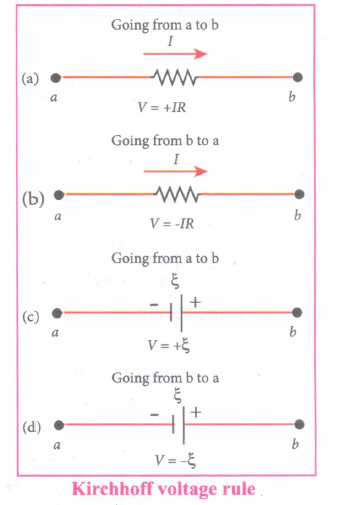
(iv) The current in the various branches are constant. The product of current and resistance is taken as positive when the direction of the current is followed.
(v) Suppose if the direction of current is opposite to the direction of the loop, then product of current and voltage across the resistor is negative. It is shown in Figure (a) and (b).
(vi) The emf is considered positive when proceeding from the negative to the positive terminal of the cell.
11.
\(\frac { P }{ Q } =\frac { R }{ S } \), when the network is balanced
\(\frac { 500 }{ 800 } =\frac { x+400 }{ 1000 } \)
\(x+400=\frac { 5 }{ 8 } \times 1000\)
x + 400 = 625
x = 625 – 400
x = 225 Ω
12.
To check which bulb will be fused, the voltage drop across each bulb has to be calculated.
The resistance of a bulb,
\(R=\frac { V^{ 2 } }{ P } =\frac { { (Ratedvoltage) }^{ 2 } }{ Ratedpower } \)
For 20W - 220V bulb,
\({ R }_{ 1 }=\frac { { \left( 220 \right) }^{ 2 } }{ 20 } \Omega =2420\Omega \)
For 100W - 220V bulb,
\({ R }_{ 2 }=\frac { { \left( 220 \right) }^{ 2 } }{ 20 } \Omega =484\Omega \)
Both the bulbs are connected in series. So same current will pass through both the bulbs. The current that passes through the circuit, \(I=\frac { V }{ { R }_{ tot } } \)
Rtot (R1 + R2)
Rtot = (484 + 2420) \(\Omega\) = 2904 \(\Omega\)
\(I=\frac { 440V }{ 2904\Omega } \approx 0.151A\)
The voltage drop across the 20W bulb is
\(V_1=IR_1=\frac { 440V }{ 2904 }\times2420 \approx 366.6V\)
The voltage drop across the 100W bulb is
\({ V }_{ 2 }=I{ R }_{ 2 }=\frac { 440 }{ 2904 } 484\approx 73.3A\)
The 20 W bulb will get fused because the voltage across it is more than the voltage rating.
13.
Magnetic moment,
μ = IA
Angular momentum,
L = Iω
Ratio \(\frac{p_m}{L}=\frac{(q/T)\pi r^2}{mr^2\omega}=\frac{q}{2m}\)
14.
\(\text {emf } e=8 \mathrm{~V} \)
\(d I=I_1-I_0=2-(-2)=4 \mathrm{~A} \)
\(\text {dt }=0.05 \mathrm{~s} \)
\(L=\frac{-e}{d I / d t}=\frac{-8}{4 / 0.05} \)
\(=\frac{-8 \times 0.05}{4}=\frac{-0.40}{4} \)
=-0.1 H
-ve sign indicates that self-induced emf always opposes the current w.r.t. time.
15.
(c)
longitudinal
16.
Energy density uE \(=\frac{U}{volume}\)
If A' = 2A d ' = 2d
Then V ' = 2A x 2d = 4Ad = 4V
Then volume would be increased. So, energy density will change.
17.
(b)
18.
Yellow - 4
Violet - 7
Orange - 103
Silver - Tolerance - 10%
19.
(i) When a magnetic needle or magnet is freely suspended in two mutually perpendicular uniform magnetic fields, it will come to rest in the direction of the resultant of the two fields.
(ii) Let B be the magnetic field produced by passing current through the coil of the tangent galvanometer and BH be the horizontal component of earth's magnetic field.
(iii) Under the action of two magnetic fields, the needle comes to rest making angle with BH , such that
B = BH tan \(\theta\) .........(1)
Where B ⇒ magnetic field produced by current
BH ⇒ horizontal component of earth's magnetic field
Construction:
(i) Copper coil of wire wound on a non-magnetic circular frame such as brass or wood. Compass box is kept at centre.
(ii) This compass box consists of pivoted magnet and aluminum pointer.
(iii) This compass box is having circular scale graduated with four quadrants.
Working:
(i) Two magnetic fields are perpendicular to each other.
(ii) Magnetic induction due to the current in the coil acting to normal to the plane of the coil.
(iii) Magnetic induction at the centre of the coil,
\(B=μ_o\frac{NI}{2R}\) .....(2)
Sub. eqn.(1) in eqn. (2)
\(B_H tan \theta =μ_o\frac{NI}{2R}\)
\(B_H =μ_o\frac{NI}{2R}\frac{1}{tan\theta}\)
20.
Unit of Inductance:
Inductance is a scalar and its unit is Wb A-1 or Vs A-1. It is also measured in henry (H).
1 H = 1 Wb A-1 = 1 V sA-1
The dimensional formula of inductance is [ML2T-2A-2].
If i = 1 A and NФB = 1 Wb turns, then L = 1 H.
Therefore, the inductance of the coil is said to be one henry, if a current of 1 A produces unit flux linkage in the coil.
If \(\frac { di }{ dt } =1\) As-1 and ε = -1 V, then L = 1H
Therefore, One henry is defined as the inductance of the coil, if a current changing at the rate of 1 A s-1 induces an opposing emf of 1 V in it.
21.
Solar spectrum
22.
1 x 10⁻¹m to 1 x 10⁴m
23.
Predominantly Inductive
24.
Lead
25.
εr = 1
26.
(b) Assertion and Reason are true but Reason is the false explanation of the Assertion.
27.
(a) Assertion and, Reason are correct and Reason is the correct explanation of Assertion.
28.
(a) Assertion and Reason are correct and Reason is the correct explanation of Assertion.

12th Standard Syllabus & Materials
12th Standard
TN 12th Computer Applications களப்பெயர் முறைமை (DNS) Sample Question Papers Study Material - QB365 Set A
NEW12th Standard
TN 12th Computer Applications வலையமைப்பு எடுத்துக்காட்டுகள் மற்றும் நெறிமுறைகள் Sample Question Papers Study Material - QB365 Set A
NEW12th Standard
TN 12th Computer Applications கணினி வலையமைப்பு ஓர் அறிமுகம் Sample Question Papers Study Material - QB365 Set A
NEW12th Standard
TN 12th Computer Applications PHP-உடன் MySQL-ஐ இணைத்தல் Sample Question Papers Study Material - QB365 Set A



Tamilnadu Stateboard 12th Standard Subjects

Maths

Chemistry
Physics

Biology

Computer Science

Business Maths and Statistics

Economics

Commerce

Accountancy

History

Computer Applications
Biology
Computer Technology
Computer Applications
Computer Science
Business Maths and Statistics
Commerce
Economics
Maths
Chemistry
Physics
Computer Technology
History
Accountancy

Tamil

English

French
Tamilnadu Stateboard Standards

