
 100% FREE ACCESS
12th Standard Syllabus & Materials
12th Standard
TN 12th Computer Applications மின்னணு தரவு பரிமாற்றம் Sample Question Papers Study Material - QB365 Set A
NEW12th Standard
TN 12th Computer Applications மின் - வணிக பாதுகாப்பு அமைப்புகள் Sample Question Papers Study Material - QB365 Set A
NEW12th Standard
TN 12th Computer Applications மின்னணு செலுத்தல் முறைகள் Sample Question Papers Study Material - QB365 Set A
NEW12th Standard
TN 12th Computer Applications மின் - வணிகம் Sample Question Papers Study Material - QB365 Set A
NEW12th Standard
TN 12th Computer Applications திறந்த மூல கருத்துருக்கள் Sample Question Papers Study Material - QB365 Set A
NEW12th Standard
TN 12th Computer Applications வலையமைப்பு வடமிடல் Sample Question Papers Study Material - QB365 Set A

Published on: 24/07/2019
Download Tamil Nadu 12th Standard Physics question papers, model tests, one-mark questions, important questions, and public exam papers in PDF format. Free study materials and answer keys for TN State Board students.
Questions + Answers key
Take MCQ Physics Test1.
Define instantaneous current.
2.
Define current.
3.
A copper wire of cross-sectional area 0.5 mm2 carries a current of 0.2 A. If the free electron density of copper is 8.4 x 1028 m-3 then compute the drift velocity of free electrons.
4.
If an electric field of magnitude 570 N C–1, is applied in the copper wire, find the acceleration experienced by the electron.
5.
Define temperature coefficient of resistance.
6.
Define electrical resistivity.
7.
Why current is a scalar?
8.
Compute the current in the wire if a charge of 120 C is flowing through a copper wire in 1 minute.
9.
How does one can understand the temperature dependence of resistivity of a conductor?
10.
Derive an expression of drift velocity and write the relation between drift velocity and mobility.
11.
Two electric bulbs marked 20 W – 220 V and 100 W – 220 V are connected in series to 440 V supply. Which bulb will get fused?
12.
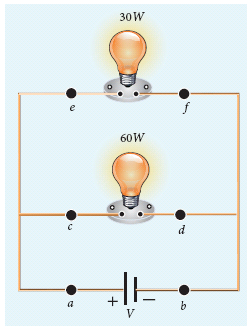
A battery of voltage V is connected to 30 W bulb and 60 W bulb as shown in the figure.
(a) Identify brightest bulb
(b) which bulb has greater resistance?
(c) Suppose the two bulbs are connected in series, which bulb will glow brighter?
13.
An electron gun in a TV shoots out a beam of electrons. The beam current is 10\(\mu\)A. The charge that strikes the screen in 1 minute is ______________.
\(+600\mu C\)
\(-600\mu C\)
\(+10\mu C\)
\(-10\mu C\)
14.
Temperature co-effieient of resistance for metals is ______________.
constant
positive
zero
negative
15.
Which of the following material has the highest specific resistance?
rubber
silver
germanium
glass
16.
The temperature co-efficient of resistance for alloys is _____________.
low
very low
high
very high
17.
Which of the following has negative temperature coefficient of resistance?
copper
tungsten
carbon
silver
18.
When 'n' resistors of equal resistance (R) are connected in series and in parallel respectively, then the ratio of their effective resistance is ______________
1: n2
n2: 1
n: 1
1: n
19.
A wire connected to a power supply of 230 V has power dissipation P1. Suppose the wire is cut into two equal pieces and connected parallel to the same power supply. In this case power dissipation is P2. The ratio \(\frac{P_2}{P_1}\) is ______.
1
2
3
4
20.
Two wires of A and B with circular cross section made up of the same material with equal lengths. Suppose RA = 3 RB, then what is the ratio of radius of wire A to that of B?
3
\(\sqrt3\)
\(\frac{1}{\sqrt3}\)
\(\frac{1}{3}\)
21.
A carbon resistor of (47 ± 4.7 ) k Ω to be marked with rings of different colours for its identification. The colour code sequence will be ______.
Yellow – Green – Violet – Gold
Yellow – Violet – Orange – Silver
Violet – Yellow – Orange – Silver
Green – Orange – Violet - Gold
22.
A toaster operating at 240 V has a resistance of 120 Ω. The power is ______.
400 W
2 W
480 W
240 W
23.
How will you represent a resistor of 3700\(\Omega \) ± 10 by colour code?
1.
The instantaneous current I is defined as the limit of the average current \(\Delta t\rightarrow 0\)
\(I=\underset { \Delta t-0 }{ lim } \cfrac { \Delta Q }{ \Delta t } =\cfrac { dQ }{ dt } \)
2.
If a net charge Q passes through any cross section of a conductor in time t, then the current is defined as \(I=\cfrac { Q }{ t } \)
3.
The relation between drift velocity of electrons and current in a wire of cross- sectional area A is
\({ v }_{ d }=\frac { I }{ neA } =\frac { 0.2 }{ 8.4\times { 10 }^{ 28 }\times 1.6\times { 10 }^{ -19 }\times 0.5\times { 10 }^{ -6 } }\)
vd = 0.03 x 10⁻³ m s-1
4.
E = 570 N C-1, e = 1.6 x 10⁻¹⁹ C,
m = 9.11 x 10⁻³¹ kg and a = ?
F = ma = eE
\(a=\frac { eE }{ m } =\frac { 570\times 1.6 \times { 10 }^{ -19 } }{ 9.11\times { 10 }^{ -31 } } \)
\(=\frac { 912\times { 10 }^{- 19 }\times { 10 }^{ 31 } }{ 9.11 } \)
= 1.001 x 10¹⁴ ms-2
5.
Temperature coefficient of resistance is defined as the ratio of increase in resistivity per degree rise in temperature to its resistivity at To.
\(\alpha=\frac{\rho_{T}-\rho_{0}}{\rho_{0}\left(T-T_{0}\right)}\)
6.
Electrical resistivity of a material is defined as the resistance offered to current flow by a conductor of unit length having unit area of cross section.
7.
Current is defined as the ratio of the net (i.e. amount of) charge (Q) passing through any cross section of a conductor to time.
\(I=\frac{Q}{t}\)
Since current is the ratio of two scalar quantities, it is a scalar. In addition current I is defined as the scalar product of the current density and area vector at which the charges cross.
I = \(\vec{J}.\vec{A}\)
8.
The current (rate of flow of charge) in the wire is
\(I=\frac { Q }{ t } =\frac { 120 }{ 60 } =2A\)
9.
(i) For conductors a is positive. If the temperature of a conductor increases, the average kinetic energy of electrons in the conductor increases. This results in more frequent collisions and hence the resistivity increases.
(ii) The graph of the Even though, the resistivity of conductors like metals varies linearly for a wide range of temperatures, there also exists a nonlinear region at very low temperatures.
(iii) The resistivity approaches some finite value as the temperature approaches absolute zero.
(iv) As the resistance is directly proportional to the resistivity of the material, we can also write the resistance of a conductor at temperature T °C as
\({ R }_{ T }=R\left[ 1+\alpha \left( T-{ T }_{ 0 } \right) \right] \)
\(\alpha =\cfrac { { R }_{ T }-{ R }_{ 0 } }{ { R }_{ 0 }\left( T-{ T }_{ 0 } \right) } =\cfrac { 1\Delta R }{ { R }_{ 0 }\Delta T } \)
\(\alpha =\cfrac { 1 }{ { R }_{ 0 } } \cfrac { \Delta R }{ \Delta T } \)
where \(\Delta R={ R }_{ 1 }-{ R }_{ 0 }\) is a change in resistance during the changing temperature \(\Delta T=T-{ T }_{ 0 }\)
10.
The drift velocity is the average velocity acquired by the electrons inside the conductor when it is subjected to an electric field. The average time between successive collisions is called the mean free time denoted by \(\tau \). The acceleration \(\vec { a } \) experienced by the electron in an electric field \(\vec { E } \) is given by
\(\vec { a } =\cfrac { -e\vec { E } }{ m } \left( since\vec { F } =-e\vec { E } \right) \)
The drift velocity is given by
\({ \vec { V } }_{ d }=\vec { a } \tau \)
\({ \vec { V } }_{ d }=\cfrac { e\tau }{ m } \vec { E } \)
\({ \vec { V } }_{ d }=-\mu \vec { E } \)
Here \(\mu =\cfrac { e\tau }{ m } \) is the mobility of the electron and it is defined as the magnitude of the drift velocity per unit electric field \(\mu =\cfrac { \left| { \vec { v } }_{ d } \right| }{ \left| \vec { E } \right| } \)
11.
To check which bulb will be fused, the voltage drop across each bulb has to be calculated.
The resistance of a bulb,
\(R=\frac { V^{ 2 } }{ P } =\frac { { (Ratedvoltage) }^{ 2 } }{ Ratedpower } \)
For 20W - 220V bulb,
\({ R }_{ 1 }=\frac { { \left( 220 \right) }^{ 2 } }{ 20 } \Omega =2420\Omega \)
For 100W - 220V bulb,
\({ R }_{ 2 }=\frac { { \left( 220 \right) }^{ 2 } }{ 20 } \Omega =484\Omega \)
Both the bulbs are connected in series. So same current will pass through both the bulbs. The current that passes through the circuit, \(I=\frac { V }{ { R }_{ tot } } \)
Rtot (R1 + R2)
Rtot = (484 + 2420) \(\Omega\) = 2904 \(\Omega\)
\(I=\frac { 440V }{ 2904\Omega } \approx 0.151A\)
The voltage drop across the 20W bulb is
\(V_1=IR_1=\frac { 440V }{ 2904 }\times2420 \approx 366.6V\)
The voltage drop across the 100W bulb is
\({ V }_{ 2 }=I{ R }_{ 2 }=\frac { 440 }{ 2904 } 484\approx 73.3A\)
The 20 W bulb will get fused because the voltage across it is more than the voltage rating.
12.
(a) The power delivered by the battery P = VI. Since the bulbs are connected in parallel, the voltage drop across each bulb is the same. If the voltage is kept fixed, then the power is directly proportional to current (P ∝ I). So 60 W bulb draws twice as much as current as 30 W and it will glow brighter than 30 W bulb.
(b) To calculate the resistance of the bulbs, we use the relation \(P=\frac { { v }^{ 2 } }{ R } \) In both the bulbs, the voltage drop is the same, so the power is inversely proportional to the resistance or resistance is inversely proportional to the power \(\left( R∝ \frac { 1 }{ P } \right) \). It implies that, the 30W has twice as much as resistance as 60 W bulb.
(c) When these two bulbs are connected in series, the current passing through each bulb is the same. It is equivalent to two resistors connected in series. The bulb which has higher resistance has higher voltage drop. So 30W bulb will glow brighter than 60W bulb. So the higher power rating does not always imply more brightness and it depends whether bulbs are connected in series or parallel.
13.
(b)
\(-600\mu C\)
14.
(b)
positive
15.
(a)
rubber
16.
(a)
low
17.
(c)
carbon
18.
(b)
n2: 1
19.
\(\mathrm{V}=230 \mathrm{~V} \)
\(P=\frac{V^2}{R} \text { since } \mathrm{V} \text { is same } \mathrm{P} \propto \frac{1}{R} \)
\(\frac{1}{R_2}=\frac{1}{\frac{R_1}{2}}+\frac{1}{\frac{R_1}{2}}=\frac{2}{R_1}+\frac{2}{R_1}=\frac{2+2}{R_1} \)
\(\frac{1}{R_2}=\frac{4}{R_1} \)
\(\therefore R_2=\frac{R_1}{4} \)
\(R_1=4 R_2 \)
\(\therefore \frac{P_2}{P_1}=\frac{R_1}{R_2}=\frac{4 R_2}{R_2}=4\)
20.
\(R \propto \frac{1}{A}, R \propto \frac{1}{r^2} \)
\(R_A \propto \frac{1}{r_A^2}, R_B \propto \frac{1}{r_B^2} \)
\(\frac{r_A}{r_B}=\left(\frac{R_B}{R_A}\right)^{1 / 2}=\left(\frac{R_B}{3 R_B}\right)^{1 / 2}=\frac{1}{3^{\frac{1}{2}}}=\frac{1}{\sqrt{3}}\)
21.
Yellow - 4
Violet - 7
Orange - 103
Silver - Tolerance - 10%
22.
\(P=\frac{V^2}{R}=\frac{240 \times 240}{120}=480 \ W\)
23.
R = 37 X 102 ± 10 %
The colour of bands corresponding to
3 - orange
7 - violet
102 - red
10% - silver.

12th Standard Syllabus & Materials
12th Standard
TN 12th Computer Applications களப்பெயர் முறைமை (DNS) Sample Question Papers Study Material - QB365 Set A
NEW12th Standard
TN 12th Computer Applications வலையமைப்பு எடுத்துக்காட்டுகள் மற்றும் நெறிமுறைகள் Sample Question Papers Study Material - QB365 Set A
NEW12th Standard
TN 12th Computer Applications கணினி வலையமைப்பு ஓர் அறிமுகம் Sample Question Papers Study Material - QB365 Set A
NEW12th Standard
TN 12th Computer Applications PHP-உடன் MySQL-ஐ இணைத்தல் Sample Question Papers Study Material - QB365 Set A



Tamilnadu Stateboard 12th Standard Subjects

Maths

Chemistry
Physics

Biology

Computer Science

Business Maths and Statistics

Economics

Commerce

Accountancy

History

Computer Applications
Biology
Computer Technology
Computer Applications
Computer Science
Business Maths and Statistics
Commerce
Economics
Maths
Chemistry
Physics
Computer Technology
History
Accountancy

Tamil

English

French
Tamilnadu Stateboard Standards

