
 100% FREE ACCESS
12th Standard Syllabus & Materials
12th Standard
TN 12th Computer Applications மின்னணு தரவு பரிமாற்றம் Sample Question Papers Study Material - QB365 Set A
NEW12th Standard
TN 12th Computer Applications மின் - வணிக பாதுகாப்பு அமைப்புகள் Sample Question Papers Study Material - QB365 Set A
NEW12th Standard
TN 12th Computer Applications மின்னணு செலுத்தல் முறைகள் Sample Question Papers Study Material - QB365 Set A
NEW12th Standard
TN 12th Computer Applications மின் - வணிகம் Sample Question Papers Study Material - QB365 Set A
NEW12th Standard
TN 12th Computer Applications திறந்த மூல கருத்துருக்கள் Sample Question Papers Study Material - QB365 Set A
NEW12th Standard
TN 12th Computer Applications வலையமைப்பு வடமிடல் Sample Question Papers Study Material - QB365 Set A

Published on: 11/03/2020
12th Standard Accountancy English Medium All Chapter Book Back and Creative Three Marks Questions 2020
Download Tamil Nadu 12th Standard Accountancy question papers, model tests, one-mark questions, important questions, and public exam papers in PDF format. Free study materials and answer keys for TN State Board students.
Questions + Answers key
Take MCQ Accountancy Test
1.
What is Credit payment period?
2.
What is functional classifications of rational analysis? and types of functional classification.
3.
Write a short note on
(i) Rights issue
(ii) Bonus issue
4.
What are the characteristics of a company?
5.
What are the objectives of financial statement analysis?
6.
What are the significance of financial statements?
7.
Youth of India sports club decided to donate Rs. 50,000 and spread awareness among the people of nearby societies about cleanliness in the country under the programme "Bharat Abhiyan". Identify the values highlighted.
8.
Yuvan foundation is formed to educate and to provide jobs to unemployed women. Identify the values involved.
9.
The firm of A and B earned a profit of Rs.2,75,000 during the year ending on 31st March, 2015. They have decided to donate 10% of this profit to an NGO working for senior citizens. Pass necessary journal entry for the distribution of profits. Identify the values shown by the firm in donating a part of profit of NGO.
10.
Which values are affected, when accounts are maintained on single entry system basis.
11.
Radhika started a small bakery for providing healthy and good quality bakery product at reasonable prices on 1st January, 2019 with a capital of Rs. 1,80,000. She appointed a ten year old boy as a sweeper. She withdrew Rs. 60,000 for household expenses. She introduced Rs. 20,000as fresh capital. Her position of assets and liabilities as at 31st December, 2019 stood as follows.
| Rs. | |
|---|---|
| Cash in hand | 70,000 |
| Stock | 80,000 |
| Bills receivable | 1,00,000 |
| Debtors | 1,50,000 |
| Creditors | 60,000 |
| Bills payable | 10,000 |
12.
What is Fluctuating capital method?
13.
Explain the classification of goodwill.
14.
What is the need for valuation of goodwill?
15.
Balu, Chandru and Nirmal are partners in a firm sharing profits and losses in the ratio of 5:3:2. On 31st March 2018, Nirmal retires from the firm. On the date of Nirmal’s retirement, goodwill appeared in the books of the firm at Rs. 60,000. By assuming fluctuating capital account, pass the necessary journal entry if the partners decide to
(a) write off the entire amount of existing goodwill
(b) write off half of the existing goodwill
16.
From the following figures obtained from Kalpana Ltd, calculate the trade payables turnover ratio and credit payment period (in days).
| Particulars | Rs. |
|---|---|
| Credit purchases during 2018 – 2019 | 1,00,000 |
| Trade creditors as on 1.4.2018 | 20,000 |
| Trade creditors as on 31.3.2019 | 10,000 |
| Bills payable as on 1.4.2018 | 4,000 |
| Bills payable as on 31.3.2019 | 6,000 |
17.
Briefly explain any three limitations of financial statements
18.
What is reissue of forfeited shares?
19.
Maruthu Ltd. forfeited 150 equity shares of Rs.10 each for non payment of final call of Rs.4 per share. Of these 100 shares were reissued @ Rs.9 per share. Pass journal entries for forfeiture and reissue.
20.
21.
How is the value of goodwill calculated under the capitalisation method?
22.
A and B contribute Rs. 4,00,000 and Rs. 2,00,000 respectively as capital. Their respective share of profit is 3:2 and the profit before interest on capital for the year is Rs. 27,000. Compute the amount of interest on capital in each of the following situations:
(i) if the partnership deed is silent as to the interest on capital
(ii) if interest on capital @ 3% is allowed as per the partnership deed
(iii) if the partnership deed allows interest on capital @ 5% p.a.
23.
How the following items will appear in the final accounts of a club for the year ending 31st March 2019?
| Receipts | Rs. | Rs. | Payments | Rs. |
|---|---|---|---|---|
| To Subscription | ||||
| 2017-2018 | 10,000 | |||
| 2018-2019 | 50,000 | |||
| 2019-2020 | 5,000 | 65,000 | ||
There are 200 members in the club each paying an annual subscription of Rs. 400 per annum. Subscription still outstanding for the year 2017- 2018 is Rs. 2,000.
24.
How the following items are dealt with in the final accounts of not–for–profit organisation?
a) Sale of sports materials
b) Life membership fees
c) Tournament fund
25.
From the following particulars, calculate total sales.
| Particulars | Rs |
|---|---|
| Debtors on 1st April 2017 | 1,50,000 |
| Bills receivable on 1st April 2017 | 40,000 |
| Cash received from debtors | 3,90,000 |
| Cash received for bills receivable | 90,000 |
| Bills receivable dishonoured | 10,000 |
| Sales return | 40,000 |
| Bills receivable on 31st March, 2018 | 30,000 |
| Sundry debtors on 31st March, 2018 | 1,30,000 |
| Cash sales | 2,00,000 |
26.
27.
Seenu and Siva are partners sharing profits and losses in the ratio of 5:3. In the view of Kowsalya admission, they decided
(a) To increase the value of building by Rs. 40,000.
(b) To bring into record investments at Rs. 10,000, which have not so far been brought in to account.
(c) To decrease the value of machinery by Rs. 14,000 and furniture by Rs. 12,000.
(d) To write off sundry creditors by Rs. 16,000.
Pass journal entries and prepare revaluation account
28.
Roja, Neela and Kanaga are partners sharing profits and losses in the ratio of 4:3:3. On 1st April 2017, Roja retires and on retirement, the following adjustments are agreed upon.
(i) Increase the value of building by Rs. 30,000.
(ii) Depreciate stock by Rs. 5,000 and furniture by Rs. 12,000.
(iii) Provide an outstanding liability of Rs. 1,000
Pass journal entries and prepare revaluation account.
29.
Explain any five applications of computerised accounting system.
30.
The following particulars are available in respect of the business carried on by a partnership firm:
(i) Profits earned: 2016: Rs. 25,000; 2017: Rs. 23,000 and 2018: Rs. 26,000.
(ii) Profit of 2016 includes a non-recurring income of Rs. 2,500.
(iii) Profit of 2017 is reduced by Rs. 3,500 due to stock destroyed by fire.
(iv) The stock was not insured. But, it is decided to insure the stock in future. The insurance premium is estimated to be Rs. 250 per annum.
You are required to calculate the value of goodwill of the firm on the basis of 2 years purchase of average profits of the last three years.
31.
Arulappan and Nallasamy are partners in a firm sharing profits and losses in the ratio of 4:1. On 1st January 2018, their capitals were Rs. 20,000 and Rs. 10,000 respectively. The partnership deed specifies the following:
(a) Interest on capital is to be allowed at 5% per annum.
(b) Interest on drawings charged to Arulappan and Nallasamy are Rs. 200 and Rs. 300 respectively.
(c) The net profit of the firm before considering interest on capital and interest on drawings amounted to Rs. 18,000.
Give necessary journal entries and prepare Profit and loss appropriation account for the year ending 31st December 2018. Assume that the capitals are fluctuating.
32.
Arun, Babu and Charles are partners sharing profits and losses equally. They admit Durai into partnership for 1/4 share in future profits. The goodwill of the firm is valued at Rs. 36,000 and Durai brought cash for his share of goodwill. The existing partners withdraw half of the amount of their share of goodwill. Pass necessary journal entries on the assumption that the fluctuating capital method is followed.
33.
The credit revenue from operations of Harini Ltd. amounted to Rs.9,60,000. Its debtors and bills receivable at the end of the accounting period amounted to Rs.1,00,000 and Rs.60,000 respectively. Calculate trade receivable turnover ratio and also collection period in months.
34.
From the following particulars of Kumar Ltd, prepare a common-size income statement for the year ended 31st March, 2018.
| Particulars | 2017-18 |
|---|---|
| Rs. | |
| Revenue from operations | 5,00,000 |
| Other income | 20,000 |
| Expenses | 3,00,000 |
1.
Credit payment period is the average time taken by the business for payment of accounts payables. Lesser the credit payment period, greater is the efficiency of the management in managing accounts payable as it indicates quicker settlement of trade payable. It is calculated as follows.
Credit payment period (in days) = \(\frac { Number\quad of\quad months\quad in\quad a\quad year }{ Trade\quad payable\quad sturn\quad over\quad ratio } \quad \) x 100
Credit payment period (in months) = \(\frac { Number\quad of\quad months\quad in\quad a\quad year }{ Trade\quad payable\quad sturn\quad over\quad ratio } \quad \).
2.
Functional classification of ratio is based on the purpose for which ratios are computed and it is the most commonly used classification. Under the functional classification, the ratios are classified as follows:
(i) Liquidity ratios
(ii) Long term solvency ratios
(iii) Turnover ratios
(iv) Profitability ratios
3.
(i) Rights issue
Issue of equity shares to the existing shareholders of the company through a letter of offer is known as rights issue.
(ii) Bonus issue
Issue of equity shares to the existing shareholders of the company free of cost out of accumulated profit is known as bonus issue.
4.
Following are the characteristics of a company:
(a) Voluntary association: A company is a voluntary association of persons. No law can compel persons to form a company
(b) Separate legal entity: Company is an artificial person. It has a separate legal entity which is separate and distinct from its members.
(c) Common seal: A company may have a common seal which can be affixed on the documents.
(d) Perpetual succession: A company continues for ever. Its continuity is not affected by the changes in its members. It can be wound up only by law.
(e) Limited liability: The liability of the shareholders of the company is limited to the extent of face value of the shares held by the shareholders.
(f) Transferability of shares: The shares of a company are freely transferable except incase of a private company.
5.
Financial statement analysis may be done with any of the following objectives.
(i) To analyse the profitability and earning capacity.
(ii) To study the long term and short term solvency of the business.
(iii) To determine the efficiency in operations and use of assets.
(iv) To determine the trend in sales, production etc.
(v) To forecast for future and prepare budgets.
(vi) To make inter-firm and intra-firm comparisons.
6.
The significance of financial statements to various stakeholders is as follows.
(i) To management:
Financial statements provide information to the management to take decision and to have control over business activities in various areas.
(ii) To shareholders:
Financial statements help the shareholders to know whether the business has potential for growth and to decide to continue their shareholding.
(iii) To creditors:
Creditors can get information about the ability of the business to repay the debts from financial statements.
(iv) To bankers:
Information given in the financial statements is significant to the bankers to assess whether there is adequate security to cover the amount of the loan or overdraft.
(v) To government:
Financial statements are Significant to government to assess the tax liability of business concerns and to frame and amend industrial policies.
7.
The values highlighted are
(i) Social responsibility towards society.
(ii) Sensitivity towards cleaner environment
8.
The value involved are Respect for women and women empowerment.
9.
| Date | Particulars | L.f | Debit Rs. |
Credit Rs. |
|---|---|---|---|---|
| Profit and loss appropriation A/c Dr | 2,47,500 | |||
| To A's capital A/c | 1,23,750 | |||
| To A's capital A/c (Being profit transferred to capital account) | 1,23,750 |
Values shown by the firm are
i. Responsibility :
Firm has shown responsibility towards senior citizens by giving them their dues.
ii. Compassion:
Partners have shown compassion towards senior citizens by fulfilling their duties towards senior citizens .
10.
Values being affected are
(i) Reliablility: Value of reliability is affected as accounts maintained on single entry system are less reliable as they are prepared from incomplete records.
(ii) Accuracy: Value of arithmetical accuracy is affected, as in single entry system, trial balance cannot be prepared which proves arithmetical accuracy of accounts.
11.
| Liabilities | Rs. | Assets | Rs |
|---|---|---|---|
| Creditors | 60,000 | Cash in hand | 70,000 |
| Bills payables | 10,000 | Stock | 80,000 |
| Capital | 3,30,000 | Bills receivables | 1,00,000 |
| (Balancing figure) | Debtors | 1,50,000 | |
| 4,00,000 | 4,00,000 |
Calculation of Profit
| Particulars | Rs. |
|---|---|
| Capital at the end | 3,30,000 |
| Add: Drawings | 60,000 |
| 3,90,000 | |
| Less: Additional capital | 20,000 |
| 3,70,000 | |
| Less: Opening capital | 1,80,000 |
| Profit for the year | 1,90,000 |
Values involved are
(i) Violating child labour act by employing 10 year old boy.
(ii) By providing good quality product she is promoting the welfare and health of society
(iii) By charging reasonable prices she is not indulged in profiteering.
12.
(i) Under this method, only one capital account is maintained for each partner.
(ii) The capital is changing from period to period.
(iii) This capital account shows always a credit balance
(iv) All adjustment relating to partners are recorded directly in the capital account.
13.
Goodwill may be classified into acquired goodwill or self-generated goodwill.
(i) Acquired or purchased goodwill:
(1) Goodwill acquired by making payment in cash or kind is called acquired or purchased goodwill.
(2) The excess of purchase consideration over the value of net assets acquired is treated as acquired goodwill.
(ii) Self - generated goodwill:
It is the goodwill which is self generated by a firm based on features of the business such as favourable location, local customers, etc. Such self-generated goodwill cannot be recorded in the books of accounts.
14.
Following are the circumstances that require valuation of goodwill of partnership firms in order to protects the rights of the partners
(i) When there is a change in the profit sharing ratio
(ii) When a new partner is admitted into a firm
(iii) When an existing partner retires from the firm or when a partner dies.
(iv) When a partnership firm is dissolved
15.
a)
| Particulars | L.F | Depit Rs |
Credit Rs |
|
|---|---|---|---|---|
| Balu's capital A/c | Dr. | 30,000 | ||
| Chandru's capital A/c | Dr | 18,000 | ||
| Nirmal's capital A/c | Dr | 12,000 | ||
| To Goodwill A/c | 60,000 | |||
| (value of goodwill entirely shared to all partners) |
b)
| Particulars | L.F | Debit Rs |
Credit Rs |
|
|---|---|---|---|---|
| Balus capital Alc | Dr | 15,000 | ||
| Chandru's capital A/c | Dr | 9,000 | ||
| Nirmal's capital A/c | Dr | 6,000 | ||
| To Goodwill A/c | 30,000 | |||
| (Half of the existing goodwill written off) |
16.
Trade payables turnover ratio = \(\frac{Net\ credit\ purchases}{Average\ trade\ payables}\) = \(\frac{1,00,000}{20,000}\) = 5 times
Average trade payables = \(\frac{Opening\ trade\ payables + Closing\ trade\ payables}{2}\)
= \(\frac{(20,000 + 4,000) + (10,000 + 6,000)}{2}\) = Rs.20,000
payment period (in days) = \(\frac{Number\ of\ days\ in\ a\ year}{Trade\ payables\ turnover\ ratio}\) = \(\frac{365}{5}\) = 73 days.
17.
(i) Give only interim reports:
Financial statements are prepared at the end of every accounting period. But the actual position of the business can be known only when the business is closed.
(ii) LImited access to external users:
The external users do not have detailed and frequent information of financial results as they have limited access
(iii) Influenced by personal judgement:
Preparation of financial statements may be influenced by personal judgements and therefore these are not free from bias.
18.
The direction of a company have an authority of reissue of shares once forfeited by them due to non-payments of calls. They can rreissue the forfeitedshares at par, at premium or at discount. When forfeited shares are reissued at a premium, the amount of such premium will be credited to securities premium account.
If the reissue price is more than the amount. Unpaid on forfeited shares it results in profit and is transferred to capital reserve account.
19.
| Date | Particulars | L.F. | Debit Rs. |
Credit Rs. |
|
|---|---|---|---|---|---|
| Equity share capital A/c (150 × 10) | Dr. | 1,500 | |||
| To Equity share final call A/c (150 × 4) | 600 | ||||
| To Forfeited shares A/c (150 × 6) | 900 | ||||
| (50 shares forfeited) | |||||
| Bank A/c (100 × 9) | Dr. | 900 | |||
| Forfeited shares A/c (100 × 1) | 100 | ||||
| To Equity share capital A/c (100 × 10) | 1,000 | ||||
| (100 forfeited shares reissued @ Rs.9 per share) | |||||
| Forfeited shares A/c | Dr. | 500 | |||
| To Capital reserve A/c | 500 | ||||
| (Gain on reissue of forfeited shares transferred to capital reserve account) |
Working note:
Forfeited amount for 150 shares = Rs.900
Forfeited amount for 100 shares = \(\frac{900}{150}\) x 100 = Rs.600
Gain or loss = Amount forfeited – loss on reissue
= 600 - 100
Net gain = Rs.500
20.
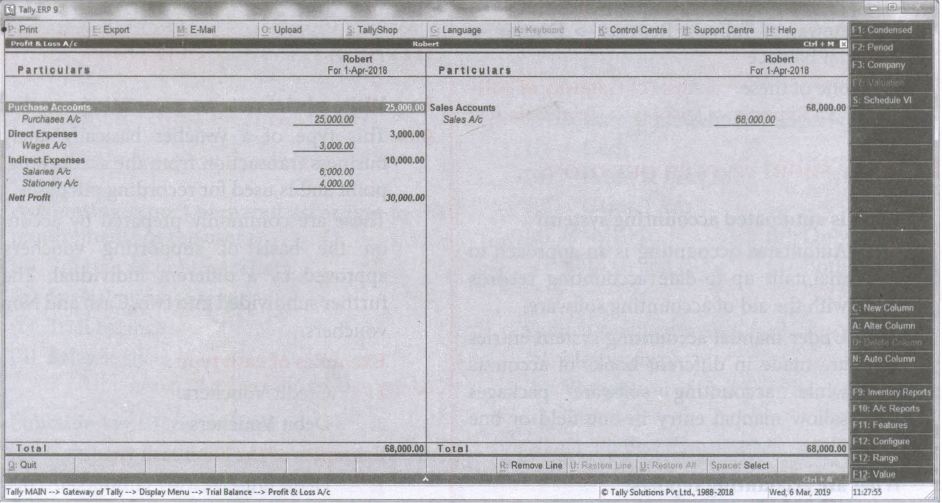
21.
(i) Under this method, goodwill is the excess of capitalised value of average profit of the business over the actual capital employed in the business.
Goodwill = Total capitalised value of the business - Actual capital employed
(ii) The total capitalised value of the business is calculated by capitalising the average profits on the basis of the normal rate of return.
Capitalised value of the business
\(=\frac{Average\ profit}{Normal\ rate of\ return}\times 100\)
(iii) Actual capital employed = Fixed assets (excluding goodwill ) + Current assets - Current liabilities
22.
(i) Interest on capital will not be allowed as the partnership deed is silent as to the interest on capital.
(ii) Profit before interest on capital is Rs. 27,000.
Computation of interest on capital:
A: 4,00,000 \(\times\) \(\frac{3}{100}\) = Rs. 12,000
B: 2,00,000 \(\times\) \(\frac{3}{100}\) = Rs. 6,000
Since there is sufficient profit, interest on capital will be provided.
(iii) Profit before interest on capital is Rs. 27,000.
Computation of interest on capital:
A: 4,00,000 \(\times\) \(\frac{5}{100}\) = Rs. 20,000
B: 2,00,000 \(\times\) \(\frac{5}{100}\) = Rs. 10,000
Since the profit is insufficient, interest on capital will not be provided. Profit of Rs. 27,000 will be distributed to the partners in their capital ratio of 2:1.
23.
| Expenditure | Rs | Income | Rs | Rs |
|---|---|---|---|---|
| By Subscription | 50,000 | |||
| Add: | ||||
| Outstanding for the year | ||||
| 2017-2018 | 30,000 | 80,000 | ||
| Total subscription due for current year (2018 - 19) (\(200 \times 400\)) | = 80,000 |
| Less : Amount received for the current year (2018-19) | = 50, 000 |
| Outstanding subscription for the current year (2018 - 19) | Rs. 3000 |
| Liabilities | Rs | Assets | Rs | Rs |
|---|---|---|---|---|
| Subscription | Outstanding subscription | |||
| rceived in advance | 2017 - 2018 | 2,000 | ||
| for the year 2019-20 | 5,000 | 2018 - 2019 | 30,000 | 32,000 |
24.
(a) Sale of sports materials :
(i) Consumable items such as sports materials, stationery, medicines, etc., consumed during the year will appear on the debit side of income and expenditure account.
(ii) Opening stock + the current year - Consumption Purchases during Closing stock
(iii) Closing stock will appear on the assets side of the balance sheet as at the end of the year.
(iv) If there is any sale of old sports materials, etc., that will be shown on the credit side of income and expenditure account or can be subtracted from the respective items consumed on the debit side of income and expenditure account.
(b) Life membership fees:
Amount received towards life membership fee from members is a capital receipt as it is nonrecurring in nature.
(c)Tournament fund : If there are any specific funds such as tournament fund, prize fund, etc., these funds should be shown on the liabilities side of the balance sheet separately.
25.
| Particulars | Rs. | Particulars | Rs |
|---|---|---|---|
| To Balance b/d | 40,000 | By Cash A/c | 90,000 |
| To Debtors A/c* | 90,000 | By Debtors A/c | 10,000 |
| (Bills received during the year – balancing figure) |
(Bills receivable dishonoured) |
||
| By Balance c/d | 30,000 | ||
| 1,30,000 | 1,30,000 |
| Particulars | Rs | Particulars | Rs |
|---|---|---|---|
| To Balance b/d | 1,50,000 | By Cash A/c | 3,90,000 |
| To Bills receivable A/c (dishonoured) | 10,000 | By Sales returns A/c | 40,000 |
| To Sales A/c (credit) | 4,90,000 | By Bills receivable A/c* | 90,000 |
| By Balance c/d | 1,30,000 | ||
| 6,50,000 | 6,50,000 |
Total Sales = Cash Sales + Credit Sales = Rs. 2,00,000 + Rs. 4,90,000 = Rs. 6,90,000.
(iii) Format of total creditors account
| Particulars | Rs | Particulars | Rs |
|---|---|---|---|
| To Cash A/c (paid) | xxx | By Balance b/d | xxx |
| To Bank A/c (cheques paid) | xxx | (opening balance) | |
| To Bills payable A/c | By Purchases A/c | xxx | |
| (bills accepted) | xxx | (credit purchases) | |
| To Discount received A/c | xxx | By Bank A/c | xxx |
| To Purchase returns A/c | xxx | (cheques dishonoured) | |
| To Balance c/d | xxx | By Bills payable A/c | xxx |
| (closing balance) | (dishonoured ) | ||
| xxx | xxx |
26.
27.
| Date | Particulars | L.F | Debit Rs. |
Credit Rs. |
|
|---|---|---|---|---|---|
| Building A/c | Dr | 70,000 | |||
| Investment A/c | Dr | 20,000 | |||
| Sundry creditors A/c | Dr | 16,000 | 1,06,000 | ||
| To Revaluation A/c | |||||
| (Profit items enterd in credit side) | |||||
| Revaluation Alc | Dr | 26,000 | |||
| To Machinery A/c | 14,000 | ||||
| To Furniture A/c | 12,000 | ||||
| (Loss items enterd in credit side) | |||||
| Revaluation A/c | Dr | 70,000 | |||
| To Seenu's capital A/c | 43,750 | ||||
| To Siva's capital A/c | 26,250 | ||||
| (old partner's capital in old ratio) |
| Particulars | Rs. | Rs. | Particulars | Rs. |
|---|---|---|---|---|
| To Machinery A/c | 14,000 | By Building A/c | 70,000 | |
| To Furniture A/c | 12,000 | By Investment A/c | 20,000 | |
| To Profit on revaluation transferred to | By Sundry creditor A/c | 16,000 | ||
| Seenu's capital A/c | 43,750 | |||
| Siva's capital A/c | 26,250 | 70,000 | ||
| 1,06,000 | 1,06,000 |
28.
| Date | Particulars | L.F | Debit Rs |
Credit Rs |
|
|---|---|---|---|---|---|
| 2017 | Building A/c | Dr | 30,000 | ||
| April 1 | To Revaluation A/c | 30,000 | |||
| (Value of building inreased) | |||||
| 2017 | Revaluation A/c | Dr | 18,000 | ||
| April1 | To Stock A/c | 5,000 | |||
| To Furniture A/c | 12,000 | ||||
| To Outstanding liability A/c | 1,000 | ||||
| (Decrease in value of assets and outstanding liability recorded | |||||
| 2017 | Revaluation A/c | Dr | 12,000 | ||
| April1 | To Roja's capital A/c | 4,800 | |||
| To Neela's capital A/c | 3,600 | ||||
| To Kanaga's capital A/c | 3,600 | ||||
| (profit on recaluation distributed) |
| Particulars | Rs | Rs | Particulars | Rs |
|---|---|---|---|---|
| To Stock A/c | 5,000 | By Building A/c | 30,000 | |
| To Furniture A/c | 12,000 | |||
| To Outstanding liability A/c | 1,000 | |||
| To Profit on revaluation transferred to | ||||
| Roja's capital A/c | 4,800 | |||
| Neela's capital A/c | 3,600 | |||
| Kanaga's capital A/c | 3,600 | |||
| 12,000 | ||||
| 30,000 | 30,000 | |||
29.
The applications of CAS are as follows:
(i) Maintaining accounting records:
In CAS, accounting records can be maintained easily and efficiently for long time period. It facilitates fast and accurate retrieval of data and information.
(ii) Inventory management:
CAS facilitates efficient management of inventory. Updated information about availability of inventory, level of inventory, etc., can be obtained instantly.
(iii) Report generation:
CAS helps to generate various routine and special purpose reports.
(iv) Data import/export:
Accounting data and information can be imported from or exported to other users within the organisation as well as outside the organisation.
(v) Taxation:
CAS helps to compute various taxes and to deduct these and deposit the same to the Government account.
30.
| Particulars | 2016 Rs. | 2017 Rs. | 2018 Rs. |
|---|---|---|---|
| Profit | 25,000 | 23,000 | 26,000 |
| Less: Non -recurring income | 2,500 | - | - |
| 22,500 | 23,000 | 26,000 | |
| Add: Stock destroyed by fire (abnormal loss) | - | 3,500 | - |
| Profit after adjustments | 1,30,000 | 1,20,000 | 2,30,000 |
Average profit \(=\frac{Total\ profit}{Number\ of\ years}\)
\(=\frac{22,000+26,000+26,000}{3}\)
\(=\frac{75,000}{3}\) = Rs. 25,000
| Rs. | |
|---|---|
| Average profit before adjusting insurance premium payable in future |
25,000 |
| Less: Insurance premium payable in future | 250 |
| Average profit | 24,750 |
Goodwill = Average profit \(\times\) Number of years of purchase
= 24,750 \(\times\) 2 = 49,500
Goodwill = Rs. 49,500
31.
| Date | Particulars | L.E. | Dr. Rs. |
Cr. Rs |
|
|---|---|---|---|---|---|
| 2018 | Interest on capital A/c | Dr. | 1,500 | ||
| Dec. 31 | To Arulappan’s capital A/c | 1,000 | |||
| To Nallasamy’s capital A/c (Interest on capital @ 5% provided) |
500 | ||||
| " | Profit and loss appropriation A/c | Dr. | 1,500 | ||
| To Interest on capital A/c (Interest on capital account closed) |
1,500 | ||||
| ' | Arulappan’s capital A/c | Dr. | 200 | ||
| Nallasamy’s capital A/c | Dr. | 300 | |||
| To Interest on drawings A/c (Interest on drawings charged) |
500 | ||||
| " | Interest on drawings A/c | Dr. | 500 | ||
| To Profit and loss appropriation A/c (Interest on drawings account closed) |
500 | ||||
| " | Profit and loss appropriation A/c Dr. | 17,000 | |||
| To Arulappan’s capital A/c | 13,600 | ||||
| To Nallasamy’s capital A/c (Profit transferred) |
3,400 |
| Particulars | Rs. | Rs. | Particulars | Rs. |
|---|---|---|---|---|
| To Interest on capital | By Profit and loss A/c | 18,000 | ||
| Arulappan | 1,000 | By Interest on drawings A/c | ||
| Nallasamy | 500 | Arulappan | 200 | |
| To Partners’ capital A/c (profit) | Nallasamy | 300 | ||
| Arulappan (4/5) | 13,600 | 17,000 | ||
| Nallasamy (1/5) | 3,400 | 18,500 | 18,500 |
32.
Durai’s share of goodwill = 36,000 × 1/4 = Rs. 9,000
As the sacrifice made by the existing partners is not mentioned, it is assumed that they sacrifice in their old profit sharing ratio 1:1:1. Therefore, sacrificing ratio is 1:1:1.
| Date | Particulars | L.F. | Debit Rs. |
Credit Rs. |
|
|---|---|---|---|---|---|
| Bank A/c | Dr.. | 9,000 | |||
| To Arun’s capital A/c | 3,000 | ||||
| To Babu’s capital A/c | 3,000 | ||||
| To Charles’s capital A/c (Cash brought for goodwill credited to old partners’ capital account in sacrificing ratio) |
3,000 | ||||
| Arun’s capital A/c | Dr. | 1,500 | |||
| Babu’s capital A/c | 1,500 | ||||
| Charles’s capital A/c | 1,500 | ||||
| To Bank A/c (Cash withdrawn by the partners |
4,500 |
33.
Trade receivables turnover ratio = \(\frac{Credit\ revenue\ from\ operations}{Average\ trade\ receivables}\) = \(\frac{9,60,000}{1,60,000}\) = 6 times
Trade receivables = Debtors + Bills receivable = 1,00,000 + 60,000 = Rs.1,60,000
34.
| Particulars | Absolute amount | Percentage of revenue from operations |
|---|---|---|
| Revenue from operations | 5,00,000 | 100 |
| Add: Other income | 20,000 | 4 |
| Total revenue | 5,20,000 | 104 |
| Less: Expenses | 3,00,000 | 60 |
| Profit before tax | 2,20,000 | 44 |
Computation of percentage for other income
\(\cfrac { 20,000 }{ 5,00,000 } \times 100=4%\)%

12th Standard Syllabus & Materials
12th Standard
TN 12th Computer Applications களப்பெயர் முறைமை (DNS) Sample Question Papers Study Material - QB365 Set A
NEW12th Standard
TN 12th Computer Applications வலையமைப்பு எடுத்துக்காட்டுகள் மற்றும் நெறிமுறைகள் Sample Question Papers Study Material - QB365 Set A
NEW12th Standard
TN 12th Computer Applications கணினி வலையமைப்பு ஓர் அறிமுகம் Sample Question Papers Study Material - QB365 Set A
NEW12th Standard
TN 12th Computer Applications PHP-உடன் MySQL-ஐ இணைத்தல் Sample Question Papers Study Material - QB365 Set A



Tamilnadu Stateboard 12th Standard Subjects

Maths

Chemistry

Physics

Biology

Computer Science

Business Maths and Statistics

Economics

Commerce
Accountancy

History

Computer Applications
Biology
Computer Technology
Computer Applications
Computer Science
Business Maths and Statistics
Commerce
Economics
Maths
Chemistry
Physics
Computer Technology
History
Accountancy

Tamil

English

French
Tamilnadu Stateboard Standards
