
 100% FREE ACCESS
12th Standard Syllabus & Materials
12th Standard
TN 12th Maths Applications of Matrices and Determinants Sample Question Papers Study Material - QB365 Set A
NEW12th Standard
TN 12th Computer Applications மின்னணு தரவு பரிமாற்றம் Sample Question Papers Study Material - QB365 Set A
NEW12th Standard
TN 12th Computer Applications மின் - வணிக பாதுகாப்பு அமைப்புகள் Sample Question Papers Study Material - QB365 Set A
NEW12th Standard
TN 12th Computer Applications மின்னணு செலுத்தல் முறைகள் Sample Question Papers Study Material - QB365 Set A
NEW12th Standard
TN 12th Computer Applications மின் - வணிகம் Sample Question Papers Study Material - QB365 Set A
NEW12th Standard
TN 12th Computer Applications திறந்த மூல கருத்துருக்கள் Sample Question Papers Study Material - QB365 Set A

Published on: 30/01/2021
12th Standard Bio-Zoology English Medium Applications of Biotechnology Reduced Syllabus Important Questions 2021
Download Tamil Nadu 12th Standard Biology question papers, model tests, one-mark questions, important questions, and public exam papers in PDF format. Free study materials and answer keys for TN State Board students.
Questions + Answers key
Take MCQ Biology Test1.
In cloning process of Dolly, how many embryos were implemented by Ian Wilmut and Campbell, out of which one successful Dolly was developed?
267
277
287
307
2.
Arrange the steps of PCR in proper sequence
Denaturation, Primer extension, Renaturation
Renaturation, Denaturation, Primer extension
Primer extension, Denaturation, Renaturati
Denaturation, Renaturation, Primer extension
3.
PCR technique was developed by
Eva Engvall
Peter Perlmann
Kary Mullis
Wilmut
4.
Identify the incorrect statement.
(i) The first clinical gene therapy was given by French Anderson.
(ii) For a four year old boy with ADA deficiency.
(iii) ACD is a autosomal dominant metabolic disorder.
(iv) Where patients have non-functioning B -lymphocytes.
i and iv only
ii, iii and iv
i, ii and iv
all the above
5.
Which one of the following palindromic base sequences in DNA can be easily cut at about the middle by some particular restriction enzyme?
5' - CGTTCG - 3' 3' -ATGGTA -5'
5'-GATATG -3' 3' CTACTA -5'
5' -GAATTC - 3' 3' - CTTAAG-5'
5' -CACGTA -3' 3' -CTCAGT -5'
6.
___________among the following will not serve as store house of stem cell.
Blood
Bone marrow
Amniotic fluid
Placenta
7.
This type of gene therapy involves the insulin C the anti sense gene which inhibits the expression of the dominant gene
gene inhibition therapy
gene augmentation therapy
germ line gene therapy
somatic cell gene therapy
8.
In the geom line gene therapy, the genes are introduced into the______
bone marrow cells
blood cells
sperms and eggs
skin cells
9.
The genes for the formation of the blood dotting factor VIII is located in the_______chromosome.
autosome
X chromosome
allosome
Y chromosome
10.
Choose the option not applicable to ELISA
It is a bio chemical produce to detect antigens in a sample
The intensity of colour obtained in the test is proportional to amount of antigen.
It can detect DNA
ELISA is a test for detecting human chorionic gonadotropin hormone
11.
Interferons are produced using________
Pigs
yeast
E.coli
viruses
12.
Vaccines that use components of a pathogenic organism rather than the whole organism are called
Subunit recombinant vaccines
attenuated recombinant vaccines
DNA vaccines
conventional vaccines
13.
Recombinant Factor VIII is produced in the ______ cells of the Chinese Hamster
Liver cells
blood cells
ovarian cells
brain cells.
14.
Transgenic animals are those which have
Foreign DNA in some of their cells
Foreign DNA in all their cells
Foreign RNA in some of their cells
Foreign RNA in all their cells
15.
Dolly, the sheep was obtained by a technique known as
Cloning by gene transfer
Cloning without the help of gametes
Cloning by tissue culture of somatic cells
Cloning by nuclear transfer
16.
Functional Insulin differs from its pre-hormonal form. How?
17.
Saccharomyces cerevisiae, acts as a best host than Encherichia coli for the production of recombinant interferons. Yes or No? Support your answer.
18.
State any two uniqueness of ELISA test.
19.
Briefly explain the structure of insulin
20.
Can DNA vaccine cause the disease?
21.
Why is E.Coli not used for production of Interferons?
22.
One of the applications of biotechnology is ‘gene therapy” to treat a person born with a hereditary disease
i) What does “gene therapy” mean?
ii) Name the hereditary disease for which the first clinical gene therapy was used.
iii) Mention the steps involved in gene therapy to treat this disease.
23.
Differentiate between Somatic cell gene therapy and germline gene therapy
24.
What are DNA vaccines?
25.
What are transgenic animals? Give examples
26.
27.
Simply define the PCR technique. Also mention its inventor
28.
Name the various kinds of ELISA.
29.
What does ELISA stands for? Who invented this technique?
30.
Comment on SCID
31.
Name the two strategies involved in gene therapy
32.
How insulin controls blood sugar level?
33.
What is a patent?
34.
Name the types of recombinant vaccines.
35.
What is hGH?
36.
PCR is a useful tool for early diagnosis of an Infectious disease. Elaborate
37.
Describe the procedure by which Dolly was developed.
38.
Enumerate the steps involved in producing transgenic animals.
39.
Explain in detail about stem cell therapy. (or) What are the multipotent cells involved in replenishing adult tissue ? What is the rich source for it?
40.
LIst the uses of transgenesis
41.
Explain the steps involved in the production of recombinant hGH
42.
Mention the advantages (3) and disadvantages of cloning (3).
1.
(b)
277
2.
(d)
Denaturation, Renaturation, Primer extension
3.
(c)
Kary Mullis
4.
(b)
ii, iii and iv
5.
(c)
5' -GAATTC - 3' 3' - CTTAAG-5'
6.
(a)
Blood
7.
(a)
gene inhibition therapy
8.
(c)
sperms and eggs
9.
(c)
allosome
10.
(c)
It can detect DNA
11.
(b)
yeast
12.
(a)
Subunit recombinant vaccines
13.
(c)
ovarian cells
14.
(b)
Foreign DNA in all their cells
15.
(d)
Cloning by nuclear transfer
16.
Pro-Insulin contains A and B segments linked by a C - chain and preceded by a leader sequence. Whereas the functional Insulin contains only A and B chain formed by the excision of C-chain and leaders sequence after translation
17.
Yes. The Saccharomyces cerevisiae, is the best source of recombinant interferon than E-coli Since E-coli does not possess the machinery for glycolysation of protein.
18.
ELISA is highly sensitive and can detect antigen even in nanograms.
ELISA test does not require radio isotopes or radiation counting apparatus
19.
The Human insulin is synthesized by the B cells of Islets of Langerhans in the pancreas. It is formed of 51 amino acids which are arranged in two polypeptide chains, A and B. The polypeptide chain A has 21 amino acids while the polypeptide chain B has 30 amino acids. Both A and B chains are attached together by disulphide bonds.
20.
The DNA vaccine cannot cause the disease as it contains only copies of a few of the genes of the pathogen
21.
The yeast Saccharomyces cerevisiae is more suitable for production of recombinant interferons than E.coli, since E.coli does not possess the machinery for glycosylation of proteins
22.
(i) Gene therapy:
1. Gene therapy is the treatment of heredity disorders by replacing a faulty gene by a normal healthy functional gene.
(ii) The first clinical gene therapy was given in 1990 by French Anderson to a four year old girl with adenosine deaminase (ADA) deficiency.
(iii) The lymphocytes from the blood of the patient are removed and grown in a nutrient culture medium.
1. A healthy and functional human gene, ADA cDNA encoding this enzyme is introduced into the lymphocytes using a retrovirus.
2. The genetically engineered lymphocytes are subsequently returned to the patient.
3. These cells are not immortal, the patient requires a periodic infusion of such genetically engineered lymphocytes.
23.
| S.No. | SOMATIC CELL GENE THERAPY | GERMLINE GENE THERAPY |
|---|---|---|
| i. | Therapeutic genes transferred into the somatic cells. | Therapeutic genes transferred into the germ cells. |
| ii. | Introduction of genes into bone marrow cells, blood cells, skin cells, etc., | Genes introduced into eggs and sperms. |
| iii. | Will not be inherited in later generations. | Heritable and passed on to later generations. |
24.
(i) Genetic immunization by using DNA vaccines is a novel approach that came into being in 1990.
(ii) The immune response of the body is stimulated by a DNA molecule.
(iii) A DNA vaccine consists of a gene encoding an antigen protein, inserted on to a plasmid, and then incorporated into the cells in a target animal.
(iv) DNA instructs the cells to make antigenic molecules which are displayed on its surfaces. This would evoke an antibody response to the free floating antigen secreted by the cells.
(v) The DNA vaccine cannot cause the disease as it contains only copies of a few of its genes.
(vi) DNA vaccines are relatively easy and inexpensive to design and produce.
(vii) Vaccines produced by these new techniques have definite advantages like producing target proteins, long lasting immunity and trigger immune response only against specific pathogens with less toxic effects.
25.
1. The foreign DNA that is introduced is called the transgene and the animals that are produced by DNA manipulations are called transgenic animals or the genetically engineered or genetically modified organisms.
2. Transgenic animals are also used for producing products useful for mankind. E.g: Transgenic cow (rosie), which produced human protein enriched milk (2.4 g/L).
3. The milk contained the human alpha lactalbumin and was nutritionally a more balanced product for human babies than natural cow's milk.
26.
27.
The Polymerase Chain Reaction (PCR) is an invitro amplification technique used for synthesising multiple identical copies (billions) of DNA of interest. The technique was developed by Kary Mullis in the year 1983
28.
There are four kinds of ELISA namely, Direct ELISA, Indirect ELISA, sandwich ELISA and competitive ELISA
29.
Enzyme Linked Immuno Sorbent Assay (ELISA). It was invented by Eva Engvall and Peter Perlmanin
30.
ADA deficiency or SCID (Severe Combined Immuno Deficiency) is an autosomal recessive metabolic disorder. It is caused by the deletion or dysfunction of the gene coding for ADA enzyme. In these patients the nonfunctioning T-Lymphocytes cannot elicit immune responses against invading pathogens
31.
(a) Gene augmentation therapy.
(b) Gene inhibition therapy
32.
Insulin controls the blood sugar level by facilitating the cellular uptake and utilisation of glucose for the release of energy.
33.
A patent is a Government issued document that allows the person for an exclusive right to manufacture, use or sell an invention for a defined period (usually 20 years). It is a legal document safeguarding the rights and privileges of an inventor / invention.
34.
(a) Subunit recombinant vaccines.
(b) Attenuated recombinant vaccines
(c) DNA vaccines
35.
hGH stands for Human Growth Hormone Somatostatin and Somatotropin are human growth hormones which are peptide hormones produced by the pituitary gland. They are produced by DNA recombinant technology and are used to treat growth disorders in children
36.
(i) PCR is a very sensitive technique which enables the amplification of desired DNA from a limited amount of DNA template.
(ii) A technique can be also used for amplifications of RNA in which case it is referred to as reverse transcription PCR (RT-PCR). In this process the RNA molecules (mRNA) must be converted to complementary DNA by the enzyme reverse transcriptase (reverse transcription).
(iii) The cDNA then serves as the template for PCR.
(iv) The specificity and sensitivity of PCR is useful for the diagnosis of inherited disorders (genetic, viral; bacterial, diseases).
(v) Hence, it can detect the presence of an infectious organism in the infected patient at an early stage of infection (even before the infectious organism has multiplied into large number).
37.
Dolly was the first mammal (Sheep) clone developed by Ian Wilmut and Campbell in 1997. Dolly, the transgenic clone was developed by the nuclear transfer technique and the phenomenon of totipotency. Totipotency refers to the potential of a cell to develop different cells, tissues, organs and finally an organism.
The mammary gland udder cells (somatic cells) from a donor sheep (ewe) were isolated and subjected to starvation for 5 days. The udder cells could not undergo normal growth cycle, entered a dormant stage and became totipotent. An ovum (egg cell) was taken from another sheep (ewe) and its nucleus was removed to form an enucleated ovum. The dormant mammary gland cell/udder cell and the enucleated ovum were fused. The outer membrane of the mammary cell was ruptured allowing the ovum to envelope the nucleus.
The fused cell was implanted into another ewe which served as a surrogate mother. Five months later dolly was born. Dolly was the first animal to be cloned from a differentiated somatic cell taken from an adult animal without the process of fertilization.
38.
The various steps involved in the production of transgenic organisms are,
(i) Identification and separation of desired gene.
(ii) Selection of a vector (generally a virus) or direct transmission.
(iii) Combining the desired gene with the vector.
(iv) Introduction of transferred vector into cells, tissues, embryo or mature individual.
(v) Demonstration of integration and expression of foreign gene in transgenic tissue or animals. Transgenic animals such as mice, rat, rabbit, pig, cow, goat, sheep and fish have been produced.
39.
Stem cells are undifferentiated cells found in most of the multi cellular animals. These cells maintain their undifferentiated state even after undergoing numerous mitotic divisions. Stem cell research has the potential to revolutionize the future of medicine with the ability to regenerate damaged and diseased organs. Stem cells are capable of self renewal and exhibit 'cellular potency'. Stem cells can differentiate into all types of cells that are derived from any of the three germ layers ectoderm, endoderm and mesoderm.
In mammals there are two main types of stem cells - embryonic stem cells (ES cells) and adult stem cells. ES cells are pluripotent and can produce the three primary germ layers ectoderm, mesoderm and endoderm. Embryonic stem cells are multipotent stem cells that can differentiate into a number of types of cells. ES cells are isolated from the epiblast tissue of the inner cell mass of a blastocyst. When stimulated ES can develop into more than 200 cells types of the adult body. ES cells are immortal ie. they can proliferate in a sterile culture medium and maintain their undifferentiated state. Adult stem cells are found in various tissues of children as well as adults. An adult stem cell or somatic stem cell can divide and create another cell similar to it. Most of the adult stem cells are multipotent and can act as a repair system of the body, replenishing adult tissues. The red bone marrow is a rich source of adult stem cells.
The most important and potential application of human stem cells is the generation of cells and tissues that could be used for cell based therapies. Human stem cells could be used to test new drugs.
40.
(i) Transgenesis is a powerful tool to study gene expression and developmental processes in higher organisms.
(ii) Transgenesis helps in the improvement of genetic characters in animals. Transgenic animals serve as good models for understanding human diseases which help in the new treatments for diseases. Transgenic models exist for many human diseases such as cancer, Alzheimer's, cystic fibrosis, rheumatoid arthritis and sickle cell anemia.
(iii) Transgenic animals are used to produce proteins which are important for medical and pharmaceutical applications.
(iv Transgenic mice are used for testing the safety of vaccines.
(v) Transgenic animals are used for testing toxicity in animals that carry genes which make them sensitive to toxic substances than non-transgenic animals exposed to toxic substances and their effects are studied.
(vi) Transgenesis is important for improving the quality and quantity of milk, meat, eggs and wool production in addition to testing drug resistance.
41.
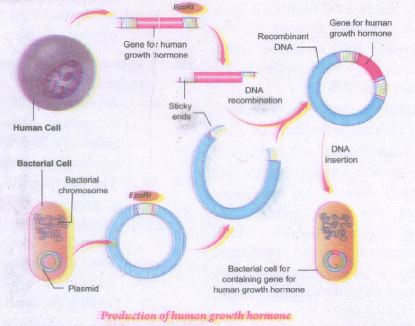
(i) Human growth hormones somatostatin and somatotropin such as are peptide hormones secreted by the pituitary gland that helps in the growth and development by increasing the uptake of amino acids and promoting protein synthesis. Deficiency of human growth hormone causes dwarfism, which could be treated by injecting hGH extracted from the human pituitary glands.
(ii) Using recombinant DNA technology hGH can be produced. The gene for hGH is isolated from the human pituitary gland cells.
(iii) The isolated gene is inserted into a plasmid vector and then is transferred into E. coli.
(iv) The recombinant E. coli then starts producing human growth hormone. The recombinant E. coli are isolated from the culture and mass production ofhGH is carried out by fermentation technology.
(v) A recombinant form of a human growth hormone called somatropin is used as a drug to treat growth disorders in children.
42.
Advantages
1. Offers benefits for clinical traits and medical research.
2. It can help in the production of help in the production of proteins and drugs in the field of medicine.
3. Aids in stem cell research
4. Animal cloning could help to save endangered species.
Disadvantages
1. In animal and human activities, it as a threat to biodiversity saying that this alters evolution which will have an impact on populations and ecosystem.
2. The process is tedious and very expensive.
3. It can cause animals to suffer
4. Reports show that animal surrogates were manifesting adverse outcomes and cloned animals were affected with disease and have high mortality rate.
5. It might compromises human health through consumption of cloned animal meat.
6. Cloned animals age faster than normal animals and are less healthy than the parent organisms as discovered in Dolly.
7. Cloning can lead to occurrence of genetic disorders in animals.
8. More than 90% of cloning attempts fail to produce a viable offspring.

12th Standard Syllabus & Materials
12th Standard
TN 12th Computer Applications வலையமைப்பு வடமிடல் Sample Question Papers Study Material - QB365 Set A
NEW12th Standard
TN 12th Computer Applications களப்பெயர் முறைமை (DNS) Sample Question Papers Study Material - QB365 Set A
NEW12th Standard
TN 12th Computer Applications வலையமைப்பு எடுத்துக்காட்டுகள் மற்றும் நெறிமுறைகள் Sample Question Papers Study Material - QB365 Set A
NEW12th Standard
TN 12th Computer Applications கணினி வலையமைப்பு ஓர் அறிமுகம் Sample Question Papers Study Material - QB365 Set A



Tamilnadu Stateboard 12th Standard Subjects

Maths

Chemistry

Physics
Biology

Computer Science

Business Maths and Statistics

Economics

Commerce

Accountancy

History

Computer Applications
Biology
Computer Technology
Computer Applications
Computer Science
Business Maths and Statistics
Commerce
Economics
Maths
Chemistry
Physics
Computer Technology
History
Accountancy

Tamil

English

French
Tamilnadu Stateboard Standards

